



Build Your Custom Market Intelligence Report
Customize Your ReportGlobal Waste-to-Energy Market Insights & Analysis
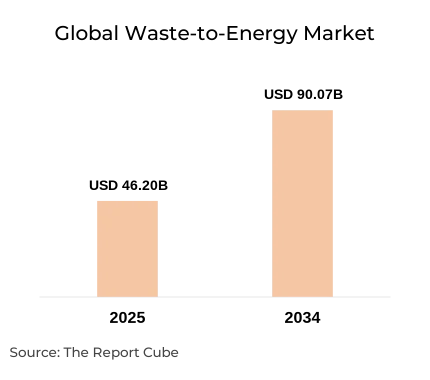
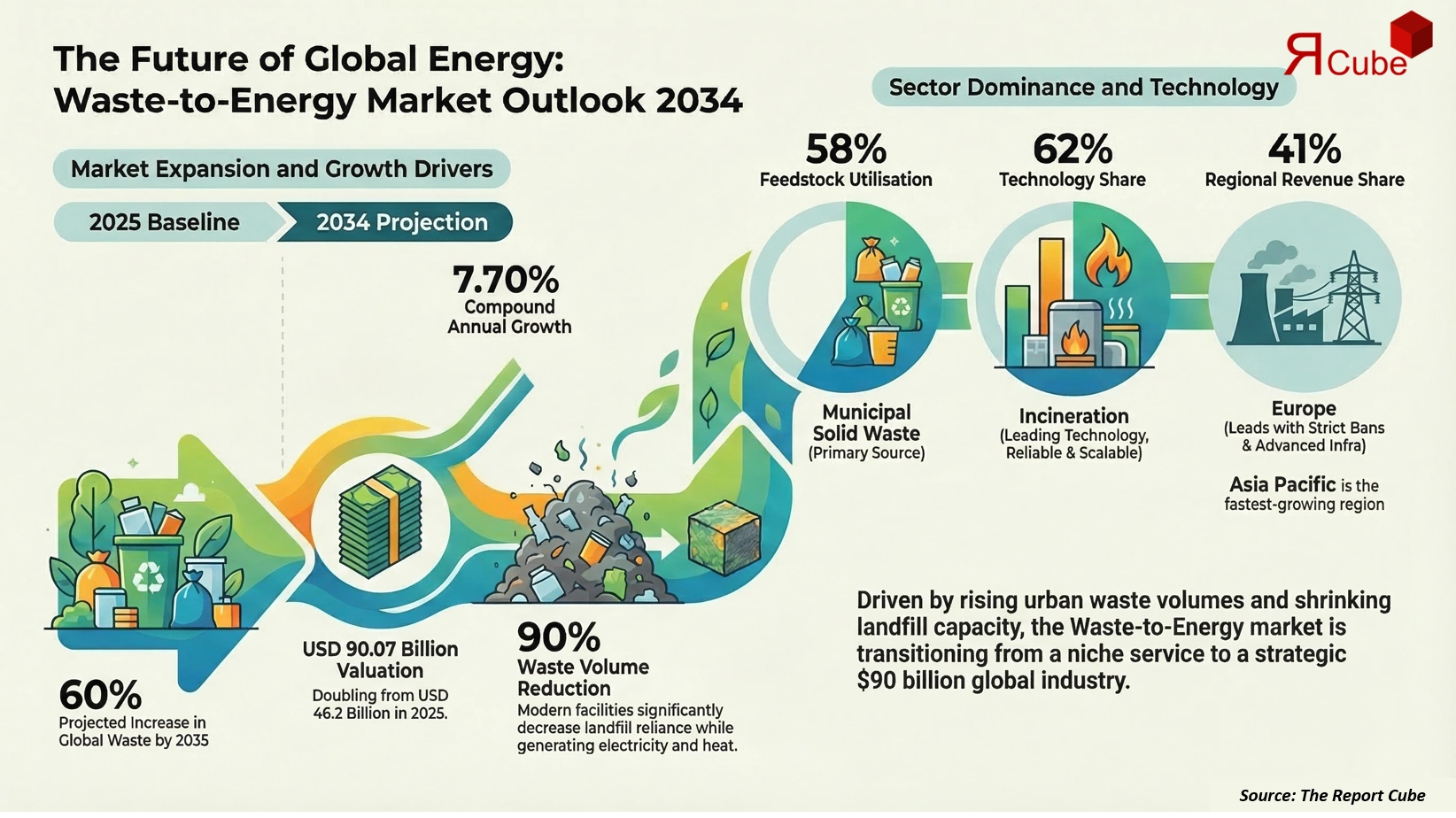
The Global Waste-to-Energy Market is anticipated to register a CAGR of 7.70% during the forecast period 2026-2034. The market size was valued at USD 46.2 billion in 2025 and is projected to reach USD 90.07 billion by 2034. This robust growth highlights the increasing global emphasis on sustainable waste management, energy security, and circular economy practices. Governments and municipalities worldwide are facing mounting pressure from rising waste volumes, shrinking landfill capacity, and stricter environmental regulations. Waste-to-energy solutions offer a dual benefit by reducing waste volumes by up to 90% while simultaneously generating electricity and heat. As urban populations expand and consumption patterns intensify, waste-to-energy infrastructure is increasingly viewed as a strategic necessity rather than an optional alternative.
Beyond basic waste disposal, the market is evolving as an integral component of renewable energy portfolios and climate action strategies. Advanced thermal and biological conversion systems are enabling higher energy recovery rates and lower emissions, addressing historical environmental concerns associated with incineration. Supporting solutions such as district heating integration, combined heat and power plants, and grid-connected electricity generation further enhance economic viability. Additionally, waste-derived fuels, landfill diversion mandates, and carbon reduction targets are reinforcing adoption across both developed and emerging economies. As a result, the waste-to-energy industry is transitioning from a niche environmental service into a mainstream energy generation and waste treatment solution.
Global Waste-to-Energy Market Recent Developments
- 2025: Veolia Environnement SA commissioned a high-efficiency waste-to-energy plant integrating carbon capture technology in Europe.
- 2025: Hitachi Zosen Corporation launched advanced gasification systems targeting municipal solid waste projects in Asia Pacific.
Government Initiatives & Policies
- EU Waste Framework Directive: Promotes waste hierarchy and recovery, supporting energy generation from non-recyclable waste.
- U.S. Renewable Fuel and Clean Energy Programs: Encourage waste-based energy production and landfill diversion.
Global Waste-to-Energy Market Dynamics
Key Driver: Rising Urban Waste Generation and Landfill Constraints
The primary driver of the waste-to-energy market is the sharp increase in urban waste generation coupled with declining landfill availability. Global municipal solid waste volumes exceeded 2.2 billion metric tons annually, with projections indicating a 60% increase by 2035. Urban regions are particularly affected, where land scarcity and rising disposal costs limit landfill expansion. Waste-to-energy facilities offer an efficient solution by significantly reducing waste volumes while producing baseload power. Municipal authorities increasingly favor these systems as they provide predictable energy output, lower long-term disposal costs, and compliance with landfill diversion targets, making them a strategic infrastructure investment.
Major Challenge: High Capital Costs and Public Perception
Despite strong fundamentals, high upfront capital requirements remain a major challenge for the waste-to-energy market. Construction costs for large-scale facilities can exceed USD 600 million, depending on technology and capacity. Financing complexity, long permitting timelines, and community resistance further delay projects. Public concerns around emissions and environmental impact persist, even as modern plants meet stringent standards. Although emissions from advanced facilities are often lower than coal-based power generation, negative perceptions can influence project approvals. Addressing this challenge requires transparent communication, improved emissions monitoring, and policy-backed financial incentives.
Industry Trends: Integration of Advanced Thermal and Hybrid Technologies
A prominent industry trend is the integration of advanced thermal technologies such as gasification and pyrolysis alongside conventional incineration. These systems enable higher efficiency, lower emissions, and greater flexibility in feedstock utilization. Hybrid facilities combining waste heat recovery, district heating, and electricity generation are becoming more common in Europe and East Asia. Additionally, digital monitoring systems and automated waste sorting improve operational efficiency and fuel consistency. Advanced emission control systems have reduced particulate and dioxin emissions by over 80% compared to legacy plants, strengthening regulatory acceptance and investor confidence.
Opportunity Ahead: Circular Economy and Low-Carbon Energy Transition
The transition toward a circular economy presents significant growth opportunities for the waste-to-energy market. Governments increasingly classify energy recovery from non-recyclable waste as a critical component of sustainable waste management. Waste-derived fuels, renewable energy credits, and carbon offset mechanisms improve project economics. Emerging economies in Asia Pacific and the Middle East are investing heavily in integrated waste management infrastructure, where waste-to-energy plays a central role. As decarbonization targets intensify, facilities capable of carbon capture and utilization are expected to attract premium investments and long-term power purchase agreements.
Global Waste-to-Energy Market Segment-wise Analysis
By Waste Type:
- Municipal Solid Waste (MSW)
- Industrial Waste
- Commercial Waste
- Agricultural Waste
- Others
Municipal solid waste dominates the market, accounting for approximately 58% of total waste-to-energy feedstock utilization in 2025. MSW availability is consistent and predictable, making it ideal for continuous energy generation. Urbanization and population growth continue to drive MSW volumes, particularly in Asia Pacific and Latin America. Governments prioritize MSW-based facilities due to landfill diversion mandates and public waste management responsibilities. Industrial and commercial waste streams follow, offering higher calorific value but requiring stricter pre-treatment, while agricultural waste remains a smaller yet regionally important segment.
By Technology:
- Incineration
- Thermochemical
- Biochemical
- Physical Processes
- Mechanical Processes
- Others
Incineration remains the leading technology, representing nearly 62% of global installed capacity in 2025. Its dominance is supported by technological maturity, proven reliability, and scalability for large urban centers. However, thermochemical technologies are gaining traction, particularly gasification systems, which deliver higher efficiency and lower emissions. Biochemical processes, such as anaerobic digestion, are increasingly used for organic waste streams, supporting decentralized energy generation. The growing diversification of technologies reflects a shift toward optimized solutions based on waste composition and regulatory frameworks.
Regional Projection of Global Waste-to-Energy Industry
- North America
- Europe
- Asia Pacific
- Middle East and Africa
- Latin America
Europe leads the global waste-to-energy market, accounting for approximately 41% of total market revenue in 2025. The region benefits from stringent landfill bans, advanced recycling frameworks, and strong district heating networks. Countries such as Germany, Sweden, and the Netherlands have achieved landfill diversion rates above 95%, relying heavily on waste-to-energy facilities. Asia Pacific is the fastest-growing region, driven by rapid urbanization and government-backed infrastructure investments in China, Japan, and Southeast Asia. North America follows with stable growth supported by municipal contracts and renewable energy incentives.
Why Choose This Report?
- Provides a comprehensive overview of the overall market analysis, encompassing key trends, consumer behavior analysis, and risk assessment to support strategic decision-making.
- Provides accurate, up-to-date insights into market size, segmentation, and emerging opportunities, helping to minimize risk & capitalizing on growth.
- Gives deep understanding of target audience preferences, investment habits, and communication channels for enhanced product development & marketing effectiveness.
- Delivers competitive analysis & benchmarking, uncovering the strengths & weaknesses of market competitors to guide strategies.
- Consolidate comprehensive market intelligence, reducing reasoning & streamlining research efforts.
- Facilitates customized market segmentation & risk mitigation strategies, fine-tuned to the business objectives.
- Aids in identifying both market challenges & untapped opportunities within the industry to drive long-term business growth.
- Provides valuable information based on actual customer data & search trends.
Table of Contents
- Introduction
- Objective of the Study
- Product and Category Definition
- Market Segmentation
- Study Variables
- Research Methodology
- Secondary Data Points
- Breakdown of Secondary Sources
- Primary Data Points
- Breakdown of Primary Interviews
- Secondary Data Points
- Executive Summary
- Market Dynamics
- Drivers
- Challenges
- Opportunity Assessment
- Recent Trends and Developments
- Regulatory and Policy Landscape
- Global Waste-to-Energy Market Overview (2020-2034)
- Market Size, By Value (USD Billion)
- Market Share, By Waste Type
- Municipal Solid Waste
- Industrial Waste
- Agricultural Waste
- Biomedical Waste
- Others
- Market Share, By Technology
- Incineration
- Gasification
- Pyrolysis
- Anaerobic Digestion
- Refuse-Derived Fuel
- Others
- Market Share, By Plant Size
- Small Scale (<10 MW)
- Medium Scale (10-50 MW)
- Large Scale (>50 MW)
- Market Share, By Energy Output
- Electricity Generation
- Heat Generation
- Combined Heat and Power
- Biogas
- Refuse-Derived Fuel Output
- Market Share, By Ownership
- Public Sector
- Private Sector
- Public-Private Partnership
- Market Share, By End User
- Utility Companies
- Industrial Users
- Commercial Establishments
- Municipal Corporations
- Others
- Market Share, By Region
- North America
- Europe
- Asia Pacific
- Middle East and Africa
- Latin America
- Market Share, By Company
- Revenue Shares
- Competitive Landscape
- North America Waste-to-Energy Market Overview (2020-2034)
- Market Size, By Value (USD Billion/Million)
- Market Share, By Waste Type
- Market Share, By Technology
- Market Share, By Plant Size
- Market Share, By Energy Output
- Market Share, By Ownership
- Market Share, By End User
- Market Share, By Country
- United States
- Canada
- Mexico
- Europe Waste-to-Energy Market Overview (2020-2034)
- Market Size, By Value (USD Billion/Million)
- Market Share, By Waste Type
- Market Share, By Technology
- Market Share, By Plant Size
- Market Share, By Energy Output
- Market Share, By Ownership
- Market Share, By End User
- Market Share, By Country
- Germany
- France
- United Kingdom
- Italy
- Spain
- Northern and Nordic Countries
- BENELUX
- Rest of Europe
- Asia Pacific Waste-to-Energy Market Overview (2020-2034)
- Market Size, By Value (USD Billion/Million)
- Market Share, By Waste Type
- Market Share, By Technology
- Market Share, By Plant Size
- Market Share, By Energy Output
- Market Share, By Ownership
- Market Share, By End User
- Market Share, By Country
- China
- India
- Japan
- South Korea
- Australia
- Rest of Asia Pacific
- Middle East and Africa Waste-to-Energy Market Overview (2020-2034)
- Market Size, By Value (USD Billion/Million)
- Market Share, By Waste Type
- Market Share, By Technology
- Market Share, By Plant Size
- Market Share, By Energy Output
- Market Share, By Ownership
- Market Share, By End User
- Market Share, By Country
- Turkey
- Saudi Arabia
- United Arab Emirates
- South Africa
- Rest of Middle East and Africa
- Latin America Waste-to-Energy Market Overview (2020-2034)
- Market Size, By Value (USD Billion/Million)
- Market Share, By Waste Type
- Market Share, By Technology
- Market Share, By Plant Size
- Market Share, By Energy Output
- Market Share, By Ownership
- Market Share, By End User
- Market Share, By Country
- Brazil
- Argentina
- Chile
- Rest of Latin America
- Competitive Outlook and Company Profiles
- Veolia Environnement SA
- Company Overview
- Product Portfolio
- Strategic Alliances/Partnerships
- Recent Developments
- SUEZ SA
- Company Overview
- Product Portfolio
- Strategic Alliances/Partnerships
- Recent Developments
- Covanta Holding Corporation
- Company Overview
- Product Portfolio
- Strategic Alliances/Partnerships
- Recent Developments
- Hitachi Zosen Corporation
- Company Overview
- Product Portfolio
- Strategic Alliances/Partnerships
- Recent Developments
- China Everbright Environment Group Ltd
- Company Overview
- Product Portfolio
- Strategic Alliances/Partnerships
- Recent Developments
- Babcock & Wilcox Enterprises Inc.
- Company Overview
- Product Portfolio
- Strategic Alliances/Partnerships
- Recent Developments
- Wheelabrator Technologies Inc.
- Company Overview
- Product Portfolio
- Strategic Alliances/Partnerships
- Recent Developments
- Waste Management Inc.
- Company Overview
- Product Portfolio
- Strategic Alliances/Partnerships
- Recent Developments
- Mitsubishi Heavy Industries Environmental & Chemical Engineering (MHIEC)
- Company Overview
- Product Portfolio
- Strategic Alliances/Partnerships
- Recent Developments
- Abu Dhabi National Energy Company PJSC (TAQA)
- Company Overview
- Product Portfolio
- Strategic Alliances/Partnerships
- Recent Developments
- Others
- Veolia Environnement SA
- Contact Us and Disclaimer
Top Key Players & Market Share Outlook
- Veolia Environnement SA
- SUEZ SA
- Covanta Holding Corporation
- Hitachi Zosen Corporation
- China Everbright Environment Group Ltd
- Babcock & Wilcox Enterprises Inc.
- Wheelabrator Technologies Inc.
- Waste Management Inc.
- Mitsubishi Heavy Industries Environmental & Chemical Engineering (MHIEC)
- Abu Dhabi National Energy Company PJSC (TAQA)
- Others
Frequently Asked Questions






