




Build Your Custom Market Intelligence Report
Customize Your ReportUAE Automotive Battery Recycling Market Insights & Analysis
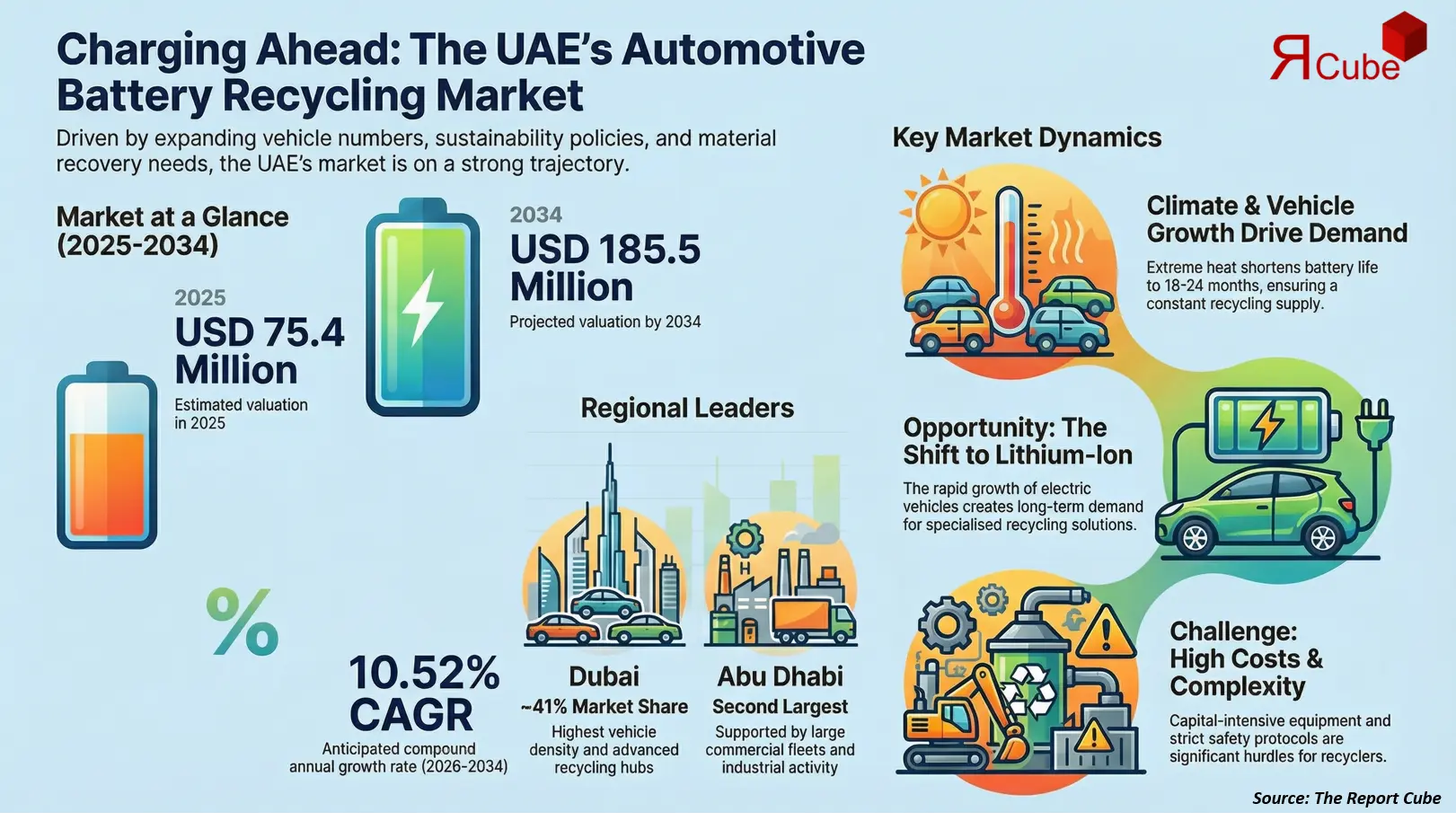
The UAE Automotive Battery Recycling Market is anticipated to register a CAGR of 10.52% during the forecast period 2026-2034. The market size was valued at USD 75.4 million in 2025 and is projected to reach USD 185.5 million by 2034. This strong growth trajectory reflects the UAE’s accelerating vehicle parc, rising battery replacement cycles, and increasing regulatory focus on sustainable waste management practices across the automotive ecosystem.
The UAE’s automotive sector is witnessing steady expansion, supported by high vehicle ownership rates, growing logistics activity, and increasing penetration of electric vehicles. As a result, the volume of end-of-life automotive batteries entering the waste stream is rising consistently. Recycling has emerged as a strategic necessity to recover valuable materials such as lead, lithium, cobalt, and nickel, while mitigating environmental risks associated with improper disposal. This shift aligns closely with the country’s circular economy ambitions and sustainability targets.
Furthermore, increasing investments in organized recycling infrastructure, coupled with higher awareness among fleet operators and consumers, are strengthening formal battery recycling channels. Leading recyclers are expanding capacity, adopting advanced processing technologies, and forming partnerships with automotive workshops and dealerships. Together, these developments position the UAE Automotive Battery Recycling Market as a fast-evolving segment with strong long-term potential.
UAE Automotive Battery Recycling Market Recent Developments
- 2025: Enviroserve expanded lithium-ion battery recycling capacity to support rising electric vehicle adoption.
- 2025: Dubatt Battery Recycling LLC upgraded lead recovery systems to improve recycling efficiency.
Government Initiatives & Policies
- UAE Circular Economy Policy: Promotes sustainable recycling and responsible waste management across industries.
- National Waste Management Strategy: Encourages diversion of hazardous waste from landfills through licensed recyclers.
UAE Automotive Battery Recycling Market Dynamics
Key Driver: Rising Vehicle Population and Battery Replacement Rates
The primary driver of the UAE Automotive Battery Recycling Market is the growing vehicle population combined with frequent battery replacement cycles. Extreme climatic conditions in the UAE significantly reduce battery lifespan, particularly for lead-acid batteries used in conventional vehicles. On average, automotive batteries in the region require replacement every 18-24 months, generating a continuous stream of end-of-life batteries. This steady supply supports consistent recycling demand. Additionally, the rapid expansion of commercial fleets, ride-hailing services, and last-mile delivery vehicles further accelerates battery consumption. As vehicle numbers rise across passenger and commercial segments, the need for structured recycling solutions becomes increasingly critical, directly fueling market growth.
Book your FREE 30-minute expert consultation today
Contact UsIndustry Trends: Transition Toward Lithium-Ion Battery Recycling
A key trend shaping the market is the gradual transition from lead-acid dominance toward lithium-ion battery recycling. While lead-acid batteries currently account for the majority of recycled volumes, the growing adoption of electric vehicles is reshaping material recovery priorities. Lithium-ion batteries contain high-value metals, prompting recyclers to invest in advanced separation and processing technologies. Market participants are developing specialized facilities capable of handling mixed chemistries safely and efficiently. This trend is also encouraging collaborations with EV manufacturers and dealerships to establish closed-loop recycling systems. Over time, lithium-ion recycling is expected to become a major revenue contributor, enhancing the technological sophistication of the UAE recycling ecosystem.
Major Challenge: High Processing Costs and Technology Complexity
Despite favorable growth drivers, high processing costs remain a significant challenge for the market. Recycling advanced battery chemistries, particularly lithium-ion, requires capital-intensive equipment, skilled labor, and strict safety protocols. Smaller recyclers often face difficulties in scaling operations due to limited access to financing and technical expertise. Additionally, fluctuating commodity prices for recovered metals can impact profitability and investment planning. Compliance with environmental and hazardous waste regulations further increases operational costs. These factors can slow capacity expansion and create entry barriers, particularly for new market entrants, moderating short-term growth potential.
Opportunity: Growth in Electric Vehicles and Circular Economy Initiatives
The rapid growth of electric vehicles presents a substantial opportunity for the UAE Automotive Battery Recycling Market. Government incentives promoting EV adoption are expected to significantly increase lithium-ion battery volumes over the coming decade. This creates long-term demand for specialized recycling solutions and secondary material recovery. Moreover, the UAE’s commitment to circular economy principles encourages the reuse of recovered materials in manufacturing, reducing dependence on imports. Recyclers that invest early in advanced technologies and strategic partnerships are well-positioned to benefit from this transition, unlocking new revenue streams and strengthening market resilience.
UAE Automotive Battery Recycling Market Segment-wise Analysis
By Battery Type:
- Lead-Acid
- Lithium-Ion
- Nickel-Based
- Other Chemistries
The Lead-Acid segment dominates the market, accounting for nearly 62% of total market share in 2025. This dominance is driven by the large installed base of conventional vehicles and the relatively short lifespan of lead-acid batteries in harsh climatic conditions. Established collection networks and mature recycling technologies further support this segment’s leadership. However, the Lithium-Ion segment is the fastest growing, supported by increasing EV adoption and higher material recovery value. Nickel-based and other chemistries contribute a smaller but steadily growing share, particularly in hybrid and specialty vehicle applications.
By Vehicle Type:
- Passenger Cars
- Light Commercial
- Heavy Commercial
- Electric Vehicles
Passenger Cars represent the leading vehicle type segment, contributing approximately 48% of recycled battery volumes. High private vehicle ownership and frequent battery replacements drive this dominance. Light and Heavy Commercial Vehicles together account for a substantial share, supported by logistics, construction, and public transport activities. Electric Vehicles, while currently contributing a smaller share, are expected to witness the highest growth rate through 2034. As EV penetration increases, this segment will play an increasingly influential role in shaping recycling capacity and technology investments.
Regional Projection of UAE Automotive Battery Recycling Industry
- Dubai
- Abu Dhabi
- Sharjah
- Northern Emirates
Dubai leads the UAE Automotive Battery Recycling Market, accounting for approximately 41% of total market share. The emirate benefits from the highest vehicle density, advanced waste management infrastructure, and the presence of major recycling hubs. Abu Dhabi follows, supported by large commercial fleets and industrial activity. Sharjah plays a growing role due to its focus on sustainability and recycling innovation, while the Northern Emirates contribute steadily through regional collection networks. Dubai’s leadership is expected to continue, driven by regulatory enforcement and private sector investments.
Need insights for a specific region within this market?
Request Regional DataWhy Choose This Report?
- Provides a comprehensive overview of the overall market analysis, encompassing key trends, consumer behavior analysis, and risk assessment to support strategic decision-making.
- Provides accurate, up-to-date insights into market size, segmentation, and emerging opportunities, helping to minimize risk & capitalizing on growth.
- Gives deep understanding of target audience preferences, investment habits, and communication channels for enhanced product development & marketing effectiveness.
- Delivers competitive analysis & benchmarking, uncovering the strengths & weaknesses of market competitors to guide strategies.
- Consolidate comprehensive market intelligence, reducing reasoning & streamlining research efforts.
- Facilitates customized market segmentation & risk mitigation strategies, fine-tuned to the business objectives.
- Aids in identifying both market challenges & untapped opportunities within the industry to drive long-term business growth.
- Provides valuable information based on actual customer data & search trends.
Table of Contents
- Introduction
- Objective of the Study
- Product and Category Definition
- Market Segmentation
- Study Variables
- Research Methodology
- Secondary Data Points
- Breakdown of Secondary Sources
- Primary Data Points
- Breakdown of Primary Interviews
- Secondary Data Points
- Executive Summary
- Market Dynamics
- Drivers
- Challenges
- Opportunity Assessment
- Recent Trends and Developments
- Regulatory and Policy Landscape
- UAE Automotive Battery Recycling Market Overview (2020–2034)
- Market Size, By Value (USD Million)
- Market Share, By Battery Type
- Lead‑Acid
- Lithium‑Ion
- Nickel‑Based
- Other Chemistries
- Market Share, By Vehicle Type
- Passenger Cars
- Light Commercial
- Heavy Commercial
- Electric Vehicles
- Market Share, By Source Type
- OEM Networks
- Aftermarket
- Scrap Dealers
- Fleet Operators
- Market Share, By Process Type
- Collection
- Sorting
- Smelting
- Refining
- Market Share, By End User
- Automotive
- Industrial
- Energy Storage
- Other Applications
- Market Share, By Region
- Dubai
- Abu Dhabi
- Sharjah
- Northern Emirates
- Market Share, By Company
- Competition Characteristics
- Revenue Shares & Analysis
- Dubai Automotive Battery Recycling Market
- Market Size, By Value (USD Million)
- Market Share, By Battery Type
- Market Share, By Vehicle Type
- Market Share, By Source Type
- Market Share, By Process Type
- Market Share, By End User
- Abu Dhabi Automotive Battery Recycling Market
- Market Size, By Value (USD Million)
- Market Share, By Battery Type
- Market Share, By Vehicle Type
- Market Share, By Source Type
- Market Share, By Process Type
- Market Share, By End User
- Sharjah Automotive Battery Recycling Market
- Market Size, By Value (USD Million)
- Market Share, By Battery Type
- Market Share, By Vehicle Type
- Market Share, By Source Type
- Market Share, By Process Type
- Market Share, By End User
- Northern Emirates Automotive Battery Recycling Market
- Market Size, By Value (USD Million)
- Market Share, By Battery Type
- Market Share, By Vehicle Type
- Market Share, By Source Type
- Market Share, By Process Type
- Market Share, By End User
- Competitive Outlook and Company Profiles
- Dubatt Battery Recycling LLC
- Company Overview
- Process & Capacity
- Strategic Alliances/Partnerships
- Recent Developments
- Green Land Recycling Solutions LLC
- Company Overview
- Process & Capacity
- Strategic Alliances/Partnerships
- Recent Developments
- Planet Green Recycling LLC
- Company Overview
- Process & Capacity
- Strategic Alliances/Partnerships
- Recent Developments
- Ecyclex International Recycling LLC
- Company Overview
- Process & Capacity
- Strategic Alliances/Partnerships
- Recent Developments
- Enviroserve (The Recycling Hub)
- Company Overview
- Process & Capacity
- Strategic Alliances/Partnerships
- Recent Developments
- Madenat Al Nokhba Recycling Services LLC
- Company Overview
- Process & Capacity
- Strategic Alliances/Partnerships
- Recent Developments
- Green Future Battery Recycling LLC
- Company Overview
- Process & Capacity
- Strategic Alliances/Partnerships
- Recent Developments
- WTG Recycling FZC
- Company Overview
- Process & Capacity
- Strategic Alliances/Partnerships
- Recent Developments
- BEEAH Recycling (Sharjah)
- Company Overview
- Process & Capacity
- Strategic Alliances/Partnerships
- Recent Developments
- Gulf Recycling Technologies (GRT)
- Company Overview
- Process & Capacity
- Strategic Alliances/Partnerships
- Recent Developments
- Others
- Dubatt Battery Recycling LLC
- Contact Us and Disclaimer
Top Key Players & Market Share Outlook
- Dubatt Battery Recycling LLC
- Green Land Recycling Solutions LLC
- Planet Green Recycling LLC
- Ecyclex International Recycling LLC
- Enviroserve (The Recycling Hub)
- Madenat Al Nokhba Recycling Services LLC
- Green Future Battery Recycling LLC
- WTG Recycling FZC
- BEEAH Recycling (Sharjah)
- Gulf Recycling Technologies (GRT)
- Others
Frequently Asked Questions






