



Build Your Custom Market Intelligence Report
Customize Your ReportUnited States Waste to Energy Market Insights & Analysis
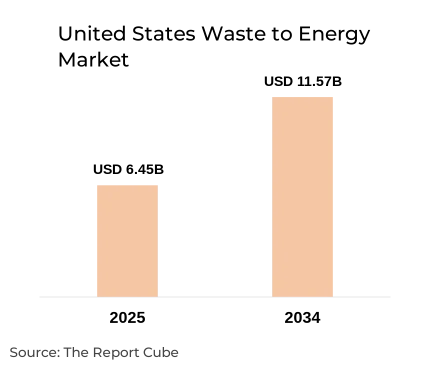
The United States Waste to Energy Market is anticipated to register a CAGR of 6.71% during 2026-2034. The market size was valued at USD 6.45 billion in 2025 and is projected to reach USD 11.57 billion by 2034. The market is gaining momentum as municipalities and private operators seek sustainable solutions to manage rising waste volumes while reducing landfill dependency. Waste-to-energy technologies are increasingly viewed as dual-benefit systems, addressing waste disposal challenges while generating electricity and heat.
This expansion is closely tied to tightening environmental regulations, landfill capacity constraints, and growing public support for cleaner energy sources. Urbanization and population growth continue to increase municipal solid waste generation, pushing local governments to adopt advanced waste processing solutions. Waste-to-energy plants help divert waste from landfills, reduce methane emissions, and support grid stability, positioning them as critical infrastructure assets across several U.S. states.
Furthermore, technological advancements in combustion efficiency, emissions control, and energy recovery are enhancing plant performance and public acceptance. As federal and state authorities emphasize circular economy principles, waste-to-energy facilities are increasingly integrated into broader sustainability and renewable energy frameworks, supporting long-term market growth through 2034.
United States Waste to Energy Market Recent Developments
- 2025: Covanta expanded energy recovery capacity at its Florida facility to improve grid contribution and waste diversion.
- 2025: Waste Management Inc. initiated advanced landfill gas-to-energy upgrades across multiple Midwest sites.
Government Initiatives & Policies
- U.S. EPA Sustainable Materials Management Program: Supports waste diversion and energy recovery initiatives nationwide.
- DOE Bioenergy Technologies Office Programs: Promotes waste-derived fuels and energy innovation.
United States Waste to Energy Market Dynamics
Key Driver: Rising Landfill Constraints and Environmental Regulations
One of the primary drivers of the United States Waste to Energy Market is the increasing pressure on landfill capacity combined with stringent environmental regulations. Several U.S. states are facing landfill saturation, leading to higher disposal costs and long-distance waste transportation. Waste-to-energy facilities offer a localized solution by reducing waste volume by nearly 90% while generating usable energy. Additionally, federal and state-level emissions standards are encouraging municipalities to adopt controlled combustion and gas recovery technologies. These factors collectively position waste-to-energy as a reliable and compliant waste management alternative.

Book your FREE 30-minute expert consultation today
Contact UsIndustry Trends: Technological Advancements and Energy Efficiency Improvements
The market is witnessing a strong trend toward advanced thermal technologies and efficiency optimization. Modern mass-burn incineration plants now achieve higher energy recovery rates while meeting strict emissions norms. Innovations in gasification and pyrolysis are gaining pilot-scale traction, offering lower emissions and higher fuel flexibility. Digital monitoring systems and predictive maintenance tools are also improving operational uptime and cost control. These trends are enhancing investor confidence and supporting broader adoption across urban and industrial regions.
Major Challenge: High Capital Investment and Public Perception
Despite its benefits, the waste-to-energy market faces challenges related to high upfront capital requirements and public opposition. Facility construction involves significant costs associated with advanced emissions control systems and regulatory compliance. Additionally, community concerns around air quality and health impacts can delay project approvals. While modern plants operate within stringent safety standards, overcoming perception barriers remains a critical hurdle, particularly in densely populated regions.
Opportunity: Integration with Renewable Energy and Circular Economy Goals
Growing alignment with renewable energy targets presents a strong opportunity for the market. Waste-to-energy facilities can complement solar and wind by providing baseload power. Furthermore, recovery of metals and by-products supports circular economy objectives. With increasing federal incentives for clean energy and infrastructure modernization, waste-to-energy projects are well-positioned to attract long-term investments and partnerships through 2034.
United States Waste to Energy Market Segment-wise Analysis
By Technology:
- Incineration
- Thermochemical
- Biochemical
- Physical Processes
- Mechanical Processes
- Others
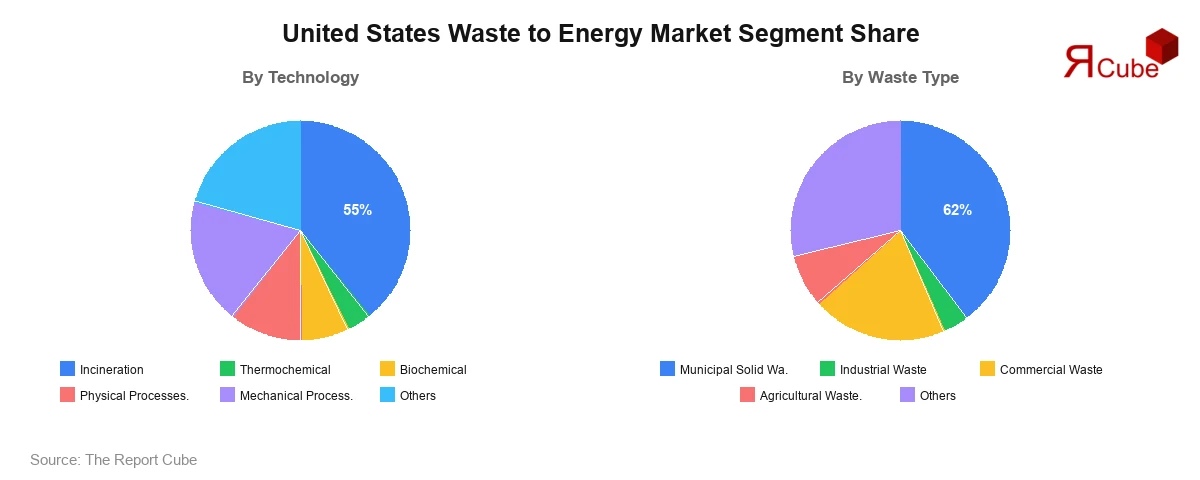
Incineration dominates the market, accounting for approximately 55% of total revenue in 2025. Its dominance is attributed to proven reliability, large-scale deployment, and consistent energy output. Refuse-derived fuel follows, supported by industrial co-firing applications. Emerging technologies such as gasification and pyrolysis are gaining attention for their lower emissions and higher efficiency potential, though adoption remains gradual.
By Waste Type:
- Municipal Solid Waste (MSW)
- Industrial Waste
- Commercial Waste
- Agricultural Waste
- Others
Municipal solid waste represents the leading waste type segment, contributing nearly 62% of market share. Urban population growth and consistent waste generation ensure a steady feedstock supply. Industrial and commercial waste streams are expanding steadily, driven by manufacturing activity and stricter disposal regulations, enhancing diversification of input sources.
Regional Projection of United States Waste to Energy Industry
- Northeast
- Midwest
- South
- West
The Northeast region leads the United States Waste to Energy Market, accounting for approximately 38% of total market share in 2025. Limited landfill space, high population density, and strong regulatory support have accelerated adoption. States such as New York and Massachusetts have long-established waste-to-energy infrastructure. The West is emerging as a high-growth region, driven by sustainability mandates and renewable energy integration initiatives.
Need insights for a specific region within this market?
Request Regional DataWhy Choose This Report?
- Provides a comprehensive overview of the overall market analysis, encompassing key trends, consumer behavior analysis, and risk assessment to support strategic decision-making.
- Provides accurate, up-to-date insights into market size, segmentation, and emerging opportunities, helping to minimize risk & capitalizing on growth.
- Gives deep understanding of target audience preferences, investment habits, and communication channels for enhanced product development & marketing effectiveness.
- Delivers competitive analysis & benchmarking, uncovering the strengths & weaknesses of market competitors to guide strategies.
- Consolidate comprehensive market intelligence, reducing reasoning & streamlining research efforts.
- Facilitates customized market segmentation & risk mitigation strategies, fine-tuned to the business objectives.
- Aids in identifying both market challenges & untapped opportunities within the industry to drive long-term business growth.
- Provides valuable information based on actual customer data & search trends.
Table of Contents
- Introduction
- Objective of the Study
- Product and Category Definition
- Market Segmentation
- Study Variables
- Research Methodology
- Secondary Data Points
- Breakdown of Secondary Sources
- Primary Data Points
- Breakdown of Primary Interviews
- Secondary Data Points
- Executive Summary
- Market Dynamics
- Drivers
- Challenges
- Opportunity Assessment
- Recent Trends and Developments
- Regulatory and Policy Landscape
- United States Waste to Energy Market Overview (2021-2034)
- Market Size, By Value (USD Billion)
- Market Share, By Waste Type
- Municipal Solid Waste
- Industrial Waste
- Agricultural Waste
- Biomedical Waste
- Others
- Market Share, By Technology
- Incineration
- Gasification
- Pyrolysis
- Anaerobic Digestion
- Refuse-Derived Fuel
- Others
- Market Share, By Plant Size
- Small Scale (<10 MW)
- Medium Scale (10-50 MW)
- Large Scale (>50 MW)
- Market Share, By Energy Output
- Electricity Generation
- Heat Generation
- Combined Heat and Power
- Biogas
- Refuse-Derived Fuel Output
- Market Share, By Ownership
- Public Sector
- Private Sector
- Public-Private Partnership
- Market Share, By End User
- Utility Companies
- Industrial Users
- Commercial Establishments
- Municipal Corporations
- Others
- Market Share, By Region
- Northeast
- Midwest
- South
- West
- Market Share, By Company
- Competition Characteristics
- Revenue Shares & Analysis
- Northeast United States Waste to Energy Market
- Market Size, By Value (USD Billion/Million)
- Market Share, By Waste Type
- Market Share, By Technology
- Market Share, By Plant Size
- Market Share, By Energy Output
- Market Share, By Ownership
- Market Share, By End User
- Midwest United States Waste to Energy Market
- Market Size, By Value (USD Billion/Million)
- Market Share, By Waste Type
- Market Share, By Technology
- Market Share, By Plant Size
- Market Share, By Energy Output
- Market Share, By Ownership
- Market Share, By End User
- South United States Waste to Energy Market
- Market Size, By Value (USD Billion/Million)
- Market Share, By Waste Type
- Market Share, By Technology
- Market Share, By Plant Size
- Market Share, By Energy Output
- Market Share, By Ownership
- Market Share, By End User
- West United States Waste to Energy Market
- Market Size, By Value (USD Billion/Million)
- Market Share, By Waste Type
- Market Share, By Technology
- Market Share, By Plant Size
- Market Share, By Energy Output
- Market Share, By Ownership
- Market Share, By End User
- Competitive Outlook and Company Profiles
- Covanta Holding Corporation
- Company Overview
- Project Portfolio
- Strategic Alliances/Partnerships
- Recent Developments
- Wheelabrator Technologies Inc.
- Company Overview
- Project Portfolio
- Strategic Alliances/Partnerships
- Recent Developments
- Waste Management Inc.
- Company Overview
- Project Portfolio
- Strategic Alliances/Partnerships
- Recent Developments
- Reworld Holding Corporation
- Company Overview
- Project Portfolio
- Strategic Alliances/Partnerships
- Recent Developments
- SUEZ SA
- Company Overview
- Project Portfolio
- Strategic Alliances/Partnerships
- Recent Developments
- Hitachi Zosen Inova AG
- Company Overview
- Project Portfolio
- Strategic Alliances/Partnerships
- Recent Developments
- Babcock & Wilcox Enterprises Inc.
- Company Overview
- Project Portfolio
- Strategic Alliances/Partnerships
- Recent Developments
- VLS Environmental Solutions LLC
- Company Overview
- Project Portfolio
- Strategic Alliances/Partnerships
- Recent Developments
- Xcel Energy Inc.
- Company Overview
- Project Portfolio
- Strategic Alliances/Partnerships
- Recent Developments
- Martin GmbH
- Company Overview
- Project Portfolio
- Strategic Alliances/Partnerships
- Recent Developments
- Others
- Covanta Holding Corporation
- Contact Us and Disclaimer
Top Key Players & Market Share Outlook
- Covanta Holding Corporation
- Wheelabrator Technologies Inc.
- Waste Management Inc.
- Reworld Holding Corporation
- SUEZ SA
- Hitachi Zosen Inova AG
- Babcock & Wilcox Enterprises Inc.
- Xcel Energy Inc.
- Martin GmbH
- Others
Frequently Asked Questions






