




Build Your Custom Market Intelligence Report
Customize Your ReportEurope Sustainable Aviation Fuel Market Insights & Analysis
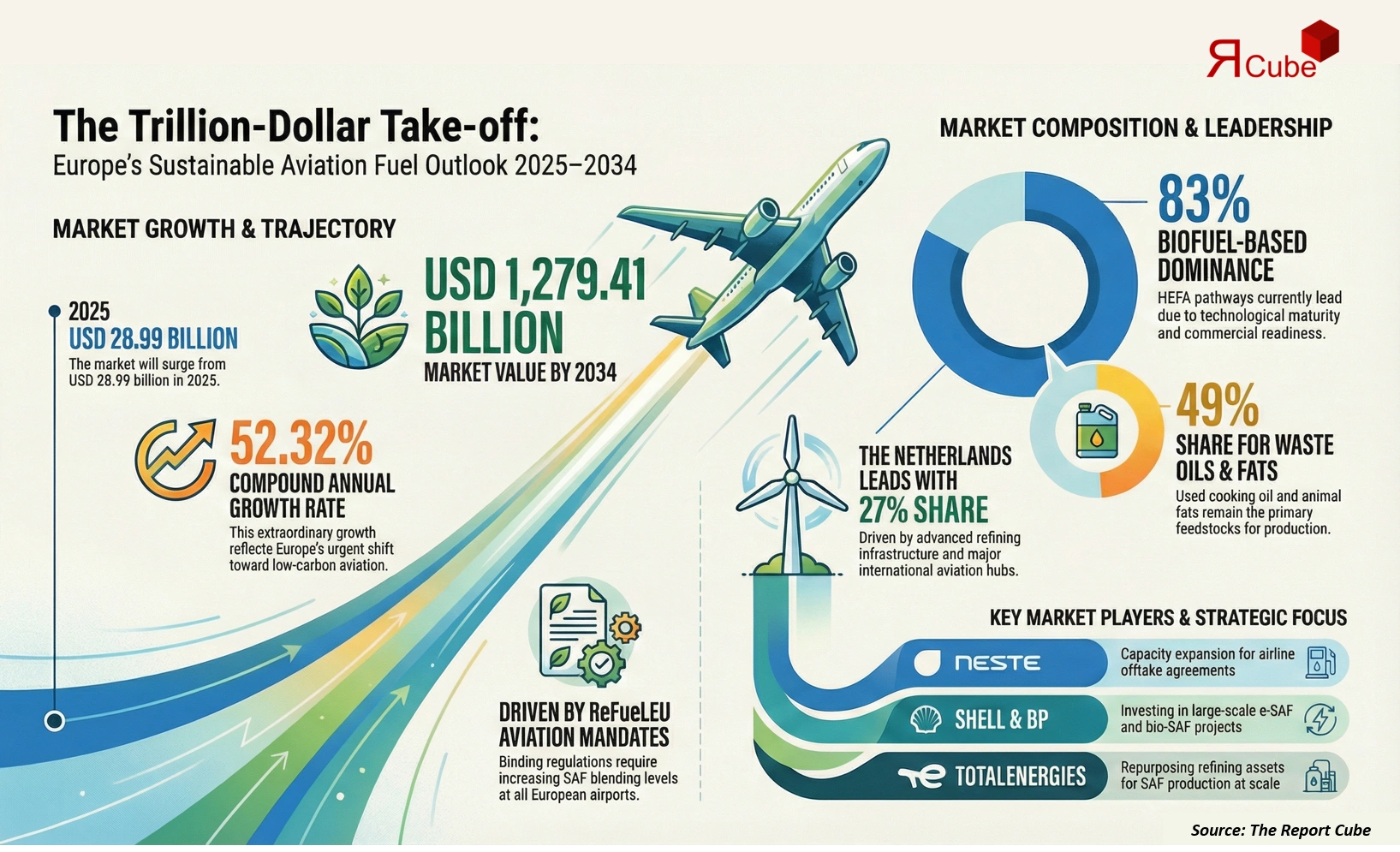
The Europe Sustainable Aviation Fuel Market is anticipated to register a CAGR of 52.32% during the forecast period 2026-2034. The market size was valued at USD 28.99 billion in 2025 and is projected to reach USD 1,279.41 billion by 2034. This extraordinary growth reflects Europe’s aggressive decarbonization roadmap for aviation and the urgent need to reduce lifecycle carbon emissions from air transport. Aviation remains one of the hardest-to-abate sectors, and sustainable aviation fuel (SAF) is currently the most viable near- to mid-term solution for achieving emission reductions without requiring major aircraft redesign. European airlines, fuel producers, and governments are collectively accelerating SAF adoption to meet regulatory mandates, corporate net-zero targets, and rising passenger expectations for sustainable travel.
Market expansion is further driven by binding blending mandates, long-term offtake agreements, and large-scale investments in bio-refineries and synthetic fuel facilities. Europe is positioning itself as a global leader in SAF deployment through early regulation, innovation funding, and cross-border collaboration. Airlines are increasingly integrating SAF into their fuel procurement strategies, while energy companies are repurposing existing refining assets to produce SAF at scale. Although current production volumes remain limited, strong policy certainty and capital inflows are creating the foundation for exponential market growth over the next decade.
Europe Sustainable Aviation Fuel Market Recent Developments
- 2025: Neste and TotalEnergies expanded SAF production capacity to support European airline offtake agreements.
- 2025: Shell and BP advanced large-scale e-SAF and bio-SAF investment projects across Europe.
Government Initiatives & Policies
- ReFuelEU Aviation Regulation: EU mandate requiring increasing SAF blending levels at European airports.
- EU Fit for 55 Package: Climate policy framework supporting aviation decarbonization and SAF scale-up.
Europe Sustainable Aviation Fuel Market Dynamics
Key Driver: Regulatory mandates and aviation decarbonization targets
The primary driver of the Europe sustainable aviation fuel market is the implementation of binding regulatory mandates aimed at reducing aviation-related greenhouse gas emissions. The ReFuelEU Aviation regulation establishes minimum SAF blending requirements, creating guaranteed long-term demand across European airports. Airlines face mounting pressure from regulators, investors, and customers to demonstrate tangible emission reductions, and SAF offers immediate compatibility with existing aircraft and infrastructure. These mandates, combined with carbon pricing mechanisms and sustainability reporting requirements, are transforming SAF from a voluntary initiative into a strategic necessity for the aviation industry.
Major Challenge: High production costs and limited feedstock availability
A major challenge facing the Europe sustainable aviation fuel market is the high cost of SAF production compared to conventional jet fuel. Bio-based SAF pathways rely on constrained feedstocks such as used cooking oil and animal fats, while synthetic e-SAF requires large volumes of renewable electricity and green hydrogen. Limited supply chains, capital-intensive facilities, and early-stage technologies contribute to cost premiums that must be absorbed through subsidies, mandates, or airline pricing strategies. Scaling production while ensuring sustainability and feedstock integrity remains a critical hurdle for market participants.
Industry Trends: Rapid scale-up of bio-SAF and emergence of e-SAF
A defining trend in the Europe sustainable aviation fuel market is the near-term dominance of biofuel-based SAF pathways, particularly HEFA, due to their technological maturity and compatibility with existing refineries. At the same time, power-to-liquid synthetic SAF is gaining strategic importance as a long-term solution capable of delivering near-zero lifecycle emissions. Major energy companies are investing heavily in pilot and commercial-scale e-SAF projects, signaling a gradual shift toward diversified SAF portfolios. Long-term airline offtake agreements are becoming a standard mechanism to de-risk investments and secure supply.
Opportunity Ahead: Integrated SAF value chains and long-term offtake contracts
Significant opportunities exist in developing fully integrated SAF value chains that link feedstock sourcing, fuel production, logistics, and airline consumption. Long-term offtake agreements between fuel producers and airlines provide revenue certainty and unlock project financing. Airports and fuel distributors also play a growing role by enabling SAF blending and storage infrastructure. Companies that can combine technological capability, regulatory expertise, and strategic partnerships are well positioned to capture value as SAF transitions from niche deployment to mass adoption across European aviation.
Europe Sustainable Aviation Fuel Market Segment-wise Analysis
By Fuel Type:
- Biofuel-based SAF (HEFA, FT-SPK, ATJ, Others)
- Power-to-Liquid / e-SAF (Synthetic)
Biofuel-based SAF dominates the market, accounting for approximately 83% of total SAF supply in 2025. HEFA pathways lead due to commercial readiness and established feedstock supply chains. Synthetic e-SAF remains a smaller share but represents the fastest-growing segment, supported by long-term decarbonization goals and falling renewable energy costs.
By Feedstock:
- Waste Oils & Fats (Used Cooking Oil, Tallow, etc.)
- Energy Crops & Agricultural Residues
- Municipal Solid Waste
- Industrial Off-gases & CO₂
- Others
Waste oils and fats represent the leading feedstock category with approximately 49% share, driven by sustainability credentials and regulatory acceptance. However, diversification toward agricultural residues, municipal waste, and captured CO₂ is accelerating to overcome feedstock constraints and support long-term scaling.
Regional Projection of Europe Sustainable Aviation Fuel Industry
- Germany
- United Kingdom
- France
- Netherlands
- Spain
- Italy
- Nordic Countries (Norway, Sweden, Denmark, Finland)
- Rest of Europe
The Netherlands leads the Europe sustainable aviation fuel market, accounting for approximately 27% of total market activity in 2025. The country’s leadership is driven by strong refining infrastructure, major aviation hubs, and early SAF investment. Germany, France, and the Nordic countries follow, supported by aggressive climate policies, airline commitments, and access to renewable energy resources.
Why Choose This Report?
- Provides a comprehensive overview of the overall market analysis, encompassing key trends, consumer behavior analysis, and risk assessment to support strategic decision-making.
- Provides accurate, up-to-date insights into market size, segmentation, and emerging opportunities, helping to minimize risk & capitalizing on growth.
- Gives deep understanding of target audience preferences, investment habits, and communication channels for enhanced product development & marketing effectiveness.
- Delivers competitive analysis & benchmarking, uncovering the strengths & weaknesses of market competitors to guide strategies.
- Consolidate comprehensive market intelligence, reducing reasoning & streamlining research efforts.
- Facilitates customized market segmentation & risk mitigation strategies, fine-tuned to the business objectives.
- Aids in identifying both market challenges & untapped opportunities within the industry to drive long-term business growth.
- Provides valuable information based on actual customer data & search trends.
Table of Contents
- Introduction
- Objective of the Study
- Product/Category Definition
- Market Segmentation
- Study Variables
- Research Methodology
- Secondary Data Points
- Breakdown of Secondary Sources
- Primary Data Points
- Breakdown of Primary Interviews
- Secondary Data Points
- Executive Summary
- Market Dynamics
- Drivers
- Challenges
- Opportunity Assessment
- Recent Trends and Developments
- Policy and Regulatory Landscape
- Europe Sustainable Aviation Fuel Market Overview (2020-2034)
- Market Size, By Volume & Value (Million Tonnes / USD Billion)
- Market Share, By Fuel Type
- Biofuel-based SAF (HEFA, FT-SPK, ATJ, Others)
- Power-to-Liquid / e-SAF (Synthetic)
- Market Share, By Feedstock
- Waste Oils & Fats (Used Cooking Oil, Tallow, etc.)
- Energy Crops & Agricultural Residues
- Municipal Solid Waste
- Industrial Off-gases & CO2
- Others
- Market Share, By Blending Capacity
- Up to 30% SAF Blend
- 31%–50% SAF Blend
- Above 50% / 100% SAF
- Market Share, By Production Pathway
- HEFA-SPK
- FT-SPK
- ATJ-SPK
- HFS-SIP
- e-SAF (Power-to-Liquid)
- Others
- Market Share, By End User
- Scheduled Commercial Airlines
- Non-scheduled Operators & Business Aviation
- Cargo & Freight Airlines
- Military & Government Aviation
- Market Share, By Distribution Mode
- On-airport Supply (Hydrant & Refueling Systems)
- Off-airport Supply (Terminals & Trucking)
- Market Share, By Country
- Germany
- United Kingdom
- France
- Netherlands
- Spain
- Italy
- Nordic Countries (Norway, Sweden, Denmark, Finland)
- Rest of Europe
- Market Share, By Company
- Revenue Shares
- Competitive Landscape
- Germany Sustainable Aviation Fuel Market
- Market Size, By Volume & Value (USD Billion)
- Market Share, By Fuel Type
- Market Share, By Feedstock
- Market Share, By End User
- Market Share, By Blending Capacity
- Market Share, By Key Airports
- United Kingdom Sustainable Aviation Fuel Market
- Market Size, By Volume & Value (USD Billion)
- Market Share, By Fuel Type
- Market Share, By Feedstock
- Market Share, By End User
- Market Share, By Blending Capacity
- Market Share, By Key Airports
- France Sustainable Aviation Fuel Market
- Market Size, By Volume & Value (USD Billion)
- Market Share, By Fuel Type
- Market Share, By Feedstock
- Market Share, By End User
- Market Share, By Blending Capacity
- Market Share, By Key Airports
- Netherlands Sustainable Aviation Fuel Market
- Market Size, By Volume & Value (USD Billion)
- Market Share, By Fuel Type
- Market Share, By Feedstock
- Market Share, By End User
- Market Share, By Blending Capacity
- Market Share, By Key Airports
- Spain Sustainable Aviation Fuel Market
- Market Size, By Volume & Value (USD Billion)
- Market Share, By Fuel Type
- Market Share, By Feedstock
- Market Share, By End User
- Market Share, By Blending Capacity
- Market Share, By Key Airports
- Italy Sustainable Aviation Fuel Market
- Market Size, By Volume & Value (USD Billion)
- Market Share, By Fuel Type
- Market Share, By Feedstock
- Market Share, By End User
- Market Share, By Blending Capacity
- Market Share, By Key Airports
- Nordic Countries (Norway, Sweden, Denmark, Finland) Sustainable Aviation Fuel Market
- Market Size, By Volume & Value (USD Billion)
- Market Share, By Fuel Type
- Market Share, By Feedstock
- Market Share, By End User
- Market Share, By Blending Capacity
- Market Share, By Key Airports
- Rest of Europe Sustainable Aviation Fuel Market
- Market Size, By Volume & Value (USD Billion)
- Market Share, By Fuel Type
- Market Share, By Feedstock
- Market Share, By End User
- Market Share, By Blending Capacity
- Competitive Outlook & Company Profiles
- Neste
- Company Overview
- SAF Production Capacity & Projects
- Strategic Alliances/Partnerships
- Recent Developments
- TotalEnergies
- Company Overview
- SAF Production Capacity & Projects
- Strategic Alliances/Partnerships
- Recent Developments
- Shell
- Company Overview
- SAF Production Capacity & Projects
- Strategic Alliances/Partnerships
- Recent Developments
- BP
- Company Overview
- SAF Production Capacity & Projects
- Strategic Alliances/Partnerships
- Recent Developments
- SkyNRG
- Company Overview
- SAF Supply & Project Portfolio
- Strategic Alliances/Partnerships
- Recent Developments
- World Energy
- Company Overview
- SAF Production Capacity & Projects
- Strategic Alliances/Partnerships
- Recent Developments
- Repsol
- Company Overview
- SAF Production Capacity & Projects
- Strategic Alliances/Partnerships
- Recent Developments
- OMV
- Company Overview
- SAF Production Capacity & Projects
- Strategic Alliances/Partnerships
- Recent Developments
- Preem
- Company Overview
- SAF Production Capacity & Projects
- Strategic Alliances/Partnerships
- Recent Developments
- Others
- Neste
- Contact Us / Disclaimer
Top Key Players & Market Share Outlook
- Neste
- TotalEnergies
- Shell
- BP
- SkyNRG
- World Energy
- Repsol
- OMV
- Preem
- Others
Frequently Asked Questions






