



Build Your Custom Market Intelligence Report
Customize Your ReportEurope Waste to Energy Market Insights & Analysis
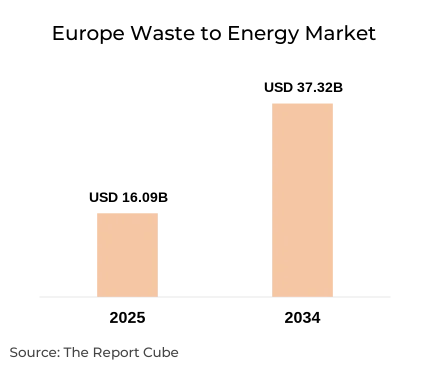
The Europe Waste to Energy Market is anticipated to register a CAGR of 9.80% during 2026-2034. The market size was valued at USD 16.09 billion in 2025 and is projected to reach USD 37.32 billion by 2034. The market is experiencing strong momentum as European nations intensify efforts to reduce landfill dependency while advancing circular economy objectives. Waste-to-energy facilities are increasingly viewed as critical infrastructure, enabling sustainable waste management while simultaneously generating electricity and heat to support regional energy security.
This expansion is closely linked to stringent European Union regulations on landfill diversion, carbon emission reduction targets, and rising urban waste volumes. Countries across Western and Northern Europe have established advanced waste segregation systems, ensuring consistent feedstock supply for waste-to-energy plants. Moreover, increasing volatility in fossil fuel prices has encouraged governments to diversify energy sources, positioning waste-derived energy as a stable and domestically available alternative.
Additionally, technological advancements in combustion efficiency, emissions control, and energy recovery rates are improving plant performance and public acceptance. Modern facilities now achieve energy recovery efficiencies exceeding 30%, while significantly reducing greenhouse gas emissions compared to landfilling. Together, regulatory support, technological progress, and energy security concerns are expected to sustain robust growth in the Europe Waste to Energy Market through 2034.
Europe Waste to Energy Market Recent Developments
- 2025: Veolia Environnement expanded its waste-to-energy capacity in Germany with a high-efficiency combined heat and power facility.
- 2025: SUEZ Group upgraded flue gas treatment systems across multiple European plants to meet stricter emission standards.
Government Initiatives & Policies
- EU Circular Economy Action Plan: Supports waste recovery, energy generation, and landfill reduction across member states.
- EU Fit for 55 Package: Policy framework targeting 55% emission reductions, encouraging low-carbon energy solutions including waste-to-energy.
Europe Waste to Energy Market Dynamics
Key Driver: Stringent Landfill Regulations and Circular Economy Mandates
Strict landfill restrictions across Europe remain the primary driver of the waste-to-energy market. Many European countries have reduced landfill rates for municipal waste to below 10%, forcing municipalities to adopt alternative treatment solutions. Waste-to-energy facilities offer a dual benefit by diverting waste from landfills while generating electricity and district heating. Germany, Sweden, and Denmark lead this transition, where waste-to-energy accounts for over 25% of non-recyclable waste treatment. These regulatory pressures ensure long-term demand stability for waste-to-energy infrastructure while encouraging private investment and public-private partnerships across the region.

Book your FREE 30-minute expert consultation today
Contact UsIndustry Trends: Shift Toward Advanced Thermal and Hybrid Technologies
The market is witnessing a gradual shift from conventional mass burn technologies toward advanced thermal and hybrid systems. Gasification and pyrolysis are gaining attention due to their higher efficiency, lower emissions, and ability to process diverse waste streams. While mass burn remains dominant, accounting for over 60% of installed capacity, newer technologies are being piloted to improve environmental performance. Additionally, integration of waste-to-energy plants with district heating networks is expanding, particularly in Northern Europe, maximizing overall energy utilization and improving economic viability.
Major Challenge: Public Opposition and Environmental Concerns
Despite technological improvements, public opposition remains a significant challenge for the Europe Waste to Energy Market. Concerns regarding air pollution, toxic ash disposal, and potential impacts on recycling rates often delay project approvals. In several countries, local resistance has led to extended permitting timelines and increased compliance costs. Although modern plants meet stringent emission standards, perception gaps persist, requiring operators to invest heavily in transparency, community engagement, and continuous monitoring systems to maintain public trust and regulatory approval.
Opportunity: Integration with Renewable Energy and Smart Grids
The integration of waste-to-energy facilities with renewable energy systems and smart grids presents a major growth opportunity. Waste-to-energy provides baseload power, complementing intermittent renewables such as wind and solar. As Europe expands smart grid infrastructure, waste-to-energy plants can offer flexible energy output and grid stabilization services. Additionally, recovery of heat for industrial processes and district heating enhances overall efficiency, creating diversified revenue streams and strengthening the role of waste-to-energy in Europe’s low-carbon energy mix.
Europe Waste to Energy Market Segment-wise Analysis
By Technology:
- Incineration
- Thermochemical
- Biochemical
- Physical Processes
- Mechanical Processes
- Others
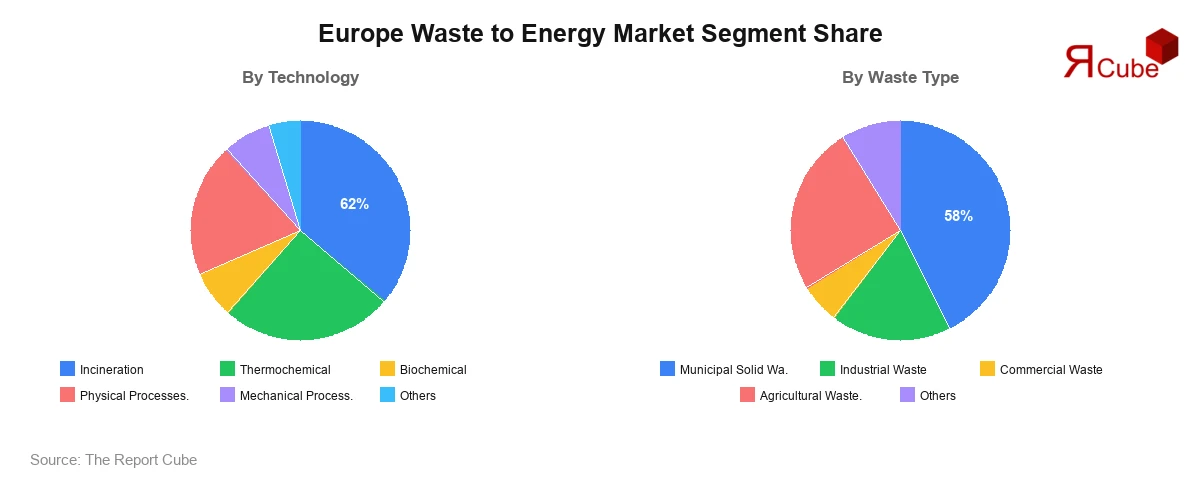
Incineration technology dominates the Europe Waste to Energy Market, holding approximately 62% market share in 2025. Its leadership is supported by proven reliability, scalability, and widespread regulatory acceptance. Countries such as Germany and France rely heavily on mass burn facilities for municipal waste management. However, gasification and pyrolysis are gaining momentum due to lower emissions and higher energy efficiency. Anaerobic digestion is increasingly adopted for organic waste streams, particularly in agricultural regions, supporting decentralized energy generation and nutrient recovery.
By Waste Type:
- Municipal Solid Waste (MSW)
- Industrial Waste
- Commercial Waste
- Agricultural Waste
- Others
Municipal solid waste represents the largest waste type segment, accounting for nearly 58% of total feedstock utilization in 2025. Rapid urbanization, high consumption levels, and limited landfill availability drive municipalities to prioritize waste-to-energy solutions. Industrial and commercial waste streams are also gaining importance due to consistent calorific value and long-term supply contracts. Sewage sludge treatment through energy recovery is expanding, particularly in wastewater treatment facilities seeking energy self-sufficiency.
Regional Projection of Europe Waste to Energy Industry
- Germany
- France
- United Kingdom
- Italy
Germany leads the Europe Waste to Energy Market, contributing approximately 28% of total regional revenue in 2025. The country’s advanced waste segregation systems, strict landfill bans, and extensive district heating networks support high utilization of waste-to-energy plants. France and the United Kingdom follow closely, driven by urban waste volumes and national decarbonization strategies. Northern European countries, including Sweden and Denmark, demonstrate the highest per-capita waste-to-energy utilization, serving as benchmarks for efficiency and integration.
Need insights for a specific region within this market?
Request Regional DataWhy Choose This Report?
- Provides a comprehensive overview of the overall market analysis, encompassing key trends, consumer behavior analysis, and risk assessment to support strategic decision-making.
- Provides accurate, up-to-date insights into market size, segmentation, and emerging opportunities, helping to minimize risk & capitalizing on growth.
- Gives deep understanding of target audience preferences, investment habits, and communication channels for enhanced product development & marketing effectiveness.
- Delivers competitive analysis & benchmarking, uncovering the strengths & weaknesses of market competitors to guide strategies.
- Consolidate comprehensive market intelligence, reducing reasoning & streamlining research efforts.
- Facilitates customized market segmentation & risk mitigation strategies, fine-tuned to the business objectives.
- Aids in identifying both market challenges & untapped opportunities within the industry to drive long-term business growth.
- Provides valuable information based on actual customer data & search trends.
Table of Contents
- Introduction
- Objective of the Study
- Product and Category Definition
- Market Segmentation
- Study Variables
- Research Methodology
- Secondary Data Points
- Breakdown of Secondary Sources
- Primary Data Points
- Breakdown of Primary Interviews
- Secondary Data Points
- Executive Summary
- Market Dynamics
- Drivers
- Challenges
- Opportunity Assessment
- Recent Trends and Developments
- Regulatory and Policy Landscape
- Europe Waste to Energy Market Overview (2020-2034)
- Market Size, By Value (USD Billion)
- Market Share, By Waste Type
- Municipal Solid Waste
- Industrial Waste
- Agricultural Waste
- Biomedical Waste
- Others
- Market Share, By Technology
- Incineration
- Gasification
- Pyrolysis
- Anaerobic Digestion
- Refuse-Derived Fuel
- Others
- Market Share, By Plant Size
- Small Scale (<10 MW)
- Medium Scale (10-50 MW)
- Large Scale (>50 MW)
- Market Share, By Energy Output
- Electricity Generation
- Heat Generation
- Combined Heat and Power
- Biogas
- Refuse-Derived Fuel Output
- Market Share, By Ownership
- Public Sector
- Private Sector
- Public-Private Partnership
- Market Share, By End User
- Utility Companies
- Industrial Users
- Commercial Establishments
- Municipal Corporations
- Others
- Market Share, By Country
- Germany
- France
- United Kingdom
- Italy
- Spain
- Sweden
- Denmark
- Norway
- Finland
- Poland
- Czechia
- Austria
- Market Share, By Company
- Revenue Shares & Analysis
- Competitive Landscape
- Germany Waste to Energy Market
- Market Size, By Value (USD Billion/Million)
- Market Share, By Waste Type
- Market Share, By Technology
- Market Share, By Plant Size
- Market Share, By Energy Output
- Market Share, By Ownership
- Market Share, By End User
- France Waste to Energy Market
- Market Size, By Value (USD Billion/Million)
- Market Share, By Waste Type
- Market Share, By Technology
- Market Share, By Plant Size
- Market Share, By Energy Output
- Market Share, By Ownership
- Market Share, By End User
- United Kingdom Waste to Energy Market
- Market Size, By Value (USD Billion/Million)
- Market Share, By Waste Type
- Market Share, By Technology
- Market Share, By Plant Size
- Market Share, By Energy Output
- Market Share, By Ownership
- Market Share, By End User
- Italy Waste to Energy Market
- Market Size, By Value (USD Billion/Million)
- Market Share, By Waste Type
- Market Share, By Technology
- Market Share, By Plant Size
- Market Share, By Energy Output
- Market Share, By Ownership
- Market Share, By End User
- Spain Waste to Energy Market
- Market Size, By Value (USD Billion/Million)
- Market Share, By Waste Type
- Market Share, By Technology
- Market Share, By Plant Size
- Market Share, By Energy Output
- Market Share, By Ownership
- Market Share, By End User
- Nordic Waste to Energy Market
- Market Size, By Value (USD Billion/Million)
- Market Share, By Waste Type
- Market Share, By Technology
- Market Share, By Plant Size
- Market Share, By Energy Output
- Market Share, By Ownership
- Market Share, By End User
- Market Size, By Value (USD Billion/Million)
- Market Share, By Waste Type
- Market Share, By Technology
- Market Share, By Plant Size
- Market Share, By Energy Output
- Market Share, By Ownership
- Market Share, By End User
- Competitive Outlook and Company Profiles
- Veolia Environnement
- Company Overview
- Project Portfolio
- Strategic Alliances/Partnerships
- Recent Developments
- SUEZ Group
- Company Overview
- Project Portfolio
- Strategic Alliances/Partnerships
- Recent Developments
- EEW Energy from Waste
- Company Overview
- Project Portfolio
- Strategic Alliances/Partnerships
- Recent Developments
- A2A Energia
- Company Overview
- Project Portfolio
- Strategic Alliances/Partnerships
- Recent Developments
- Hitachi Zosen Inova
- Company Overview
- Project Portfolio
- Strategic Alliances/Partnerships
- Recent Developments
- Martin GmbH
- Company Overview
- Project Portfolio
- Strategic Alliances/Partnerships
- Recent Developments
- Covanta Holding
- Company Overview
- Project Portfolio
- Strategic Alliances/Partnerships
- Recent Developments
- Babcock & Wilcox
- Company Overview
- Project Portfolio
- Strategic Alliances/Partnerships
- Recent Developments
- Fortum Oyj
- Company Overview
- Project Portfolio
- Strategic Alliances/Partnerships
- Recent Developments
- Indaver NV
- Company Overview
- Project Portfolio
- Strategic Alliances/Partnerships
- Recent Developments
- Others
- Veolia Environnement
- Contact Us and Disclaimer
Top Key Players & Market Share Outlook
- Veolia Environnement
- SUEZ Group
- EEW Energy from Waste
- A2A Energia
- Hitachi Zosen Inova
- Martin GmbH
- Covanta Holding
- Babcock & Wilcox
- Fortum Oyj
- Indaver NV
- Others
Frequently Asked Questions






