



Build Your Custom Market Intelligence Report
Customize Your ReportLatin America Waste to Energy Market Insights & Analysis
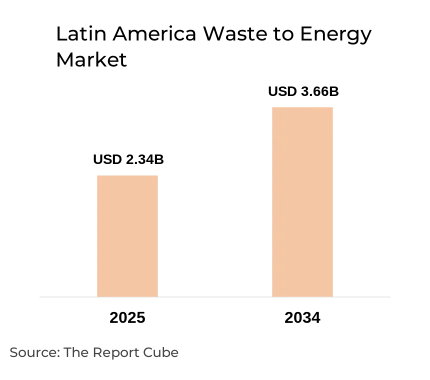
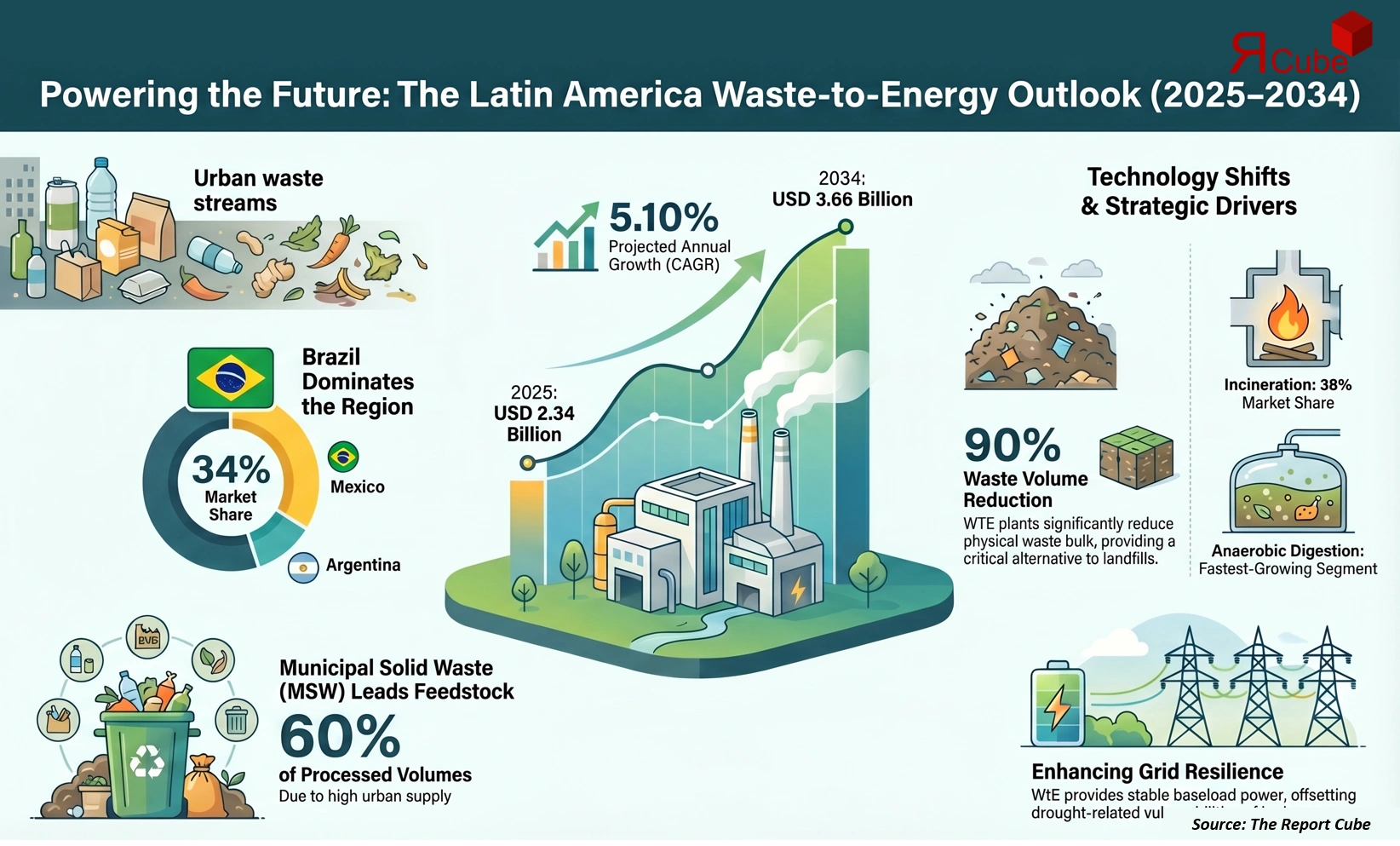
The Latin America Waste to Energy Market is anticipated to register a CAGR of 5.10% during 2026-2034. The market size was valued at USD 2.34 billion in 2025 and is projected to reach USD 3.66 billion by 2034. The market is gaining steady traction as Latin American economies address rising urban waste volumes, landfill saturation, and energy security challenges simultaneously. Rapid urbanization across Brazil, Mexico, and Argentina has significantly increased municipal solid waste generation, exceeding 540 million tons annually across the region. Waste-to-energy solutions are increasingly viewed as a dual-benefit approach, enabling waste volume reduction while generating baseload electricity and thermal energy. Countries facing landfill constraints are prioritizing incineration, anaerobic digestion, and refuse-derived fuel technologies to divert waste streams.
Energy diversification policies are also strengthening demand. Several Latin American countries continue to rely heavily on hydropower, making energy systems vulnerable to droughts. Waste-to-energy plants provide stable, weather-independent output, improving grid resilience. Additionally, growing private sector participation, public-private partnerships, and long-term power purchase agreements are improving project bankability.
Environmental regulations mandating methane reduction and improved waste management practices are further accelerating market adoption. With over 55% of waste still disposed in open dumps across parts of Latin America, governments are increasingly supporting energy recovery infrastructure to meet climate targets. These combined factors position the Latin America Waste to Energy Market as a resilient, medium-growth infrastructure segment through 2034.
Latin America Waste to Energy Market Recent Developments
- 2025: Veolia Environment commissioned an upgraded waste-to-energy facility in Brazil, increasing power output efficiency by over 12%.
- 2025: Hitachi Zosen Inova partnered with a Mexican municipality to deploy advanced flue gas treatment technology.
Government Initiatives & Policies
- Brazil National Solid Waste Policy (PNRS): Promotes waste recovery, landfill reduction, and energy generation from waste.
- Mexico Energy Transition Law: Encourages renewable energy integration, including waste-to-energy projects.
Latin America Waste to Energy Market Dynamics
Key Driver: Rising Urban Waste Generation and Landfill Constraints
Escalating urban population growth is the primary driver of the Latin America Waste to Energy Market. Urbanization rates exceed 80% in several countries, resulting in mounting municipal solid waste volumes. Landfill capacity is becoming increasingly limited, particularly around major metropolitan areas such as São Paulo, Mexico City, and Buenos Aires. Waste-to-energy facilities offer a practical solution by reducing waste volume by up to 90% while simultaneously generating electricity and heat. Governments are actively promoting alternatives to landfilling due to rising land acquisition costs and community resistance. Additionally, waste-to-energy plants help reduce methane emissions, supporting national climate commitments. These structural pressures make waste-to-energy infrastructure an essential component of modern waste management strategies across Latin America.
Book your FREE 30-minute expert consultation today
Contact UsIndustry Trends: Shift Toward Advanced Thermal and Biological Technologies
The market is witnessing a transition from conventional mass burn incineration toward advanced thermal and biological technologies. Gasification and anaerobic digestion are gaining momentum due to higher efficiency rates and lower emission profiles. Anaerobic digestion, in particular, is expanding across agricultural regions, utilizing organic residues and sewage sludge to produce biogas. Refuse-derived fuel adoption is also rising, especially in cement and industrial co-incineration applications. Digital monitoring systems and automated combustion controls are improving plant efficiency and regulatory compliance. These trends reflect a broader industry focus on operational optimization, emission reduction, and technology diversification.
Major Challenge: High Capital Investment and Financing Complexity
Despite favorable fundamentals, high upfront capital requirements remain a major barrier. Waste-to-energy projects require significant investment in engineering, construction, and environmental control systems. Financing complexity is compounded by long project development timelines and regulatory approvals. In several Latin American markets, limited access to low-cost financing and currency volatility further constrain investment. Public opposition driven by emission concerns and misinformation can also delay project approvals. Addressing these challenges requires transparent environmental assessments, stable regulatory frameworks, and enhanced public-private collaboration to ensure long-term project viability.
Opportunity: Integration with Renewable Energy and Circular Economy Programs
The growing emphasis on circular economy models presents substantial growth opportunities. Waste-to-energy facilities are increasingly integrated with recycling and material recovery systems, improving overall waste management efficiency. Governments are aligning waste-to-energy projects with renewable energy targets, enabling access to green financing mechanisms. Carbon credit monetization and renewable energy certificates further enhance revenue potential. Additionally, decentralized waste-to-energy plants offer scalable solutions for mid-sized cities, expanding addressable markets. These opportunities position waste-to-energy as a strategic infrastructure investment across Latin America.
Latin America Waste to Energy Market Segment-wise Analysis
By Technology:
- Incineration
- Thermochemical
- Biochemical
- Physical Processes
- Mechanical Processes
- Others
Incineration remains the leading technology, accounting for approximately 38% market share due to its scalability and reliability. These systems are widely deployed in urban centers handling mixed municipal waste streams. However, anaerobic digestion is the fastest-growing segment, driven by increasing organic waste segregation initiatives. Gasification is gaining adoption for its higher energy efficiency and lower emission output, particularly in new installations. Refuse-derived fuel and co-incineration applications are expanding within industrial sectors, supporting fuel substitution and cost reduction strategies.
By Waste Type:
- Municipal Solid Waste (MSW)
- Industrial Waste
- Commercial Waste
- Agricultural Waste
- Others
Municipal solid waste dominates feedstock utilization, contributing nearly 60% of total processed volumes. The abundance and consistent supply of municipal waste make it the preferred input for large-scale facilities. Agricultural residues are emerging as a high-growth segment, particularly in Brazil and Argentina, where bioenergy policies support rural waste valorization. Sewage sludge utilization is increasing through anaerobic digestion, driven by wastewater treatment upgrades. Industrial waste feedstock remains stable, primarily supporting co-incineration applications.
Regional Projection of Latin America Waste to Energy Industry
- Brazil
- Mexico
- Argentina
- Chile
- Rest of Latin America
Brazil leads the Latin America Waste to Energy Market, accounting for approximately 34% of regional revenue. The country benefits from large urban waste volumes, supportive federal policies, and growing private sector investment. São Paulo and Rio de Janeiro are key hubs for waste-to-energy deployment. Mexico follows closely, supported by energy transition mandates and municipal partnerships. Argentina and Chile are expanding gradually, driven by landfill reduction goals and renewable integration. The rest of Latin America presents long-term potential as regulatory frameworks mature.
Need insights for a specific region within this market?
Request Regional DataWhy Choose This Report?
- Provides a comprehensive overview of the overall market analysis, encompassing key trends, consumer behavior analysis, and risk assessment to support strategic decision-making.
- Provides accurate, up-to-date insights into market size, segmentation, and emerging opportunities, helping to minimize risk & capitalizing on growth.
- Gives deep understanding of target audience preferences, investment habits, and communication channels for enhanced product development & marketing effectiveness.
- Delivers competitive analysis & benchmarking, uncovering the strengths & weaknesses of market competitors to guide strategies.
- Consolidate comprehensive market intelligence, reducing reasoning & streamlining research efforts.
- Facilitates customized market segmentation & risk mitigation strategies, fine-tuned to the business objectives.
- Aids in identifying both market challenges & untapped opportunities within the industry to drive long-term business growth.
- Provides valuable information based on actual customer data & search trends.
Table of Contents
- Introduction
- Objective of the Study
- Product and Category Definition
- Market Segmentation
- Study Variables
- Research Methodology
- Secondary Data Points
- Breakdown of Secondary Sources
- Primary Data Points
- Breakdown of Primary Interviews
- Secondary Data Points
- Executive Summary
- Market Dynamics
- Drivers
- Challenges
- Opportunity Assessment
- Recent Trends and Developments
- Regulatory and Policy Landscape
- Latin America Waste to Energy Market Overview (2021-2034)
- Market Size, By Value (USD Billion)
- Market Share, By Waste Type
- Municipal Solid Waste
- Industrial Waste
- Agricultural Waste
- Biomedical Waste
- Others
- Market Share, By Technology
- Incineration
- Gasification
- Pyrolysis
- Anaerobic Digestion
- Refuse-Derived Fuel
- Others
- Market Share, By Plant Size
- Small Scale (<10 MW)
- Medium Scale (10-50 MW)
- Large Scale (>50 MW)
- Market Share, By Energy Output
- Electricity Generation
- Heat Generation
- Combined Heat and Power
- Biogas
- Refuse-Derived Fuel Output
- Market Share, By Ownership
- Public Sector
- Private Sector
- Public-Private Partnership
- Market Share, By End User
- Utility Companies
- Industrial Users
- Commercial Establishments
- Municipal Corporations
- Others
- Market Share, By Region
- North India
- West India
- South India
- East India
- Central India
- Northeast India
- Market Share, By Company
- Revenue Shares and Analysis
- Competitive Landscape
- Brazil Waste to Energy Market
- Market Size, By Value (USD Billion/Million)
- Market Share, By Waste Type
- Market Share, By Technology
- Market Share, By Plant Size
- Market Share, By Energy Output
- Market Share, By Ownership
- Market Share, By End User
- Mexico Waste to Energy Market
- Market Size, By Value (USD Billion/Million)
- Market Share, By Waste Type
- Market Share, By Technology
- Market Share, By Plant Size
- Market Share, By Energy Output
- Market Share, By Ownership
- Market Share, By End User
- Argentina Waste to Energy Market
- Market Size, By Value (USD Billion/Million)
- Market Share, By Waste Type
- Market Share, By Technology
- Market Share, By Plant Size
- Market Share, By Energy Output
- Market Share, By Ownership
- Market Share, By End User
- Chile Waste to Energy Market
- Market Size, By Value (USD Billion/Million)
- Market Share, By Waste Type
- Market Share, By Technology
- Market Share, By Plant Size
- Market Share, By Energy Output
- Market Share, By Ownership
- Market Share, By End User
- Rest of Latin America Waste to Energy Market
- Market Size, By Value (USD Billion/Million)
- Market Share, By Waste Type
- Market Share, By Technology
- Market Share, By Plant Size
- Market Share, By Energy Output
- Market Share, By Ownership
- Market Share, By End User
- Competitive Outlook and Company Profiles
- Veolia Environment
- Company Overview
- Technology Portfolio
- Latin America Footprint
- Recent Developments
- CNIM Group
- Company Overview
- Technology Portfolio
- Latin America Footprint
- Recent Developments
- Hitachi Zosen Inova
- Company Overview
- Technology Portfolio
- Latin America Footprint
- Recent Developments
- Keppel Seghers
- Company Overview
- Technology Portfolio
- Latin America Footprint
- Recent Developments
- Suez SA
- Company Overview
- Technology Portfolio
- Latin America Footprint
- Recent Developments
- Estre Ambiental
- Company Overview
- Service Portfolio
- Waste to Energy Projects
- Recent Developments
- Solvi Participacoes
- Company Overview
- Service Portfolio
- Waste to Energy Projects
- Recent Developments
- Cliba Group
- Company Overview
- Service Portfolio
- Waste to Energy Initiatives
- Recent Developments
- KDM Empresas
- Company Overview
- Service Portfolio
- Waste to Energy Initiatives
- Recent Developments
- Petramas SA
- Company Overview
- Service Portfolio
- Waste to Energy Initiatives
- Recent Developments
- Others
- Veolia Environment
- Contact Us and Disclaimer
Top Key Players & Market Share Outlook
- Veolia Environment
- CNIM Group
- Hitachi Zosen Inova
- Keppel Seghers
- Suez SA
- Estre Ambiental
- Solvi Participacoes
- Cliba Group
- KDM Empresas
- Petramas SA
- Others
Frequently Asked Questions