



Build Your Custom Market Intelligence Report
Customize Your ReportAsia-Pacific Ethylene Market Key Highlights
By Application:
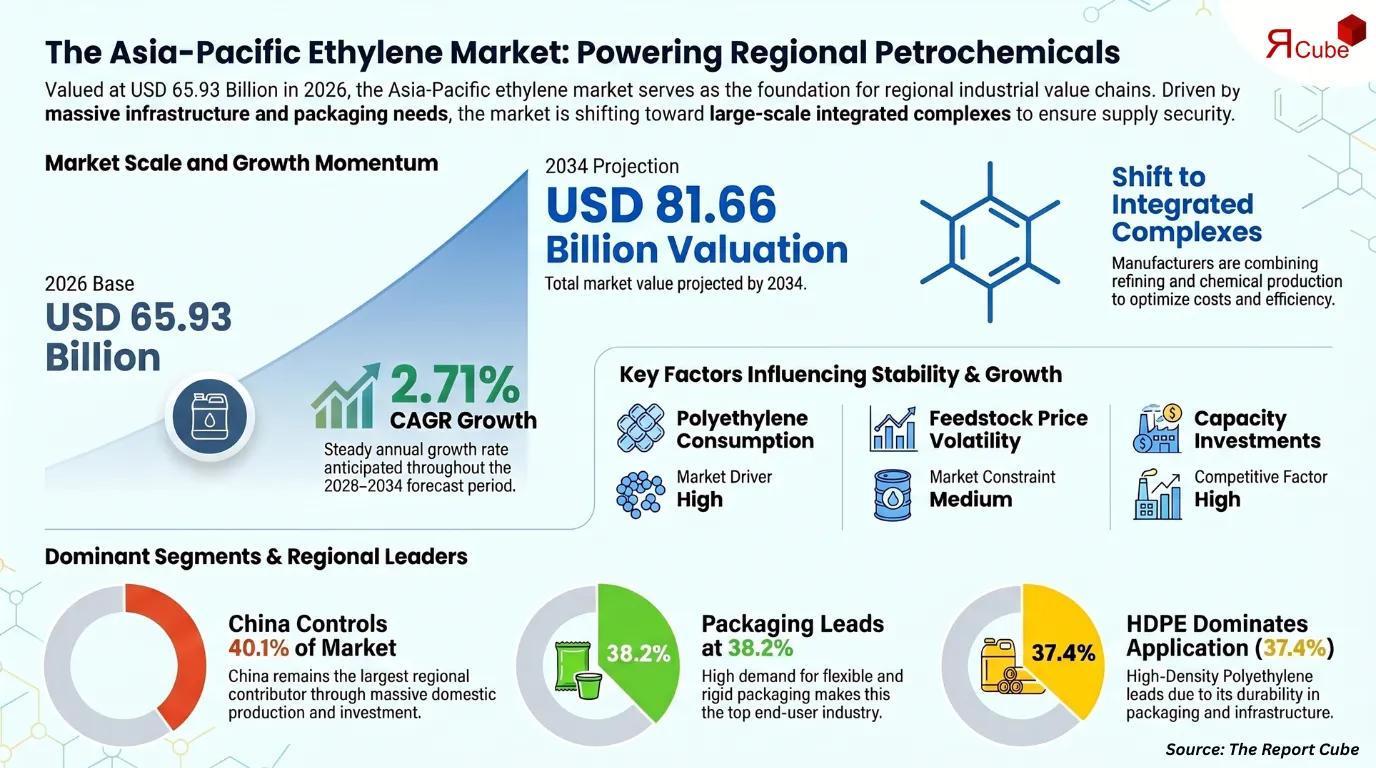
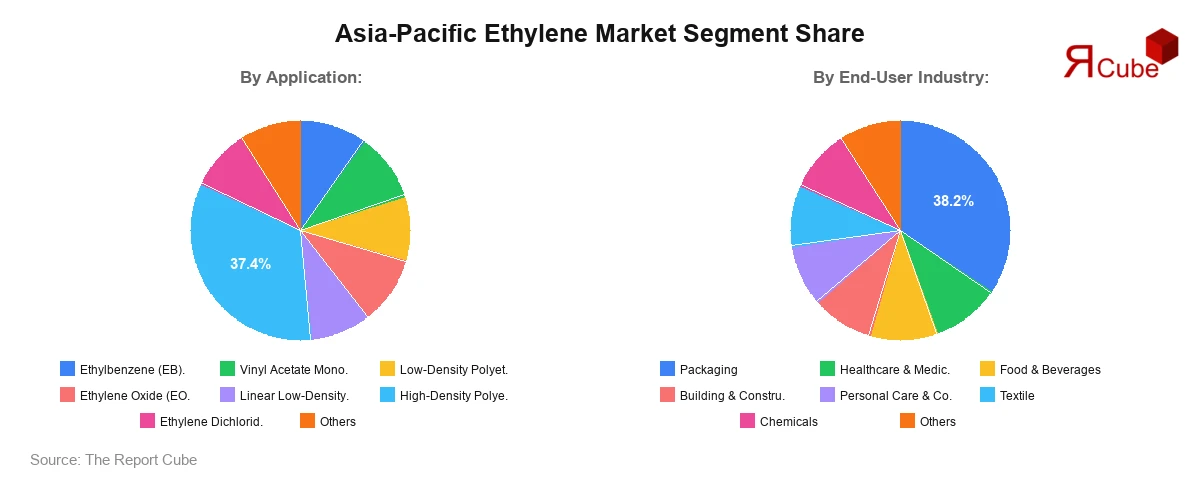
High-Density Polyethylene (HDPE) segment leads the market with approximately 37.4% share.
By End-User Industry:
Packaging segment dominates the market with nearly 38.2% of revenue.
Regional Outlook:
China dominates the Asia-Pacific Ethylene Market with around 40.1% share.
Asia-Pacific Ethylene Market Insights & Analysis
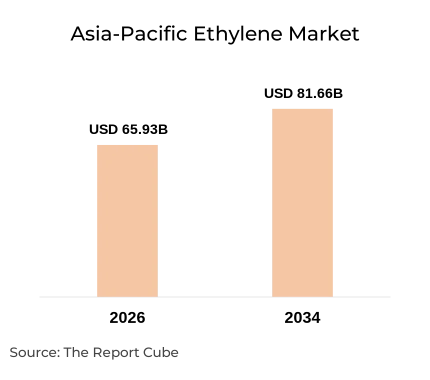
The Asia-Pacific Ethylene Market is anticipated to register a CAGR of around 2.71% during the forecast period 2026-2034. The market size is valued at USD 65.93 Billion in 2026 and is projected to reach USD 81.66 Billion by 2034. Ethylene remains the foundation of the regional petrochemical value chain, serving as a critical raw material for polyethylene, ethylene oxide, ethylene dichloride, and several industrial intermediates. Demand growth continues to be supported by expanding manufacturing activity, infrastructure investments, and rising consumption of packaged products across China, India, Indonesia, Vietnam, and other developing economies. The region accounts for a significant share of global petrochemical production, supported by large-scale refining and petrochemical integration projects that improve feedstock efficiency and reduce production costs.
Industry investments announced during 2025 and 2026 are reshaping the Asia-Pacific Ethylene Manufacturing Industry. Major producers are expanding cracker capacities to meet long-term demand from packaging, construction, automotive, healthcare, and chemical sectors. China continues to strengthen domestic production through integrated refinery-to-chemical projects, while Southeast Asian economies are attracting substantial foreign investment in petrochemical infrastructure. New-generation facilities are being designed with higher operational efficiency, improved energy utilization, and enhanced feedstock flexibility. These developments are improving regional supply security while creating opportunities for downstream manufacturers that rely on stable ethylene availability for large-scale production.
Asia-Pacific Ethylene Market Impact Analysis
| Factor | Type | Specific Impact on Market | Magnitude | Business Implication |
|---|---|---|---|---|
| Growing Polyethylene Consumption | Market Driver | Higher demand from packaging, pipes, films, and containers | High | Supports capacity additions for ethylene and derivatives |
| Regional Industrial Expansion | Structural Driver | Industrial growth raises ethylene use in key end sectors | High | Strengthens long term demand visibility for producers |
| Feedstock Price Volatility | Market Constraint | Fluctuating naphtha and gas costs affect production margins | Medium | Requires hedging and diversified feedstock strategies |
| Capacity Investments & Integration | Competitive Factor | Large integrated complexes enhance scale and reliability | High | Intensifies competition and shifts cost curve advantages |
| Environmental & Emission Regulations | Regulatory Factor | Stricter rules encourage cleaner and efficient production | Medium | Drives upgrades in technology and process optimization |
| Chemical Recycling Initiatives | Technological Trend | Recycling projects impact virgin ethylene demand growth | Low-Medium | Encourages integration with circular plastic solutions |
| Global Trade & Export Dynamics | Market Structure | Export flows influence regional price and supply balance | Medium | Necessitates flexible logistics and market diversification |
Asia-Pacific Ethylene Market Dynamics
Key Driver: Expanding Polyethylene Demand Across Industrial Value Chains
One of the strongest growth drivers for the Asia-Pacific Ethylene Market is the sustained increase in polyethylene consumption across multiple industries. HDPE, LDPE, and LLDPE collectively represent the largest downstream applications of ethylene due to their widespread use in flexible packaging, rigid containers, industrial films, agricultural products, and infrastructure materials. Rapid urbanization and industrial development across emerging Asian economies continue to generate substantial demand for these materials.
The packaging sector alone accounts for a considerable share of regional polyethylene consumption. Growth in organized retail, food processing, pharmaceutical manufacturing, and e-commerce logistics has accelerated the adoption of high-performance plastic packaging solutions. Additionally, infrastructure projects across India, China, Indonesia, and Vietnam are increasing demand for HDPE pipes, geomembranes, and construction materials. These trends continue to strengthen the long-term consumption outlook for ethylene and its derivatives throughout the region.
Industry Trends: Rise of Integrated Petrochemical Manufacturing Complexes
A notable trend within the Asia-Pacific Ethylene Manufacturing Industry is the rapid expansion of integrated refining and petrochemical complexes. Industry participants are increasingly investing in facilities that combine refining operations with steam cracking and downstream chemical production. This model enables manufacturers to improve feedstock optimization, enhance operational efficiency, and strengthen cost competitiveness across the value chain.
Several large-scale projects announced across China, Indonesia, and India demonstrate this transition. New facilities are being designed to support higher production flexibility while reducing logistics costs associated with importing petrochemical feedstocks. Companies are also investing in advanced process technologies, digital monitoring systems, and energy management solutions to improve plant reliability and production efficiency. These investments are expected to enhance regional production capabilities while supporting long-term market stability.
Book your FREE 30-minute expert consultation today
Contact UsMajor Challenge: Feedstock Cost Volatility and Market Oversupply Risks
Feedstock pricing remains one of the most significant challenges affecting ethylene producers across Asia-Pacific. Naphtha-based crackers, which account for a large share of regional production, remain highly sensitive to fluctuations in crude oil prices. Sudden changes in feedstock costs can affect operating margins, influence production economics, and delay planned investment decisions across the petrochemical sector.
At the same time, aggressive capacity expansion in certain markets has increased the possibility of temporary oversupply conditions. Several countries are commissioning new cracker facilities within a relatively short timeframe, creating competitive pressure on pricing and profitability. Producers must therefore focus on operational excellence, feedstock diversification, and downstream integration strategies to maintain sustainable returns in an increasingly competitive environment.
Opportunity: Industrial Growth Across Emerging Asian Economies
The industrial expansion underway across emerging Asian economies presents significant opportunities for ethylene producers and downstream manufacturers. Governments throughout the region continue to prioritize industrial development, infrastructure modernization, and manufacturing localization initiatives. These programs are increasing demand for plastics, synthetic materials, chemicals, and industrial intermediates derived from ethylene.
Healthcare, automotive, renewable energy, electronics, and construction sectors are expected to remain important growth contributors during the forecast period. Demand for medical packaging, lightweight automotive components, cable insulation, construction membranes, and industrial chemicals is rising steadily across developing economies. As manufacturing investment continues to expand throughout Asia-Pacific, ethylene producers are expected to benefit from broader downstream consumption and stronger regional value-chain integration.
Asia-Pacific Ethylene Market Segment-wise Analysis
By Application:
- Ethylbenzene (EB)
- Vinyl Acetate Monomer (VAM)
- Low-Density Polyethylene (LDPE)
- Ethylene Oxide (EO)
- Linear Low-Density Polyethylene (LLDPE)
- High-Density Polyethylene (HDPE)
- Ethylene Dichloride (EDC)
- Others
High-Density Polyethylene (HDPE) remains the leading application segment within the Asia-Pacific Ethylene Market, accounting for an estimated 37.4% share of total demand. The segment's leadership is closely linked to its extensive use across packaging, water infrastructure, industrial storage, agriculture, and construction applications. HDPE's high tensile strength, durability, chemical resistance, and cost efficiency make it one of the most widely consumed polyethylene grades in the region. Large infrastructure investments across China, India, and Southeast Asia continue to drive demand for HDPE pipes and utility systems.
In addition, growing consumption of rigid packaging products for food, beverages, household goods, and industrial applications is further supporting segment growth. Strong downstream demand and continuous capacity additions by major polyethylene producers are expected to reinforce HDPE's dominant market position throughout the forecast period.
By End-User Industry:
- Packaging
- Healthcare & Medical
- Food & Beverages
- Building & Construction
- Personal Care & Cosmetics
- Textile
- Chemicals
- Automotive
- Others
Packaging remains the largest end-user industry in the Asia-Pacific Ethylene Market, contributing approximately 38.2% of total revenue. The segment benefits from strong demand across food packaging, pharmaceutical packaging, consumer goods, industrial logistics, and e-commerce applications. Polyethylene materials derived from ethylene continue to be preferred due to their lightweight nature, durability, flexibility, and moisture resistance. The expansion of organized retail channels and rising demand for packaged food products have significantly increased consumption of flexible and rigid packaging formats throughout the region.
Furthermore, growth in cross-border trade and logistics activities has accelerated demand for protective packaging solutions. As consumer industries continue to expand and supply chains become more sophisticated, the packaging sector is expected to remain the primary demand center for ethylene-derived materials.
Regional Projection of Asia-Pacific Ethylene Industry
- China
- India
- South Korea
- Japan
- Indonesia
- Thailand
- Vietnam
- Australia
China maintains its position as the largest contributor to the Asia-Pacific Ethylene Market, accounting for approximately 40.1% of regional demand. The country's dominance is supported by its extensive petrochemical manufacturing base, large-scale industrial production, and significant consumption of polyethylene, ethylene glycol, and specialty chemicals. Strong demand from packaging, automotive, construction, electronics, and consumer goods industries continues to drive ethylene consumption across the country.
China has also emerged as one of the most active markets for petrochemical capacity expansion. Major state-owned and private enterprises are investing heavily in integrated refining and chemical production facilities to strengthen domestic supply capabilities and reduce import dependency. Projects such as Sinopec's Xinjiang ethylene expansion highlight the country's long-term commitment to petrochemical self-sufficiency. Supported by continuous industrial development, advanced manufacturing growth, and infrastructure investment, China is expected to retain its leadership position within the Asia-Pacific Ethylene Manufacturing Industry through 2034.
Need insights for a specific region within this market?
Request Regional DataAsia-Pacific Ethylene Market - Country Analysis
The Asia-Pacific ethylene market is led by China, with other key producers and importers adapting to oversupply and demand shifts.
| Country | Market Role | Capacity / Imports Focus | System Dominance | Core Demand Logic | Growth Nature |
|---|---|---|---|---|---|
| China | Regional export hub | Massive cracker capacity | Naphtha and mixed-feed | Oversupply reshaping prices | Volume-led, margin pressure |
| India | High-growth importer | Fast-growing demand base | Naphtha-based complexes | Packaging and PE demand | Demand-driven, deficit market |
| South Korea | Export-oriented producer | Capacity cuts and rationalization | Steam crackers under review | Competing with Chinese exports | Consolidation-led transition |
| Japan | Mature, shrinking supplier | Cracker closures underway | Older naphtha crackers | Weak demand and high costs | Declining, selective upgrades |
| Indonesia | Import-reliant consumer | Limited domestic capacity | Naphtha and condensate feed | Plastic and construction needs | Import-led, steady expansion |
| Thailand | Regional mid-size hub | Integrated refinery-petchem | Naphtha and gas crackers | Exports plus local converters | Moderate, efficiency-focused |
| Vietnam | Emerging demand center | New complexes and imports | New naphtha-based projects | Downstream plastics growth | Rapid, from low base |
| Australia | Niche, high-cost market | Small-scale local output | Gas-based production | Domestic demand with imports | Stable, limited expansion |
Government Initiatives & Policies
- China Petrochemical Industry Stabilization and Upgrade Work Plan (2025-2026): China's Ministry of Industry and Information Technology introduced a 2025-2026 action plan focused on industrial upgrading, advanced chemical production, sustainability improvements, and modernization of petrochemical manufacturing facilities.
- India PCPIR Development Program and Chemical Sector Expansion Initiative (2025): India continues to promote Petroleum, Chemicals and Petrochemicals Investment Regions (PCPIRs) to attract large-scale investments, improve infrastructure, and strengthen domestic petrochemical manufacturing capabilities.
Asia-Pacific Ethylene Industry Recent Developments
- 2025: Lotte Chemical inaugurated a USD 4 billion petrochemical complex in Indonesia featuring a naphtha cracker capable of producing approximately 1 million metric tons of ethylene annually. The project significantly enhances Southeast Asia's production capacity, strengthens regional supply security, and supports downstream polyethylene, automotive, packaging, and consumer goods industries.
- 2025: Sinopec commenced construction of its Xinjiang refining and petrochemical expansion project, including a new 800,000-ton-per-year ethylene cracker. The development will strengthen domestic ethylene production, improve feedstock integration, support downstream manufacturing growth, and reinforce China's petrochemical self-sufficiency objectives.
Why Choose This Report?
- Provides a comprehensive overview of the overall market analysis, encompassing key trends, consumer behavior analysis, and risk assessment to support strategic decision-making.
- Provides accurate, up-to-date insights into market size, segmentation, and emerging opportunities, helping to minimize risk & capitalizing on growth.
- Gives deep understanding of target audience preferences, investment habits, and communication channels for enhanced product development & marketing effectiveness.
- Delivers competitive analysis & benchmarking, uncovering the strengths & weaknesses of market competitors to guide strategies.
- Consolidate comprehensive market intelligence, reducing reasoning & streamlining research efforts.
- Facilitates customized market segmentation & risk mitigation strategies, fine-tuned to the business objectives.
- Aids in identifying both market challenges & untapped opportunities within the industry to drive long-term business growth.
- Provides valuable information based on actual customer data & search trends.
Table of Contents
- Introduction
- Objective of the Study
- Product and Category Definition
- Market Segmentation
- Study Variables
- Research Methodology
- Secondary Data Points
- Breakdown of Secondary Sources
- Primary Data Points
- Breakdown of Primary Interviews
- Secondary Data Points
- Executive Summary
- Market Dynamics
- Emerging Opportunities
- Adoption Trends
- Demand Drivers
- Disruption Analysis (Challenges)
- Industry Analysis & Strategic Insights
- Supply/Value Chain Analysis
- Pricing Analysis
- Go-To-Market (GTM) Strategy
- BCG Matrix
- Recent Trends and Developments
- Import and Export Analysis
- Regulatory and Policy Landscape
- Country-wise Policies
- Government Initiatives
- Asia-Pacific Ethylene Market Overview and Forecast Analysis (2021-2034)
- Market Size, By Value, By Growth Rate (CAGR/USD Billion)
- Market Share, By Application
- Ethylbenzene (EB)
- Vinyl Acetate Monomer (VAM)
- Low-Density Polyethylene (LDPE)
- Ethylene Oxide (EO)
- Linear Low-Density Polyethylene (LLDPE)
- High-Density Polyethylene (HDPE)
- Ethylene Dichloride (EDC)
- Others
- Market Share, By Feedstock
- Natural Gas (Ethane-Based Feedstock)
- Naphtha
- Others
- Market Share, By End-User Industry
- Packaging
- Healthcare & Medical
- Food & Beverages
- Building & Construction
- Personal Care & Cosmetics
- Textile
- Chemicals
- Automotive
- Others
- Market Share, By Country
- China
- India
- South Korea
- Japan
- Indonesia
- Thailand
- Vietnam
- Australia
- Market Share, By Company
- Revenue Shares & Analysis
- Competitive Landscape
- China Ethylene Market Overview and Forecast Analysis (2021-2034)
- Market Size, By Value, By Growth Rate (CAGR/USD Billion/Million)
- Market Share, By Application
- Market Share, By Feedstock
- Market Share, By End-User Industry
- India Ethylene Market Overview and Forecast Analysis (2021-2034)
- Market Size, By Value, By Growth Rate (CAGR/USD Billion/Million)
- Market Share, By Application
- Market Share, By Feedstock
- Market Share, By End-User Industry
- South Korea Ethylene Market Overview and Forecast Analysis (2021-2034)
- Market Size, By Value, By Growth Rate (CAGR/USD Billion/Million)
- Market Share, By Application
- Market Share, By Feedstock
- Market Share, By End-User Industry
- Japan Ethylene Market Overview and Forecast Analysis (2021-2034)
- Market Size, By Value, By Growth Rate (CAGR/USD Billion/Million)
- Market Share, By Application
- Market Share, By Feedstock
- Market Share, By End-User Industry
- Indonesia Ethylene Market Overview and Forecast Analysis (2021-2034)
- Market Size, By Value, By Growth Rate (CAGR/USD Billion/Million)
- Market Share, By Application
- Market Share, By Feedstock
- Market Share, By End-User Industry
- Thailand Ethylene Market Overview and Forecast Analysis (2021-2034)
- Market Size, By Value, By Growth Rate (CAGR/USD Billion/Million)
- Market Share, By Application
- Market Share, By Feedstock
- Market Share, By End-User Industry
- Vietnam Ethylene Market Overview and Forecast Analysis (2021-2034)
- Market Size, By Value, By Growth Rate (CAGR/USD Billion/Million)
- Market Share, By Application
- Market Share, By Feedstock
- Market Share, By End-User Industry
- Australia Ethylene Market Overview and Forecast Analysis (2021-2034)
- Market Size, By Value, By Growth Rate (CAGR/USD Billion/Million)
- Market Share, By Application
- Market Share, By Feedstock
- Market Share, By End-User Industry
- Competitive Analysis, 2026
- Market Share of Key Players
- Competitive Mapping for Each Segment and Companies Operating Regionally
- China Ethylene Companies Share & Competitive Analysis, 2026
- India Ethylene Companies Share & Competitive Analysis, 2026
- South Korea Ethylene Companies Share & Competitive Analysis, 2026
- Japan Ethylene Companies Share & Competitive Analysis, 2026
- Indonesia Ethylene Companies Share & Competitive Analysis, 2026
- Thailand Ethylene Companies Share & Competitive Analysis, 2026
- Vietnam Ethylene Companies Share & Competitive Analysis, 2026
- Australia Ethylene Companies Share & Competitive Analysis, 2026
- Company Profile (Partial List)
- Dow Inc.
- Company Overview
- Product Portfolio
- Strategic Alliances/Partnerships
- Recent Developments
- Yeochun NCC
- Company Overview
- Product Portfolio
- Strategic Alliances/Partnerships
- Recent Developments
- LG Chem
- Company Overview
- Product Portfolio
- Strategic Alliances/Partnerships
- Recent Developments
- Formosa Plastics Corporation
- Company Overview
- Product Portfolio
- Strategic Alliances/Partnerships
- Recent Developments
- PetroChina
- Company Overview
- Product Portfolio
- Strategic Alliances/Partnerships
- Recent Developments
- Lotte Chemical
- Company Overview
- Product Portfolio
- Strategic Alliances/Partnerships
- Recent Developments
- Reliance Industries Limited
- Company Overview
- Product Portfolio
- Strategic Alliances/Partnerships
- Recent Developments
- Mitsubishi Chemical Corporation
- Company Overview
- Product Portfolio
- Strategic Alliances/Partnerships
- Recent Developments
- SK Geo Centric
- Company Overview
- Product Portfolio
- Strategic Alliances/Partnerships
- Recent Developments
- Indian Oil Corporation Limited
- Company Overview
- Product Portfolio
- Strategic Alliances/Partnerships
- Recent Developments
- Hanwha TotalEnergies Petrochemical
- Company Overview
- Product Portfolio
- Strategic Alliances/Partnerships
- Recent Developments
- LyondellBasell Industries N.V.
- Company Overview
- Product Portfolio
- Strategic Alliances/Partnerships
- Recent Developments
- Sinopec
- Company Overview
- Product Portfolio
- Strategic Alliances/Partnerships
- Recent Developments
- Haldia Petrochemicals Limited
- Company Overview
- Product Portfolio
- Strategic Alliances/Partnerships
- Recent Developments
- Chandra Asri Pacific Tbk
- Company Overview
- Product Portfolio
- Strategic Alliances/Partnerships
- Recent Developments
- Others (Partial List)
- Dow Inc.
- Contact Us and Disclaimer
Top Key Players & Market Share Outlook
- Dow Inc.
- Yeochun NCC
- LG Chem
- Formosa Plastics Corporation
- PetroChina
- Lotte Chemical
- Reliance Industries Limited
- Mitsubishi Chemical Corporation
- SK Geo Centric
- Indian Oil Corporation Limited
- Hanwha TotalEnergies Petrochemical
- LyondellBasell Industries N.V.
- Sinopec
- Haldia Petrochemicals Limited
- Chandra Asri Pacific Tbk
- Others
Frequently Asked Questions