



Build Your Custom Market Intelligence Report
Customize Your ReportEurope Beer Market Insights & Analysis
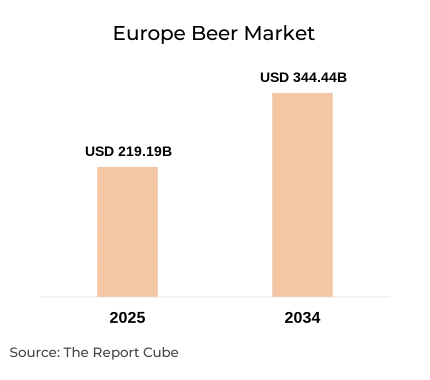
The Europe Beer Market is anticipated to register a CAGR of 5.15% during 2026-2034. The market size was valued at USD 219.19 billion in 2025 and is projected to reach USD 344.44 billion by 2034. Europe remains one of the most mature yet dynamic beer markets globally, supported by deep-rooted beer culture, strong on-trade infrastructure, and high per-capita consumption across multiple countries. Beer continues to play a central role in social, cultural, and culinary traditions, sustaining consistent baseline demand despite economic cycles.
Market expansion is increasingly shaped by premiumization, product innovation, and evolving consumer preferences toward differentiated beer experiences. Craft and specialty beers, alongside flavored and low-alcohol options, are gaining traction as consumers seek variety, moderation, and quality. Large brewers are responding by diversifying portfolios and acquiring or partnering with regional craft producers, ensuring relevance across demographics. This structural adaptability has enabled the Europe Beer Market to balance tradition with innovation.
Furthermore, improvements in distribution efficiency, growing tourism flows, and recovery of the hospitality sector are reinforcing volume growth. While consumption patterns vary significantly across countries, the collective European market benefits from scale, strong branding, and export-oriented production hubs. These factors collectively position the Europe Beer Market for sustainable growth through 2034.
Europe Beer Market Recent Developments
- 2025: Heineken NV expanded Heineken 0.0 draught to 10,000 European on-trade outlets, strengthening alcohol-free presence.
- 2025: Carlsberg Group’s Carlsberg Sweden launched “Electric Beer”, an alcohol-free beer brewed and shipped using renewable energy.
Government Initiatives & Policies
- EU Alcohol Strategy Framework: Promotes responsible alcohol consumption and product transparency across member states.
- European Green Deal: Encourages sustainable packaging and reduced carbon emissions in beverage manufacturing.
Europe Beer Market Dynamics
Key Driver: Strong Cultural Integration and High Per-Capita Consumption
Beer’s deep cultural integration across Europe remains a primary driver of market growth. Countries such as Germany, Belgium, and the United Kingdom maintain strong consumption traditions supported by festivals, pubs, and regional brewing identities. Average per-capita beer consumption in Europe exceeds 70 liters annually, significantly higher than global averages. This cultural embeddedness ensures stable demand even during economic slowdowns. Additionally, tourism plays a reinforcing role, as international visitors actively participate in local beer experiences, driving on-trade sales. Together, cultural continuity and tourism-led consumption provide a resilient foundation for long-term market expansion.
Book your FREE 30-minute expert consultation today
Contact UsIndustry Trends: Premiumization and Flavor Innovation
Premiumization has emerged as a defining trend within the Europe Beer Market. Consumers are increasingly willing to pay higher prices for superior quality, unique flavors, and authentic brand stories. Flavored beers, seasonal variants, and specialty brews are gaining shelf space across retail and on-trade channels. This shift is particularly strong among younger consumers seeking experimentation and differentiated taste profiles. Simultaneously, established brewers are modernizing classic offerings through limited editions and refined packaging. As a result, value growth is increasingly outpacing volume growth, signaling a structural shift toward higher-margin products.
Major Challenge: Regulatory Pressures and Rising Production Costs
The market faces mounting challenges from stringent regulations and rising production costs. Alcohol taxation varies widely across Europe, creating pricing complexities for cross-border operators. Additionally, stricter labeling, sustainability mandates, and advertising restrictions increase compliance costs. Rising input prices for barley, hops, energy, and packaging materials further pressure margins, particularly for smaller brewers. While large players can absorb these costs through scale, independent breweries face profitability risks, potentially leading to consolidation within the market.
Opportunity: Growth of Low and No-Alcohol Beer Segments
Changing consumer attitudes toward health and moderation present a significant opportunity for the Europe Beer Market. Low and no-alcohol beers are witnessing double-digit growth in several Western European countries. These products appeal to consumers seeking social inclusion without high alcohol intake, expanding consumption occasions beyond traditional settings. Brewer investments in advanced brewing technologies have improved taste profiles, increasing acceptance among mainstream consumers. As regulatory support and consumer awareness grow, this segment is expected to contribute meaningfully to incremental market value through 2034.
Europe Beer Market Segment-wise Analysis
By Alcohol Level:
- Low
- Regular
- High
Regular alcohol beer dominates the Europe Beer Market, accounting for approximately 68% of total market revenue in 2025. Its dominance reflects entrenched consumer preferences and widespread availability across on-trade and off-trade channels. Regular beer remains central to social gatherings, festivals, and hospitality venues. While low-alcohol beer is growing rapidly, regular beer continues to command the largest share due to taste familiarity, brand loyalty, and cultural acceptance across major European countries.
By Flavor:
- Unflavored Beer
- Flavored Beer
Unflavored beer holds the leading position, contributing nearly 72% of the Europe Beer Market share in 2025. Traditional lagers, ales, and pilsners remain core consumption choices, particularly among older demographics. However, flavored beer is steadily expanding, driven by younger consumers and seasonal demand. Fruit-infused and botanical flavors are increasingly popular in Southern and Western Europe, signaling gradual diversification within the flavor segment.
Regional Projection of Europe Beer Industry
- Germany
- United Kingdom
- France
- Italy
- Spain
- Poland
- Netherlands
- Belgium
- Russia
- Rest of Europe
Germany leads the Europe Beer Market, accounting for approximately 24% of total regional revenue in 2025. The country’s dominance is underpinned by its historic brewing heritage, high domestic consumption, and strong export presence. Germany hosts thousands of breweries, ranging from global players to regional specialists, supporting a diverse and resilient market structure. While Western Europe drives premium value growth, Eastern European markets such as Poland are emerging as volume growth contributors due to rising disposable income and urbanization.
Need insights for a specific region within this market?
Request Regional DataWhy Choose This Report?
- Provides a comprehensive overview of the overall market analysis, encompassing key trends, consumer behavior analysis, and risk assessment to support strategic decision-making.
- Provides accurate, up-to-date insights into market size, segmentation, and emerging opportunities, helping to minimize risk & capitalizing on growth.
- Gives deep understanding of target audience preferences, investment habits, and communication channels for enhanced product development & marketing effectiveness.
- Delivers competitive analysis & benchmarking, uncovering the strengths & weaknesses of market competitors to guide strategies.
- Consolidate comprehensive market intelligence, reducing reasoning & streamlining research efforts.
- Facilitates customized market segmentation & risk mitigation strategies, fine-tuned to the business objectives.
- Aids in identifying both market challenges & untapped opportunities within the industry to drive long-term business growth.
- Provides valuable information based on actual customer data & search trends.
Table of Contents
- Introduction
- Objective of the Study
- Product and Category Definition
- Market Segmentation
- Study Variables
- Research Methodology
- Secondary Data Points
- Breakdown of Secondary Sources
- Primary Data Points
- Breakdown of Primary Interviews
- Secondary Data Points
- Executive Summary
- Market Dynamics
- Drivers
- Challenges
- Opportunity Assessment
- Recent Trends and Developments
- Regulatory and Policy Landscape
- Europe Beer Market Overview (2020-2034)
- Market Size, By Value (USD Billion)
- Market Share, By Beer Type
- Ale
- Stouts
- Lager
- Others
- Market Share, By Age Group
- 18-25 years
- 25-40 years
- 40-55 years
- 55+ years
- Market Share, By Packaging
- Glass Bottle
- Metal Can
- Draught Beer
- Others
- Market Share, By Alcohol Level
- Low
- Regular
- High
- Market Share, By Flavor
- Unflavored Beer
- Flavored Beer
- Market Share, By Distribution
- On Trade
- Off Trade
- Supermarkets Hypermarkets
- Convenience Stores
- Specialty Stores
- Others
- Market Share, By Gender
- Male
- Female
- Others
- Market Share, By Country
- Germany
- United Kingdom
- France
- Italy
- Spain
- Poland
- Netherlands
- Belgium
- Russia
- Rest of Europe
- Market Share, By Company
- Competition Characteristics
- Revenue Shares & Analysis
- Germany Beer Market
- Market Size, By Value (USD Billion)
- Market Share, By Beer Type
- Market Share, By Age Group
- Market Share, By Packaging
- Market Share, By Alcohol Level
- Market Share, By Flavor
- Market Share, By Distribution
- Market Share, By Gender
- United Kingdom Beer Market
- Market Size, By Value (USD Billion)
- Market Share, By Beer Type
- Market Share, By Age Group
- Market Share, By Packaging
- Market Share, By Alcohol Level
- Market Share, By Flavor
- Market Share, By Distribution
- Market Share, By Gender
- France Beer Market
- Market Size, By Value (USD Billion)
- Market Share, By Beer Type
- Market Share, By Age Group
- Market Share, By Packaging
- Market Share, By Alcohol Level
- Market Share, By Flavor
- Market Share, By Distribution
- Market Share, By Gender
- Italy Beer Market
- Market Size, By Value (USD Billion)
- Market Share, By Beer Type
- Market Share, By Age Group
- Market Share, By Packaging
- Market Share, By Alcohol Level
- Market Share, By Flavor
- Market Share, By Distribution
- Market Share, By Gender
- Spain Beer Market
- Market Size, By Value (USD Billion)
- Market Share, By Beer Type
- Market Share, By Age Group
- Market Share, By Packaging
- Market Share, By Alcohol Level
- Market Share, By Flavor
- Market Share, By Distribution
- Market Share, By Gender
- Poland Beer Market
- Market Size, By Value (USD Billion)
- Market Share, By Beer Type
- Market Share, By Age Group
- Market Share, By Packaging
- Market Share, By Alcohol Level
- Market Share, By Flavor
- Market Share, By Distribution
- Market Share, By Gender
- Netherlands Beer Market
- Market Size, By Value (USD Billion)
- Market Share, By Beer Type
- Market Share, By Age Group
- Market Share, By Packaging
- Market Share, By Alcohol Level
- Market Share, By Flavor
- Market Share, By Distribution
- Market Share, By Gender
- Belgium Beer Market
- Market Size, By Value (USD Billion)
- Market Share, By Beer Type
- Market Share, By Age Group
- Market Share, By Packaging
- Market Share, By Alcohol Level
- Market Share, By Flavor
- Market Share, By Distribution
- Market Share, By Gender
- Russia Beer Market
- Market Size, By Value (USD Billion)
- Market Share, By Beer Type
- Market Share, By Age Group
- Market Share, By Packaging
- Market Share, By Alcohol Level
- Market Share, By Flavor
- Market Share, By Distribution
- Market Share, By Gender
- Competitive Outlook and Company Profiles
- Anheuser Busch InBev
- Company Overview
- Product Portfolio
- Strategic Alliances Partnerships
- Recent Developments
- Heineken NV
- Company Overview
- Product Portfolio
- Strategic Alliances Partnerships
- Recent Developments
- Carlsberg Group
- Company Overview
- Product Portfolio
- Strategic Alliances Partnerships
- Recent Developments
- Molson Coors Beverage
- Company Overview
- Product Portfolio
- Strategic Alliances Partnerships
- Recent Developments
- Asahi Group Holdings
- Company Overview
- Product Portfolio
- Strategic Alliances Partnerships
- Recent Developments
- Kirin Holdings
- Company Overview
- Product Portfolio
- Strategic Alliances Partnerships
- Recent Developments
- Oettinger Brewery
- Company Overview
- Product Portfolio
- Strategic Alliances Partnerships
- Recent Developments
- Bitburger Brewery
- Company Overview
- Product Portfolio
- Strategic Alliances Partnerships
- Recent Developments
- Constellation Brands
- Company Overview
- Product Portfolio
- Strategic Alliances Partnerships
- Recent Developments
- Boston Beer Company
- Company Overview
- Product Portfolio
- Strategic Alliances Partnerships
- Recent Developments
- Others
- Anheuser Busch InBev
- Contact Us and Disclaimer
Top Key Players & Market Share Outlook
- Anheuser Busch InBev
- Heineken NV
- Carlsberg Group
- Molson Coors Beverage
- Asahi Group Holdings
- Kirin Holdings
- Oettinger Brewery
- Bitburger Brewery
- Constellation Brands
- Boston Beer Company
- Others
Frequently Asked Questions






