



Build Your Custom Market Intelligence Report
Customize Your ReportSouth Africa Beer Market Insights & Analysis
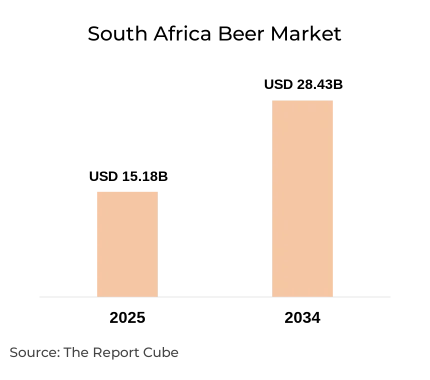
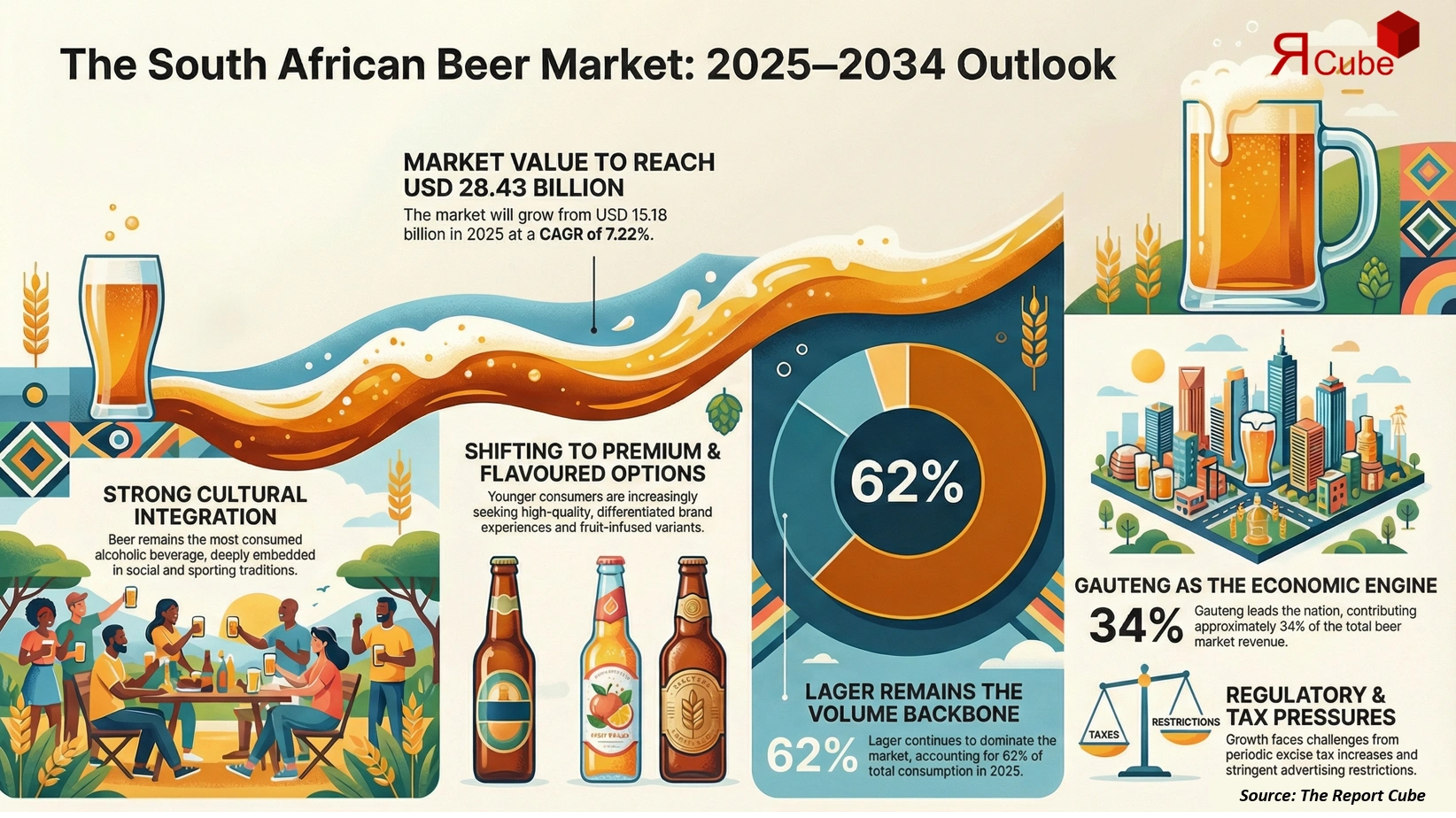
The South Africa Beer Market is anticipated to register a CAGR of 7.22% during 2026-2034. The market size was valued at USD 15.18 billion in 2025 and is projected to reach USD 28.43 billion by 2034. The market demonstrates strong momentum, supported by evolving consumer preferences, rising urbanization, and a growing culture of social drinking across diverse demographics. Beer remains the most consumed alcoholic beverage in South Africa, driven by its affordability, wide availability, and strong cultural acceptance across social occasions.
The market’s expansion is closely linked to premiumization trends and the steady rise of flavored and craft-style beer offerings. Younger consumers are increasingly experimenting with new beer styles, flavors, and packaging formats, moving beyond traditional lagers. This behavioral shift has encouraged brewers to diversify product portfolios and focus on innovation, branding, and experiential marketing. At the same time, established beer brands continue to maintain high volumes through strong distribution networks and price competitiveness.
Furthermore, improvements in retail penetration, growth of modern trade channels, and increased on-trade consumption in urban hubs are reinforcing market growth. Despite economic fluctuations, beer consumption remains resilient due to its deep-rooted presence in social gatherings, sports events, and entertainment culture. Collectively, these factors position the South Africa Beer Market for sustained expansion throughout the forecast period.
South Africa Beer Market Recent Developments
- 2025: South African Breweries launched a new low‑alcohol beer that later received Product Launches honours.
- 2025: Heineken South Africa partnered with Soufflet Malt to build a €100m low‑emission local malting facility.
Government Initiatives & Policies
- National Liquor Policy Review: Focuses on responsible alcohol trade, licensing reform, and market transparency.
- Industrial Policy Action Plan: Supports local beverage manufacturing and supply chain development.
South Africa Beer Market Dynamics
Key Driver: Strong Cultural Acceptance and High Per Capita Consumption
The widespread cultural acceptance of beer consumption is a primary driver of the South Africa Beer Market. Beer is deeply embedded in social traditions, sports viewings, and casual gatherings, making it a preferred alcoholic beverage across income groups. South Africa consistently ranks among the leading beer-consuming nations in Africa, with per capita consumption remaining resilient even during economic slowdowns. The availability of affordable lager variants further strengthens consumption volumes, while premium beers drive value growth. Additionally, expanding urban populations and increased participation in nightlife and entertainment activities continue to support consistent demand across both on-trade and off-trade channels.
Book your FREE 30-minute expert consultation today
Contact UsIndustry Trends: Premiumization and Flavored Beer Innovation
Premiumization is a defining trend reshaping the South Africa Beer Market. Consumers are increasingly willing to pay more for perceived quality, unique flavors, and differentiated brand experiences. Flavored beers, in particular, are gaining traction among younger consumers and first-time drinkers seeking variety beyond traditional beer profiles. Breweries are responding by introducing fruit-infused, low-bitterness, and seasonal variants. Packaging innovation, including cans and sleek bottle designs, further enhances shelf appeal. This trend not only improves margins for producers but also elevates overall market value growth.
Major Challenge: Regulatory Constraints and Excise Tax Pressures
Stringent alcohol regulations and rising excise duties pose a significant challenge to market growth. Restrictions on advertising, trading hours, and alcohol promotion limit brand visibility and marketing flexibility. Additionally, periodic increases in excise taxes directly impact retail pricing, making beer less affordable for price-sensitive consumers. Smaller brewers face heightened pressure as compliance costs and taxation reduce profitability. These regulatory constraints require market players to carefully balance pricing strategies while maintaining volumes and brand loyalty.
Opportunity: Expansion of Craft and Localized Beer Offerings
The growing consumer preference for locally inspired and craft-style beers presents a strong opportunity for the South Africa Beer Market. Craft breweries and premium imports are gaining recognition for authenticity, storytelling, and unique taste profiles. This creates space for regional flavors, limited-edition launches, and experiential tasting events. As consumers seek differentiation and authenticity, breweries that emphasize local sourcing and innovative brewing techniques can capture niche but high-value segments, driving long-term market diversification.
South Africa Beer Market Segment-wise Analysis
By Beer Type:
- Lager
- Ale
- Abbey & Trappist
- Wheat Beer
- Lambic & Sour
- Stout & Porter
- Non/Low-Alcohol Beer
- Others
Lager dominates the South Africa Beer Market, accounting for approximately 62% of total consumption in 2025. Its dominance is driven by mass-market appeal, affordability, and long-standing consumer familiarity. Lager’s light taste profile suits a broad demographic, making it the preferred choice for social and casual consumption. While ales and stouts are growing steadily within niche segments, particularly among urban consumers, lager remains the volume backbone of the market.
By Flavor:
- Unflavored Beer
- Flavored Beer
Unflavored beer continues to lead the market with nearly 70% share, supported by traditional consumption patterns and strong brand loyalty. However, flavored beer is the fastest-growing segment, expanding at a higher CAGR due to rising experimentation and demand for variety. This segment benefits from innovation in fruit flavors and lighter alcohol profiles, appealing especially to younger consumers and new entrants into beer consumption.
Regional Projection of South Africa Beer Industry
- Gauteng
- KwaZulu-Natal
- Western Cape
- Eastern Cape
- Rest of South Africa
Gauteng leads the South Africa Beer Market, contributing approximately 34% of total revenue in 2025. The region benefits from high population density, strong urban infrastructure, and vibrant nightlife culture. Johannesburg and Pretoria host a wide concentration of on-trade outlets, driving higher consumption volumes. Western Cape follows closely, supported by tourism and a growing craft beer scene. While Gauteng remains dominant, KwaZulu-Natal and Eastern Cape are emerging as growth regions due to rising urbanization and retail expansion.
Need insights for a specific region within this market?
Request Regional DataWhy Choose This Report?
- Provides a comprehensive overview of the overall market analysis, encompassing key trends, consumer behavior analysis, and risk assessment to support strategic decision-making.
- Provides accurate, up-to-date insights into market size, segmentation, and emerging opportunities, helping to minimize risk & capitalizing on growth.
- Gives deep understanding of target audience preferences, investment habits, and communication channels for enhanced product development & marketing effectiveness.
- Delivers competitive analysis & benchmarking, uncovering the strengths & weaknesses of market competitors to guide strategies.
- Consolidate comprehensive market intelligence, reducing reasoning & streamlining research efforts.
- Facilitates customized market segmentation & risk mitigation strategies, fine-tuned to the business objectives.
- Aids in identifying both market challenges & untapped opportunities within the industry to drive long-term business growth.
- Provides valuable information based on actual customer data & search trends.
Table of Contents
- Introduction
- Objective of the Study
- Product and Category Definition
- Market Segmentation
- Study Variables
- Research Methodology
- Secondary Data Points
- Breakdown of Secondary Sources
- Primary Data Points
- Breakdown of Primary Interviews
- Secondary Data Points
- Executive Summary
- Market Dynamics
- Drivers
- Challenges
- Opportunity Assessment
- Recent Trends and Developments
- Regulatory and Policy Landscape
- South Africa Beer Market Overview (2020-2034)
- Market Size, By Value (USD Million)
- Market Share, By Beer Type
- Lager
- Ale
- Abbey & Trappist
- Wheat Beer
- Lambic & Sour
- Stout & Porter
- Non/Low-Alcohol Beer
- Others
- Market Share, By Age Group
- 18-25 years
- 25-40 years
- 40-55 years
- 55+ years
- Market Share, By Packaging
- Bottles
- Cans
- Kegs & Draught
- Others
- Market Share, By Alcohol Level
- Low
- Regular
- High
- Market Share, By Flavor
- Unflavored Beer
- Flavored Beer
- Market Share, By Distribution
- On Trade
- Off Trade
- Supermarkets Hypermarkets
- Convenience Stores
- Specialty Stores
- Others
- Market Share, By Gender
- Male
- Female
- Others
- Market Share, By Brewery Type
- International/Macro Breweries
- Regional & Local Breweries
- Craft & Microbreweries
- Market Share, By Region
- Gauteng
- KwaZulu-Natal
- Western Cape
- Eastern Cape
- Rest of South Africa
- Market Share, By Company
- Competition Characteristics
- Revenue Shares & Analysis
- Gauteng Beer Market
- Market Size, By Value (USD Million)
- Market Share, By Beer Type
- Market Share, By Age Group
- Market Share, By Packaging
- Market Share, By Alcohol Level
- Market Share, By Flavor
- Market Share, By Distribution
- Market Share, By Gender
- KwaZulu-Natal Beer Market
- Market Size, By Value (USD Million)
- Market Share, By Beer Type
- Market Share, By Age Group
- Market Share, By Packaging
- Market Share, By Alcohol Level
- Market Share, By Flavor
- Market Share, By Distribution
- Market Share, By Gender
- Western Cape Beer Market
- Market Size, By Value (USD Million)
- Market Share, By Beer Type
- Market Share, By Age Group
- Market Share, By Packaging
- Market Share, By Alcohol Level
- Market Share, By Flavor
- Market Share, By Distribution
- Market Share, By Gender
- Eastern Cape Beer Market
- Market Size, By Value (USD Million)
- Market Share, By Beer Type
- Market Share, By Age Group
- Market Share, By Packaging
- Market Share, By Alcohol Level
- Market Share, By Flavor
- Market Share, By Distribution
- Market Share, By Gender
- Competitive Outlook and Company Profiles
- South African Breweries (SAB)
- Company Overview
- Product Portfolio
- Strategic Alliances Partnerships
- Recent Developments
- Heineken South Africa
- Company Overview
- Product Portfolio
- Strategic Alliances Partnerships
- Recent Developments
- Distell Group
- Company Overview
- Product Portfolio
- Strategic Alliances Partnerships
- Recent Developments
- United National Breweries
- Company Overview
- Product Portfolio
- Strategic Alliances Partnerships
- Recent Developments
- AB InBev Africa
- Company Overview
- Product Portfolio
- Strategic Alliances Partnerships
- Recent Developments
- Devil's Peak Brewing
- Company Overview
- Product Portfolio
- Strategic Alliances Partnerships
- Recent Developments
- Woodstock Brewery
- Company Overview
- Product Portfolio
- Strategic Alliances Partnerships
- Recent Developments
- Darling Brew
- Company Overview
- Product Portfolio
- Strategic Alliances Partnerships
- Recent Developments
- Mitchell's Brewery
- Company Overview
- Product Portfolio
- Strategic Alliances Partnerships
- Recent Developments
- Other Local Breweries
- Company Overview
- Product Portfolio
- Strategic Alliances Partnerships
- Recent Developments
- South African Breweries (SAB)
- Contact Us and Disclaimer
Top Key Players & Market Share Outlook
- South African Breweries (SAB)
- Heineken South Africa
- Distell Group
- United National Breweries
- AB InBev Africa
- Devil's Peak Brewing
- Woodstock Brewery
- Darling Brew
- Mitchell's Brewery
- Other Local Breweries
Frequently Asked Questions






