



Build Your Custom Market Intelligence Report
Customize Your ReportIndia EV Battery Scrap Market Statistics and Insights
Market Size Statistics
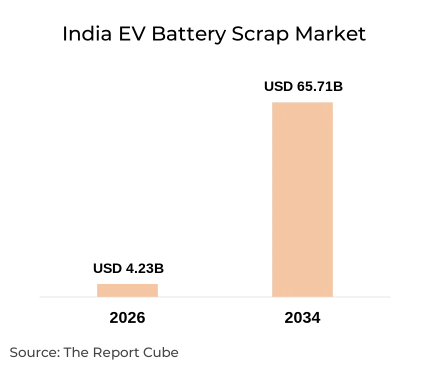
- India EV Battery Scrap Market reached USD 4.23 billion 2026
- Market projected to reach USD 65.71 billion by 2034
- Market expected to grow at CAGR 40.90% during forecast period
By Source of Scrap
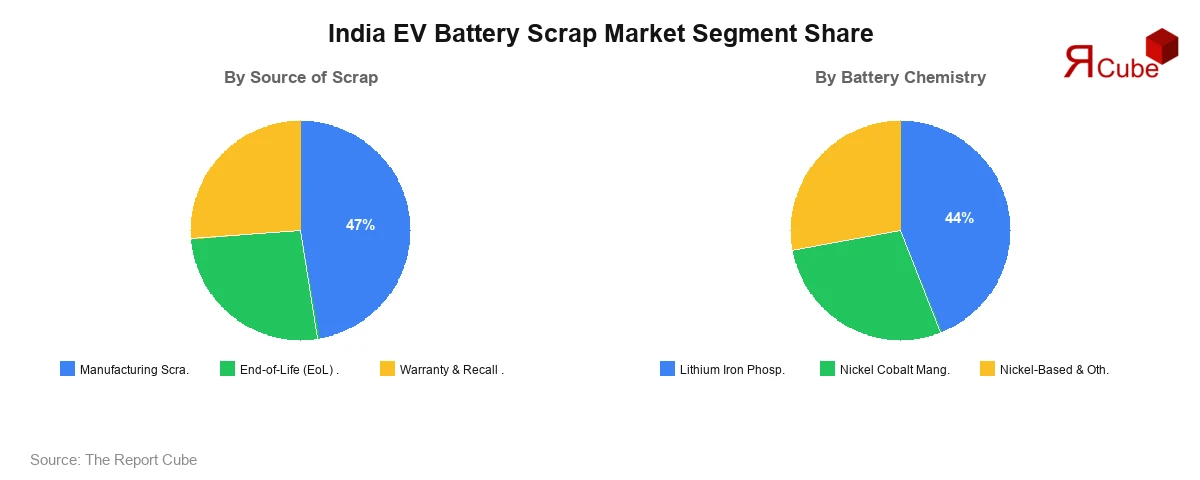
- Manufacturing scrap segment holds dominant 47% share generation
Competitive Landscape
- More than 10 companies are actively engaged in producing India EV Battery Scrap Market
- Top 5 companies acquired around 59% of the market share.
- Lohum Cleantech, Attero Recycling, BatX Energies, RecycleKaro, Exigo Recycling, and others
By Battery Chemistry
- Lithium iron phosphate segment accounts for 44% driven adoption
India EV Battery Scrap Market Insights & Analysis
The India EV Battery Scrap Market is anticipated to register a 40.90% CAGR during 2026-2034. The market size was valued at USD 4.23 billion in 2026 and is projected to reach USD 65.71 billion by 2034. The market is witnessing exponential growth driven by increasing electric vehicle adoption, expanding battery manufacturing capacity, and rising focus on sustainable resource recovery across India. Government initiatives such as the Faster Adoption and Manufacturing of Electric Vehicles scheme and Production Linked Incentive programs are encouraging domestic battery manufacturing and recycling ecosystem development.
Additionally, rising investments in lithium-ion battery gigafactories and growing demand for critical minerals recovery are accelerating market expansion. Increasing environmental concerns regarding battery disposal and stringent waste management regulations are further supporting growth. Technological advancements in hydrometallurgical and direct recycling processes are also improving recovery efficiency and commercial viability across India’s EV battery recycling industry.
India EV Battery Scrap Market Dynamics
Key Market Driver: Rapid Electric Vehicle Adoption and Expanding Battery Manufacturing Capacity
The rapid growth of electric vehicle adoption in India is a major driver of the EV battery scrap market. Increasing production of electric two-wheelers, passenger vehicles, and commercial EVs is generating substantial battery manufacturing scrap and future end-of-life battery volumes. Government incentives supporting domestic EV manufacturing and battery localization are further accelerating market growth. Studies indicate that lithium-ion battery demand in India is expected to rise significantly over the next decade. Additionally, increasing focus on circular economy initiatives and critical mineral recovery is driving investments in advanced battery recycling infrastructure nationwide.
Major Industry Challenge: Limited Recycling Infrastructure and Complex Battery Collection Systems
The India EV battery scrap market faces challenges associated with limited recycling infrastructure and fragmented battery collection networks. Efficient transportation and safe handling of hazardous lithium-ion battery waste require specialized logistics and regulatory compliance systems. Additionally, inadequate awareness regarding battery disposal and recycling practices can hinder organized scrap collection. Variations in battery chemistry and design also create operational complexity for recycling facilities. High capital investment requirements for advanced recycling technologies further impact scalability. Addressing these challenges requires improved collection ecosystems, policy support, and investments in standardized recycling infrastructure across India.
Emerging Trend Shaping Outlook: Adoption of Advanced Hydrometallurgical and Direct Recycling Technologies
The increasing adoption of advanced recycling technologies is transforming the India EV battery scrap market. Hydrometallurgical and direct recycling processes are improving recovery rates for critical materials such as lithium, cobalt, nickel, and manganese while reducing environmental impact. AI-powered battery diagnostics and automated sorting technologies are enhancing recycling efficiency and operational scalability. Additionally, second-life battery applications for energy storage systems are gaining traction, supporting resource optimization. Battery manufacturers and recycling companies are increasingly forming strategic partnerships to establish integrated circular economy models. These technological advancements are expected to significantly support long-term market development across India.

Need Specific Data, Let’s Customize the Report for You
Request CustomizationIndia EV Battery Scrap Market Segment-wise Analysis
By Source of Scrap
- Manufacturing Scrap
- End-of-Life (EoL) Batteries
- Warranty & Recall Scrap
The manufacturing scrap segment dominates the India EV Battery Scrap Market, accounting for approximately 47% of total revenue share. This dominance is driven by increasing domestic battery manufacturing activities and rising production inefficiencies during cell fabrication and assembly processes. Manufacturing scrap provides high-quality recoverable materials with lower contamination levels, making recycling economically attractive. End-of-life batteries are also witnessing rapid growth due to increasing EV adoption and expected battery replacement cycles over the coming years. Warranty and recall scrap contribute steadily to the market with rising quality control and battery safety management practices among manufacturers.
By Battery Chemistry
- Lithium Iron Phosphate (LFP)
- Nickel Cobalt Manganese (NCM/NMC)
- Nickel-Based & Others
The lithium iron phosphate segment leads the market with an estimated 44% share, driven by increasing adoption of LFP batteries in electric two-wheelers, buses, and energy storage systems across India. LFP batteries offer enhanced thermal stability, lower costs, and longer operational life, supporting widespread deployment. NCM and NMC batteries also contribute significantly due to their higher energy density and extensive use in passenger electric vehicles. Nickel-based and other battery chemistries continue to support niche industrial applications. Continuous advancements in battery technology and recycling capabilities are driving growth across all chemistry segments.
Regional Projection of India EV Battery Scrap Market
- North India
- South India
- East India
- West India
South India leads the market, accounting for approximately 38% share due to the concentration of EV manufacturing facilities, battery assembly plants, and recycling startups in states such as Tamil Nadu, Karnataka, and Telangana. The region benefits from strong industrial infrastructure, government EV policies, and increasing investments in battery recycling technologies. West India also contributes significantly, supported by expanding electric mobility ecosystems and industrial manufacturing activities. North and East India are gradually witnessing growth with rising EV adoption and increasing focus on sustainable waste management initiatives.
India EV Battery Scrap Market: Recent Develpoment (2025)
- Lohum Cleantech expanded lithium ion battery recycling infrastructure enhancing critical mineral recovery capabilities across India significantly
- Attero Recycling introduced advanced hydrometallurgical technologies improving battery material extraction efficiency and sustainability performance nationwide
- BatX Energies strengthened automated battery dismantling systems supporting scalable electric vehicle battery recycling operations across India
- RecycleKaro expanded strategic battery collection partnerships enhancing organized EV battery scrap management and recycling accessibility nationwide
India EV Battery Scrap Market Future Outlook (2034)
The India EV Battery Scrap Market is expected to grow at a CAGR of 40.90%, reaching USD 65.71 billion by 2034. Growth will be driven by increasing EV adoption, expansion of domestic battery manufacturing, and rising demand for critical mineral recovery solutions. AI-powered battery diagnostics and advanced recycling technologies will improve operational efficiency and material recovery rates. The expansion of circular economy initiatives and second-life battery applications will further support market growth. Additionally, government incentives supporting battery recycling infrastructure and sustainable mobility initiatives will contribute significantly to long-term market expansion across India.
India EV Battery Scrap Market Report Coverage
|
Report Features |
Details |
|---|---|
|
Market Size (Value, 2026) |
USD 4.23 Billion |
|
Market Size (Value, 2034) |
USD 65.71 Billion |
|
Forecast Period |
2026-2034 |
|
CAGR |
40.90% |
|
Base Year |
2026 |
|
Historical Data |
2021-2025 |
|
Customization |
Available |
|
Segments Covered |
By Source of Scrap; By Battery Chemistry; By Recycling Process; By End-Use Application, By End-Use Application |
|
Regions Covered |
North India, South India, East India, West India |
|
Key Companies |
Lohum Cleantech, Attero Recycling, BatX Energies, RecycleKaro, Exigo Recycling |
|
Report Format |
PPT, PDF & Excel |
Why Choose This Report?
- Regulatory mapping built in: Every segment analysis is cross-referenced against India's Battery Waste Management Rules, 2022 EPR compliance timelines so you know how policy shifts affect volume and pricing, not just background context.
- Chemistry-level economics: Recovered material value is broken down by chemistry (LFP vs. NCM) with commodity price sensitivity enabling investment decisions based on per-tonne margins, not aggregate market size.
- Second-life market layer included: The report quantifies the second-life battery deployment opportunity as a distinct intermediate market a revenue stream that pure scrap reports omit.
- Informal sector sizing: The 70% informal sector share is quantified by region and scrap source, giving formal players a data-backed view of addressable volume currently outside their reach.
- Critical mineral recovery modelling: Lithium, cobalt, and nickel recovery volumes are projected through 2034 against India's import dependency baseline connecting recycling economics to strategic mineral policy.
- Regional collection infrastructure gap analysis: Each region is assessed on formal processing capacity versus projected scrap inflow, identifying where first-mover collection networks carry the highest commercial return.
- Competitive landscape with EPR partnership mapping: Key players are profiled on processing technology, OEM take-back agreements, and EPR certifications the three factors that determine feedstock access in India's compliance-driven market.
Table of Contents
- Introduction
- Objective of the study
- Product Definition
- Market Segmentation
- Study Variables
- Research Methodology
- Secondary Data Points
- Companies Interviewed
- Primary Data Points
- Breakdown of Primary Interviews
- Secondary Data Points
- Executive Summary
- Market Dynamics
- Drivers
- Challenges
- Opportunity Assessment
- Recent Trends and Developments
- Policy and Regulatory Landscape
- India EV battery Scrap Market Overview (2021-2034)
- Market Size, By Value, By growth rate (CAGR/USD Billions)
- Demand - Supply Trends
- Market Share, By Source of Scrap
- Manufacturing Scrap
- End-of-Life (EoL) Batteries
- Warranty & Recall Scrap
- Market Share, By Battery Chemistry
- Lithium Iron Phosphate (LFP)
- Nickel Cobalt Manganese (NCM/NMC)
- Nickel-Based & Others
- Market Share, By Recycling Process
- Hydrometallurgical
- Pyrometallurgical
- Direct/Physical Recycling
- Market Share, By End-Use Application
- Battery-to-Battery
- Second-Life Applications
- Industrial Chemicals
- Market Share, By Vehicle Type
- Passenger Electric Vehicles
- Commercial Vehicles
- 2 & 3 Wheelers
- Market Share, By Region
- North India
- South India
- East India
- West India
- Market Share, By Competitors
- Competition Characteristics
- Revenue Shares
- India Manufacturing Scrap EV battery Scrap Market Overview, 2021-2034F
- By Value (USD Million)
- By Battery Chemistry- Market Size & Forecast 2021-2034, USD Million
- By Recycling Process- Market Size & Forecast 2021-2034, USD Million
- By End-Use Application- Market Size & Forecast 2021-2034, USD Million
- By Vehicle Type- Market Size & Forecast 2021-2034, USD Million
- India End-of-Life (EoL) Batteries EV battery Scrap Market Overview, 2021-2034F
- By Value (USD Million)
- By Battery Chemistry- Market Size & Forecast 2021-2034, USD Million
- By Recycling Process- Market Size & Forecast 2021-2034, USD Million
- By End-Use Application- Market Size & Forecast 2021-2034, USD Million
- By Vehicle Type- Market Size & Forecast 2021-2034, USD Million
- India Warranty & Recall Scrap EV battery Scrap Market Overview, 2021-2034F
- By Value (USD Million)
- By Battery Chemistry- Market Size & Forecast 2021-2034, USD Million
- By Recycling Process- Market Size & Forecast 2021-2034, USD Million
- By End-Use Application- Market Size & Forecast 2021-2034, USD Million
- By Vehicle Type- Market Size & Forecast 2021-2034, USD Million
- Competitive Outlook (Company Profile - Partial List)
- Lohum Cleantech
- Company Overview
- Business Segments
- Strategic Alliances/Partnerships
- Recent Developments
- Attero Recycling
- Company Overview
- Business Segments
- Strategic Alliances/Partnerships
- Recent Developments
- BatX Energies
- Company Overview
- Business Segments
- Strategic Alliances/Partnerships
- Recent Developments
- RecycleKaro
- Company Overview
- Business Segments
- Strategic Alliances/Partnerships
- Recent Developments
- Exigo Recycling
- Company Overview
- Business Segments
- Strategic Alliances/Partnerships
- Recent Developments
- Others
- Lohum Cleantech
- Contact Us & Disclaimer
Top Key Players & Market Share Outlook
- Lohum Cleantech
- Attero Recycling
- BatX Energies
- RecycleKaro
- Exigo Recycling
- Others
Frequently Asked Questions






