




Build Your Custom Market Intelligence Report
Customize Your ReportIndia Battery Energy Storage System (BESS) Market Insights & Analysis
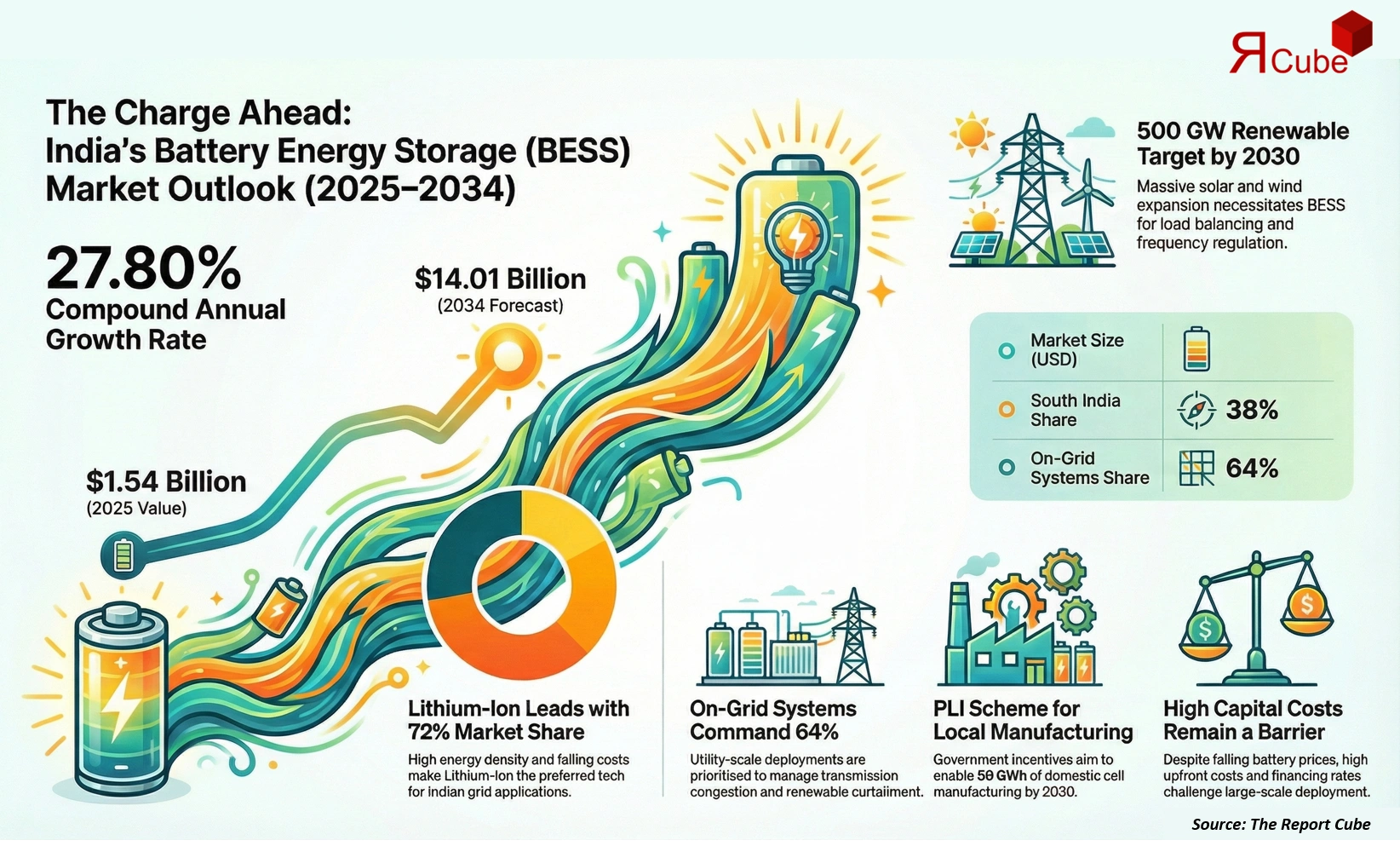
The India Battery Energy Storage System (BESS) Market is anticipated to register a CAGR of 27.80% during 2026-2034. The market size was valued at USD 1.54 billion in 2025 and is projected to reach USD 14.01 billion by 2034. This exponential growth trajectory highlights India’s accelerating transition toward renewable energy integration, grid modernization, and power reliability enhancement. Battery energy storage systems are emerging as a critical backbone for balancing intermittent renewable generation, improving grid stability, and supporting peak load management across the country. With ambitious renewable capacity targets exceeding 500 GW by 2030, energy storage has shifted from a supporting technology to a strategic necessity within India’s power ecosystem.
Beyond renewable integration, the market expansion is being reinforced by rapid electrification, urbanization, and rising electricity demand across industrial, commercial, and residential sectors. Grid-scale battery storage projects are increasingly deployed to address transmission congestion, frequency regulation, and load shifting challenges. Simultaneously, distributed storage solutions are gaining adoption for microgrids, data centers, and industrial facilities seeking uninterrupted power supply. Leading players and other domestic manufacturers are actively scaling manufacturing capacity, EPC capabilities, and project pipelines to capitalize on this fast-evolving opportunity landscape.
India Battery Energy Storage System (BESS) Market Recent Developments
- 2025: Tata Power Renewable Energy commissioned utility-scale battery storage projects supporting solar and wind integration.
- 2025: Reliance New Energy advanced giga-scale battery manufacturing investments under India’s localization initiatives.
Government Initiatives & Policies
- National Energy Storage Mission (NESM): Government framework promoting large-scale energy storage adoption and domestic manufacturing.
- PLI Scheme for Advanced Chemistry Cells: Incentive program supporting local battery manufacturing capacity expansion.
India Battery Energy Storage System (BESS) Market Dynamics
Key Driver: Renewable Energy Integration and Grid Stability
The primary growth driver for the India BESS market is the rapid expansion of renewable energy capacity and the corresponding need for grid stability. Solar and wind power generation in India exceeded 180 GW in 2024, creating significant intermittency challenges during peak and off-peak periods. Battery storage systems enable effective load balancing, frequency regulation, and peak shaving, making renewables dispatchable and reliable. Utilities increasingly rely on grid-scale storage to defer transmission upgrades and reduce curtailment losses, which currently account for an estimated 3-;5% of renewable output in high-penetration states. As renewable penetration rises, demand for lithium-ion battery storage, grid battery systems, and utility-scale storage projects continues to accelerate.
Major Challenge: High Capital Costs and Financing Constraints
Despite strong policy backing, high upfront capital costs remain a significant challenge for large-scale deployment of battery energy storage systems in India. Lithium-ion battery prices have declined by nearly 85% over the past decade, yet storage projects still face cost sensitivity due to financing rates and long payback periods. Limited long-term revenue certainty from ancillary services markets and evolving tariff structures further constrain investment decisions. Smaller developers often struggle to secure competitive financing, slowing project execution. Addressing these challenges will require innovative financing models, long-term offtake agreements, and clearer regulatory frameworks supporting storage monetization.
Industry Trends: Shift Toward Grid-Scale and Hybrid Projects
A notable industry trend is the rapid shift toward grid-scale battery installations and hybrid renewable-plus-storage projects. Solar-plus-storage and wind-plus-storage configurations are increasingly favored in competitive tenders, improving dispatchability and round-the-clock power supply. Several state utilities have begun issuing standalone storage tenders exceeding 500 MWh capacity, signaling a structural shift in procurement strategies. Flow batteries and advanced battery technologies are also gaining pilot-scale traction for long-duration storage applications beyond four hours, supporting seasonal energy balancing and industrial demand cycles.
Opportunity Ahead: Domestic Manufacturing and Export Potential
India’s push for domestic battery manufacturing presents a substantial long-term opportunity for the BESS market. The PLI scheme is expected to enable over 50 GWh of advanced cell manufacturing capacity by 2030, reducing import dependency and improving cost competitiveness. As local supply chains mature, India could emerge as a regional export hub for battery systems and energy storage solutions, particularly across South Asia and the Middle East.
India Battery Energy Storage System (BESS) Market Segment-wise Analysis
By Battery Type:
- Lithium-Ion Batteries
- Lead-Acid Batteries
- Flow Batteries
- Advanced Batteries
Lithium-ion batteries dominate the Indian BESS market, accounting for approximately 72% of total installed capacity in 2025. Their high energy density, falling costs, and proven performance across grid and behind-the-meter applications make them the preferred choice. Flow batteries and advanced chemistries are emerging for long-duration use cases, while lead-acid batteries maintain limited presence in backup and small-scale systems.
By Connection Type:
- On-Grid Systems
- Off-Grid Systems
On-grid systems represent nearly 64% of total market demand, driven by utility-scale deployments and grid modernization projects. These systems support peak load management, renewable integration, and ancillary services. Off-grid systems are expanding steadily in remote and islanded regions, industrial microgrids, and telecom infrastructure, where reliability and energy independence are critical.
Regional Projection of India Battery Energy Storage System (BESS) Industry
- North India
- South India
- East India
- West India
South India leads the national BESS market with an estimated 38% share in 2025, supported by high renewable penetration, progressive state policies, and early adoption of hybrid energy projects. States such as Karnataka and Tamil Nadu have emerged as hubs for solar-plus-storage deployments. West India follows closely due to industrial demand and grid congestion challenges, while North and East India show accelerating adoption driven by transmission upgrades and rural electrification initiatives.
Why Choose This Report?
- Provides a comprehensive overview of the overall market analysis, encompassing key trends, consumer behavior analysis, and risk assessment to support strategic decision-making.
- Provides accurate, up-to-date insights into market size, segmentation, and emerging opportunities, helping to minimize risk & capitalizing on growth.
- Gives deep understanding of target audience preferences, investment habits, and communication channels for enhanced product development & marketing effectiveness.
- Delivers competitive analysis & benchmarking, uncovering the strengths & weaknesses of market competitors to guide strategies.
- Consolidate comprehensive market intelligence, reducing reasoning & streamlining research efforts.
- Facilitates customized market segmentation & risk mitigation strategies, fine-tuned to the business objectives.
- Aids in identifying both market challenges & untapped opportunities within the industry to drive long-term business growth.
- Provides valuable information based on actual customer data & search trends.
Table of Contents
- Introduction
- Objective of the Study
- Product and Category Definition
- Market Segmentation
- Study Variables
- Research Methodology
- Secondary Data Points
- Breakdown of Secondary Sources
- Primary Data Points
- Breakdown of Primary Interviews
- Secondary Data Points
- Executive Summary
- Market Dynamics
- Drivers
- Challenges
- Opportunity Assessment
- Recent Trends and Developments
- Regulatory and Policy Landscape
- India Battery Energy Storage System (BESS) Market Overview (2021-2034)
- Market Size, By Value (USD Million)
- Market Share, By Battery Type
- Lithium-Ion Batteries
- Lead-Acid Batteries
- Flow Batteries
- Advanced Batteries
- Market Share, By Connection Type
- On-Grid Systems
- Off-Grid Systems
- Market Share, By Ownership
- Utility-Owned Systems
- Third-Party Owned
- Customer-Owned Systems
- Market Share, By Energy Capacity
- Below 1 MWh
- 1-50 MWh
- Above 50 MWh
- Market Share, By Application
- Residential
- Commercial
- Industrial
- Utility-Scale
- Microgrid Applications
- Market Share, By Region
- North India
- South India
- East India
- West India
- Market Share, By Company
- Revenue Shares
- Competition Characteristics
- Revenue Shares & Analysis
- North India BESS Market
- Market Size, By Value (USD Million)
- Market Share, By Battery Type
- Market Share, By Connection Type
- Market Share, By Ownership
- Market Share, By Application
- Market Share, By State
- Delhi NCR
- Uttar Pradesh
- Haryana
- Rajasthan
- Punjab
- Other North India
- South India BESS Market
- Market Size, By Value (USD Million)
- Market Share, By Battery Type
- Market Share, By Connection Type
- Market Share, By Ownership
- Market Share, By Application
- Market Share, By State
- Tamil Nadu
- Karnataka
- Andhra Pradesh
- Telangana
- Kerala
- Other South India
- West India BESS Market
- Market Size, By Value (USD Million)
- Market Share, By Battery Type
- Market Share, By Connection Type
- Market Share, By Ownership
- Market Share, By Application
- Market Share, By State
- Maharashtra
- Gujarat
- Rajasthan (Western)
- Goa
- Other West India
- East India BESS Market
- Market Size, By Value (USD Million)
- Market Share, By Battery Type
- Market Share, By Connection Type
- Market Share, By Ownership
- Market Share, By Application
- Market Share, By State
- West Bengal
- Odisha
- Bihar
- Jharkhand
- Other East India
- Competitive Outlook and Company Profiles
- Tata Power Renewable Energy
- Company Overview
- Project Portfolio
- Strategic Alliances / Partnerships
- Recent Developments
- Fluence Energy (AES-Siemens)
- Company Overview
- Project Portfolio
- Strategic Alliances / Partnerships
- Recent Developments
- Reliance New Energy
- Company Overview
- Project Portfolio
- Strategic Alliances / Partnerships
- Recent Developments
- JSW Energy (JSW Neo)
- Company Overview
- Project Portfolio
- Strategic Alliances / Partnerships
- Recent Developments
- Adani Energy Solutions
- Company Overview
- Project Portfolio
- Strategic Alliances / Partnerships
- Recent Developments
- Exide Energy Solutions
- Company Overview
- Product Portfolio
- Strategic Alliances / Partnerships
- Recent Developments
- Amara Raja Energy Mobility
- Company Overview
- Product Portfolio
- Strategic Alliances / Partnerships
- Recent Developments
- Delta Electronics India
- Company Overview
- System Portfolio
- Strategic Alliances / Partnerships
- Recent Developments
- Hitachi Energy India
- Company Overview
- System Portfolio
- Strategic Alliances / Partnerships
- Recent Developments
- Siemens Energy India
- Company Overview
- System Portfolio
- Strategic Alliances / Partnerships
- Recent Developments
- Others
- Tata Power Renewable Energy
- Contact Us and Disclaimer
Top Key Players & Market Share Outlook
- Tata Power Renewable Energy
- Fluence Energy (AES-Siemens)
- Reliance New Energy
- JSW Energy (JSW Neo)
- Adani Energy Solutions
- Exide Energy Solutions
- Amara Raja Energy Mobility
- Delta Electronics India
- Hitachi Energy India
- Siemens Energy India
- Others
Frequently Asked Questions






