



Build Your Custom Market Intelligence Report
Customize Your ReportIndia Agricultural Biotechnology Market Insights & Analysis
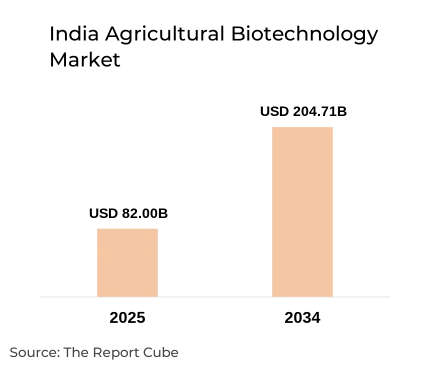
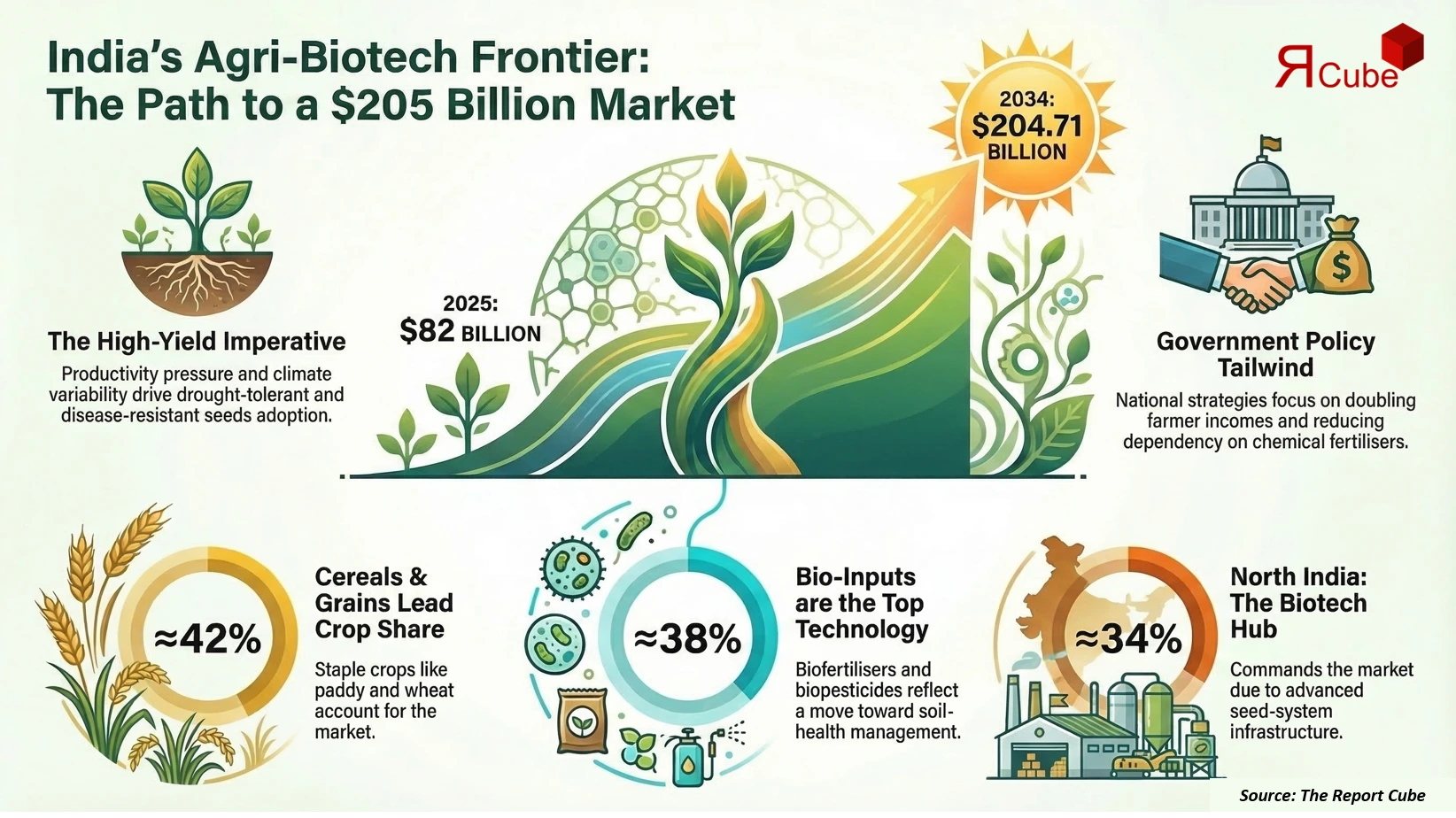
The India Agricultural Biotechnology Market is projected to grow at a 10.70% CAGR during 2026-2034. The market stood at USD 82 billion in 2025 and is expected to reach USD 204.71 billion by 2034. Rapid adoption of advanced seed technologies, expanding use of marker-assisted breeding, and scaling of biofertilizer and biopesticide applications are major growth drivers. India’s large agrarian base and government emphasis on doubling farmer incomes, improving crop yields, and reducing chemical fertilizer dependency provide a supportive policy backdrop. Private and public R&D investments are accelerating commercialization of tissue-culture planting materials, GM traits in select crops, and integrated pest management solutions. The blend of domestic seed champions, agri-input conglomerates, and biotech-focused startups is creating a diverse ecosystem that spans trait development, contract seed production, formulation of biological inputs, and digital agri-services. These factors collectively underpin rapid market expansion as technology penetration deepens across major cropping zones.
Additionally, rising farmer acceptance of precision and biotech-enabled agronomy supported by extension services, demonstration plots, and contract farming models improves technology uptake. Cost savings from reduced chemical inputs, higher harvest quality, and improved post-harvest attributes encourage adoption of bio-based solutions. Export demand for higher-quality commodities and the need for resilient varieties in the face of climate variability are prompting faster deployment of marker-assisted breeding and tissue-culture programs. Partnerships between Indian seed houses and global biotech firms also accelerate technology transfer and regulatory navigation. Together, these dynamics position India to capture substantial value throughout the agriculture biotechnology value chain, from upstream R&D to downstream distribution and farmer advisory services.
India Agricultural Biotechnology Market Recent Developments
- 2025: Several domestic seed companies expanded marker-assisted breeding pipelines for drought and disease-resistant maize and rice hybrids, shortening variety release cycles.
- 2025: Scale-up of biofertilizer production capacity occurred across multiple states to support national soil-health and reduced-chemical input goals.
Government Initiatives & Policies
- National Biotechnology Development Strategies: Programs to incentivize biotech R&D, public-private partnerships, and capacity building in agribiotech research institutions and state seed corporations.
- Soil Health and Organic-Input Promotion Schemes: Policy drives promoting biofertilizers and biopesticides, combined with subsidy and extension support to accelerate on-farm adoption and reduce chemical fertilizer dependence.
India Agricultural Biotechnology Market Dynamics
Driver: High Yield Imperative, Climate Resilience & Need for Sustainable Input Alternatives
India’s agriculture sector is under pressure to raise productivity while coping with climate variability, pest pressures, and soil degradation. Agricultural biotechnology offers tangible yield gains via improved hybrids, disease-resistant varieties, and bio-based soil enhancers while reducing dependency on synthetic inputs. Marker-assisted breeding accelerates the release of region-adapted varieties with traits like drought tolerance and disease resistance, which directly address yield volatility. Biofertilizers and biopesticides provide sustainable input alternatives that can lower cost-of-cultivation and improve soil microbiome health. Public schemes emphasizing soil-health management, along with a growing private extension network, help translate these technologies into on-farm gains, supporting broad-based adoption and market expansion at scale.
Challenge: Regulatory Complexity, Public Perception & Seed-System Fragmentation
Despite strong technical progress, the sector faces regulatory complexity for genetically modified crops, lengthy variety release and biosafety clearances, and fragmented seed-distribution networks that complicate timely farmer access. Public concerns and political sensitivity around GM technologies require careful stakeholder engagement and transparent data on safety and benefits. Smallholder-dominated landscapes and reliance on informal seed systems amplify the challenge of delivering certified, biotech-enhanced seed to remote farmers. Additionally, variability in state-level agricultural extension capacity and inconsistent quality control for microbial bio-inputs hinder consistent outcomes. Addressing these structural and perception issues is essential to unlock full market potential.
Opportunity: Scale-up of Biofertilizers, Contract Seed Production & Precision Breeding
Large opportunity exists in scaling commercial biofertilizer and bio-pesticide manufacturing to meet national soil-health targets and in institutionalizing contract seed-production models that ensure consistent seed quality and availability. Precision breeding tools marker-assisted selection, genomic selection, and rapid tissue-culture multiplication enable faster deployment of farmer-preferred traits. Agrochemical firms and seed houses can diversify into biologicals, leveraging existing distribution networks to cross-sell integrated packages. Digital advisory services and farm-level demonstration models can accelerate farmer confidence and facilitate premium pricing for quality seeds and biologics. These integrated business models present substantial revenue and impact potential across major cropping systems.
Trend: Convergence of Biotech, Digital Agronomy & Value-Chain Partnerships
A notable trend is the convergence of biotechnology with digital agronomy platforms that deliver tailored crop-management recommendations and link farmers to certified input supplies. Data-driven phenotype selection, remote-sensing-assisted trialing, and digital marketplaces for seed and biological inputs speed commercialization cycles and optimize adoption patterns. Public-private platforms for varietal testing and seed multiplication, together with contract-farming arrangements for cash crops, bolster supply reliability. Collaboration across multinational trait developers, Indian seed firms, and state extension agencies accelerates technology transfer and localization. This systems-level integration strengthens both economic return and resilience for smallholder farmers while scaling the biotech market across diverse Indian geographies.
India Agricultural Biotechnology Market Segment-wise Analysis
By Technology Type:
- Genetically Modified (GM) Crops
- Marker-Assisted Breeding
- Tissue Culture & Micropropagation
- Biofertilizers & Biopesticides
- Others
Biofertilizers & Biopesticides represent the largest technology-type segment with an estimated around 38% share, reflecting rapid policy support and scaling manufacturing capacity. These biologically based inputs address soil-health priorities, reduce chemical fertilizer dependency, and provide cost-efficient pest management options for smallholder farmers. Government subsidies, procurement programs for organic inputs, and private investment in microbial fermentation facilities have improved supply stability in recent years. Additionally, bio-inputs are readily integrated into existing farmer practices and are often perceived as lower-risk alternatives to synthetic chemicals. As regulatory quality controls and formulations improve, demand for biological inputs is expected to accelerate across major cropping systems including cereals, oilseeds, and vegetables.
By Crop Type:
- Cereals & Grains
- Oilseeds & Pulses
- Fruits & Vegetables
- Cash Crops (Cotton, Sugarcane, etc.)
- Others
Cereals & Grains hold the dominant crop-type share at about 42%, driven by the large acreage under paddy and wheat and the strategic importance of improving yields and input efficiency in staple production. Biotechnology interventions ranging from marker-assisted drought-tolerant lines to biofertilizer-led nitrogen optimization deliver measurable yield and input-cost benefits in cereal systems. Public and private breeding programs prioritize cereals for food-security reasons, accelerating adoption of improved seed varieties and agronomic packages. As climate pressures rise, cereals will remain a priority for biotech deployment, with significant downstream demand for quality seed, micronutrient-fortified varieties, and complementary biological inputs.
Regional Projection of India Agricultural Biotechnology Industry
By Region:
- North India
- West India
- South India
- East & North-East India
- Others
North India leads the market with an estimated approximately 34% share, supported by extensive cereal cultivation zones, advanced state-level seed systems, and a concentration of agribiotech research institutions and seed enterprises. Punjab, Haryana, and western Uttar Pradesh host high-input, mechanized farming systems where adoption of improved seeds, precision agronomy, and biological inputs is comparatively faster. Well-developed procurement channels, extension services, and local processing infrastructure also facilitate rapid commercialization of biotech solutions. Given its strategic role in national food security and high cropping intensity, North India will continue to anchor demand for seed technologies, biologicals, and tissue-culture planting material across the forecast period.
What Does Our India Agricultural Biotechnology Market Research Study Entail?
- Provides comprehensive market sizing and forecasting from 2026-2034, showing growth from USD 82 billion in 2025 to USD 204.71 billion by 2034 at a 10.70% CAGR, including scenario analysis by technology adoption rates and policy pathways.
- Delivers detailed segmentation across Technology Types and Crop Types with sub-segment share estimates and growth drivers to identify high-impact opportunities such as bio-input scale-up and tissue-culture expansion.
- Offers regional insights covering North, West, South, and East & North-East India to highlight adoption clusters, seed-system capacity, and distribution bottlenecks.
- Presents competitive profiling of leading players including Mahyco, Nuziveedu Seeds, Kaveri Seed, Rasi Seeds, Biostadt, IFFCO, NFL, GSFC, AgriLife, IPL Biologicals, Kan Biosys and others, with strategic considerations for partnerships and manufacturing scale-up.
- Reviews regulatory frameworks, biosafety pathways, commercialization roadmaps, digital agronomy integration, and actionable go-to-market recommendations for input manufacturers, seed companies, and agri-tech investors.
Table of Contents
- Introduction
- Objective of the Study
- Product/Technology Definition
- Market Segmentation
- Study Variables
- Research Methodology
- Secondary Data Points
- Breakdown of Secondary Sources
- Primary Data Points
- Breakdown of Primary Interviews
- Secondary Data Points
- Executive Summary
- Market Dynamics
- Drivers
- Challenges
- Opportunity Assessment
- Recent Trends and Developments
- Policy and Regulatory Landscape
- India Agricultural Biotechnology Market Overview (2020–2034)
- Market Size, By Volume (Hectares / Metric Tons) & Value (USD Million)
- Market Share, By Technology Type
- Genetically Modified (GM) Crops
- Marker-Assisted Breeding
- Tissue Culture & Micropropagation
- Biofertilizers & Biopesticides
- Others
- Market Share, By Crop Type
- Cereals & Grains
- Oilseeds & Pulses
- Fruits & Vegetables
- Cash Crops (Cotton, Sugarcane, etc.)
- Others
- Market Share, By Application
- Yield Enhancement
- Pest & Disease Resistance
- Drought & Stress Tolerance
- Nutritional Enhancement
- Others
- Market Share, By Region
- North India
- West India
- South India
- East & North-East India
- Market Share, By Company
- Revenue Shares
- Competitive Landscape
- Segment-wise & Industry-wise Market Forecast (2026–2034)
- By Technology Type
- By Crop Type
- By Application
- By Region
- Regional Analysis (2020–2034)
- North India Agricultural Biotechnology Market
- Market Size, By Volume & Value (USD Million)
- Market Share, By Technology Type
- Market Share, By Crop Type
- Market Share, By Key States
- West India Agricultural Biotechnology Market
- Market Size, By Volume & Value (USD Million)
- Market Share, By Technology Type
- Market Share, By Crop Type
- Market Share, By Key States
- South India Agricultural Biotechnology Market
- Market Size, By Volume & Value (USD Million)
- Market Share, By Technology Type
- Market Share, By Crop Type
- Market Share, By Key States
- East & North-East India Agricultural Biotechnology Market
- Market Size, By Volume & Value (USD Million)
- Market Share, By Technology Type
- Market Share, By Crop Type
- Market Share, By Key States
- Competitive Outlook & Company Profiles
- Mahyco (Maharashtra Hybrid Seeds Company Ltd.)
- Company Overview
- Business Segments
- Strategic Alliances/Partnerships
- Recent Developments
- Nuziveedu Seeds Ltd.
- Company Overview
- Business Segments
- Strategic Alliances/Partnerships
- Recent Developments
- Kaveri Seed Company Ltd.
- Company Overview
- Business Segments
- Strategic Alliances/Partnerships
- Recent Developments
- Rasi Seeds Pvt. Ltd.
- Company Overview
- Business Segments
- Strategic Alliances/Partnerships
- Recent Developments
- Biostadt India Limited
- Company Overview
- Business Segments
- Strategic Alliances/Partnerships
- Recent Developments
- Indian Farmers Fertiliser Cooperative Limited (IFFCO)
- Company Overview
- Business Segments
- Strategic Alliances/Partnerships
- Recent Developments
- National Fertilizers Limited (NFL)
- Company Overview
- Business Segments
- Strategic Alliances/Partnerships
- Recent Developments
- Gujarat State Fertilizers & Chemicals Ltd. (GSFC)
- Company Overview
- Business Segments
- Strategic Alliances/Partnerships
- Recent Developments
- AgriLife (SOM Phytopharma (India) Limited)
- Company Overview
- Business Segments
- Strategic Alliances/Partnerships
- Recent Developments
- IPL Biologicals Limited
- Company Overview
- Business Segments
- Strategic Alliances/Partnerships
- Recent Developments
- T. Stanes and Company Limited
- Company Overview
- Business Segments
- Strategic Alliances/Partnerships
- Recent Developments
- Kan Biosys
- Company Overview
- Business Segments
- Strategic Alliances/Partnerships
- Recent Developments
- Others
- Mahyco (Maharashtra Hybrid Seeds Company Ltd.)
- Contact Us / Disclaimer
Top Key Players & Market Share Outlook
- Mahyco
- Nuziveedu Seeds Ltd.
- Kaveri Seed Company Ltd.
- Rasi Seeds Pvt. Ltd.
- Biostadt India Limited
- Indian Farmers Fertiliser Cooperative Limited
- National Fertilizers Limited
- Gujarat State Fertilizers & Chemicals Ltd.
- AgriLife
- IPL Biologicals Limited
- T. Stanes and Company Limited
- Kan Biosys
- Others
Frequently Asked Questions






