




Build Your Custom Market Intelligence Report
Customize Your ReportUnited States (US) Eye Care Market Insights & Analysis
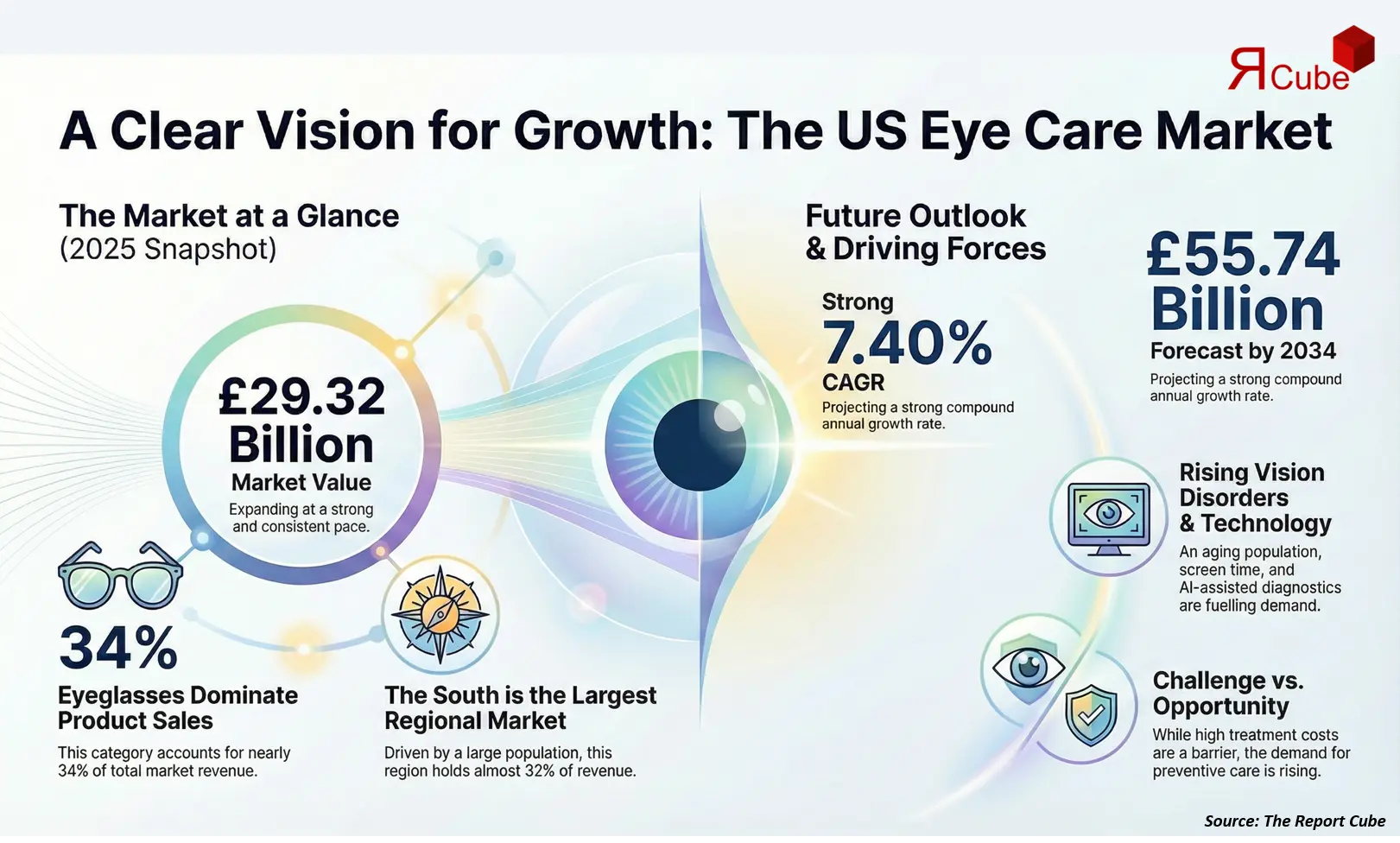
The United States (US) Eye Care Market is anticipated to register a CAGR of 7.40% during 2026-2034. The market size was valued at USD 29.32 billion in 2025 and is projected to reach USD 55.74 billion by 2034. The market is expanding at a strong pace, supported by rising vision impairment cases, increasing screen exposure, and a growing aging population. Nearly 45% of U.S. adults experience some form of vision-related issue, which continues to drive consistent demand for eye care products and services.
This growth is further reinforced by advancements in diagnostic technologies and wider adoption of premium vision correction solutions. Consumers are increasingly seeking early diagnosis, preventive eye care, and advanced treatments for chronic eye conditions such as glaucoma, cataracts, and macular degeneration. Additionally, strong insurance coverage for eye exams and corrective procedures across employer-sponsored plans enhances affordability and access, sustaining market momentum. Moreover, the integration of digital eye exams, tele-optometry, and AI-assisted diagnostics is reshaping care delivery models. These innovations improve patient convenience and clinical accuracy while reducing long-term treatment costs. As consumer awareness of eye health deepens, the US Eye Care Market is expected to maintain steady and diversified growth through 2034.
US Eye Care Market Recent Developments
- 2025: Alcon introduced an advanced presbyopia-correcting intraocular lens across major U.S. surgical centers.
- 2025: EssilorLuxottica expanded AI-powered vision screening tools across retail optical clinics nationwide.
Government Initiatives & Policies
- CDC Vision Health Initiative: Federal program promoting early detection and preventive eye care services.
- National Eye Institute Research Programs: Supports innovation in eye disease prevention and treatment.
United States (US) Eye Care Market Dynamics
Key Driver: Rising Prevalence of Vision Disorders Across All Age Groups
The increasing incidence of vision disorders is a primary driver of the US Eye Care Market. Conditions such as myopia, presbyopia, and dry eye syndrome are affecting a broader demographic due to prolonged digital screen exposure and lifestyle changes. More than 16 million Americans are estimated to have uncorrected or under-corrected vision, fueling demand for corrective eyewear, contact lenses, and diagnostic services. Additionally, the growing elderly population significantly contributes to higher surgical intervention rates for cataracts and glaucoma, strengthening long-term market demand.
Book your FREE 30-minute expert consultation today
Contact UsIndustry Trends: Technological Advancements in Diagnostic and Surgical Devices
Rapid innovation in eye care technology remains a defining industry trend. Advanced optical coherence tomography systems, AI-enabled retinal imaging, and minimally invasive surgical devices are improving diagnostic accuracy and treatment outcomes. These technologies are increasingly adopted across hospitals and specialty clinics. Furthermore, smart contact lenses and digitally customized eyewear are gaining traction among tech-savvy consumers, enhancing patient experience while driving premium product adoption.
Major Challenge: High Cost of Advanced Eye Care Treatments
Despite strong growth prospects, the high cost of advanced eye care solutions presents a notable challenge. Premium intraocular lenses, laser-based surgeries, and cutting-edge diagnostic equipment often remain inaccessible to uninsured or underinsured populations. Out-of-pocket expenses can discourage timely treatment, particularly for elective vision correction procedures. This cost barrier limits market penetration in lower-income segments, restraining overall growth potential.
Opportunity: Expansion of Preventive and Dry Eye Management Solutions
The growing focus on preventive eye care offers a major opportunity for market participants. Demand for eye drops, nutritional supplements, and routine screening services is rising as consumers prioritize long-term eye health. Dry eye management products alone are witnessing annual growth above 8%, driven by workplace screen exposure and environmental factors. Companies investing in education-led marketing and subscription-based care models can unlock sustained revenue growth.
United States (US) Eye Care Market Segment-wise Analysis
By Product Category:
- Eyeglasses
- Contact Lenses
- Intraocular Lenses
- Eye Drops & Ointments
Eyeglasses dominate the product category segment, accounting for nearly 34% of total market revenue in 2025. Their leadership is supported by widespread vision correction needs, fashion-driven demand, and frequent replacement cycles. Contact lenses follow closely, particularly among younger consumers seeking convenience and aesthetics. Intraocular lenses maintain steady growth, driven by rising cataract surgeries among the aging population.
By Application:
- Vision Correction
- Eye Disease Treatment
- Dry Eye Management
- Preventive Care
Vision correction leads the application segment, contributing approximately 40% of total market share. High demand for corrective eyewear and contact lenses underpins this dominance. Eye disease treatment is expanding rapidly due to increasing glaucoma and retinal disorder diagnoses, while preventive care applications are gaining momentum as awareness of early intervention improves.
Regional Projection of United States (US) Eye Care Industry
- Northeast
- Midwest
- South
- West
The South region leads the US Eye Care Market, holding nearly 32% of total revenue in 2025. This dominance is driven by a large population base, higher incidence of diabetes-related eye conditions, and expanding healthcare infrastructure. The West follows closely, supported by strong adoption of advanced vision technologies and premium eyewear products. Regional diversification ensures stable growth across the national market.
Need insights for a specific region within this market?
Request Regional DataWhy Choose This Report?
- Provides a comprehensive overview of the overall market analysis, encompassing key trends, consumer behavior analysis, and risk assessment to support strategic decision-making.
- Provides accurate, up-to-date insights into market size, segmentation, and emerging opportunities, helping to minimize risk & capitalizing on growth.
- Gives deep understanding of target audience preferences, investment habits, and communication channels for enhanced product development & marketing effectiveness.
- Delivers competitive analysis & benchmarking, uncovering the strengths & weaknesses of market competitors to guide strategies.
- Consolidate comprehensive market intelligence, reducing reasoning & streamlining research efforts.
- Facilitates customized market segmentation & risk mitigation strategies, fine-tuned to the business objectives.
- Aids in identifying both market challenges & untapped opportunities within the industry to drive long-term business growth.
- Provides valuable information based on actual customer data & search trends.
Table of Contents
- Introduction
- Objective of the Study
- Product and Category Definition
- Market Segmentation
- Study Variables
- Research Methodology
- Secondary Data Points
- Breakdown of Secondary Sources
- Primary Data Points
- Breakdown of Primary Interviews
- Secondary Data Points
- Executive Summary
- Market Dynamics
- Drivers
- Challenges
- Opportunity Assessment
- Recent Trends and Developments
- Regulatory and Policy Landscape
- U.S. Eye Care Market Overview (2020-2034)
- Market Size, By Value (USD Billion)
- Market Share, By Product Category
- Eyeglasses
- Contact Lenses
- Intraocular Lenses
- Eye Drops & Ointments
- Vitamins & Supplements
- Surgical Devices
- Diagnostic Devices
- Market Share, By Application
- Vision Correction
- Eye Disease Treatment
- Dry Eye Management
- Allergy Relief
- Preventive Care
- Market Share, By Mode of Purchase
- Prescribed (Rx)
- Over-the-Counter
- Online Channels
- Market Share, By End User
- Hospitals
- Clinics
- Retail Stores
- E-commerce
- Market Share, By Region
- Northeast
- Midwest
- South
- West
- Market Share, By Company
- Competition Characteristics
- Revenue Shares & Analysis
- Northeast U.S. Eye Care Market
- Market Size, By Value (USD Billion)
- Market Share, By Product Category
- Market Share, By Application
- Market Share, By Mode of Purchase
- Market Share, By End User
- Midwest U.S. Eye Care Market
- Market Size, By Value (USD Billion)
- Market Share, By Product Category
- Market Share, By Application
- Market Share, By Mode of Purchase
- Market Share, By End User
- South U.S. Eye Care Market
- Market Size, By Value (USD Billion)
- Market Share, By Product Category
- Market Share, By Application
- Market Share, By Mode of Purchase
- Market Share, By End User
- West U.S. Eye Care Market
- Market Size, By Value (USD Billion)
- Market Share, By Product Category
- Market Share, By Application
- Market Share, By Mode of Purchase
- Market Share, By End User
- Competitive Outlook and Company Profiles
- Alcon
- Company Overview
- Product Portfolio
- Strategic Alliances/Partnerships
- Recent Developments
- Johnson & Johnson Vision
- Company Overview
- Product Portfolio
- Strategic Alliances/Partnerships
- Recent Developments
- Bausch + Lomb
- Company Overview
- Product Portfolio
- Strategic Alliances/Partnerships
- Recent Developments
- Carl Zeiss Meditec
- Company Overview
- Product Portfolio
- Strategic Alliances/Partnerships
- Recent Developments
- HOYA Corporation
- Company Overview
- Product Portfolio
- Strategic Alliances/Partnerships
- Recent Developments
- EssilorLuxottica
- Company Overview
- Product Portfolio
- Strategic Alliances/Partnerships
- Recent Developments
- CooperVision
- Company Overview
- Product Portfolio
- Strategic Alliances/Partnerships
- Recent Developments
- AbbVie (Allergan)
- Company Overview
- Product Portfolio
- Strategic Alliances/Partnerships
- Recent Developments
- Novartis
- Company Overview
- Product Portfolio
- Strategic Alliances/Partnerships
- Recent Developments
- Regeneron
- Company Overview
- Product Portfolio
- Strategic Alliances/Partnerships
- Recent Developments
- Others
- Alcon
- Contact Us and Disclaimer
Top Key Players & Market Share Outlook
- Alcon
- Johnson & Johnson Vision
- Bausch + Lomb
- Carl Zeiss Meditec
- HOYA Corporation
- EssilorLuxottica
- CooperVision
- AbbVie (Allergan)
- Novartis
- Regeneron
- Others
Frequently Asked Questions






