




Build Your Custom Market Intelligence Report
Customize Your ReportPhilippines Vision Care Market Insights & Analysis
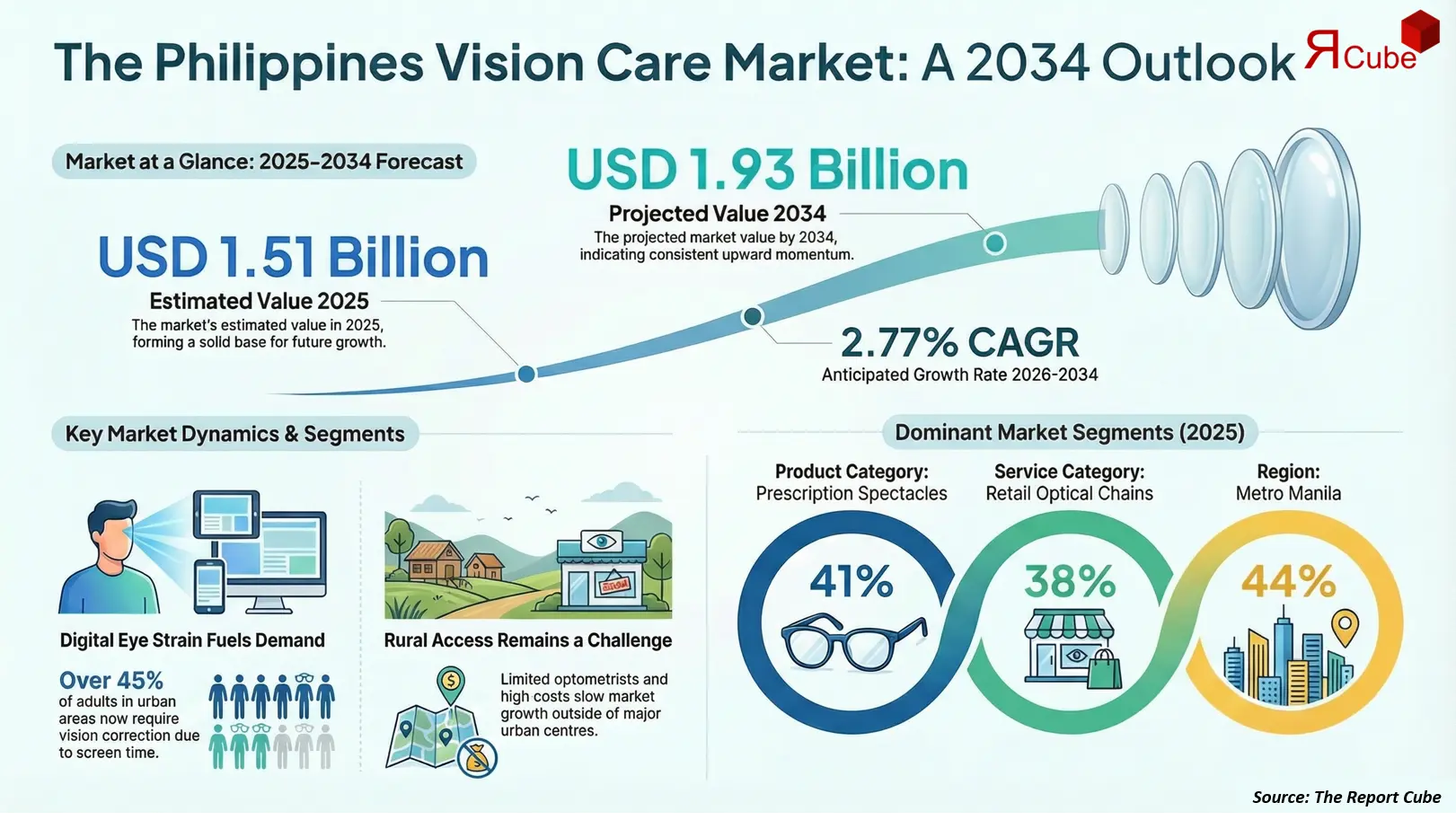
The Philippines Vision Care Market is anticipated to register a CAGR of 2.77% during 2026-2034. The market size was valued at USD 1.51 billion in 2025 and is projected to reach USD 1.93 billion by 2034. The market is expanding at a steady pace, supported by increasing awareness of eye health, rising screen exposure, and a growing middle-class population with higher healthcare spending capacity. Vision correction is no longer viewed as optional, but as an essential healthcare need, particularly among working professionals, students, and the elderly.
In addition, lifestyle shifts driven by prolonged digital device usage have increased the incidence of refractive errors, digital eye strain, and early-onset myopia. This has strengthened demand for prescription spectacles, contact lenses, and eye care drops. Urbanization and the expansion of organized retail optical chains have improved accessibility to professional eye examinations, further supporting market development. Moreover, the integration of tele-eye consultations and mobile optometry services is improving access to vision care in underserved areas. As preventive eye care gains importance and consumers become more proactive about regular eye checkups, the Philippines Vision Care Market is expected to maintain stable growth through 2034.
Philippines Vision Care Market Recent Developments
- 2025: EssilorLuxottica expanded affordable lens offerings across major retail optical chains in Metro Manila.
- 2025: Alcon Inc. introduced enhanced dry-eye relief drops targeting urban professionals.
Government Initiatives & Policies
- Philippine National Eye Health Program: Strengthens preventive eye care, screenings, and access to corrective solutions nationwide.
- Universal Health Care Act: Supports inclusion of basic eye care services under national health coverage.
Philippines Vision Care Market Dynamics
Key Driver: Rising Prevalence of Refractive Errors and Digital Eye Strain
The increasing prevalence of refractive errors such as myopia, hyperopia, and astigmatism is a primary driver of the Philippines Vision Care Market. Over 45% of adults in urban areas now require some form of vision correction, largely due to extended screen time from smartphones, computers, and online learning platforms. Children and young adults are being diagnosed earlier, driving repeat demand for prescription spectacles and contact lenses. Regular eye examinations are becoming more common, supported by awareness campaigns and employer-led health initiatives, directly contributing to sustained market demand.
Book your FREE 30-minute expert consultation today
Contact UsIndustry Trends: Expansion of Organized Optical Retail and Service Diversification
The market is witnessing a shift from independent opticians to organized retail optical chains offering standardized services and wider product ranges. These players combine eye examinations, eyewear retail, and after-sales services under one roof, enhancing convenience and trust. Additionally, service diversification through tele-eye consults and mobile eye clinics is gaining traction, particularly in secondary cities. Nearly 30% of vision care providers introduced digital appointment systems by 2025, improving patient engagement and operational efficiency.
Major Challenge: Limited Access to Vision Care in Rural Areas
Despite progress, unequal access to professional vision care remains a major challenge. Rural and remote regions face shortages of trained optometrists and limited diagnostic infrastructure. Cost sensitivity also restricts adoption of premium eyewear and advanced ophthalmic devices. While government programs aim to improve coverage, out-of-pocket expenditure still accounts for a large share of vision care spending, slowing market penetration outside major urban centers.
Opportunity: Growing Demand for Preventive and Specialized Eye Care Solutions
Preventive eye care and specialized solutions present strong growth opportunities. Demand for blue-light filtering lenses, pediatric vision correction, and dry-eye management products is rising rapidly. Consumers are increasingly willing to invest in quality eyewear and branded lenses to enhance comfort and long-term eye health. Partnerships between optical chains and healthcare providers can further expand reach, particularly through school screening programs and workplace vision care initiatives.
Philippines Vision Care Market Segment-wise Analysis
By Product Category:
- Prescription Spectacles
- Sunglasses
- Contact Lenses
- Ophthalmic Devices
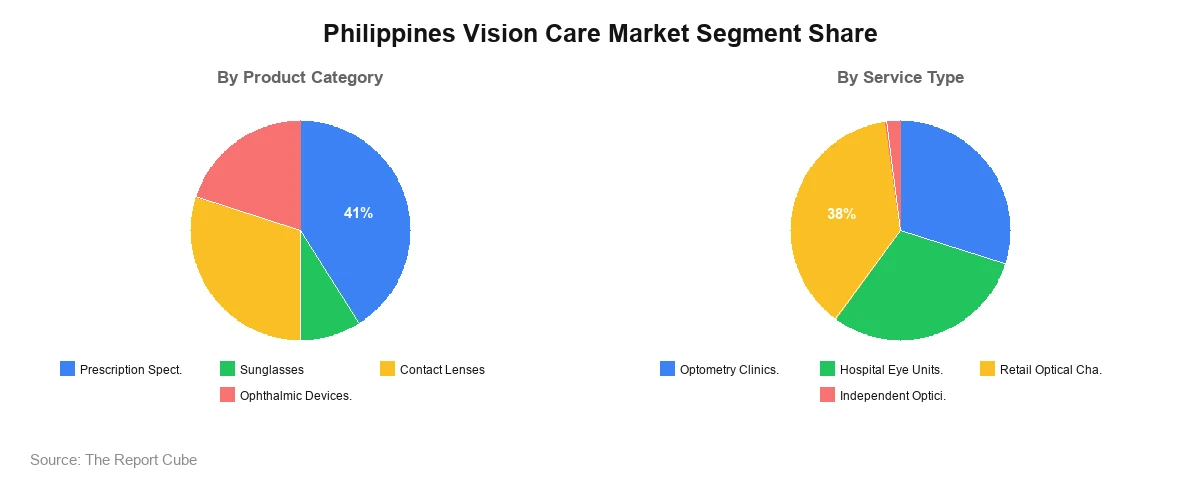
Prescription spectacles dominate the product category segment, accounting for nearly 41% of market revenue in 2025. Their leadership is supported by affordability, wide availability, and strong repeat demand due to changing prescriptions. Contact lenses are gaining popularity among younger consumers, while eye care drops continue to see steady growth due to rising dry-eye cases associated with screen exposure.
By Service Type:
- Optometry Clinics
- Hospital Eye Units
- Retail Optical Chains
- Independent Opticians
Retail optical chains hold the leading share in the service type segment, representing approximately 38% of the market. Their success is driven by integrated service models, competitive pricing, and strong urban presence. Hospital eye units remain essential for advanced treatments, while tele-eye consults are emerging as supportive channels, particularly for follow-ups and basic screenings.
Regional Projection of Philippines Vision Care Industry
- Luzon
- Visayas
- Mindanao
- Metro Manila
Metro Manila leads the Philippines Vision Care Market, contributing around 44% of total revenue in 2025. The region benefits from higher income levels, dense population, and concentration of optical retail chains and hospitals. Luzon follows closely due to expanding urban centers. Meanwhile, Visayas and Mindanao are emerging growth regions as healthcare infrastructure and awareness improve.
Need insights for a specific region within this market?
Request Regional DataWhy Choose This Report?
- Provides a comprehensive overview of the overall market analysis, encompassing key trends, consumer behavior analysis, and risk assessment to support strategic decision-making.
- Provides accurate, up-to-date insights into market size, segmentation, and emerging opportunities, helping to minimize risk & capitalizing on growth.
- Gives deep understanding of target audience preferences, investment habits, and communication channels for enhanced product development & marketing effectiveness.
- Delivers competitive analysis & benchmarking, uncovering the strengths & weaknesses of market competitors to guide strategies.
- Consolidate comprehensive market intelligence, reducing reasoning & streamlining research efforts.
- Facilitates customized market segmentation & risk mitigation strategies, fine-tuned to the business objectives.
- Aids in identifying both market challenges & untapped opportunities within the industry to drive long-term business growth.
- Provides valuable information based on actual customer data & search trends.
Table of Contents
- Introduction
- Objective of the Study
- Product and Category Definition
- Market Segmentation
- Study Variables
- Research Methodology
- Secondary Data Points
- Breakdown of Secondary Sources
- Primary Data Points
- Breakdown of Primary Interviews
- Secondary Data Points
- Executive Summary
- Market Dynamics
- Drivers
- Challenges
- Opportunity Assessment
- Recent Trends and Developments
- Regulatory and Policy Landscape
- Philippines Vision Care Market Overview (2020-2034)
- Market Size, By Value (USD Billion)
- Market Share, By Product Category
- Prescription Spectacles
- Sunglasses
- Contact Lenses
- Ophthalmic Devices
- Eye Care Drops
- Market Share, By Service Type
- Optometry Clinics
- Hospital Eye Units
- Retail Optical Chains
- Independent Opticians
- Tele‑eye Consults
- Market Share, By Condition Type
- Myopia
- Hyperopia
- Astigmatism
- Presbyopia
- Dry Eye
- Market Share, By Customer Segment
- Children
- Youth Adults
- Working Professionals
- Senior Citizens
- Market Share, By Distribution Channel
- Optical Retail
- Hospital Pharmacies
- Drugstores
- Online Platforms
- Market Share, By Region
- Luzon
- Visayas
- Mindanao
- Metro Manila
- Rest of Philippines
- Market Share, By Company
- Competition Characteristics
- Revenue Shares & Analysis
- Luzon Vision Care Market
- Market Size, By Value (USD Billion)
- Market Share, By Product Category
- Market Share, By Service Type
- Market Share, By Condition Type
- Market Share, By Customer Segment
- Market Share, By Distribution Channel
- Visayas Vision Care Market
- Market Size, By Value (USD Billion)
- Market Share, By Product Category
- Market Share, By Service Type
- Market Share, By Condition Type
- Market Share, By Customer Segment
- Market Share, By Distribution Channel
- Mindanao Vision Care Market
- Market Size, By Value (USD Billion)
- Market Share, By Product Category
- Market Share, By Service Type
- Market Share, By Condition Type
- Market Share, By Customer Segment
- Market Share, By Distribution Channel
- Metro Manila Vision Care Market
- Market Size, By Value (USD Billion)
- Market Share, By Product Category
- Market Share, By Service Type
- Market Share, By Condition Type
- Market Share, By Customer Segment
- Market Share, By Distribution Channel
- Competitive Outlook and Company Profiles
- Johnson & Johnson Vision
- Company Overview
- Product Portfolio
- Strategic Alliances/Partnerships
- Recent Developments
- Alcon Inc.
- Company Overview
- Product Portfolio
- Strategic Alliances/Partnerships
- Recent Developments
- EssilorLuxottica
- Company Overview
- Product Portfolio
- Strategic Alliances/Partnerships
- Recent Developments
- Bausch + Lomb
- Company Overview
- Product Portfolio
- Strategic Alliances/Partnerships
- Recent Developments
- Carl Zeiss Meditec
- Company Overview
- Product Portfolio
- Strategic Alliances/Partnerships
- Recent Developments
- Hoya Corporation
- Company Overview
- Product Portfolio
- Strategic Alliances/Partnerships
- Recent Developments
- Nidek Co. Ltd.
- Company Overview
- Product Portfolio
- Strategic Alliances/Partnerships
- Recent Developments
- Topcon Corporation
- Company Overview
- Product Portfolio
- Strategic Alliances/Partnerships
- Recent Developments
- Roche Holding
- Company Overview
- Product Portfolio
- Strategic Alliances/Partnerships
- Recent Developments
- Novartis AG
- Company Overview
- Product Portfolio
- Strategic Alliances/Partnerships
- Recent Developments
- Others
- Johnson & Johnson Vision
- Contact Us and Disclaimer
Top Key Players & Market Share Outlook
- Johnson & Johnson Vision
- Alcon Inc.
- EssilorLuxottica
- Bausch + Lomb
- Carl Zeiss Meditec
- Hoya Corporation
- Nidek Co. Ltd.
- Topcon Corporation
- Roche Holding
- Novartis AG
- Others
Frequently Asked Questions






