




Build Your Custom Market Intelligence Report
Customize Your ReportSouth Africa Fintech Market Insights & Analysis
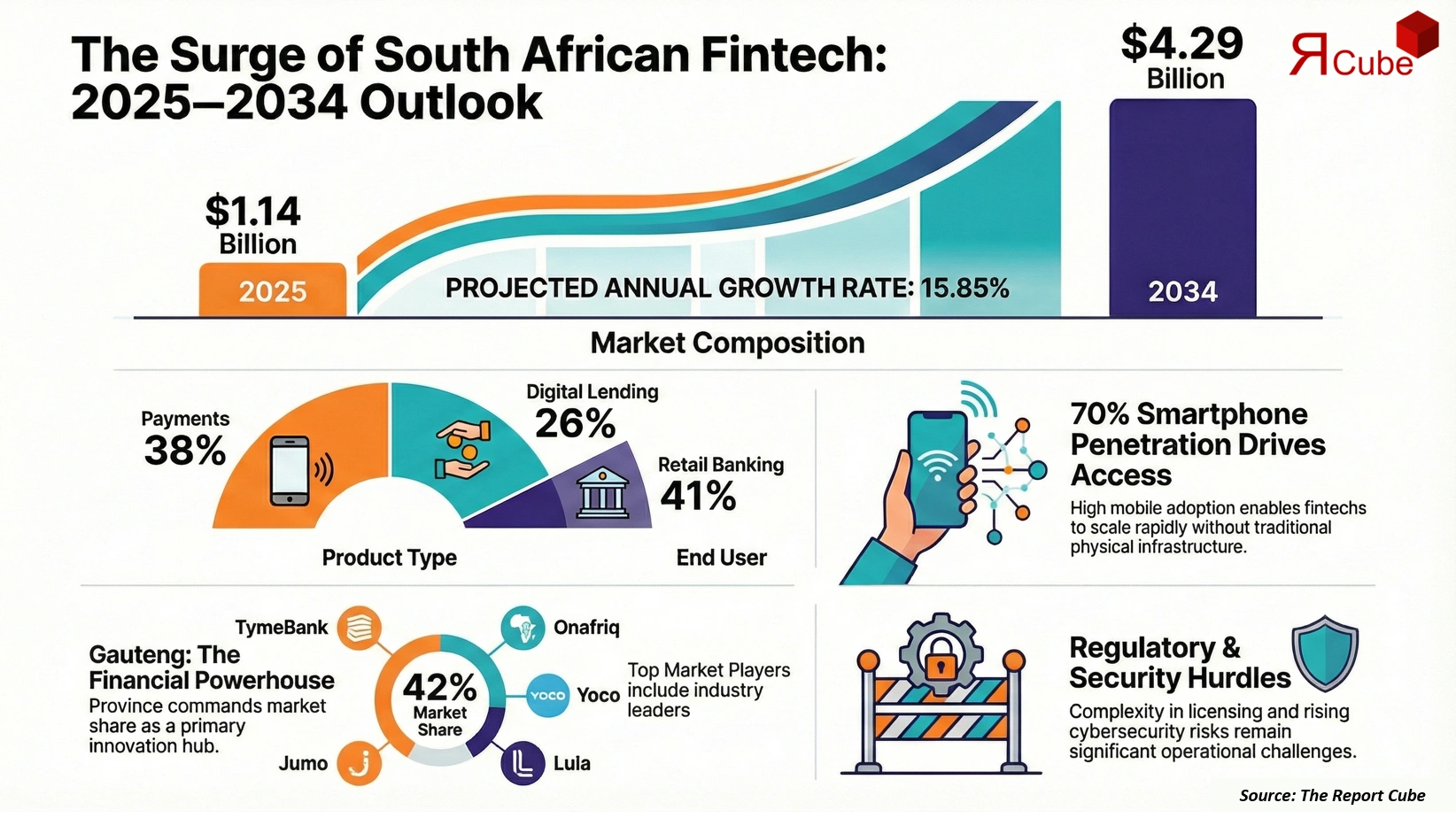
The South Africa Fintech Market is anticipated to register a CAGR of 15.85% during the forecast period 2026-2034. The market size was valued at USD 1.14 billion in 2025 and is projected to reach USD 4.29 billion by 2034. This rapid expansion reflects South Africa’s accelerating digital transformation across financial services, supported by high mobile penetration, growing internet accessibility, and an underserved population seeking affordable financial solutions.
The fintech ecosystem in South Africa has evolved beyond basic digital payments to include lending, wealth management, insurtech, and personal finance platforms. Startups and scale-ups are addressing long-standing gaps in traditional banking by offering faster onboarding, lower transaction costs, and tailored products for individuals and small businesses. The rise of real-time payment systems and open banking frameworks has further strengthened collaboration between fintech firms and incumbent financial institutions.
Moreover, regulatory support from the South African Reserve Bank and innovation sandboxes has encouraged experimentation while maintaining system stability. As consumer trust in digital financial services improves, fintech adoption is deepening across income groups. These interconnected factors position South Africa as one of Africa’s most mature and scalable fintech markets, with strong long-term growth fundamentals.
South Africa Fintech Market Recent Developments
-
(2025): TymeBank launched a new savings product offering higher interest rates for digital-savvy customers.
-
(2025): Jumo expanded partnerships with African banks to enhance its digital lending services across Africa.
Government Initiatives & Policies
- Intergovernmental Fintech Working Group (IFWG): Regulatory sandbox supporting fintech innovation and compliance.
- National Development Plan - Digital Economy: Promotes financial inclusion and digital financial infrastructure.
South Africa Fintech Market Dynamics
Key Driver: Rising Demand for Financial Inclusion and Digital Access
The strongest driver of the South Africa Fintech Market is the growing demand for financial inclusion across underserved and unbanked populations. Despite a relatively advanced banking sector, millions of South Africans still face barriers to accessing credit, insurance, and savings products. Fintech platforms are addressing these gaps through mobile-first solutions, simplified onboarding, and alternative credit scoring models. Over 70% of adults now use smartphones, enabling fintech firms to scale rapidly without heavy physical infrastructure. Digital wallets, peer-to-peer payments, and micro-lending platforms are particularly impactful in township and rural economies. This expanding user base is reinforcing network effects, driving transaction volumes, and accelerating revenue growth across the fintech value chain.
Book your FREE 30-minute expert consultation today
Contact UsIndustry Trends: Embedded Finance and Platform-Based Ecosystems
A major trend reshaping the market is the rise of embedded finance and platform-based financial ecosystems. Fintech solutions are increasingly integrated into e-commerce platforms, ride-hailing apps, and SME management tools, enabling seamless payments, lending, and insurance offerings. This trend reduces friction for users while expanding distribution channels for fintech providers. Additionally, partnerships between fintech firms and traditional banks are becoming more common, blending agility with balance-sheet strength. WealthTech and personal finance apps are also gaining traction among younger, digitally native consumers seeking automated savings and investment solutions. These trends collectively signal a shift from standalone fintech products toward holistic, ecosystem-driven financial experiences.
Major Challenge: Regulatory Complexity and Cybersecurity Risks
While regulation has generally been supportive, compliance complexity remains a challenge for fintech operators. Navigating licensing requirements, data protection laws, and anti-money laundering regulations can increase operational costs, particularly for early-stage firms. At the same time, rising digital adoption has heightened cybersecurity risks, including fraud and data breaches. Maintaining robust security infrastructure requires continuous investment, which can strain margins. Consumer trust is closely tied to data protection, making cybersecurity resilience a non-negotiable priority. These challenges may slow market entry for smaller players, even as larger, well-capitalized firms continue to scale.
Opportunity: SME Digitization and Alternative Lending Growth
The digitization of small and medium-sized enterprises presents a significant growth opportunity for the South Africa Fintech Market. SMEs account for a large share of employment but often struggle to access traditional bank financing. Fintech lenders are leveraging transaction data, invoicing records, and cash-flow analytics to offer faster and more flexible credit solutions. As more SMEs adopt digital payments and accounting tools, data availability improves, further strengthening alternative lending models. This creates a virtuous cycle of adoption, credit expansion, and economic participation, positioning SME-focused fintech solutions as a high-growth segment through 2034.
South Africa Fintech Market Segment-wise Analysis
By Product Type:
- Payments
- Digital Lending
- Insurtech
- WealthTech
- Personal Finance
The Payments segment leads the market, accounting for approximately 38% of total market share in 2025. High transaction volumes, merchant adoption, and consumer preference for cashless payments underpin this dominance. Digital Lending follows with nearly 26% share, driven by SME and consumer credit demand. Insurtech and WealthTech are emerging rapidly as awareness of digital insurance and investment tools grows. Personal finance platforms, while smaller in share, are gaining traction through budgeting and savings applications. The diversified product mix highlights the maturity and breadth of South Africa’s fintech ecosystem.
By End User:
- Retail Banking
- SME Banking
- Insurance
- Securities
Retail Banking remains the largest end-user segment, holding close to 41% market share, supported by mass adoption of digital payments and mobile banking tools. SME Banking follows with approximately 29% share, reflecting strong demand for working capital and payment acceptance solutions. The Insurance and Securities segments are expanding steadily as digital platforms simplify policy distribution and investment access. This balanced end-user adoption demonstrates fintech’s role across both consumer and business financial services.
Regional Projection of South Africa Fintech Industry
- Gauteng
- Western Cape
- KwaZulu-Natal
- Eastern Cape
- Other Provinces
Gauteng leads the South Africa Fintech Market with an estimated 42% market share, driven by its concentration of businesses, financial institutions, and urban consumers. Johannesburg and Pretoria serve as fintech innovation hubs, attracting investment and talent. The Western Cape follows, supported by Cape Town’s strong startup ecosystem. KwaZulu-Natal is emerging as a growth region due to increasing digital adoption among SMEs. Gauteng’s economic density and infrastructure advantages are expected to sustain its leadership throughout the forecast period.
Need insights for a specific region within this market?
Request Regional DataWhy Choose This Report?
- Provides a comprehensive overview of the overall market analysis, encompassing key trends, consumer behavior analysis, and risk assessment to support strategic decision-making.
- Provides accurate, up-to-date insights into market size, segmentation, and emerging opportunities, helping to minimize risk & capitalizing on growth.
- Gives deep understanding of target audience preferences, investment habits, and communication channels for enhanced product development & marketing effectiveness.
- Delivers competitive analysis & benchmarking, uncovering the strengths & weaknesses of market competitors to guide strategies.
- Consolidate comprehensive market intelligence, reducing reasoning & streamlining research efforts.
- Facilitates customized market segmentation & risk mitigation strategies, fine-tuned to the business objectives.
- Aids in identifying both market challenges & untapped opportunities within the industry to drive long-term business growth.
- Provides valuable information based on actual customer data & search trends.
Table of Contents
- Introduction
- Objective of the Study
- Product and Category Definition
- Market Segmentation
- Study Variables
- Research Methodology
- Secondary Data Points
- Breakdown of Secondary Sources
- Primary Data Points
- Breakdown of Primary Interviews
- Secondary Data Points
- Executive Summary
- Market Dynamics
- Drivers
- Challenges
- Opportunity Assessment
- Recent Trends and Developments
- Regulatory and Policy Landscape
- South Africa Fintech Market Overview (2021-2034)
- Market Size, By Value (USD Billion)
- Market Share, By Product Type
- Payments
- Digital Lending
- Insurtech
- WealthTech
- Personal Finance
- Market Share, By End User
- Retail Banking
- SME Banking
- Insurance
- Securities
- Market Share, By Technology
- Mobile Wallets
- Open Banking
- Blockchain
- AI Analytics
- Market Share, By Region
- Gauteng
- Western Cape
- KwaZulu-Natal
- Eastern Cape
- Other Provinces
- Market Share, By Company
- Competition Characteristics
- Revenue Shares & Analysis
- Gauteng Fintech Market
- Market Size, By Value (USD Billion)
- Market Share, By Product Type
- Market Share, By End User
- Market Share, By Technology
- Western Cape Fintech Market
- Market Size, By Value (USD Billion)
- Market Share, By Product Type
- Market Share, By End User
- Market Share, By Technology
- KwaZulu-Natal Fintech Market
- Market Size, By Value (USD Billion)
- Market Share, By Product Type
- Market Share, By End User
- Market Share, By Technology
- Competitive Outlook and Company Profiles
- TymeBank
- Company Overview
- Product Portfolio
- Strategic Alliances/Partnerships
- Recent Developments
- Jumo
- Company Overview
- Product Portfolio
- Strategic Alliances/Partnerships
- Recent Developments
- Onafriq
- Company Overview
- Product Portfolio
- Strategic Alliances/Partnerships
- Recent Developments
- Yoco
- Company Overview
- Product Portfolio
- Strategic Alliances/Partnerships
- Recent Developments
- Lula
- Company Overview
- Product Portfolio
- Strategic Alliances/Partnerships
- Recent Developments
- Ozow
- Company Overview
- Product Portfolio
- Strategic Alliances/Partnerships
- Recent Developments
- Peach Payments
- Company Overview
- Product Portfolio
- Strategic Alliances/Partnerships
- Recent Developments
- Entersekt
- Company Overview
- Product Portfolio
- Strategic Alliances/Partnerships
- Recent Developments
- Jambo
- Company Overview
- Product Portfolio
- Strategic Alliances/Partnerships
- Recent Developments
- VALR
- Company Overview
- Product Portfolio
- Strategic Alliances/Partnerships
- Recent Developments
- Others
- TymeBank
- Contact Us and Disclaimer
Top Key Players & Market Share Outlook
- TymeBank
- Jumo
- Onafriq
- Yoco
- Lula
- Ozow
- Peach Payments
- Entersekt
- Jambo
- VALR
- Others
Frequently Asked Questions