



Build Your Custom Market Intelligence Report
Customize Your ReportUS Fintech Market Insights & Analysis
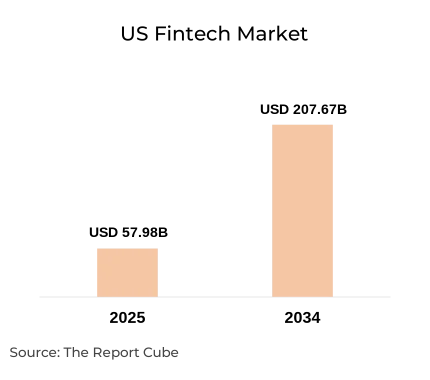
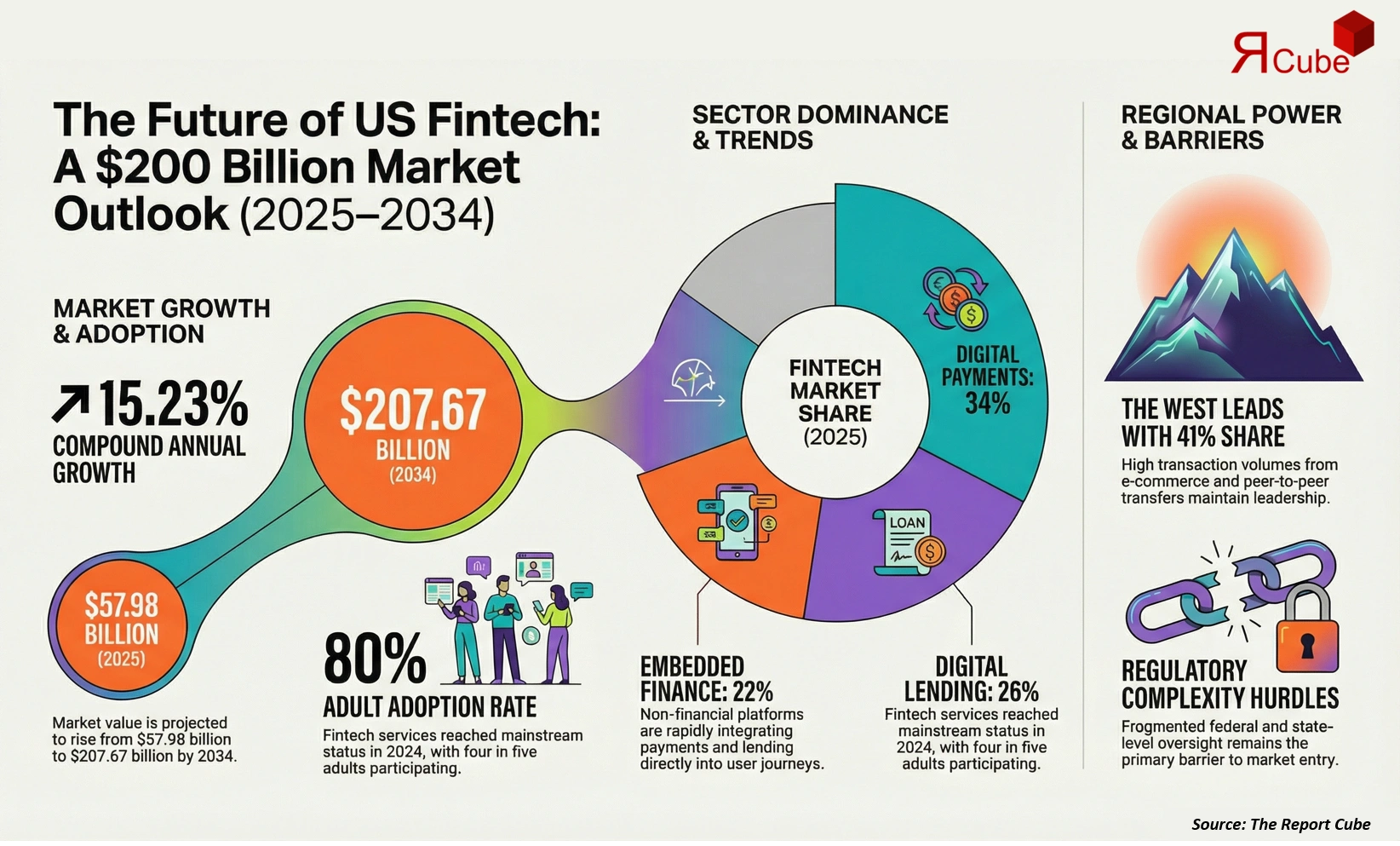
The US Fintech Market is anticipated to register a CAGR of 15.23% during the forecast period 2026-2034. The market size was valued at USD 57.98 billion in 2025 and is projected to reach USD 207.67 billion by 2034. This strong growth trajectory highlights the accelerating digital transformation of financial services across the United States, driven by changing consumer expectations, rapid technology adoption, and a supportive innovation ecosystem.
The US fintech landscape benefits from a mature digital infrastructure, high smartphone penetration, and a tech-savvy population increasingly favoring digital-first financial solutions. Consumers and businesses alike are shifting toward seamless, app-based platforms for payments, lending, investing, and banking. Traditional financial institutions are responding by partnering with fintech firms or acquiring innovative startups to remain competitive, further strengthening market expansion.
In parallel, regulatory clarity around digital payments, open banking frameworks, and data security has improved investor confidence and encouraged capital inflows into fintech ventures. Venture funding and public market participation remain robust, particularly in areas such as embedded finance and banking-as-a-service. Together, these interconnected factors position the US Fintech Market as one of the most dynamic and influential financial technology ecosystems globally.
US Fintech Market Recent Developments
- 2025: Stripe expanded embedded finance tools for US enterprises, supporting integrated payments and lending solutions.
- 2025: PayPal enhanced AI-driven fraud detection across its digital payments platform to improve transaction security.
Government Initiatives & Policies
- Consumer Financial Protection Bureau Open Banking Rule: Supports consumer data access and financial data portability.
- Federal Reserve Faster Payments Initiative: Promotes real-time payments adoption through FedNow services.
US Fintech Market Dynamics
Key Driver: Rapid Adoption of Digital Financial Services
The primary driver of the US Fintech Market is the rapid adoption of digital financial services by consumers and businesses. Mobile payments, peer-to-peer transfers, and app-based banking have become mainstream, with over 80% of US adults using at least one fintech service in 2024. Convenience, speed, and personalized user experiences are encouraging customers to shift away from traditional branch-based banking. Small and medium-sized businesses are also adopting fintech platforms for invoicing, payments, and cash-flow management, fueling B2B demand. This widespread acceptance creates a reinforcing cycle where higher usage attracts more innovation, further accelerating market growth through 2034.
Book your FREE 30-minute expert consultation today
Contact UsIndustry Trends: Rise of Embedded Finance and Platform Integration
Embedded finance has emerged as a defining trend within the US fintech ecosystem. Non-financial platforms, including e-commerce, SaaS, and gig-economy applications, are integrating payments, lending, and insurance directly into their user journeys. This trend allows businesses to monetize financial services while offering frictionless experiences to customers. Banking-as-a-service models support this shift by enabling fintechs to scale quickly without building full banking infrastructure. As platforms seek to increase user engagement and lifetime value, embedded finance is expected to account for a growing share of fintech revenues, reshaping competitive dynamics across the market.
Major Challenge: Regulatory Complexity and Compliance Costs
Despite strong growth prospects, regulatory complexity remains a significant challenge for the US Fintech Market. Fintech companies must navigate a fragmented regulatory environment involving federal and state-level oversight, increasing compliance costs and operational complexity. Data privacy requirements, anti-money laundering rules, and consumer protection standards demand continuous investment in compliance infrastructure. For early-stage fintechs, these costs can slow innovation and market entry. While regulation supports market stability and trust, balancing compliance with rapid product development remains a critical hurdle for sustained growth.
Opportunity: Expansion of Digital Lending and Wealthtech
Digital lending and wealthtech present substantial growth opportunities within the US Fintech Market. Alternative credit scoring, AI-driven underwriting, and real-time data analytics are expanding access to credit for underserved consumers and small businesses. Simultaneously, wealthtech platforms offering low-cost investing, robo-advisory, and fractional ownership are attracting younger demographics. Assets managed through digital investment platforms have grown at double-digit rates annually, signaling long-term potential. These segments benefit from recurring revenue models and high user engagement, positioning them as key growth engines during the forecast period.
US Fintech Market Segment-wise Analysis
By Type:
- Digital Payments
- Digital Lending
- Wealthtech
- Insurtech
- Neobanking
Digital Payments lead the US Fintech Market, accounting for approximately 34% of total market share in 2025. This dominance is supported by high transaction volumes from e-commerce, subscription services, and peer-to-peer transfers. Digital Lending follows, with nearly 26% share, driven by buy-now-pay-later solutions and SME-focused platforms. Wealthtech is expanding steadily as retail investors seek low-cost, app-based investment tools. Insurtech and Neobanking continue to gain traction, supported by personalized offerings and transparent pricing, contributing to a diversified and resilient market structure.
By Business Model:
- Direct-to-Consumer
- Bank Partnerships
- B2B Platforms
- Embedded Finance
- Banking-as-a-Service
Direct-to-Consumer models currently hold the largest share at around 31%, reflecting strong brand recognition and user trust in leading fintech apps. Embedded Finance is the fastest-growing sub-segment, capturing close to 22% share, as platforms integrate financial services seamlessly. Bank Partnerships and Banking-as-a-Service models support scalability and regulatory compliance, while B2B Platforms serve enterprise clients with payments and financial automation tools. Together, these models create a flexible ecosystem that supports innovation across customer segments.
Regional Projection of US Fintech Industry
- Northeast
- Midwest
- South
- West
The West region leads the US Fintech Market, accounting for approximately 41% of total market share. This leadership is driven by the concentration of fintech startups, venture capital, and technology talent in states such as California. The Northeast follows, supported by strong financial services presence and regulatory institutions. The South is emerging rapidly due to population growth and favorable business environments, while the Midwest continues steady adoption across banking and payments. The regional balance highlights both innovation hubs and expanding adoption nationwide.
Need insights for a specific region within this market?
Request Regional DataWhy Choose This Report?
- Provides a comprehensive overview of the overall market analysis, encompassing key trends, consumer behavior analysis, and risk assessment to support strategic decision-making.
- Provides accurate, up-to-date insights into market size, segmentation, and emerging opportunities, helping to minimize risk & capitalizing on growth.
- Gives deep understanding of target audience preferences, investment habits, and communication channels for enhanced product development & marketing effectiveness.
- Delivers competitive analysis & benchmarking, uncovering the strengths & weaknesses of market competitors to guide strategies.
- Consolidate comprehensive market intelligence, reducing reasoning & streamlining research efforts.
- Facilitates customized market segmentation & risk mitigation strategies, fine-tuned to the business objectives.
- Aids in identifying both market challenges & untapped opportunities within the industry to drive long-term business growth.
- Provides valuable information based on actual customer data & search trends.
Table of Contents
- Introduction
- Objective of the Study
- Product and Category Definition
- Market Segmentation
- Study Variables
- Research Methodology
- Secondary Data Points
- Breakdown of Secondary Sources
- Primary Data Points
- Breakdown of Primary Interviews
- Secondary Data Points
- Executive Summary
- Market Dynamics
- Drivers
- Challenges
- Opportunity Assessment
- Recent Trends and Developments
- Regulatory and Policy Landscape
- United States Fintech Market Overview (2021-2034)
- Market Size, By Value (USD Billion)
- Market Share, By Type
- Digital Payments
- Digital Lending
- Wealthtech
- Insurtech
- Neobanking
- Market Share, By Business Model
- Direct‑to‑Consumer
- Bank Partnerships
- B2B Platforms
- Embedded Finance
- Banking‑as‑a‑Service
- Market Share, By Channel Type
- Mobile Apps
- Web Platforms
- POS / Terminals
- Market Share, By Customer
- Retail Consumers
- SMEs
- Large Enterprises
- Financial Institutions
- Market Share, By Region
- Northeast
- Midwest
- South
- West
- Market Share, By Company
- Competition Characteristics
- Revenue Shares & Analysis
- Northeast US Fintech Market
- Market Size, By Value (USD Billion)
- Market Share, By Type
- Market Share, By Business Model
- Market Share, By Channel Type
- Market Share, By Customer
- Market Share, By Sub‑Region
- Market Share, By State
- New York
- Massachusetts
- Pennsylvania
- New Jersey
- Midwest US Fintech Market
- Market Size, By Value (USD Billion)
- Market Share, By Type
- Market Share, By Business Model
- Market Share, By Channel Type
- Market Share, By Customer
- Market Share, By Sub‑Region
- Market Share, By State
- Illinois
- Ohio
- Michigan
- Minnesota
- South US Fintech Market
- Market Size, By Value (USD Billion)
- Market Share, By Type
- Market Share, By Business Model
- Market Share, By Channel Type
- Market Share, By Customer
- Market Share, By Sub‑Region
- Market Share, By State
- Texas
- Florida
- Georgia
- North Carolina
- West US Fintech Market
- Market Size, By Value (USD Billion)
- Market Share, By Type
- Market Share, By Business Model
- Market Share, By Channel Type
- Market Share, By Customer
- Market Share, By Sub‑Region
- Market Share, By State
- California
- Washington
- Colorado
- Arizona
- Competitive Outlook and Company Profiles
- PayPal
- Company Overview
- Product Portfolio
- Strategic Alliances/Partnerships
- Recent Developments
- Stripe
- Company Overview
- Product Portfolio
- Strategic Alliances/Partnerships
- Recent Developments
- Block (Square)
- Company Overview
- Product Portfolio
- Strategic Alliances/Partnerships
- Recent Developments
- Intuit
- Company Overview
- Product Portfolio
- Strategic Alliances/Partnerships
- Recent Developments
- Chime
- Company Overview
- Product Portfolio
- Strategic Alliances/Partnerships
- Recent Developments
- SoFi
- Company Overview
- Product Portfolio
- Strategic Alliances/Partnerships
- Recent Developments
- Affirm
- Company Overview
- Product Portfolio
- Strategic Alliances/Partnerships
- Recent Developments
- Coinbase
- Company Overview
- Product Portfolio
- Strategic Alliances/Partnerships
- Recent Developments
- Robinhood
- Company Overview
- Product Portfolio
- Strategic Alliances/Partnerships
- Recent Developments
- Fiserv
- Company Overview
- Product Portfolio
- Strategic Alliances/Partnerships
- Recent Developments
- Others
- PayPal
- Contact Us and Disclaimer
Top Key Players & Market Share Outlook
- PayPal
- Stripe
- Block (Square)
- Intuit
- Chime
- SoFi
- Affirm
- Coinbase
- Robinhood
- Fiserv
- Others
Frequently Asked Questions






