



Build Your Custom Market Intelligence Report
Customize Your ReportKey Takeaways: KSA Flexible Packaging Market
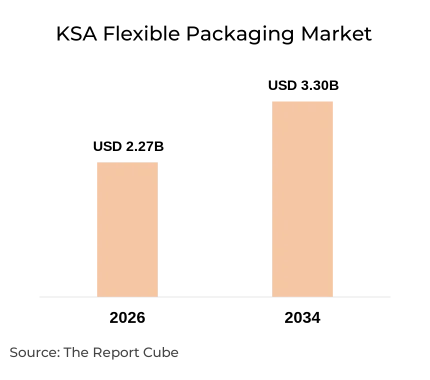
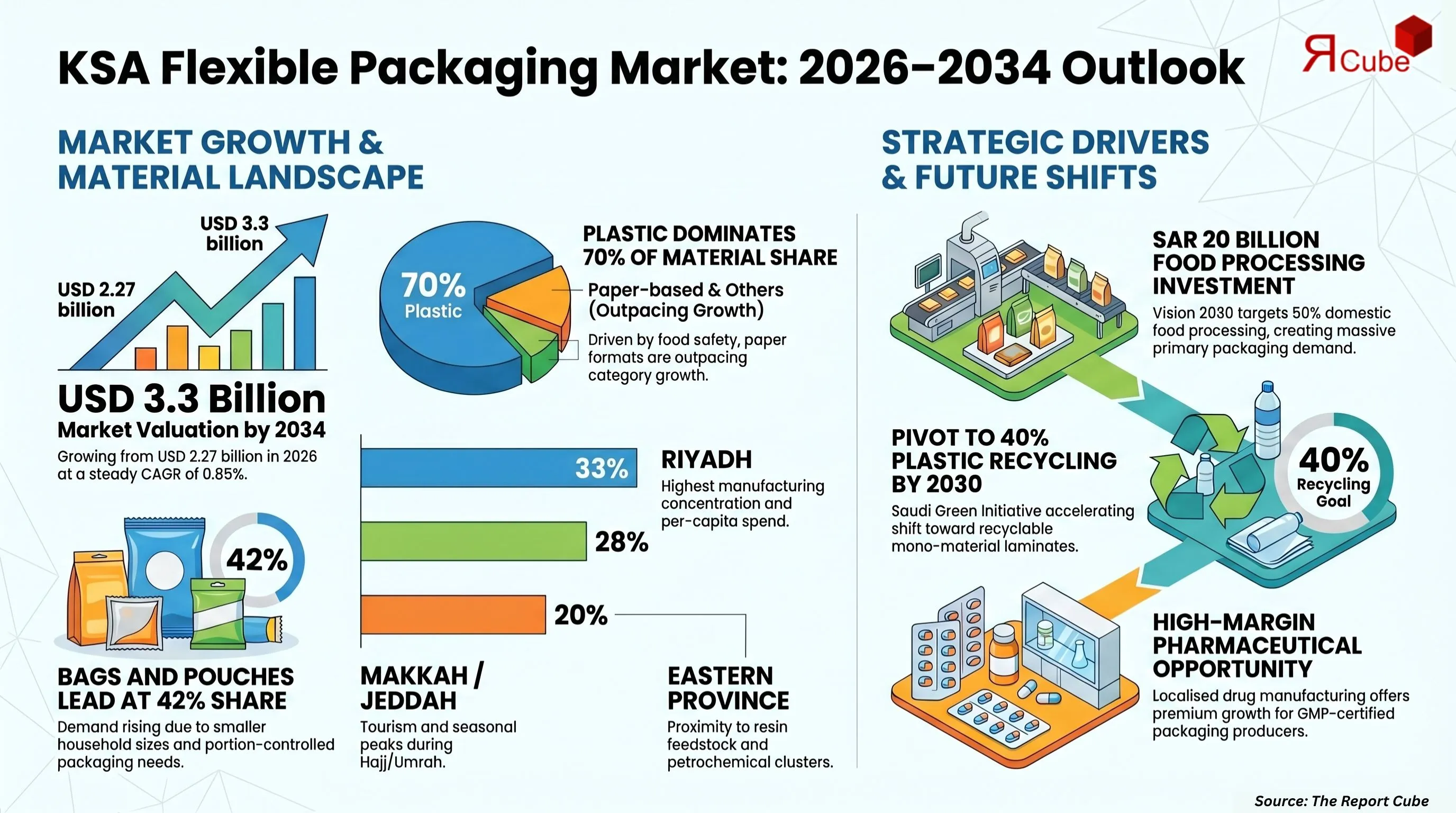
- The KSA flexible packaging market is projected to grow from USD 2.27 billion in 2026 to USD 3.3 billion by 2034, expanding at a CAGR of 0.85% over the forecast period.
- Plastic remains the dominant material type, driven by food safety requirements and the wide adoption of multi-layer films in processed food packaging.
- Bags and pouches lead the product segment, supported by growing demand from the food and beverage, personal care, and pharmaceutical sectors across the Kingdom.
- Saudi Vision 2030-aligned investments in domestic manufacturing and food processing industries are generating sustained demand for flexible packaging solutions.
- Regional players such as Al Bayader International and INDEVCO Group compete alongside global leaders including Amcor Plc and Berry Global Group, creating a moderately consolidated competitive environment.
KSA Flexible Packaging Market Insights & Analysis
Saudi Arabia's packaged food sector posted a retail value of approximately USD 24 billion in 2023, with household penetration of pre-packaged products exceeding 70% in urban centres (Saudi Food and Drug Authority, 2023). That demand base is the structural engine of the KSA flexible packaging market - yet growth at 0.85% CAGR signals a market in a maturity transition, not a decline. Brands and converters that misread moderate growth as stagnation will cede shelf position to rivals investing in next-format solutions. This section maps the underlying demand architecture and identifies where value concentration is shifting.
Per-capita packaged food expenditure in KSA reached USD 645 in 2023 (World Bank, 2023), roughly 2.3 times the MENA regional average - a differential that anchors consistent volume demand for primary flexible packaging. Simultaneously, Vision 2030's National Industrial Development and Logistics Program (NIDLP) has allocated over SAR 20 billion to food processing capacity expansion, generating a co-located demand pull for packaging inputs
The market is also under a quiet material substitution pressure: the Saudi Green Initiative's 2030 targets for a 50% reduction in single-use plastics are accelerating interest in paper-based and recyclable multi-layer laminates. Converters that integrate sustainability-compliant SKUs before regulatory mandates arrive will control price-setting in that emerging sub-segment. Plastic currently holds structural dominance, but paper's CAGR trajectory over 2026–2034 is projected to outpace the category average, driven by foodservice and quick-service restaurant applications.
KSA Flexible Packaging Market Dynamics
Key Market Driver: Vision 2030-Linked Food Processing Capacity Expansion
Saudi Arabia processed less than 30% of its domestically consumed food in 2022; Vision 2030's NTP target is 50% by 2030 (Ministry of Investment Saudi Arabia, 2023). Every new processing line commissioned inside the Kingdom creates a primary packaging demand unit that previously did not exist. Domestic food manufacturers scaling production in NEOM, King Abdullah Economic City, and Jeddah's industrial clusters are contracting flexible packaging supply agreements at multi-year terms, generating a predictable volume floor for converters with local manufacturing presence.
Between 2021 and 2024, Saudi Arabia licensed 312 new food and beverage production facilities under the Ministry of Industry and Mineral Resources investment programme, each requiring primary and secondary flexible packaging inputs (MIMR, 2024). Converters with in-Kingdom extrusion and lamination capacity hold a 15–22% landed-cost advantage over import-dependent rivals, a differential that is widening as freight costs remain elevated post-2022. This driver supports sustained volume growth across plastic films, bags, and pouches through 2034.
Major Industry Challenge: Volatile Resin Prices and Import Dependency
KSA flexible packaging converters source 60–75% of their polyethylene and polypropylene resin needs from petrochemical intermediaries, primarily SABIC and SIPCHEM, but global resin price swings of 20–35% annually compress converter margins when contracts are indexed to spot prices (SABIC Annual Report, 2023). The challenge is structural: converters with limited vertical integration cannot absorb feedstock volatility without passing costs to brand owners - yet long-term supply agreements increasingly include price-lock clauses that shift margin risk back upstream.
Capital allocation toward backward integration is the medium-term response, but entry costs for a standalone resin compounding line exceed USD 15 million - a barrier that favours large multinationals such as Amcor and Berry Global over regional mid-market players. Until KSA-based converters achieve broader vertical integration, resin price exposure will remain the single largest margin risk factor, limiting EBITDA expansion even in periods of volume growth.
Emerging Trend: Shift Toward Recyclable and Mono-Material Laminates
Saudi Arabia's Circular Carbon Economy framework, endorsed at COP26 and operationalised through the Saudi Green Initiative, has set a domestic plastics recycling rate target of 40% by 2030 - up from an estimated 9% in 2022 (Saudi Green Initiative Secretariat, 2023). Brand owners in the food and personal care segments are responding ahead of regulation, requesting recyclable mono-material pouch structures as a standard option in new packaging briefs.
Mono-material PE and PP structures currently carry a 12–18% cost premium over conventional mixed-laminate equivalents (Mondi Group Technical Brief, 2023), creating a short-term adoption hurdle for value-price SKUs. However, as scale builds and recycling infrastructure matures - Saudi Aramco and SABIC have jointly committed USD 1.2 billion to advanced recycling capacity by 2028 - that premium is forecast to narrow to 5–8% by 2030, accelerating mainstream adoption across the bags and pouches and films and wraps product segments.
Need Specific Data, Let’s Customize the Report for You
Request CustomizationEmerging Opportunity: Pharmaceutical and Healthcare Flexible Packaging Demand
Saudi Arabia's pharmaceutical market is projected to reach USD 10.4 billion by 2028 (Saudi Food and Drug Authority, 2024), driven by the government's domestic drug manufacturing localisation programme targeting 40% local production by 2030. Pharmaceutical flexible packaging - sachets, stick packs, blister-adjacent foil laminates, and sterile pouches - commands a 35–55% price premium over food-grade equivalents and requires converters to hold Good Manufacturing Practice (GMP) certification. The segment is currently under-served by KSA-based converters, with most pharmaceutical flexible packaging imported from European and South Asian suppliers, creating a direct entry opportunity for certified domestic producers.
KSA Flexible Packaging Market Segment-wise Analysis
By Material Type
Plastic dominates the KSA flexible packaging material mix, holding an estimated 68–72% share of total market value in 2026, anchored by polyethylene and oriented polypropylene films used across food, personal care, and agriculture end-uses (SABIC, 2023). Paper-based flexible packaging accounts for approximately 16–19% of market value, with penetration concentrated in foodservice wraps, bakery liners, and fast-growing quick-service restaurant applications. Metal - primarily aluminium foil - holds the remainder, predominantly in pharmaceutical sachets and high-barrier snack packaging.
|
Material Type |
Estimated Share (2026) |
Growth Outlook |
Primary End-Use |
|---|---|---|---|
|
Plastic |
70% |
Moderate; material substitution headwind post-2027 |
Food & Beverage, Personal Care |
|
Paper |
17% |
Above-average; sustainability pull from foodservice |
Bakery, QSR, Foodservice |
|
Metal (Aluminium Foil) |
13% |
Steady; driven by pharma and high-barrier snacks |
Pharmaceutical, Premium Snacks |
By Product Type
Bags and pouches lead the KSA flexible packaging product segment, accounting for the largest value share in 2026 owing to their broad applicability across processed food, pet food, personal care, and household chemicals. Stand-up pouches with resealable zippers are the fastest-growing sub-format, driven by single-household demographic growth - Saudi Arabia's average household size declined from 5.9 to 4.8 persons between 2010 and 2022 (General Authority for Statistics, KSA, 2022), increasing demand for portion-controlled, reclosable packaging. Films and wraps hold the second-largest share, underpinned by stretch wrap demand in the retail and logistics sector. Sachets and stick packs are the highest-unit-growth sub-segment, indexed to pharmaceutical and nutraceutical sector expansion.
|
Product Type |
Estimated Share (2026) |
Key Growth Driver |
Notable Application |
|---|---|---|---|
|
Bags and Pouches |
42% |
Household size reduction; premium food migration |
Snacks, Pet Food, Personal Care |
|
Films and Wraps |
31% |
Retail logistics growth; fresh produce packaging |
Stretch Wrap, Fresh Produce |
|
Sachets and Stick Packs |
15% |
Pharma and nutraceutical localisation |
Single-dose OTC, Condiments |
|
Other (Lidding, Labels) |
12% |
Dairy and ready-meal format growth |
Lidding Films, Flow-Wrap |
Regional Projection of KSA Flexible Packaging Market
Saudi Arabia is analysed as a single sovereign market; however, sub-regional demand concentration follows the Kingdom's economic geography across five distinct zones.
- Riyadh Region: The capital and central economic hub commands the largest sub-regional share of demand, estimated at 32–35% of national flexible packaging consumption, driven by the highest per-capita packaged food expenditure and the largest concentration of food and beverage manufacturers (General Authority for Statistics KSA, 2023). Vision 2030's National Transformation Programme has accelerated industrial zone expansion in Riyadh, adding converter and brand-owner capacity simultaneously.
- Makkah Region (including Jeddah): The Western Province accounts for approximately 27–29% of national demand, anchored by Jeddah's role as KSA's primary import gateway and the highest tourist and Hajj/Umrah-driven food service demand concentration in the Kingdom. Seasonal peaks during Hajj generate volume spikes of 18–23% above baseline for single-serve sachets and portion pouches (Saudi Tourism Authority, 2023).
- Eastern Province: Home to the majority of KSA's petrochemical and food processing industrial clusters, the Eastern Province contributes approximately 20% of demand - but supplies the majority of domestic resin feedstock. Converter proximity to SABIC and SIPCHEM facilities generates a structural landed-cost advantage for Eastern Province-based packaging operations.
- Madinah and Northern Regions: Combined share of approximately 10–12%, growing in line with Vision 2030 infrastructure and population dispersal programmes targeting secondary cities.
- NEOM and New City Developments: A nascent but structurally significant demand vector, with food and retail infrastructure in Neom's THE LINE and Diriyah Gate generating institutional packaging demand that did not exist pre-2022.
|
Sub-Region |
Estimated Demand Share (2026) |
Key Driver |
Strategic Gap |
|---|---|---|---|
|
Riyadh |
33% |
Manufacturing scale; per-capita spend |
Premium format adoption |
|
Makkah / Jeddah |
28% |
Tourism; import gateway |
Seasonal supply chain resilience |
|
Eastern Province |
20% |
Feedstock proximity; industrial clusters |
Converter value-chain integration |
|
Madinah + North |
11% |
Population growth; Vision 2030 dispersal |
Distribution infrastructure |
|
NEOM + New Cities |
8% |
Government-led demand; institutional supply |
Certified GMP converter access |
KSA Flexible Packaging Market - Recent Developments (2025)
- Amcor Plc (January 2025): Announced expansion of its Middle East flexible packaging portfolio to include AmLite Ultra-Recyclable structures targeting Saudi brand owners ahead of anticipated single-use plastic regulations. Press release confirmed commercial availability in KSA Q2 2025.
- INDEVCO Group (February 2025): Announced a capital investment programme targeting mono-material recyclable pouch expansion across its KSA-serving production assets in Lebanon and KSA, with estimated completion Q4 2025.
KSA Flexible Packaging Market Future Outlook (2034)
Flexible packaging's structural role in KSA's consumer economy is secure through 2034; the question is not whether demand grows but which formats and materials capture a disproportionate share of that growth. Three converging forces will reshape the segment mix: regulatory pressure on conventional plastics, demographic demand evolution, and the maturation of the Kingdom's domestic pharmaceutical manufacturing base.
Saudi Arabia's population is forecast to reach 40 million by 2030, with the urban share rising to 87% (World Bank Population Projections, 2024). Urbanisation densifies retail formats, shortens supply chains, and raises demand for resealable, portion-controlled primary packaging - all structural positives for stand-up pouches, sachets, and stick packs at the expense of bulk and secondary formats. The 15–29 age cohort, which will constitute approximately 28% of the population by 2030, shows demonstrably higher brand switching frequency and packaging-driven purchase behaviour, creating a commercial incentive for brand owners to invest in premium flexible formats.
On the regulatory axis, the Saudi Standards, Metrology and Quality Organisation (SASO) is expected to finalise extended producer responsibility (EPR) regulations for packaging between 2026 and 2028, aligning KSA with the EU Packaging and Packaging Waste Regulation trajectory. When EPR fees apply to non-recyclable laminates, the effective cost gap between conventional and recyclable structures will narrow by an estimated 8–12 percentage points (Ministry of Environment, Water and Agriculture KSA, 2023), making mono-material conversion economically compelling without mandates alone.
By 2034, pharmaceutical, nutraceutical, and clinical nutrition applications are projected to represent the fastest-growing flexible packaging end-use in KSA, displacing food and beverage as the highest-margin demand source. Converters that achieve GMP certification and invest in cleanroom lamination capacity before 2028 will be positioned to serve a captive premium segment with materially higher barriers to entry than commodity food film supply.
KSA Flexible Packaging Market Report Coverage
|
Report Features |
Details |
||
|---|---|---|---|
|
Market Size (Value, 2026) |
USD 2.27 Billion |
||
|
Market Size (Value, 2034) |
USD 3.3 Billion |
||
|
Forecast Period |
2026-034 |
||
|
CAGR |
0.85% |
||
|
Base Year |
2026 |
||
|
Historical Data |
2021–2025 |
||
|
Segments Covered |
By Material Type (Plastic, Paper, Metal); By Product Type (Bags and Pouches, Films and Wraps, Sachets and Stick Packs, Other) |
||
|
Geography Covered |
Kingdom of Saudi Arabia (sub-regional breakdown: Riyadh, Makkah/Jeddah, Eastern Province, Madinah/North, NEOM) |
||
|
Key Companies Profiled |
Amcor Plc, Berry Global Group, Inc., Constantia Flexibles, Mondi Group, Huhtamaki Group, Al Bayader International, INDEVCO Group, Emirates Printing Press (EPP), Flex Middle East |
||
|
Report Format |
PPT, PDF & Excel |
||
|
Customization |
Available |
||
|
Delivery |
PPT, PDF & Excel |
||
Why Choose This Report?
- Quantified sub-regional demand allocation across five KSA economic zones - Riyadh, Makkah/Jeddah, Eastern Province, Madinah/North, and NEOM - not available in standard GCC-level reports.
- Dedicated analysis of Vision 2030's National Industrial Development and Logistics Programme (NIDLP) as a structural demand driver for domestic converter investment decisions.
- Pharmaceutical and nutraceutical flexible packaging opportunity sized separately, with GMP certification requirement implications for converter market entry modelled through 2034.
- SASO EPR regulation scenario analysis quantifying the cost-gap narrowing effect on mono-material laminate adoption timelines.
- Resin price volatility exposure assessment per converter tier - large multinational, regional mid-market, and domestic SME - mapped against margin risk thresholds.
- Competitive landscape profiling of both global multinationals (Amcor, Berry Global, Mondi) and KSA-serving regional specialists (Al Bayader International, INDEVCO Group, Flex Middle East) with recent development timelines through Q1 2025.
- Actionable segment-level strategic recommendations aligned to the 2026–2034 forecast horizon for converters, brand owners, and infrastructure investors.
Table of Contents
- Introduction
- Objective of the study
- Product Definition
- Market Segmentation
- Study Variables
- Research Methodology
- Secondary Data Points
- Companies Interviewed
- Primary Data Points
- Breakdown of Primary Interviews
- Secondary Data Points
- Executive Summary
- Market Dynamics
- Drivers
- Challenges
- Opportunity Assessment
- Recent Trends and Developments
- Policy and Regulatory Landscape
- KSA Flexible Packaging Market Overview and Forecast Analysis (2021-2034)
- Market Size, By Value, By growth rate (CAGR/USD Billions)
- Demand - Supply Trends
- Market Share, By Material Type
- Plastic
- Paper
- Metal
- Market Share, By Product Type
- Bags and Pouches
- Films and Wraps
- Sachets and Stick Packs
- Other Product Types
- Market Share, By End-User Industry
- Food
- Beverage
- Pharmaceutical and Medical
- Household and Personal Care
- Industrial and Chemicals
- Market Share, By Printing Technology
- Flexography
- Rotogravure
- Digital
- Offset
- Market Share, By Region
- Riyadh
- Makkah / Jeddah
- Eastern Province
- Madinah + North
- NEOM + New Cities
- Market Share, By Competitors
- Competition Characteristics
- Revenue Shares
- KSA Plastic Flexible Packaging Market Overview, 2021-2034F
- By Value (USD Million)
- By Product Type- Market Size & Forecast 2021-2034, USD Million
- By End-User Industry- Market Size & Forecast 2021-2034, USD Million
- By Printing Technology- Market Size & Forecast 2021-2034, USD Million
- KSA Paper Flexible Packaging Market Overview, 2021-2034F
- By Value (USD Million)
- By Product Type- Market Size & Forecast 2021-2034, USD Million
- By End-User Industry- Market Size & Forecast 2021-2034, USD Million
- By Printing Technology- Market Size & Forecast 2021-2034, USD Million
- KSA Metal Flexible Packaging Market Overview, 2021-2034F
- By Value (USD Million)
- By Product Type- Market Size & Forecast 2021-2034, USD Million
- By End-User Industry- Market Size & Forecast 2021-2034, USD Million
- By Printing Technology- Market Size & Forecast 2021-2034, USD Million
- Competitive Outlook (Company Profile - Partial List)
- Amcor Plc
- Company Overview
- Business Segments
- Strategic Alliances/Partnerships
- Recent Developments
- Berry Global Group, Inc.
- Company Overview
- Business Segments
- Strategic Alliances/Partnerships
- Recent Developments
- Constantia Flexibles
- Company Overview
- Business Segments
- Strategic Alliances/Partnerships
- Recent Developments
- Mondi Group
- Company Overview
- Business Segments
- Strategic Alliances/Partnerships
- Recent Developments
- Huhtamaki Group
- Company Overview
- Business Segments
- Strategic Alliances/Partnerships
- Recent Developments
- Al Bayader International
- Company Overview
- Business Segments
- Strategic Alliances/Partnerships
- Recent Developments
- INDEVCO Group
- Company Overview
- Business Segments
- Strategic Alliances/Partnerships
- Recent Developments
- Emirates Printing Press (EPP)
- Company Overview
- Business Segments
- Strategic Alliances/Partnerships
- Recent Developments
- Flex Middle East
- Company Overview
- Business Segments
- Strategic Alliances/Partnerships
- Recent Developments
- Others
- Amcor Plc
- Contact Us & Disclaimer
Top Key Players & Market Share Outlook
- Amcor Plc
- Berry Global Group, Inc.
- Constantia Flexibles
- Mondi Group
- Huhtamaki Group
- Al Bayader International
- INDEVCO Group
- Emirates Printing Press (EPP)
- Flex Middle East
- Others
Frequently Asked Questions






