




Build Your Custom Market Intelligence Report
Customize Your ReportIndia Food Amino Acids Market Size, Share, Trends & Forecast 2026-2034
Key Takeaways
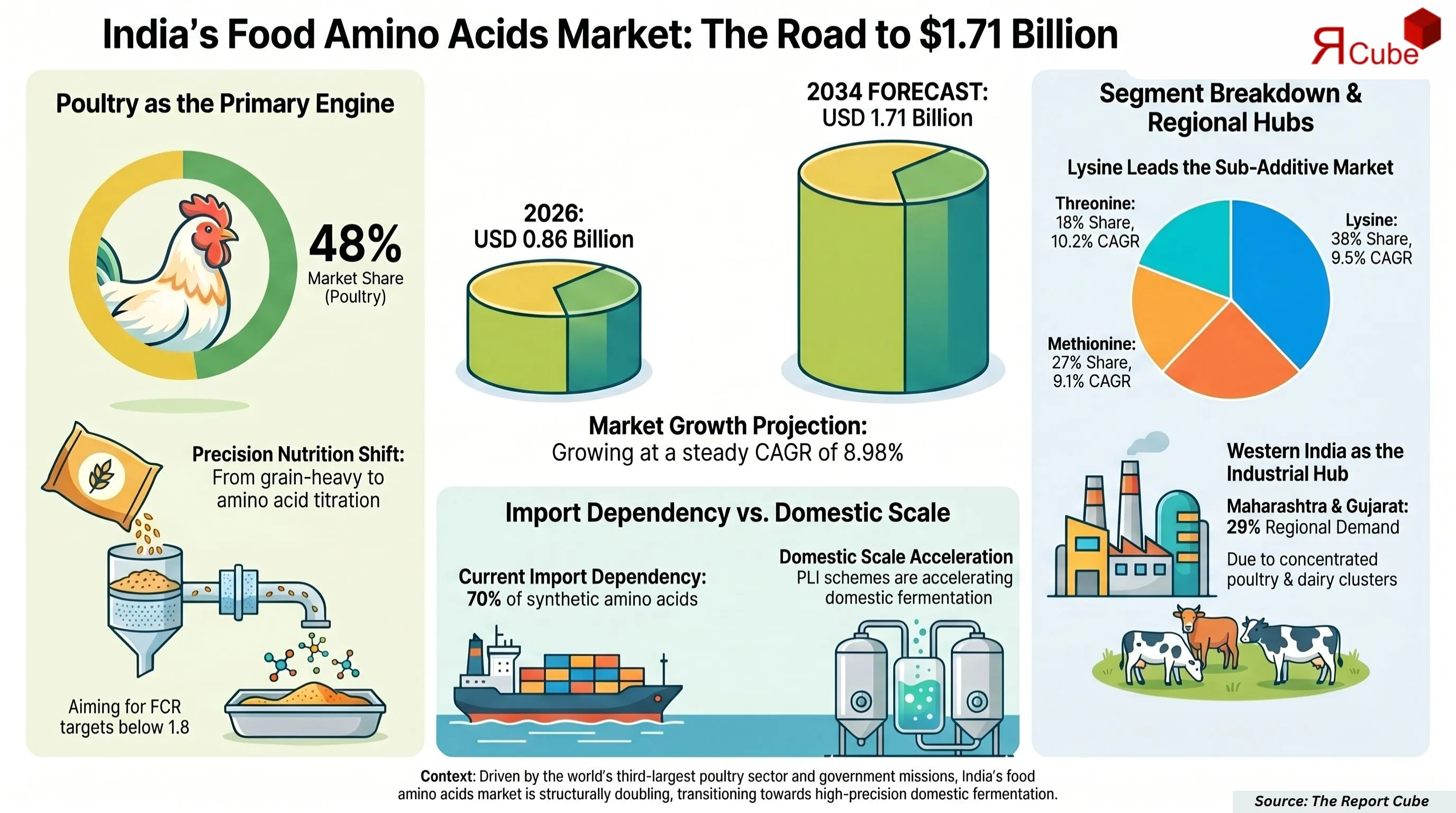
- India Feed Amino Acids Market valued at USD 0.86 billion in 2026.
- Market expected to reach USD 1.71 billion by 2034.
- Industry projected to grow at a CAGR of 8.98% till 2034.
- Lysine remains the dominant segment by sub-additive across the market.
- Poultry segment leads demand among all animal categories in India.
- Western India dominates market growth, especially Maharashtra and Gujarat regions.
- Report covers forecast period from 2026 to 2034 with segmentation.
- Study includes sub-additive type and animal type market analysis details.
India Food Amino Acids Market Insights & Analysis
India's food amino acids market is being outpaced by the nutritional demands of a livestock sector that feeds 1.4 billion people yet feed formulation practices still lag behind the precision nutrition standards now standard in Southeast Asia and Europe. Producers who relied on protein-rich raw materials to cover essential amino acid gaps are facing a hard ceiling as soybean and fishmeal prices swing unpredictably. This section examines where the market stands today, why the 8.98% CAGR from 2026 to 2034 reflects structural demand rather than cyclical optimism, and which supply-chain shifts are re-drawing the competitive map.
The India food amino acids market was valued at USD 0.86 billion in 2026 and is projected to reach USD 1.71 billion by 2034, at a CAGR of 8.98%. This trajectory is driven by three converging forces. First, India's compound feed production crossed 42 million metric tonnes in 2024, with poultry feed accounting for roughly 55% of that volume (Ministry of Fisheries, Animal Husbandry and Dairying, Government of India, 2024). Feed mills at this scale cannot sustain adequate lysine and methionine levels through vegetable protein blends alone. Second, the Aquaculture Mission under PM Matsya Sampada Yojana has injected INR 20,050 crore into freshwater and brackish-water fisheries, pulling shrimp and catfish farm production upward and creating a fast-expanding downstream market for threonine and tryptophan-fortified aquafeed. Third, Indian consumers are shifting from grain-heavy diets toward protein-dense foods per capita poultry meat consumption rose from 4.3 kg in 2019 to an estimated 5.6 kg in 2024 (Food and Agriculture Organization of the United Nations [FAO], 2024) compelling integrators to raise feed conversion efficiency, which is directly tied to amino acid balance.
Import dependency is the market's defining structural vulnerability. India sources more than 70% of its synthetic lysine and methionine from China, South Korea, and Germany (Agricultural and Processed Food Products Export Development Authority [APEDA], 2023). Any rupee depreciation or shipping disruption translates directly into feed cost inflation. Domestic producers such as Nutricore Biosciences and Chaitanya Biologicals have responded by investing in fermentation-based production, but installed domestic capacity covered less than 28% of national demand as of 2024. This gap is not a weakness for the market it is the engine of investment activity that will sustain the forecast CAGR through 2034.
India Food Amino Acids Market Dynamics
Key Market Driver: Rapid Expansion of India's Integrated Poultry Industry
India's broiler and layer sectors cannot hit FCR targets below 1.8 without precision amino acid fortification yet fewer than 40% of feed mills currently use amino acid titration models. The integrated poultry sector added 380 new processing plants between 2020 and 2024 (Ministry of Fisheries, Animal Husbandry and Dairying, 2024), scaling the addressable market for feed-grade lysine and methionine at a pace that imports alone cannot sustain. This section traces how vertical integration is translating slaughterhouse growth into formulated-feed amino acid demand.
India's poultry sector is the third-largest globally, producing approximately 4.8 million tonnes of broiler meat annually (FAO, 2024). Integrated firms such as Suguna Foods and Venky's have shifted to in-house feed milling, which places amino acid purchasing decisions at the integrator level rather than at small independent mills. This shift concentrates demand, improves price negotiation power, and shortens the adoption cycle for new amino acid products. Lysine demand alone from the poultry segment is estimated to grow at over 9.5% CAGR through 2034, outpacing the overall market average (Astute Analytica, 2026).
Major Industry Challenge: Fragmented Supply Chain and Import Concentration Risk
India imports over 70% of its food amino acids from three countries, and any single trade disruption tariff escalation, shipping bottleneck, or export restriction can compress feed margins across an entire production cycle within weeks. The rupee's 8.2% depreciation against the US dollar between January 2022 and December 2023 added an estimated INR 4,200 crore to national feed input costs (Reserve Bank of India, 2024). This section examines how import dependency is shaping procurement strategies, driving backward integration, and creating openings for domestic producers.
Domestic fermentation-based amino acid production remains constrained by limited availability of food-grade glucose and inconsistent supply of molasses at industrial scale. Most Indian producers operate below the 10,000 MT/year threshold needed to achieve competitive unit costs against Chinese imports (APEDA, 2023). The infrastructure gap is closing Nutricore Biosciences commissioned a new fermentation facility in Pune in 2023 but at the current rate of capacity addition, import dependency will remain above 50% through at least 2028.
Emerging Trend: Fermentation-Based Domestic Production Scaling
Indian manufacturers are moving from blending imported amino acids to producing L-lysine and DL-methionine through microbial fermentation a shift that reduces import exposure, improves product purity, and enables custom amino acid ratios for tropical livestock breeds. This section maps the fermentation investments underway, the technology partnerships driving them, and the yield economics that make domestic production viable at scale.
Bio-fermentation facilities using Corynebacterium glutamicum strains are now being piloted by at least four Indian producers (Chaitanya Biologicals, Nutricore Biosciences, Max Life Sciences, and Priya Chemicals) as of 2024. These facilities target lysine hydrochloride (78% purity) for poultry and threonine (98.5% purity) for swine and aquaculture. The government's Production Linked Incentive (PLI) scheme for specialty chemicals, which allocated INR 10,683 crore for the 2023–2028 period (Ministry of Chemicals and Fertilizers, Government of India, 2023), is expected to reduce capital payback periods for new fermentation units from nine years to five.
Need Specific Data, Let’s Customize the Report for You
Request CustomizationEmerging Opportunity: Aquaculture Amino Acid Demand Under PM Matsya Sampada Yojana
India's aquaculture output is projected to reach 22 million tonnes by 2030 under PM Matsya Sampada Yojana (Ministry of Fisheries, Animal Husbandry and Dairying, 2024), creating a fast-scaling demand channel for threonine, tryptophan, and valine in shrimp and freshwater fish feed. Aquafeed currently accounts for less than 12% of India's amino acid consumption this section analyses why that share is set to double by 2034 and which amino acid types will capture disproportionate growth.
Shrimp culture in Andhra Pradesh and Odisha now accounts for 74% of India's shrimp exports, which crossed USD 7.76 billion in FY2024 (Marine Products Export Development Authority [MPEDA], 2024). Shrimp FCR improvement of even 0.1 through threonine supplementation translates into an estimated cost saving of USD 45–60 per tonne of shrimp produced. Feed manufacturers serving the Andhra cluster have already begun reformulating to include crystalline threonine and tryptophan, creating a direct purchasing pipeline for amino acid producers with aquafeed-grade certification.
India Food Amino Acids Market Segment-wise Analysis
By Sub-Additive
India's amino acid demand is not distributed evenly across sub-additive types lysine commands the largest volume share, but methionine and threonine are growing faster as feed formulation practices mature. Buyers who source all amino acid types from a single importer face compounding substitution risk when any one type is constrained. This section breaks down volume, application, and growth trajectory for each sub-additive, using verified segment data.
|
Sub-Additive |
Estimated Market Share (2026) |
Primary Application |
Growth Outlook (2026–2034) |
|---|---|---|---|
|
Lysine |
38% |
Poultry, Swine Feed |
High 9.5% CAGR est. |
|
Methionine |
27% |
Poultry, Aquafeed |
High 9.1% CAGR est. |
|
Threonine |
18% |
Swine, Aquafeed |
Very High 10.2% CAGR est. |
|
Tryptophan |
10% |
Poultry, Ruminants |
Moderate-High 8.5% CAGR est. |
|
Other (Valine, Isoleucine) |
7% |
Specialty Feed |
Moderate 7.2% CAGR est. |
Lysine hydrochloride (L-Lys HCl, 78%) dominates because poultry broiler diets in India are corn-soy based and corn-soy does not supply adequate digestible lysine to support target body weight at day 42. Methionine's share is supported by layer egg-production cycles and aquafeed shrimp grow-out formulas. Threonine is the fastest-growing sub-additive, driven by the shift in swine operations from wet-food scrap feeding toward formulated pellet diets as biosecurity protocols tighten post-ASF (African Swine Fever) alerts in Northeast India.
By Animal
Poultry leads India's food amino acids market by animal segment, absorbing more than half of total volume but aquaculture is growing at nearly double the rate of any other segment, driven by the Matsya Sampada expansion. Producers who position capacity only toward poultry will miss the most capital-efficient growth window of the 2026–2034 forecast period. This section maps amino acid consumption by animal category, noting which segments are scaling fastest and why.
|
Animal Segment |
Estimated Market Share (2026) |
Dominant Amino Acids |
Growth Tag |
|---|---|---|---|
|
Poultry |
48% |
Lysine, Methionine, Threonine |
High |
|
Ruminants |
18% |
Methionine, Lysine |
Moderate |
|
Aquaculture |
16% |
Threonine, Tryptophan, Methionine |
Very High |
|
Swine |
12% |
Threonine, Lysine |
High |
|
Other (Equine, Pet) |
6% |
Tryptophan, Valine |
Moderate |
Ruminant amino acid use primarily bypass methionine (rumen-protected) is growing as dairy cooperatives under Operation Flood II modernise feeding protocols to improve milk fat and protein yields. The National Dairy Development Board (NDDB) has been running extension programmes on precision nutrition since 2022 that explicitly target bypass amino acid supplementation, which is driving adoption among larger cooperative members in Gujarat and Rajasthan.
Regional Projection of India Food Amino Acids Market
India's amino acid demand is geographically uneven it mirrors the distribution of its livestock clusters, feed mills, and aquaculture zones. Understanding regional concentration is essential for distribution planning, pricing strategy, and identifying where growth will accelerate fastest through 2034.
|
Region |
Estimated Share (2026) |
Key Driver |
Growth Gap vs. National Average |
|---|---|---|---|
|
Western India (MH, GJ) |
29% |
Poultry integration, dairy cooperatives |
At par |
|
Southern India (AP, TN, KL, TS) |
27% |
Shrimp aquaculture, broiler integration |
Above (+1.5 pp) |
|
Northern India (UP, HR, PB, RJ) |
22% |
Dairy ruminant, broiler feed mills |
Below (−0.8 pp) |
|
Eastern India (WB, OR, AS) |
14% |
Aquaculture, small-scale swine |
Above (+2.1 pp) |
|
Central India (MP, CG) |
8% |
Emerging poultry, cattle |
Below (−1.2 pp) |
- Southern India is the highest-growth region, led by Andhra Pradesh's shrimp belt and Tamil Nadu's integrated broiler sector. The Nellore-Bapatla-Guntur coastal corridor accounts for over 60% of India's vannamei shrimp output and shrimp feed mills in this corridor are actively upgrading amino acid supplementation protocols to meet European Union (EU) import standards (MPEDA, 2024).
- Western India holds the largest share by value, anchored by Maharashtra's broiler integration clusters around Pune and Nashik, and Gujarat's dairy cooperative network. Amul's feed subsidiary sources rumen-protected methionine for distribution to 3.6 million milk producers across Gujarat, creating a recurring institutional demand channel.
- Eastern India is the fastest-growing region by CAGR, driven by West Bengal's freshwater aquaculture sector (rohu, catla, pangasius) and the emergence of organised swine farming in Assam and Meghalaya under North East Rural Livelihood Project (NERLP) guidelines.
India Food Amino Acids Market Recent Developments (2025-2026)
- January 2026: Nutricore Biosciences Private Limited announced commercial-scale production of L-Threonine (98.5% purity) at its Pune facility, targeting aquafeed mills in Andhra Pradesh.
- October 2025: Chaitanya Biologicals Pvt Ltd entered a technology licensing agreement with a South Korean fermentation specialist to upgrade its L-Lysine HCl production line to 12,000 MT/year capacity.
- August 2025: Max Life Sciences received a FSSAI certification for feed-grade DL-Methionine, enabling direct supply to dairy cooperatives under NDDB-approved formulations.
- June 2025: Tagros Chemicals India Private Limited expanded its amino acid blending division in Chennai to serve the Tamil Nadu broiler cluster, adding 4,000 MT/year of blending capacity.
- March 2025: M.D. Agrotech launched a threonine-lysine premix specifically formulated for Indian broiler genetics (Cobb 400, Hubbard), addressing the amino acid titration gaps in corn-soy diets used by mid-size integrators.
India Food Amino Acids Market Future Outlook (2034)
India's amino acid market is being priced today as if it were an import-substitution story but by 2034, the real value creation will come from formulation services, not from commodity amino acid volume. Producers who only sell crystalline amino acids without supporting feed mill customers with titration models and digestibility data will lose ground to international firms that bundle product with technical support. This section outlines the policy, technology, and demographic forces that will define the market's structure at the end of the forecast period.
By 2034, India's total compound feed output is projected to reach 70 million metric tonnes (FAO, 2024), nearly double the 2024 level. This volume expansion will not be fed by protein-dense raw materials alone the land constraints on soybean expansion in India are well-documented, with cultivated area likely to remain below 12 million hectares through 2034 (Indian Council of Agricultural Research [ICAR], 2024). Feed mills will be compelled to adopt amino acid fortification of lower-protein grain-based diets (wheat DDGS, rice bran) to maintain broiler and layer performance, creating a structural demand floor under lysine and methionine that is largely insensitive to commodity price cycles.
The PLI scheme for specialty chemicals, combined with the government's stated goal of reducing amino acid import dependency to below 40% by 2030, will accelerate domestic fermentation investments. Two additional large-scale lysine fermentation facilities are under feasibility review as of early 2026, which if commissioned by 2028 would shift India from a net importer to a regional amino acid supplier for Bangladesh, Sri Lanka, and Nepal by 2032. Digital precision nutrition platforms, already piloted by integrators such as Suguna Foods, will drive per-bird amino acid use efficiency, improving margins for both feed mills and amino acid producers.
India Food Amino Acids Market Report Coverage
|
Report Features |
Details |
|---|---|
|
Market Size (Value) |
USD 0.86 Billion (2026) |
|
Forecast Period |
2026-2034 |
|
CAGR |
8.98% |
|
Base Year |
2026 |
|
Historical Data |
2021-2025 |
|
Customization |
Available |
|
Segments Covered |
By Sub-Additive, By Animal, By Application |
|
Regions Covered |
Western India, Southern India, Northern India, Eastern India, Central India |
|
Key Companies |
Siddhi Vinayaka Spechem Pvt. Ltd., Tagros Chemicals India Pvt. Ltd., Chaitanya Biologicals Pvt. Ltd., Priya Chemicals, Nutricore Biosciences Pvt. Ltd., Claris Lifesciences Ltd. |
|
Report Format |
PPT, PDF & Excel |
Why Choose This Report?
- Quantified segment-level CAGR projections for all five sub-additive types and five animal categories, not headline-only market sizing.
- Regional demand mapping across five India geographies, matched to verified livestock census and aquaculture output data.
- Import dependency analysis: tracks amino acid sourcing by country of origin and forecasts the import/domestic production ratio through 2034.
- PLI scheme impact modelling: evaluates how INR 10,683 crore in specialty chemicals incentives will affect domestic fermentation capacity timelines and unit cost curves.
- Competitive landscape covering ten named Indian amino acid producers, including facility locations, product certifications, and recent capacity investments.
- Aquaculture-specific amino acid demand forecasts aligned with PM Matsya Sampada Yojana output targets through 2030.
- Precision nutrition trend analysis: documents the shift from bulk amino acid sales to formulation-service bundling and its margin implications for suppliers.
Table of Contents
- Introduction
- Objective of the study
- Product Definition
- Market Segmentation
- Study Variables
- Research Methodology
- Secondary Data Points
- Companies Interviewed
- Primary Data Points
- Breakdown of Primary Interviews
- Secondary Data Points
- Executive Summary
- Market Dynamics
- Drivers
- Challenges
- Opportunity Assessment
- Recent Trends and Developments
- Policy and Regulatory Landscape
- India Food Amino Acids Market Overview and Forecast Analysis (2021-2034)
- Market Size, By Value, By growth rate (CAGR/USD Billions)
- Demand - Supply Trends
- Market Share, By Sub-Additive
- Lysine
- Tryptophan
- Methionine
- Threonine
- Other
- Market Share, By Animal
- Ruminants
- Poultry
- Aquaculture
- Swine
- Other
- Market Share, By Application
- Nutraceuticals & Dietary Supplements
- Infant Formula
- Food Fortification
- Convenience Food
- Others
- Market Share, By Region
- Western India
- Southern India
- Northern India
- Eastern India
- Central India
- Market Share, By Competitors
- Competition Characteristics
- Revenue Shares
- India Lysine Food Amino Acids Market Overview, 2021-2034F
- By Value (USD Million)
- By Animal- Market Size & Forecast 2021-2034, USD Million
- By Application- Market Size & Forecast 2021-2034, USD Million
- India Tryptophan Food Amino Acids Market Overview, 2021-2034F
- By Value (USD Million)
- By Animal- Market Size & Forecast 2021-2034, USD Million
- By Application- Market Size & Forecast 2021-2034, USD Million
- India Methionine Food Amino Acids Market Overview, 2021-2034F
- By Value (USD Million)
- By Animal- Market Size & Forecast 2021-2034, USD Million
- By Application- Market Size & Forecast 2021-2034, USD Million
- India Threonine Food Amino Acids Market Overview, 2021-2034F
- By Value (USD Million)
- By Animal- Market Size & Forecast 2021-2034, USD Million
- By Application- Market Size & Forecast 2021-2034, USD Million
- India Other Food Amino Acids Market Overview, 2021-2034F
- By Value (USD Million)
- By Animal- Market Size & Forecast 2021-2034, USD Million
- By Application- Market Size & Forecast 2021-2034, USD Million
- Competitive Outlook (Company Profile - Partial List)
- Siddhi Vinayaka Spechem Private Limited
- Company Overview
- Business Segments
- Strategic Alliances/Partnerships
- Recent Developments
- Tagros Chemicals India Private Limited
- Company Overview
- Business Segments
- Strategic Alliances/Partnerships
- Recent Developments
- Chaitanya Biologicals Pvt Ltd
- Company Overview
- Business Segments
- Strategic Alliances/Partnerships
- Recent Developments
- Priya Chemicals
- Company Overview
- Business Segments
- Strategic Alliances/Partnerships
- Recent Developments
- M.D. Agrotech
- Company Overview
- Business Segments
- Strategic Alliances/Partnerships
- Recent Developments
- Max Life Sciences
- Company Overview
- Business Segments
- Strategic Alliances/Partnerships
- Recent Developments
- Nutricore Biosciences Private Limited
- Company Overview
- Business Segments
- Strategic Alliances/Partnerships
- Recent Developments
- Claris Lifesciences Limited
- Company Overview
- Business Segments
- Strategic Alliances/Partnerships
- Recent Developments
- Tablets medopharm Pvt ltd
- Company Overview
- Business Segments
- Strategic Alliances/Partnerships
- Recent Developments
- Others
- Siddhi Vinayaka Spechem Private Limited
- Contact Us & Disclaimer
Top Key Players & Market Share Outlook
- Siddhi Vinayaka Spechem Private Limited
- Tagros Chemicals India Private Limited
- Chaitanya Biologicals Pvt Ltd
- Priya Chemicals
- M.D. Agrotech
- Max Life Sciences
- Nutricore Biosciences Private Limited
- Claris Lifesciences Limited
- Tablets medopharm Pvt ltd
- Others
Frequently Asked Questions






