



Build Your Custom Market Intelligence Report
Customize Your ReportIndia Vertical Farming Market Insights & Analysis
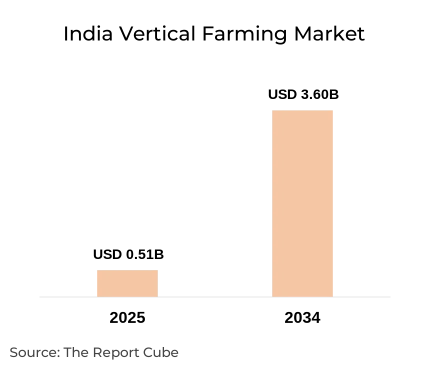
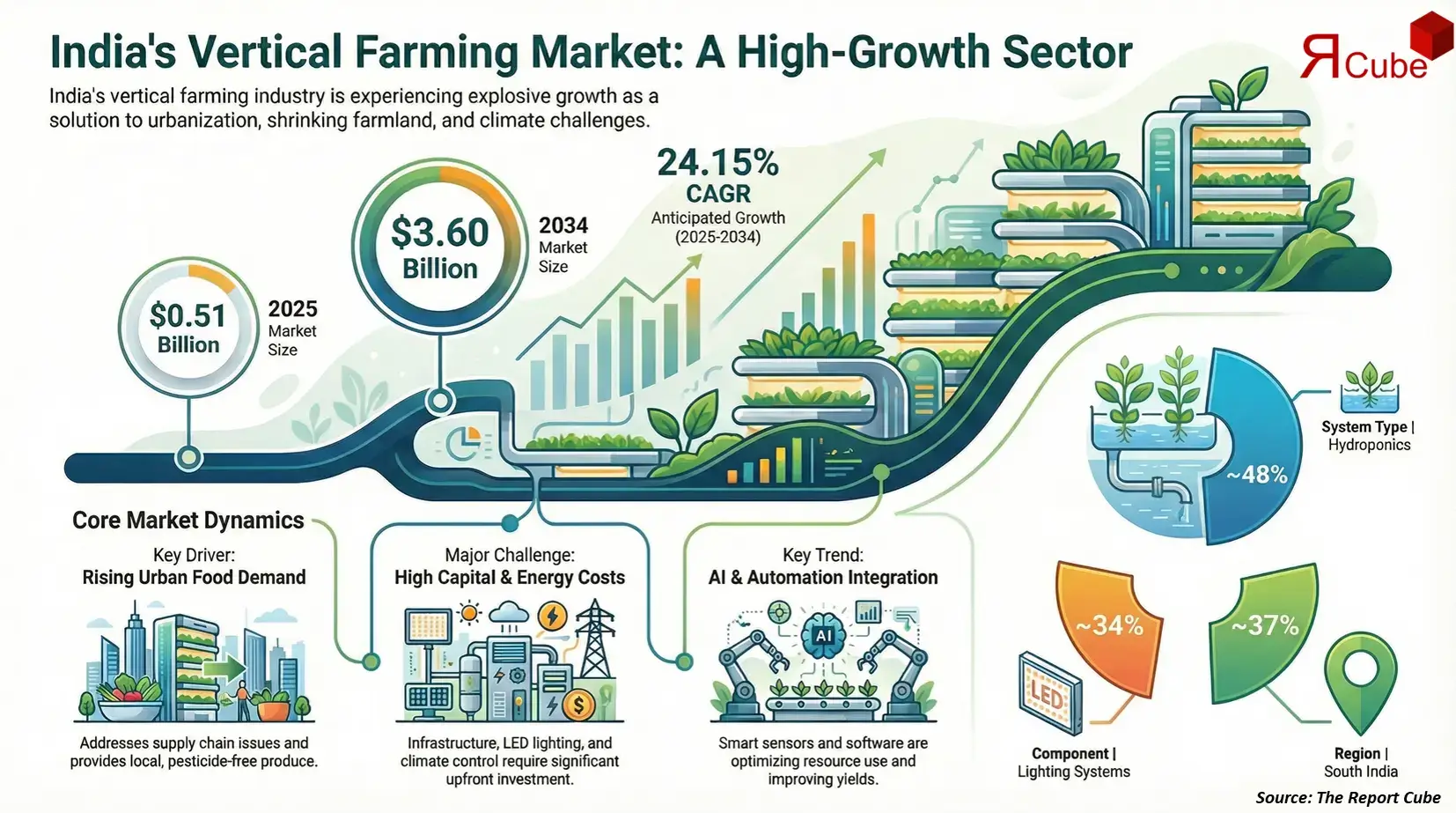
The India Vertical Farming Market is anticipated to register a CAGR of 24.15% during 2026–2034. The market size was valued at USD 514.48 million in 2025 and is projected to reach USD 3,604.87 million by 2034. India’s vertical farming industry is gaining strong momentum as the country faces mounting challenges related to urbanization, shrinking arable land, climate volatility, and food security. Vertical farming offers a sustainable solution by enabling high-yield crop production in controlled environments using minimal land and water resources. Rising demand for pesticide-free produce, leafy greens, herbs, and exotic vegetables from urban consumers is accelerating adoption across major cities. Technology-driven startups and agri-tech companies are investing heavily in hydroponic and aeroponic systems integrated with sensors, automation, and data analytics. Government encouragement for smart agriculture, combined with private sector innovation, is positioning vertical farming as a critical pillar of India’s future agri-food ecosystem.
India Vertical Farming Market Recent Developments
- 2025: CropIn Technology expanded AI-powered farm intelligence platforms supporting large-scale vertical farming operations.
- 2025: Sky Greens India scaled hydroponic vertical farms supplying premium greens to metropolitan retail chains.
Government Initiatives & Policies
- National Mission on Sustainable Agriculture: Initiative promoting resource-efficient and climate-resilient farming technologies.
- Agri-Tech Startup & Innovation Support Programs: Government-backed schemes encouraging precision and indoor farming adoption.
India Vertical Farming Market Dynamics
Key Driver: Rising Urban Food Demand & Need for Climate-Resilient Agriculture
A key driver of India’s vertical farming market is the rising demand for fresh, locally grown, and pesticide-free produce in urban areas. Rapid urbanization has increased the distance between farms and consumers, leading to supply chain inefficiencies and post-harvest losses. Vertical farming addresses these challenges by enabling year-round production close to consumption centers. Additionally, climate variability, erratic rainfall, and soil degradation are pushing farmers and investors toward controlled-environment agriculture. Vertical farms reduce dependency on weather conditions while offering higher yields per square foot. These advantages make vertical farming an increasingly attractive solution for India’s food system challenges.
Major Challenge: High Initial Capital Costs & Energy Consumption
Despite strong growth potential, high upfront investment remains a significant barrier to widespread adoption. Vertical farming systems require substantial capital for infrastructure, LED lighting, climate control, sensors, and automation technologies. Energy consumption, particularly for lighting and cooling, adds to operational expenses and impacts profitability. Small and medium-scale farmers often face difficulties accessing financing or achieving economies of scale. Additionally, limited technical expertise and skilled workforce availability can slow deployment. Addressing these challenges through cost-effective system designs, renewable energy integration, and financing support will be critical for market scalability.
Industry Trends: Integration of AI, Automation & Data-Driven Farming
The Indian vertical farming industry is witnessing rapid integration of AI, automation, and advanced data analytics. Smart sensors and IoT-enabled monitoring systems allow real-time control of temperature, humidity, nutrient levels, and lighting conditions. AI-driven software platforms help optimize crop growth cycles, reduce resource waste, and improve yield predictability. Automation in seeding, harvesting, and packaging is also gaining traction, particularly in large commercial facilities. These trends are improving operational efficiency and reducing labor dependency, making vertical farming more viable and scalable across diverse urban and peri-urban settings.
Opportunity Ahead: Expansion Across Tier-2 Cities & Institutional Demand
Significant opportunities exist in expanding vertical farming operations beyond metro cities into Tier-2 urban centers, where demand for quality produce is rising rapidly. Hotels, restaurants, cloud kitchens, hospitals, and corporate campuses are increasingly sourcing fresh greens directly from vertical farms. Institutional buyers value consistency, traceability, and reduced logistics costs. Additionally, integration of renewable energy and localized distribution models offers new avenues for cost optimization. As consumer awareness of sustainable food systems grows, vertical farming is well positioned to capture expanding market demand across India.
India Vertical Farming Market Segment-wise Analysis
By System Type:
- Hydroponics
- Aeroponics
- Aquaponics
- Fogponics
- Others
Hydroponics dominates the Indian vertical farming market, accounting for approximately 48% market share in 2025. Its leadership is driven by relatively lower system complexity, proven scalability, and suitability for leafy greens, herbs, and vegetables. Hydroponic systems offer efficient nutrient management and faster crop cycles, making them popular among commercial vertical farms. Aeroponics is gaining momentum due to higher yield potential and water efficiency, while aquaponics remains niche due to operational complexity. Overall, hydroponics continues to lead due to cost-effectiveness, reliability, and widespread adoption.
By Component:
- Lighting Systems
- Climate Control Systems
- Irrigation & Nutrient Delivery
- Sensors & Monitoring
- Software & Automation
- Support Services
Lighting systems represent the largest component segment with nearly 34% market share in 2025. LED grow lights are essential for plant photosynthesis in indoor vertical farms and significantly influence crop yield and quality. Advances in energy-efficient LEDs and spectrum optimization are driving investment in this segment. Climate control systems and irrigation solutions also account for substantial demand to maintain optimal growing conditions. Meanwhile, software and automation components are experiencing the fastest growth as farms increasingly adopt AI-driven platforms for operational optimization and yield forecasting.
Regional Projection of India Vertical Farming Industry
- North India
- West India
- South India
- East India
- Central India
South India leads the vertical farming market with an estimated 37% share in 2025, driven by strong agri-tech startup presence, favorable policy support, and high urban demand in cities such as Bengaluru, Hyderabad, and Chennai. The region benefits from robust technology ecosystems and early adoption of controlled-environment agriculture. West India follows closely, supported by Mumbai and Pune’s premium food demand and investment activity. North India shows rising adoption in Delhi-NCR, while other regions are gradually emerging. South India remains dominant due to innovation-driven growth and strong market maturity.
Why Choose This Report?
- Provides a comprehensive overview of the overall market analysis, encompassing key trends, consumer behavior analysis, and risk assessment to support strategic decision-making.
- Provides accurate, up-to-date insights into market size, segmentation, and emerging opportunities, helping to minimize risk & capitalizing on growth.
- Gives deep understanding of target audience preferences, investment habits, and communication channels for enhanced product development & marketing effectiveness.
- Delivers competitive analysis & benchmarking, uncovering the strengths & weaknesses of market competitors to guide strategies.
- Consolidate comprehensive market intelligence, reducing reasoning & streamlining research efforts.
- Facilitates customized market segmentation & risk mitigation strategies, fine-tuned to the business objectives.
- Aids in identifying both market challenges & untapped opportunities within the industry to drive long-term business growth.
- Provides valuable information based on actual customer data & search trends.
Table of Contents
- Introduction
- Objective of the Study
- Product/Category Definition
- Market Segmentation
- Study Variables
- Research Methodology
- Secondary Data Points
- Breakdown of Secondary Sources
- Primary Data Points
- Breakdown of Primary Interviews
- Secondary Data Points
- Executive Summary
- Market Dynamics
- Drivers
- Challenges
- Opportunity Assessment
- Recent Trends and Developments
- Policy and Regulatory Landscape
- India Vertical Farming Market Overview (2020-2034)
- Market Size, By Cultivated Area (Hectares) & Value (INR Crore / USD Million)
- Market Share, By System Type
- Hydroponics
- Aeroponics
- Aquaponics
- Fogponics
- Others
- Market Share, By Component
- Lighting Systems
- Climate Control Systems
- Irrigation & Nutrient Delivery
- Sensors & Monitoring
- Software & Automation
- Support Services
- Market Share, By Crop Type
- Leafy Greens
- Herbs & Spices
- Fruits & Vegetables
- Flowers & Ornamentals
- Medicinal Plants
- Market Share, By End User
- Commercial Farms
- Retail Chains
- Restaurants & Hospitality
- Research & Academic Institutions
- Others
- Market Share, By Region
- North India
- West India
- South India
- East India
- Central India
- Market Share, By Company
- Revenue Shares
- Competitive Landscape
- Segment-wise & Industry-wise Market Forecast (2026-2034)
- By System Type
- By Component
- By Crop Type
- By End User
- By Region
- North India Vertical Farming Market
- Market Size, By Cultivated Area & Value (INR Crore)
- Market Share, By System Type
- Market Share, By Component
- Market Share, By Crop Type
- Market Share, By End User
- West India Vertical Farming Market
- Market Size, By Cultivated Area & Value (INR Crore)
- Market Share, By System Type
- Market Share, By Component
- Market Share, By Crop Type
- Market Share, By End User
- South India Vertical Farming Market
- Market Size, By Cultivated Area & Value (INR Crore)
- Market Share, By System Type
- Market Share, By Component
- Market Share, By Crop Type
- Market Share, By End User
- East India Vertical Farming Market
- Market Size, By Cultivated Area & Value (INR Crore)
- Market Share, By System Type
- Market Share, By Component
- Market Share, By Crop Type
- Market Share, By End User
- Central India Vertical Farming Market
- Market Size, By Cultivated Area & Value (INR Crore)
- Market Share, By System Type
- Market Share, By Component
- Market Share, By Crop Type
- Market Share, By End User
- Competitive Outlook & Company Profiles
- Atomberg Technologies
- Company Overview
- Product Portfolio
- Strategic Alliances/Partnerships
- Recent Developments
- VNR Seeds Pvt. Ltd.
- Company Overview
- Product Portfolio
- Strategic Alliances/Partnerships
- Recent Developments
- CropIn Technology Solutions
- Company Overview
- Product Portfolio
- Strategic Alliances/Partnerships
- Recent Developments
- Sky Greens India
- Company Overview
- Product Portfolio
- Strategic Alliances/Partnerships
- Recent Developments
- NinjaCart
- Company Overview
- Product Portfolio
- Strategic Alliances/Partnerships
- Recent Developments
- SureHarvest India
- Company Overview
- Product Portfolio
- Strategic Alliances/Partnerships
- Recent Developments
- Hydrogreens India
- Company Overview
- Product Portfolio
- Strategic Alliances/Partnerships
- Recent Developments
- FarmAgain India
- Company Overview
- Product Portfolio
- Strategic Alliances/Partnerships
- Recent Developments
- Vertical Farms India Pvt. Ltd.
- Company Overview
- Product Portfolio
- Strategic Alliances/Partnerships
- Recent Developments
- Others
- Atomberg Technologies
- Contact Us / Disclaimer
Top Key Players & Market Share Outlook
- Atomberg Technologies
- VNR Seeds Pvt. Ltd.
- CropIn Technology Solutions
- Sky Greens India
- NinjaCart
- SureHarvest India
- Hydrogreens India
- FarmAgain India
- Vertical Farms India Pvt. Ltd.
- Others
Frequently Asked Questions