



Build Your Custom Market Intelligence Report
Customize Your ReportUAE Renewable Energy Storage Market Insights & Analysis
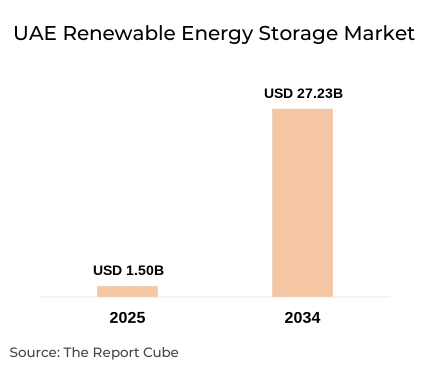
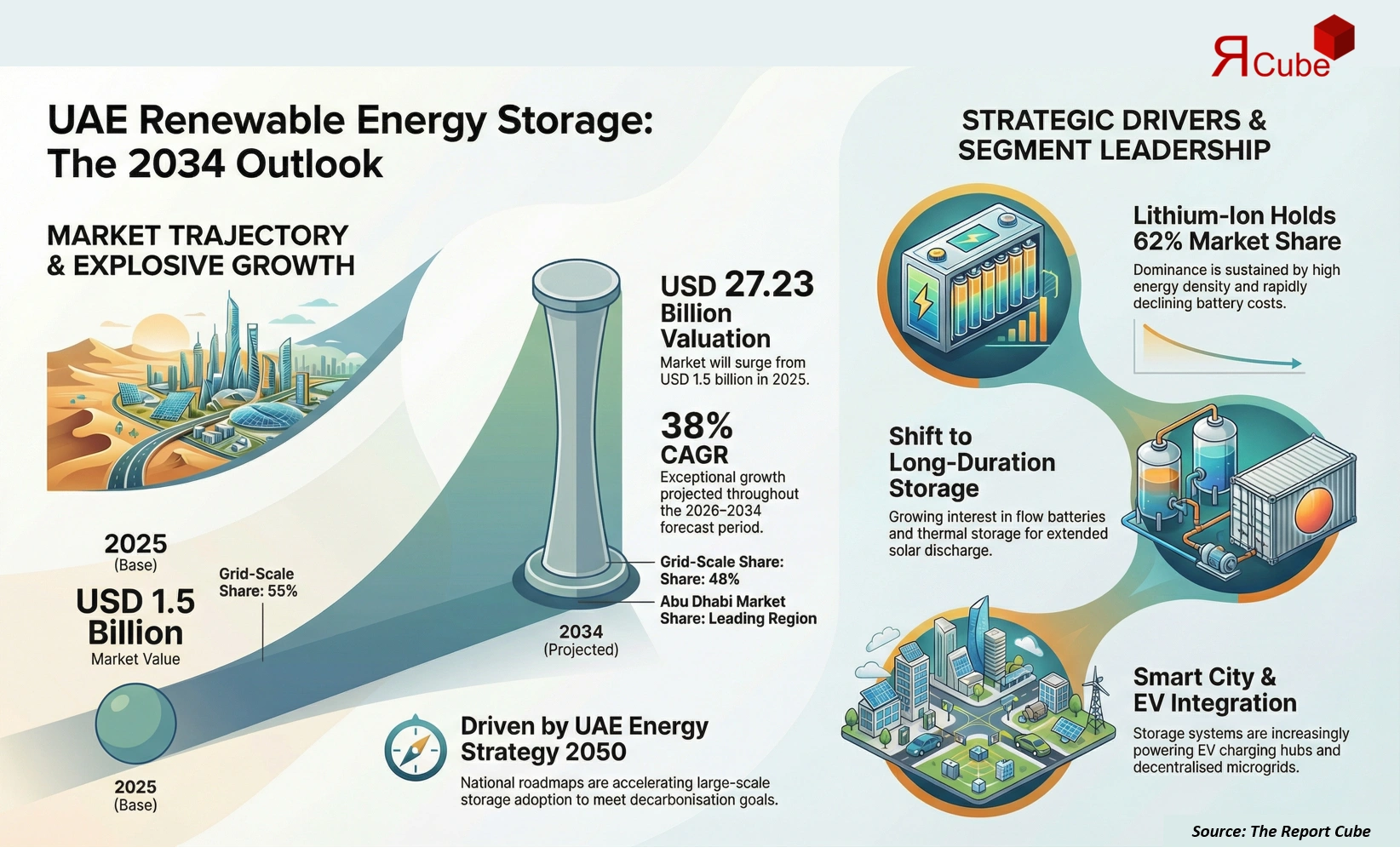
The UAE Renewable Energy Storage Market is anticipated to register a CAGR of 38% during 2026-2034. The market size was valued at USD 1.5 billion in 2025 and is projected to reach USD 27.23 billion by 2034. The market is entering a high-growth phase as the UAE accelerates its transition toward clean energy, grid resilience, and long-term decarbonization goals. Large-scale renewable projects, particularly solar photovoltaic installations, are driving the need for efficient and scalable energy storage solutions to manage intermittency and ensure stable power supply.
This rapid expansion is closely aligned with the UAE’s national energy diversification strategy, which targets a significant reduction in reliance on fossil fuels. Energy storage systems are increasingly viewed as critical infrastructure that enables higher renewable penetration while maintaining grid reliability. Utilities, independent power producers, and industrial consumers are investing heavily in advanced storage technologies to support peak shaving, frequency regulation, and load balancing. As a result, energy storage is evolving from a supplementary asset into a core component of the UAE’s power ecosystem.
Furthermore, declining battery costs, improved energy density, and favorable regulatory frameworks are accelerating commercial adoption. Both public and private stakeholders are prioritizing long-duration storage solutions to support round-the-clock clean energy availability. These interconnected factors collectively underpin the exceptional growth outlook for the UAE Renewable Energy Storage Market through 2034.
UAE Renewable Energy Storage Market Recent Developments
- 2025: Abu Dhabi commissioned a utility-scale battery storage project supporting large solar capacity integration.
- 2025: Dubai expanded grid-scale storage pilots to enhance peak demand management and grid stability.
Government Initiatives & Policies
- UAE Energy Strategy 2050: National roadmap promoting renewable energy and large-scale energy storage adoption.
- Dubai Clean Energy Strategy 2050: Supports advanced storage technologies to achieve clean energy targets.
UAE Renewable Energy Storage Market Dynamics
Key Driver: Aggressive Renewable Energy Expansion and Grid Modernization
The UAE’s aggressive expansion of renewable energy capacity is the primary driver of the renewable energy storage market. Massive solar projects and increasing wind integration are creating a strong need for storage systems capable of managing variability and ensuring grid reliability. Energy storage enables utilities to store excess generation during low-demand periods and dispatch power during peak hours, reducing curtailment and enhancing asset utilization. Grid modernization initiatives, including smart grid deployment and digital energy management, further amplify the demand for flexible storage solutions. As renewable penetration continues to rise, energy storage is becoming indispensable for maintaining power quality and system stability.
Book your FREE 30-minute expert consultation today
Contact UsIndustry Trends: Shift Toward Large-Scale and Long-Duration Storage Solutions
A notable trend in the UAE Renewable Energy Storage Market is the shift toward large-scale and long-duration storage technologies. While lithium-ion batteries currently dominate deployments, interest in flow batteries, thermal storage, and pumped hydro systems is increasing due to their suitability for extended discharge durations. Utilities are prioritizing solutions that can support multi-hour storage to align with solar generation profiles. Additionally, hybrid projects combining renewable generation with integrated storage are becoming more common, improving project economics and grid performance. This trend reflects a strategic move toward resilience-focused energy infrastructure.
Major Challenge: High Initial Capital Investment Requirements
Despite strong growth prospects, high upfront capital costs remain a significant challenge for the UAE Renewable Energy Storage Market. Large-scale storage projects require substantial investment in technology, grid integration, and supporting infrastructure. While costs are declining, long-duration and emerging storage technologies still face economic barriers. Financing complexity and long payback periods can delay project execution, particularly for private developers. Addressing these challenges will require innovative financing models, regulatory incentives, and continued cost reductions to sustain long-term market momentum.
Opportunity: Integration of Storage with EV Infrastructure and Smart Cities
The rapid development of electric vehicle infrastructure and smart city initiatives presents a major opportunity for the market. Energy storage systems are increasingly integrated with EV charging hubs to manage load demand and reduce grid stress. In smart cities, storage supports decentralized energy systems, microgrids, and demand response programs. These applications create diversified revenue streams and enhance system flexibility. As urbanization and electrification accelerate, energy storage will play a central role in enabling efficient, low-carbon urban energy systems across the UAE.
UAE Renewable Energy Storage Market Segment-wise Analysis
By Technology:
- Lithium-Ion Batteries
- Flow Batteries
- Pumped Hydro Storage
- Thermal Storage
Lithium-ion batteries lead the UAE Renewable Energy Storage Market by technology, accounting for nearly 62% of installed capacity in 2025. Their dominance is driven by high energy density, fast response times, and declining costs. These systems are widely deployed in grid-scale and commercial applications. However, flow batteries and thermal storage are gaining attention for long-duration use cases, particularly in large renewable projects where extended discharge capability is critical.
By Application:
- Grid-Scale Storage
- Commercial & Industrial
- Residential Storage
- Microgrids
Grid-scale storage represents the largest application segment, holding approximately 55% market share in 2025. Utility-led deployments focus on peak shaving, frequency regulation, and renewable integration. Commercial and industrial users are increasingly adopting storage to reduce energy costs and improve reliability. Residential storage remains smaller but is expected to grow steadily as rooftop solar adoption expands and energy awareness increases.
Regional Projection of UAE Renewable Energy Storage Industry
- Abu Dhabi
- Dubai
- Sharjah
- Northern Emirates
Abu Dhabi leads the UAE Renewable Energy Storage Market, contributing approximately 48% of total market value in 2025. The emirate benefits from large-scale renewable projects, strong government backing, and utility-driven storage investments. Dubai follows closely, driven by smart grid initiatives and clean energy targets. Other emirates are gradually increasing adoption, supported by distributed energy projects and localized grid enhancement programs.
Need insights for a specific region within this market?
Request Regional DataWhy Choose This Report?
- Provides a comprehensive overview of the overall market analysis, encompassing key trends, consumer behavior analysis, and risk assessment to support strategic decision-making.
- Provides accurate, up-to-date insights into market size, segmentation, and emerging opportunities, helping to minimize risk & capitalizing on growth.
- Gives deep understanding of target audience preferences, investment habits, and communication channels for enhanced product development & marketing effectiveness.
- Delivers competitive analysis & benchmarking, uncovering the strengths & weaknesses of market competitors to guide strategies.
- Consolidate comprehensive market intelligence, reducing reasoning & streamlining research efforts.
- Facilitates customized market segmentation & risk mitigation strategies, fine-tuned to the business objectives.
- Aids in identifying both market challenges & untapped opportunities within the industry to drive long-term business growth.
- Provides valuable information based on actual customer data & search trends.
Table of Contents
- Introduction
- Objective of the Study
- Product and Category Definition
- Market Segmentation
- Study Variables
- Research Methodology
- Secondary Data Points
- Breakdown of Secondary Sources
- Primary Data Points
- Breakdown of Primary Interviews
- Secondary Data Points
- Executive Summary
- Market Dynamics
- Drivers
- Challenges
- Opportunity Assessment
- Recent Trends and Developments
- Regulatory and Policy Landscape
- UAE Renewable Energy Storage Market Overview (2020-2034)
- Market Size, By Value (USD Billion)
- Market Share, By Technology
- Lithium-Ion Batteries
- Flow Batteries
- Pumped Hydro Storage
- Thermal Storage
- Flywheel Systems
- Market Share, By Application
- Grid-Scale Storage
- Commercial & Industrial
- Residential Storage
- Microgrids
- EV Charging Hubs
- Market Share, By Connection Type
- On-Grid Systems
- Off-Grid Systems
- Market Share, By Deployment Mode
- New-Build Projects
- Retrofit Projects
- Market Share, By Region (Market Geography)
- Abu Dhabi
- Dubai
- Sharjah
- Northern Emirates
- Market Share, By Company
- Revenue Shares
- Competitive Landscape
- Abu Dhabi Renewable Energy Storage Market
- Market Size, By Value (USD Billion)
- Market Share, By Technology
- Market Share, By Application
- Market Share, By Connection Type
- Market Share, By Deployment Mode
- Dubai Renewable Energy Storage Market
- Market Size, By Value (USD Billion)
- Market Share, By Technology
- Market Share, By Application
- Market Share, By Connection Type
- Market Share, By Deployment Mode
- Sharjah Renewable Energy Storage Market
- Market Size, By Value (USD Billion)
- Market Share, By Technology
- Market Share, By Application
- Market Share, By Connection Type
- Market Share, By Deployment Mode
- Northern Emirates Renewable Energy Storage Market
- Market Size, By Value (USD Billion)
- Market Share, By Technology
- Market Share, By Application
- Market Share, By Connection Type
- Market Share, By Deployment Mode
- Competitive Outlook and Company Profiles
- Tesla Inc.
- Company Overview
- Product Portfolio
- Strategic Alliances/Partnerships
- Recent Developments
- Samsung SDI
- Company Overview
- Product Portfolio
- Strategic Alliances/Partnerships
- Recent Developments
- LG Energy Solution
- Company Overview
- Product Portfolio
- Strategic Alliances/Partnerships
- Recent Developments
- ABB Ltd
- Company Overview
- Product Portfolio
- Strategic Alliances/Partnerships
- Recent Developments
- GE Vernova
- Company Overview
- Product Portfolio
- Strategic Alliances/Partnerships
- Recent Developments
- Siemens Energy
- Company Overview
- Product Portfolio
- Strategic Alliances/Partnerships
- Recent Developments
- BYD Company
- Company Overview
- Product Portfolio
- Strategic Alliances/Partnerships
- Recent Developments
- Fluence Energy
- Company Overview
- Product Portfolio
- Strategic Alliances/Partnerships
- Recent Developments
- NGK Insulators
- Company Overview
- Product Portfolio
- Strategic Alliances/Partnerships
- Recent Developments
- Eaton Corporation
- Company Overview
- Product Portfolio
- Strategic Alliances/Partnerships
- Recent Developments
- Others
- Tesla Inc.
- Contact Us and Disclaimer
Top Key Players & Market Share Outlook
- Tesla Inc.
- Samsung SDI
- LG Energy Solution
- ABB Ltd
- GE Vernova
- Siemens Energy
- BYD Company
- Fluence Energy
- NGK Insulators
- Eaton Corporation
- Others
Frequently Asked Questions






