



Build Your Custom Market Intelligence Report
Customize Your ReportGlobal Forklift Battery Market Key Highlights
By Forklift Class:
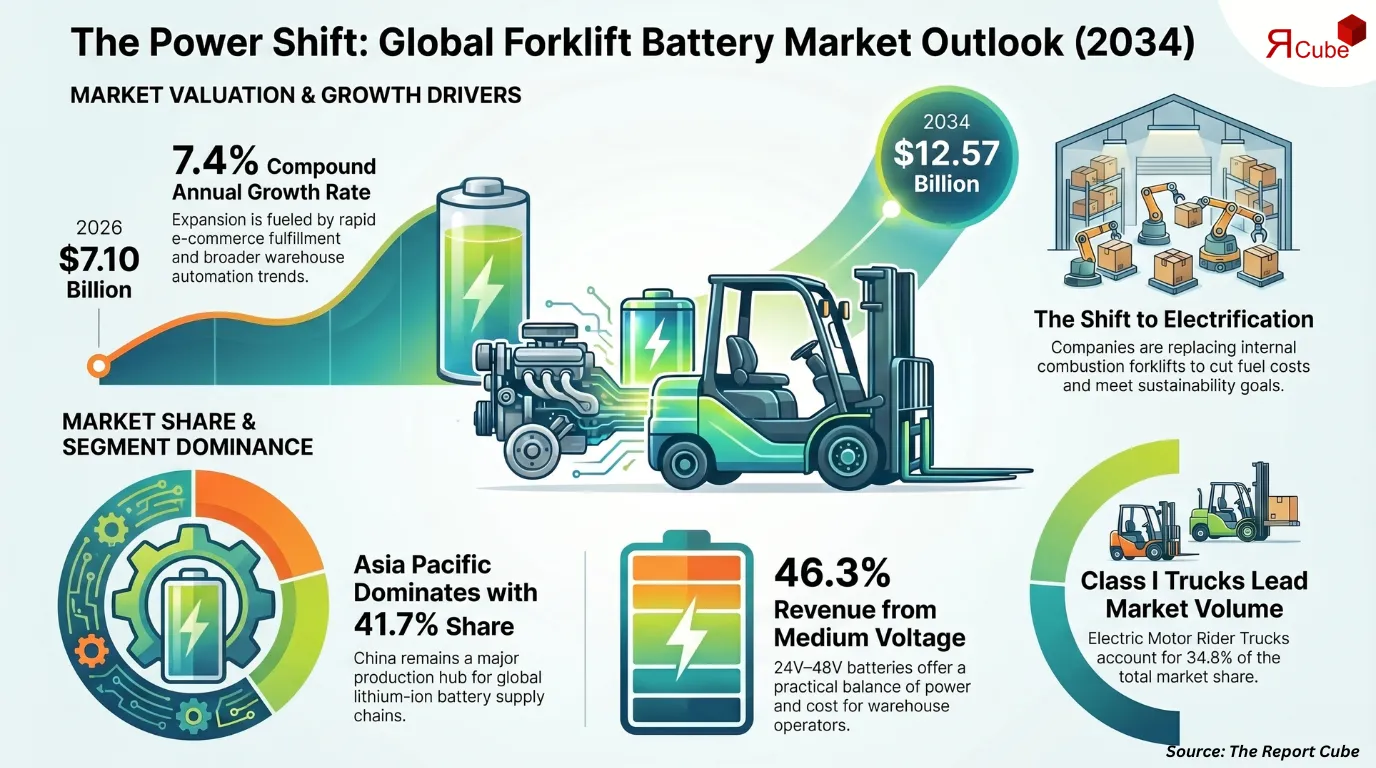
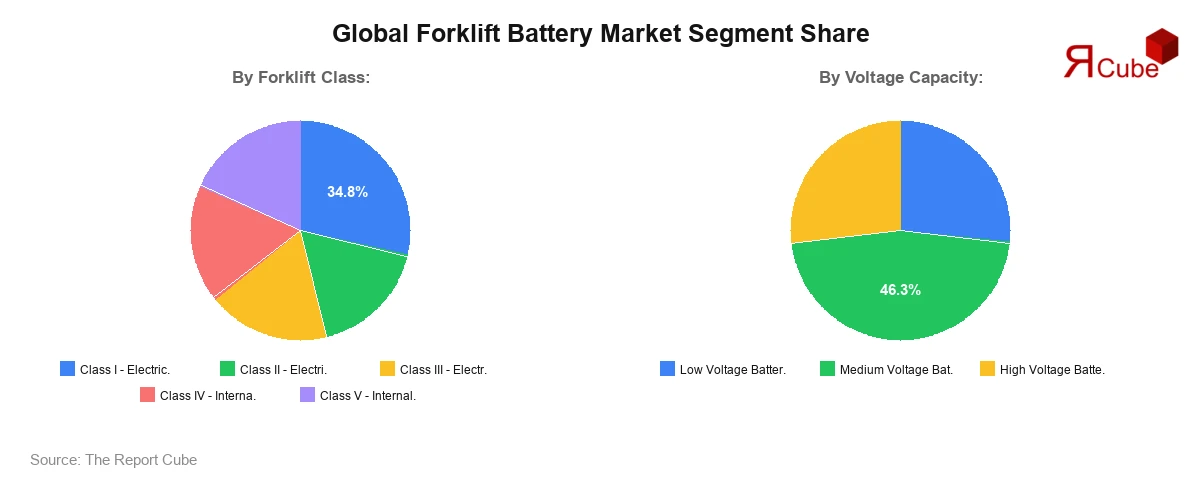
Class I - Electric Motor Rider Trucks segment leads the market with nearly 34.8% share.
By Voltage Capacity:
Medium Voltage Batteries (24V - 48V) segment dominates the market with approximately 46.3% of total revenue.
Regional Outlook:
Asia Pacific dominates the Global Forklift Battery Market with nearly 41.7% share.
Global Forklift Battery Market Insights & Analysis
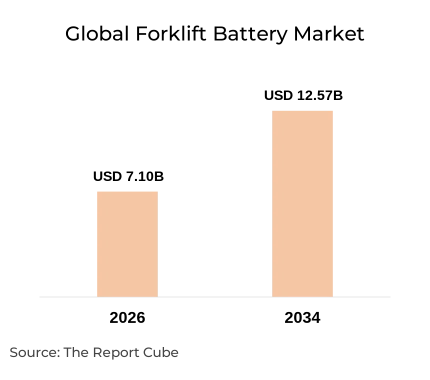
The Global Forklift Battery Market is anticipated to register a CAGR of around 7.4% during the forecast period 2026-2034. The market size is valued at USD 7.10 billion in 2026 and is projected to reach USD 12.57 billion by 2034. Growth in the forklift battery market is closely tied to the broader shift toward warehouse automation, the rapid expansion of e-commerce fulfillment networks, and the steady move toward electric material handling equipment. Across logistics operations, many companies are replacing internal combustion forklifts with battery-powered alternatives to cut fuel costs, improve efficiency, and meet sustainability goals. Within this shift, lithium-ion forklift batteries are gaining momentum thanks to their faster charging capability, opportunity charging, and lower maintenance needs compared to traditional lead-acid systems.
At the same time, battery manufacturers are scaling up production and adding more advanced features such as battery management systems, predictive monitoring tools, and smarter charging technologies. Growing industrial electrification in regions like North America, Europe, and Asia Pacific is further strengthening demand for high-performance traction batteries. Investments in lithium processing, recycling infrastructure, and localized supply chains are also helping stabilize supply and improve competitiveness. On the regulatory side, stricter emissions standards and workplace safety requirements are accelerating the adoption of electric forklifts across warehousing, retail distribution, food processing, automotive, and third-party logistics sectors, supporting sustained long-term market growth.
Global Forklift Battery Market Impact Analysis
| Factor | Type | Specific Impact on Market | Magnitude | Business Implication |
|---|---|---|---|---|
| Growth in Warehousing & E‑commerce | Market | Higher material handling activity lifts global forklift usage. | High | Drives sustained demand for new and replacement forklift batteries. |
| Shift from ICE to Electric Forklifts | Technological | Electrification of fleets increases battery content per forklift. | High | Boosts long‑term battery volumes and value per unit sold. |
| Advances in Lithium‑ion Technology | Technological | Li‑ion offers fast charging and longer cycle life than lead acid. | High | Enables premium pricing and deeper penetration in intensive duty fleets. |
| Dominance and Maturity of Lead‑acid | Competitive | Low‑cost lead‑acid remains widely used and well established. | Medium | Creates price pressure yet protects volumes in cost‑sensitive segments. |
| Stringent Workplace Safety & Emission Norms | Regulatory | Rules favor low‑emission electric equipment in warehouses. | Medium | Accelerates fleet conversion to battery powered forklifts globally. |
| Asia Pacific Production & Demand Hub | Market | Region leads battery manufacturing and forklift deployment growth. | High | Shifts investment focus toward APAC for capacity and partnerships. |
| Recycling and Sustainability Requirements | Environmental | Recycling rules shape chemistry choice and lifecycle economics. | Medium | Drives need for circular programs and greener battery portfolios. |
Global Forklift Battery Market Dynamics
Key Driver: Rapid Electrification of Warehousing and Material Handling Operations
Demand for more efficient warehouse operations continues to be a key driver of the forklift battery market. E-commerce platforms, retail distribution networks, and manufacturing facilities are increasingly investing in electric forklifts to enhance productivity while reducing operating costs. Compared to diesel-powered alternatives, battery-operated forklifts offer lower emissions, quieter performance, and reduced maintenance needs, making them especially suitable for indoor logistics environments where air quality and noise control are important.
At the same time, corporate sustainability initiatives are playing a major role in accelerating adoption. Large warehouse operators are pursuing carbon reduction targets by electrifying their material handling fleets, while rising fuel costs and stricter workplace emission regulations further support the shift away from internal combustion equipment. As more industrial facilities deploy automated storage and retrieval systems, the need for reliable, high-performance forklift batteries capable of supporting continuous, high-intensity operations is expected to grow steadily over the forecast period
Industry Trends: Growing Shift Toward Lithium-Ion and Smart Battery Technologies
Lithium-ion technology is increasingly reshaping the forklift battery industry as operators prioritize higher energy density, faster charging cycles, and longer service life. Many logistics facilities now favor lithium-ion systems because they eliminate the need for battery watering and significantly reduce downtime associated with battery swapping and maintenance. Opportunity charging has also become a key advantage in high-throughput warehouse environments, allowing forklifts to be recharged during short breaks and kept in near-continuous operation.
Alongside chemistry improvements, battery manufacturers are integrating advanced monitoring platforms, cloud-based diagnostics, and sophisticated battery management systems that deliver real-time performance insights. These smart battery solutions support predictive maintenance by identifying potential issues early, helping to extend equipment uptime and reduce unexpected failures. This trend is especially prominent in automated warehouse settings, where uninterrupted forklift availability is critical to maintaining productivity. As a result, demand is rising for premium battery suppliers that can deliver intelligent, connected energy management systems rather than basic power storage solutions.
Book your FREE 30-minute expert consultation today
Contact UsMajor Challenge: Supply Chain Volatility and Raw Material Cost Fluctuations
The forklift battery market continues to face structural challenges tied to the supply chains of key raw materials such as lithium, nickel, cobalt, and graphite. Price volatility in these inputs creates ongoing uncertainty for battery manufacturers and forklift OEMs, often influencing both production costs and end-user pricing. In addition, geopolitical tensions, evolving trade policies, and constrained availability of critical minerals can disrupt procurement cycles and extend delivery timelines, adding further complexity to supply planning.
At the same time, industrial battery producers are under increasing compliance pressure from recycling mandates, sustainability reporting frameworks, and battery traceability regulations across major markets. While efforts to diversify supply chains and secure alternative sourcing routes are underway, the industry still remains heavily dependent on a relatively limited group of upstream suppliers. As a result, manufacturers must carefully balance cost competitiveness with rising investments in sustainable sourcing practices, closed-loop recycling systems, and regulatory compliance, factors that are expected to weigh on profit margins over the forecast period.
Opportunity: Expansion of Battery Recycling and Regional Manufacturing Capacity
Rising investment in domestic battery manufacturing and recycling infrastructure is creating significant opportunities for forklift battery suppliers. Governments in major economies are increasingly promoting localized battery production to reduce reliance on imports, strengthen industrial resilience, and secure critical supply chains. The expansion of new manufacturing facilities is also improving the availability of industrial batteries, while aligning with broader energy security and industrial policy objectives.
In parallel, battery recycling initiatives are emerging as an important growth avenue. Industrial fleet operators are placing greater emphasis on sustainable end-of-life battery management to meet environmental and ESG targets. As a result, demand is increasing for efficient collection, processing, and material recovery solutions. The development of circular battery ecosystems, including advanced recycling technologies and second-life battery applications, is expected to enhance resource efficiency and reduce long-term operating costs. Companies that invest early in recycling capabilities and localized supply networks are likely to strengthen their competitive positioning in the evolving forklift battery market.
Global Forklift Battery Market Segment-wise Analysis
By Forklift Class:
- Class I - Electric Motor Rider Trucks
- Counterbalanced Electric Forklifts
- Electric Sit-Down Rider Forklifts
- Electric Pneumatic Tire Forklifts
- Class II - Electric Narrow Aisle Trucks
- Reach Trucks
- Order Pickers
- Turret Trucks
- Class III - Electric Hand Trucks
- Pallet Jacks
- Walkie Stackers
- Tow Tractors
- Class IV - Internal Combustion Cushion Tire Forklifts
- Hybrid-Compatible Forklifts
- Auxiliary Battery Systems
- Class V - Internal Combustion Pneumatic Tire Forklifts
- Electrified Retrofit Forklifts
- Hybrid Power Forklifts
Class I electric motor rider trucks currently represent the largest share of the global forklift battery market, accounting for approximately 34.8% of total revenue in 2026. This dominance is driven by their extensive deployment in high-utilization environments such as warehouse logistics, retail distribution centers, automotive manufacturing facilities, and food processing plants, where continuous, multi-shift operations are common. Within this category, counterbalanced electric forklifts and sit-down rider models remain the most widely used due to their operational versatility, load-handling efficiency, and suitability for indoor material handling tasks. These characteristics make them essential assets in modern supply chain and industrial operations.
A key trend shaping this segment is the accelerating shift toward lithium-ion battery systems. Compared to traditional lead-acid batteries, lithium-ion solutions offer faster charging times, reduced maintenance requirements, and longer operational uptime, enabling higher fleet productivity and improved energy efficiency. Looking ahead, the rapid expansion of automated fulfillment centers and smart warehouse infrastructure, particularly across Asia Pacific and North America, is expected to further drive demand for advanced forklift battery systems. As logistics networks continue to prioritize automation, electrification, and sustainability, Class I electric forklift fleets are likely to remain a core growth driver in the global battery market.
By Voltage Capacity:
- Low Voltage Batteries (12V - 24V)
- Medium Voltage Batteries (24V - 48V)
- High Voltage Batteries (48V and Above)
Medium-voltage forklift batteries (24V to 48V) hold the largest share of the market at about 46.3% because they fit a wide range of warehouse equipment such as electric rider trucks, reach trucks, and pallet movers. They offer a practical balance between power, runtime, and cost, which makes them a preferred option for warehouse operators. Instead of investing in higher-voltage systems, many facilities choose this range because it can support mixed fleets while keeping charging infrastructure relatively simple.
There is also a clear shift toward lithium-ion batteries in this segment. Operators are moving away from traditional chemistries to improve uptime, reduce maintenance needs, and increase overall productivity. At the same time, battery management systems are being adopted more widely to track battery health, optimize charging cycles, and reduce unexpected downtime. As global warehousing demand grows and operations become more time sensitive, medium-voltage battery systems are expected to remain a strong growth category.
Regional Projection of Global Forklift Battery Industry
- North America
- Europe
- Asia Pacific
- Middle East and Africa
- South America
Asia Pacific leads the global forklift battery market with an estimated 41.7 percent share. Countries such as China, Japan, South Korea, and India are making substantial investments in battery manufacturing capacity, warehouse infrastructure, and industrial automation technologies. The rapid expansion of e-commerce fulfillment networks across the region has significantly increased demand for electric forklifts and their associated battery systems. China continues to serve as a major production hub for lithium-ion batteries, supporting both domestic demand and global supply chains.
Industrial growth in Southeast Asia is also contributing to market expansion as manufacturers upgrade logistics and material handling operations. In addition, government incentives for battery production, rising adoption of electric industrial vehicles, and the strong presence of leading battery manufacturers are reinforcing Asia Pacific’s position as the largest regional market for forklift battery solutions.
Need insights for a specific region within this market?
Request Regional DataGlobal Forklift Battery Market Regional Analysis
The global forklift battery market varies significantly across regions due to industrialization levels, e-commerce growth, and electrification adoption rates.
| Region | Demand Level | Key Markets | Battery Type Dominance | Core Demand Logic | Growth Nature |
|---|---|---|---|---|---|
| North America | Very High | United States, Canada | Lithium-ion (54.62% share) | E-commerce warehouses & logistics automation | Technology-driven growth |
| Europe | High | Germany, France, UK | Electric AC (53% share) | Sustainability regulations & green mandates | ESG-compliance expansion |
| Asia Pacific | Extremely High | China, Japan, India | Li-ion & Lead-acid mix | Manufacturing boom & industrial expansion | Fastest-growing segment |
| Middle East & Africa | Medium | UAE, Saudi Arabia, Turkey | Electric forklifts rising | Infrastructure projects & diversification | Emerging market growth |
| South America | High | Brazil, Mexico, Argentina | Lithium-ion adoption | Logistics expansion & nearshoring demand | Golden lane expansion |
Government Initiatives & Policies
- European Union Battery Regulation (EU 2023/1542): The regulation strengthens battery sustainability, labeling, recycling efficiency, supply-chain transparency, and lifecycle management requirements for industrial batteries.
- U.S. Department of Energy Advanced Battery Manufacturing Program: The DOE continues supporting domestic battery production, processing, recycling, and supply-chain development through multi-billion-dollar funding initiatives aimed at strengthening industrial battery manufacturing capacity.
Global Forklift Battery Industry Recent Developments
- 2026: EnerSys highlighted expanding lithium-battery commercialization initiatives and industrial energy-storage investments during fiscal 2026 earnings discussions, reinforcing long-term growth strategies across material handling and warehouse electrification applications.
- 2026: Crown Equipment Corporation promoted V-Force lithium-ion battery upgrades for warehouse forklifts, focusing on enhanced charging performance, reduced maintenance requirements, and improved fleet productivity.
- 2025: Contemporary Amperex Technology Co. Limited advanced Indonesia battery manufacturing investments, supporting global industrial battery production capacity and long-term supply chain diversification.
- 2025: EnerSys initiated strategic restructuring programs aimed at improving industrial battery operations, operational efficiency, and long-term profitability performance.
Why Choose This Report?
- Provides a comprehensive overview of the overall market analysis, encompassing key trends, consumer behavior analysis, and risk assessment to support strategic decision-making.
- Provides accurate, up-to-date insights into market size, segmentation, and emerging opportunities, helping to minimize risk & capitalizing on growth.
- Gives deep understanding of target audience preferences, investment habits, and communication channels for enhanced product development & marketing effectiveness.
- Delivers competitive analysis & benchmarking, uncovering the strengths & weaknesses of market competitors to guide strategies.
- Consolidate comprehensive market intelligence, reducing reasoning & streamlining research efforts.
- Facilitates customized market segmentation & risk mitigation strategies, fine-tuned to the business objectives.
- Aids in identifying both market challenges & untapped opportunities within the industry to drive long-term business growth.
- Provides valuable information based on actual customer data & search trends.
Table of Contents
- Introduction
- Objective of the Study
- Product and Category Definition
- Market Segmentation
- Study Variables
- Research Methodology
- Secondary Data Points
- Breakdown of Secondary Sources
- Primary Data Points
- Breakdown of Primary Interviews
- Secondary Data Points
- Executive Summary
- Market Dynamics
- Emerging Opportunities
- Adoption Trends
- Demand Drivers
- Disruption Analysis (Challenges)
- Industry Analysis & Strategic Insights
- Supply/Value Chain Analysis
- Pricing Analysis
- Go-To-Market (GTM) Strategy
- BCG Matrix
- Recent Trends and Developments
- Import and Export Analysis
- Regulatory and Policy Landscape
- Region-wise policies
- Government Initiatives
- Global Forklift Battery Market Overview and Forecast Analysis (2021-2034)
- Market Size, By Value, By Growth Rate (CAGR/USD Billion)
- Market Share, By Battery Type
- Emerging Battery Technologies
- Nickel-Based Batteries
- Nickel-Metal Hydride Batteries
- Nickel-Iron Batteries
- Nickel-Cadmium Batteries
- Lithium-Ion Batteries
- High-Voltage Lithium Batteries
- Modular Lithium Forklift Batteries
- Lithium Titanate Oxide (LTO) Batteries
- Smart Lithium Batteries with BMS
- Lithium Manganese Oxide (LMO) Batteries
- Lithium Iron Phosphate (LFP) Batteries
- Lithium Cobalt Oxide (LCO) Batteries
- Lithium Nickel Manganese Cobalt (NMC) Batteries
- Lead-Acid Batteries
- Deep Cycle Lead-Acid Batteries
- Flooded Lead-Acid Batteries
- Gel Batteries
- Opportunity-Charging Lead-Acid Batteries
- Thin Plate Pure Lead (TPPL) Batteries
- Motive Power Lead-Acid Batteries
- Flat Plate Batteries
- AGM (Absorbent Glass Mat) Batteries
- Sealed Lead-Acid Batteries
- Fast-Charge Lead-Acid Batteries
- VRLA (Valve Regulated Lead Acid) Batteries
- Tubular Plate Batteries
- Market Share, By Forklift Class
- Class I - Electric Motor Rider Trucks
- Counterbalanced Electric Forklifts
- Electric Sit-Down Rider Forklifts
- Electric Pneumatic Tire Forklifts
- Class II - Electric Narrow Aisle Trucks
- Reach Trucks
- Order Pickers
- Turret Trucks
- Class III - Electric Hand Trucks
- Pallet Jacks
- Walkie Stackers
- Tow Tractors
- Class IV - Internal Combustion Cushion Tire Forklifts
- Hybrid-Compatible Forklifts
- Auxiliary Battery Systems
- Class V - Internal Combustion Pneumatic Tire Forklifts
- Electrified Retrofit Forklifts
- Hybrid Power Forklifts
- Class I - Electric Motor Rider Trucks
- Market Share, By Voltage Capacity
- Low Voltage Batteries (12V - 24V)
- Medium Voltage Batteries (24V - 48V)
- High Voltage Batteries (48V and Above)
- Market Share, By Battery Capacity
- Below 200 Ah
- 200 - 600 Ah
- 600 Ah and Above
- Market Share, By Charging Technology
- Wireless Charging
- Autonomous Charging Docks
- Inductive Charging
- Fast Charging
- Rapid DC Chargers
- High Frequency Chargers
- Smart Charging Systems
- AI-Based Energy Optimization Chargers
- IoT-Enabled Chargers
- Opportunity Charging
- Shift-Based Charging
- Partial State Charging
- Conventional Charging
- Multi-Shift Charging
- Overnight Charging
- Wireless Charging
- Market Share, By Application
- Food & Beverage
- Retail & E-Commerce
- Construction
- Manufacturing
- Warehousing
- Pharmaceuticals
- Mining
- Logistics & Freight
- Others
- Market Share, By End-User
- Commercial Sector
- SMEs
- Large Enterprises
- Government & Public Sector
- Industrial Sector
- Others
- Market Share, By Sales Channel
- Distributor Sales
- Aftermarket Sales
- Online Sales
- OEM Sales
- Market Share, By Region
- North America
- Europe
- Asia Pacific
- Middle East and Africa
- South America
- Market Share, By Company
- Revenue Shares & Analysis
- Competitive Landscape
- North America Forklift Battery Market Overview and Forecast Analysis (2021-2034)
- Market Size, By Value, By Growth Rate (CAGR/USD Billion/Million)
- Market Share, By Battery Type
- Market Share, By Forklift Class
- Market Share, By Voltage Capacity
- Market Share, By Battery Capacity
- Market Share, By Charging Technology
- Market Share, By Application
- Market Share, By End-User
- Market Share, By Sales Channel
- Market Share, By Country
- The US
- Canada
- Mexico
- Rest of North America
- Europe Forklift Battery Market Overview and Forecast Analysis (2021-2034)
- Market Size, By Value, By Growth Rate (CAGR/USD Billion/Million)
- Market Share, By Battery Type
- Market Share, By Forklift Class
- Market Share, By Voltage Capacity
- Market Share, By Battery Capacity
- Market Share, By Charging Technology
- Market Share, By Application
- Market Share, By End-User
- Market Share, By Sales Channel
- Market Share, By Country
- Germany
- The UK
- France
- Italy
- Spain
- Netherlands
- Russia
- Poland
- Belgium
- Sweden
- Rest of Europe
- Asia Pacific Forklift Battery Market Overview and Forecast Analysis (2021-2034)
- Market Size, By Value, By Growth Rate (CAGR/USD Billion/Million)
- Market Share, By Battery Type
- Market Share, By Forklift Class
- Market Share, By Voltage Capacity
- Market Share, By Battery Capacity
- Market Share, By Charging Technology
- Market Share, By Application
- Market Share, By End-User
- Market Share, By Sales Channel
- Market Share, By Country
- China
- India
- Japan
- South Korea
- Australia
- Indonesia
- Thailand
- Malaysia
- Vietnam
- Philippines
- Singapore
- New Zealand
- Rest of Asia-Pacific
- Middle East and Africa Forklift Battery Market Overview and Forecast Analysis (2021-2034)
- Market Size, By Value, By Growth Rate (CAGR/USD Billion/Million)
- Market Share, By Battery Type
- Market Share, By Forklift Class
- Market Share, By Voltage Capacity
- Market Share, By Battery Capacity
- Market Share, By Charging Technology
- Market Share, By Application
- Market Share, By End-User
- Market Share, By Sales Channel
- Market Share, By Country
- Saudi Arabia
- The UAE
- South Africa
- Egypt
- Nigeria
- Morocco
- Turkey
- Rest of the Middle East & Africa
- South America Forklift Battery Market Overview and Forecast Analysis (2021-2034)
- Market Size, By Value, By Growth Rate (CAGR/USD Billion/Million)
- Market Share, By Battery Type
- Market Share, By Forklift Class
- Market Share, By Voltage Capacity
- Market Share, By Battery Capacity
- Market Share, By Charging Technology
- Market Share, By Application
- Market Share, By End-User
- Market Share, By Sales Channel
- Market Share, By Country
- Brazil
- Argentina
- Chile
- Colombia
- Peru
- Rest of South America
- Competitive Analysis, 2026
- Market Share of Key Players
- Competitive Mapping for Each Segment and Companies Operating Regionally
- North America Forklift Battery Companies Share & Competitive Analysis, 2026
- Europe Forklift Battery Companies Share & Competitive Analysis, 2026
- Asia Pacific Forklift Battery Companies Share & Competitive Analysis, 2026
- Middle East and Africa Forklift Battery Companies Share & Competitive Analysis, 2026
- South America Forklift Battery Companies Share & Competitive Analysis, 2026
- Company Profile (Partial List)
- Sunlight Group
- Company Overview
- Product Portfolio
- Strategic Alliances/Partnerships
- Recent Developments
- KION Group
- Company Overview
- Product Portfolio
- Strategic Alliances/Partnerships
- Recent Developments
- EnerSys
- Company Overview
- Product Portfolio
- Strategic Alliances/Partnerships
- Recent Developments
- Flux Power Holdings
- Company Overview
- Product Portfolio
- Strategic Alliances/Partnerships
- Recent Developments
- Mitsubishi Logisnext
- Company Overview
- Product Portfolio
- Strategic Alliances/Partnerships
- Recent Developments
- Electrovaya
- Company Overview
- Product Portfolio
- Strategic Alliances/Partnerships
- Recent Developments
- East Penn Manufacturing
- Company Overview
- Product Portfolio
- Strategic Alliances/Partnerships
- Recent Developments
- Hangcha Group
- Company Overview
- Product Portfolio
- Strategic Alliances/Partnerships
- Recent Developments
- Leoch International Technology
- Company Overview
- Product Portfolio
- Strategic Alliances/Partnerships
- Recent Developments
- Jungheinrich AG
- Company Overview
- Product Portfolio
- Strategic Alliances/Partnerships
- Recent Developments
- Exide Technologies
- Company Overview
- Product Portfolio
- Strategic Alliances/Partnerships
- Recent Developments
- Clark Material Handling
- Company Overview
- Product Portfolio
- Strategic Alliances/Partnerships
- Recent Developments
- Toyota Industries Corporation
- Company Overview
- Product Portfolio
- Strategic Alliances/Partnerships
- Recent Developments
- GS Yuasa Corporation
- Company Overview
- Product Portfolio
- Strategic Alliances/Partnerships
- Recent Developments
- BYD Company
- Company Overview
- Product Portfolio
- Strategic Alliances/Partnerships
- Recent Developments
- Triathlon Batterien GmbH
- Company Overview
- Product Portfolio
- Strategic Alliances/Partnerships
- Recent Developments
- Hoppecke Batterien
- Company Overview
- Product Portfolio
- Strategic Alliances/Partnerships
- Recent Developments
- Crown Equipment Corporation
- Company Overview
- Product Portfolio
- Strategic Alliances/Partnerships
- Recent Developments
- Anhui Forklift Group
- Company Overview
- Product Portfolio
- Strategic Alliances/Partnerships
- Recent Developments
- Hyster-Yale Materials Handling
- Company Overview
- Product Portfolio
- Strategic Alliances/Partnerships
- Recent Developments
- Saft Groupe
- Company Overview
- Product Portfolio
- Strategic Alliances/Partnerships
- Recent Developments
- Hitachi Chemical
- Company Overview
- Product Portfolio
- Strategic Alliances/Partnerships
- Recent Developments
- Amara Raja Energy & Mobility
- Company Overview
- Product Portfolio
- Strategic Alliances/Partnerships
- Recent Developments
- Doosan Bobcat
- Company Overview
- Product Portfolio
- Strategic Alliances/Partnerships
- Recent Developments
- MIDAC Batteries
- Company Overview
- Product Portfolio
- Strategic Alliances/Partnerships
- Recent Developments
- Contemporary Amperex Technology Co. Limited
- Company Overview
- Product Portfolio
- Strategic Alliances/Partnerships
- Recent Developments
- Trojan Battery Company
- Company Overview
- Product Portfolio
- Strategic Alliances/Partnerships
- Recent Developments
- Others (Partial List)
- Sunlight Group
- Contact Us and Disclaimer
Top Key Players & Market Share Outlook
- Sunlight Group
- KION Group
- EnerSys
- Flux Power Holdings
- Mitsubishi Logisnext
- Electrovaya
- East Penn Manufacturing
- Hangcha Group
- Leoch International Technology
- Jungheinrich AG
- Exide Technologies
- Clark Material Handling
- Toyota Industries Corporation
- GS Yuasa Corporation
- BYD Company
- Triathlon Batterien GmbH
- Hoppecke Batterien
- Crown Equipment Corporation
- Anhui Forklift Group
- Hyster-Yale Materials Handling
- Saft Groupe
- Hitachi Chemical
- Amara Raja Energy & Mobility
- Doosan Bobcat
- MIDAC Batteries
- Contemporary Amperex Technology Co. Limited
- Trojan Battery Company
Frequently Asked Questions






