



Build Your Custom Market Intelligence Report
Customize Your ReportGCC Beer Market Insights & Analysis
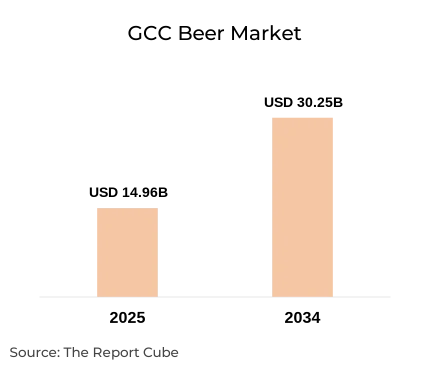
The GCC Beer Market is anticipated to register a CAGR of 8.14% during 2026-2034. The market size was valued at USD 14.96 billion in 2025 and is projected to reach USD 30.25 billion by 2034. Despite strict regulatory frameworks across several GCC countries, the market continues to expand steadily, supported by tourism growth, expatriate population inflows, and controlled licensing environments. Premiumization trends and rising demand for international beer brands are reshaping consumption patterns across approved hospitality and retail channels.
The market’s growth is closely linked to the hospitality and tourism sectors, particularly in countries such as the UAE and Bahrain, where regulated alcohol consumption is permitted. Hotels, bars, and licensed venues account for a substantial share of demand, with international tourists driving volume growth. Additionally, evolving consumer preferences toward premium and craft beer varieties are increasing average selling prices, supporting revenue expansion even where volume growth remains moderate.
Furthermore, leading brewers are investing in brand positioning, product innovation, and supply chain efficiencies to navigate regulatory complexity. Strategic partnerships with hospitality groups and duty-free retailers continue to strengthen market presence. As tourism diversification initiatives accelerate across the GCC, beer consumption within regulated frameworks is expected to rise steadily through 2034.
GCC Beer Market Recent Developments
- 2025: Heineken began building Dubai’s Sirocco brewery to locally produce Heineken, Amstel and Kingfisher for GCC.
- 2025: Anheuser‑Busch InBev expanded Corona Cero non‑alcoholic beer availability across Saudi Arabian hotels, restaurants and retail chains.
Government Initiatives & Policies
- UAE Tourism Strategy 2031: Supports hospitality expansion, indirectly boosting regulated alcohol demand.
- Bahrain Economic Vision 2030: Encourages tourism-led growth and hospitality sector investment.
GCC Beer Market Dynamics
Key Driver: Tourism Growth and Expanding Hospitality Infrastructure
The rapid expansion of tourism and hospitality infrastructure across the GCC is a primary driver of the beer market. Countries such as the UAE and Qatar are witnessing record tourist arrivals, with international visitors accounting for a significant share of beer consumption. Licensed hotels, resorts, and entertainment venues serve as controlled access points, ensuring steady demand growth. In 2025, tourism-related beer consumption represented nearly 65% of total market revenue. Large-scale events, global exhibitions, and sports tournaments further stimulate short-term demand spikes, reinforcing the market’s upward trajectory.
Book your FREE 30-minute expert consultation today
Contact UsIndustry Trends: Premiumization and Brand Differentiation
Premiumization is a defining trend in the GCC Beer Market, as consumers increasingly prefer internationally recognized and premium beer brands. High-income expatriates and tourists show willingness to pay premium prices, encouraging brewers to focus on higher-margin products rather than volume-led strategies. Craft-style offerings and specialty imports are gaining traction within licensed venues, particularly in urban centers. This trend is reshaping product portfolios, with premium and super-premium beers contributing over 40% of total revenue in 2025.
Major Challenge: Regulatory Restrictions and Limited Retail Access
Strict alcohol regulations across several GCC countries remain the most significant challenge to market expansion. In Saudi Arabia and Kuwait, beer sales are either prohibited or extremely restricted, limiting regional volume growth. Even in more liberal markets, licensing requirements, taxation, and import controls increase operational complexity and costs. These constraints restrict market penetration and require brewers to operate within narrowly defined channels, limiting scalability and increasing compliance-related expenditures.
Opportunity: Duty-Free and Controlled Retail Expansion
Duty-free outlets and controlled specialty retail stores present a major growth opportunity for the GCC Beer Market. Airports across the region are expanding duty-free zones, capturing high-spending international travelers. Additionally, regulated retail frameworks in the UAE and Bahrain are evolving to allow broader access under licensing systems. These developments enable brewers to diversify distribution while maintaining regulatory compliance, unlocking incremental revenue streams over the forecast period.
GCC Beer Market Segment-wise Analysis
By Beer Type:
- Ale
- Stouts
- Lager
- Others
Lager dominates the GCC Beer Market, accounting for approximately 52% of total market share in 2025. Its widespread international acceptance, lighter taste profile, and compatibility with diverse cuisines make it the preferred choice among tourists and expatriates. Major global brands focus heavily on lager variants, ensuring strong availability across licensed venues. Ales and stouts cater to niche segments, primarily within premium hospitality settings, while other beer types remain limited but show gradual growth.
By Distribution:
- On Trade
- Supermarkets Hypermarkets
- Convenience Stores
- Specialty Stores
- Others
The on-trade segment leads distribution, contributing nearly 60% of total beer sales in 2025. Hotels, bars, clubs, and restaurants dominate consumption due to regulatory frameworks favoring controlled environments. Specialty stores and duty-free outlets follow, driven by tourist demand. Supermarkets, hypermarkets, and convenience stores operate under strict licensing, limiting volume but supporting premium pricing strategies.
Country-wise Projection of GCC Beer Industry
- Saudi Arabia
- UAE
- Qatar
- Kuwait
- Oman
- Bahrain
The UAE leads the GCC Beer Market, accounting for approximately 48% of total regional revenue in 2025. Its mature tourism sector, liberal licensing framework, and extensive hospitality infrastructure support sustained demand. Bahrain follows as a secondary hub due to its relatively open alcohol policies. Other countries contribute marginally due to stricter regulations, though tourism-driven demand in Qatar and Oman continues to rise gradually.
Need insights for a specific region within this market?
Request Regional DataWhy Choose This Report?
- Provides a comprehensive overview of the overall market analysis, encompassing key trends, consumer behavior analysis, and risk assessment to support strategic decision-making.
- Provides accurate, up-to-date insights into market size, segmentation, and emerging opportunities, helping to minimize risk & capitalizing on growth.
- Gives deep understanding of target audience preferences, investment habits, and communication channels for enhanced product development & marketing effectiveness.
- Delivers competitive analysis & benchmarking, uncovering the strengths & weaknesses of market competitors to guide strategies.
- Consolidate comprehensive market intelligence, reducing reasoning & streamlining research efforts.
- Facilitates customized market segmentation & risk mitigation strategies, fine-tuned to the business objectives.
- Aids in identifying both market challenges & untapped opportunities within the industry to drive long-term business growth.
- Provides valuable information based on actual customer data & search trends.
Table of Contents
- Introduction
- Objective of the Study
- Product and Category Definition
- Market Segmentation
- Study Variables
- Research Methodology
- Secondary Data Points
- Breakdown of Secondary Sources
- Primary Data Points
- Breakdown of Primary Interviews
- Secondary Data Points
- Executive Summary
- Market Dynamics
- Drivers
- Challenges
- Opportunity Assessment
- Recent Trends and Developments
- Regulatory and Policy Landscape
- GCC Beer Market Overview (2020-2034)
- Market Size, By Value (USD Billion)
- Market Share, By Beer Type
- Ale
- Stouts
- Lager
- Others
- Market Share, By Age Group
- 18-25 years
- 25-40 years
- 40-55 years
- 55+ years
- Market Share, By Packaging
- Glass Bottle
- Metal Can
- Draught Beer
- Others
- Market Share, By Alcohol Level
- Low
- Regular
- High
- Market Share, By Flavor
- Unflavored Beer
- Flavored Beer
- Market Share, By Distribution
- On Trade
- Off Trade
- Supermarkets Hypermarkets
- Convenience Stores
- Specialty Stores
- Others
- Market Share, By Gender
- Male
- Female
- Others
- Market Share, By Country
- Saudi Arabia
- UAE
- Qatar
- Kuwait
- Oman
- Bahrain
- Market Share, By Company
- Market Share, By Company
- Competition Characteristics
- Revenue Shares & Analysis
- Saudi Arabia Beer Market
- Market Size, By Value (USD Billion)
- Market Share, By Beer Type
- Market Share, By Age Group
- Market Share, By Packaging
- Market Share, By Alcohol Level
- Market Share, By Flavor
- Market Share, By Distribution
- Market Share, By Gender
- UAE Beer Market
- Market Size, By Value (USD Billion)
- Market Share, By Beer Type
- Market Share, By Age Group
- Market Share, By Packaging
- Market Share, By Alcohol Level
- Market Share, By Flavor
- Market Share, By Distribution
- Market Share, By Gender
- Qatar Beer Market
- Market Size, By Value (USD Billion)
- Market Share, By Beer Type
- Market Share, By Age Group
- Market Share, By Packaging
- Market Share, By Alcohol Level
- Market Share, By Flavor
- Market Share, By Distribution
- Market Share, By Gender
- Kuwait Beer Market
- Market Size, By Value (USD Billion)
- Market Share, By Beer Type
- Market Share, By Age Group
- Market Share, By Packaging
- Market Share, By Alcohol Level
- Market Share, By Flavor
- Market Share, By Distribution
- Market Share, By Gender
- Oman Beer Market
- Market Size, By Value (USD Billion)
- Market Share, By Beer Type
- Market Share, By Age Group
- Market Share, By Packaging
- Market Share, By Alcohol Level
- Market Share, By Flavor
- Market Share, By Distribution
- Market Share, By Gender
- Bahrain Beer Market
- Market Size, By Value (USD Billion)
- Market Share, By Beer Type
- Market Share, By Age Group
- Market Share, By Packaging
- Market Share, By Alcohol Level
- Market Share, By Flavor
- Market Share, By Distribution
- Market Share, By Gender
- Competitive Outlook and Company Profiles
- Heineken
- Company Overview
- Product Portfolio
- Strategic Alliances Partnerships
- Recent Developments
- Anheuser‑Busch InBev
- Company Overview
- Product Portfolio
- Strategic Alliances Partnerships
- Recent Developments
- Carlsberg Group
- Company Overview
- Product Portfolio
- Strategic Alliances Partnerships
- Recent Developments
- Diageo
- Company Overview
- Product Portfolio
- Strategic Alliances Partnerships
- Recent Developments
- AB InBev Efes (Regional)
- Company Overview
- Product Portfolio
- Strategic Alliances Partnerships
- Recent Developments
- Al Ahram Beverages (GCC Imports)
- Company Overview
- Product Portfolio
- Strategic Alliances Partnerships
- Recent Developments
- Heineken Zero Brands
- Company Overview
- Product Portfolio
- Strategic Alliances Partnerships
- Recent Developments
- Moussy (Regional Brand)
- Company Overview
- Product Portfolio
- Strategic Alliances Partnerships
- Recent Developments
- Barbican (Regional Brand)
- Company Overview
- Product Portfolio
- Strategic Alliances Partnerships
- Recent Developments
- Bavaria
- Company Overview
- Product Portfolio
- Strategic Alliances Partnerships
- Recent Developments
- Others
- Heineken
- Contact Us and Disclaimer
Top Key Players & Market Share Outlook
- Heineken
- Anheuser‑Busch InBev
- Carlsberg Group
- Diageo
- AB InBev Efes (Regional)
- Al Ahram Beverages (GCC Imports)
- Heineken Zero Brands
- Moussy (Regional Brand)
- Barbican (Regional Brand)
- Bavaria
- Others
Frequently Asked Questions






