



Build Your Custom Market Intelligence Report
Customize Your ReportGermany Frozen Meat Market Insights & Analysis
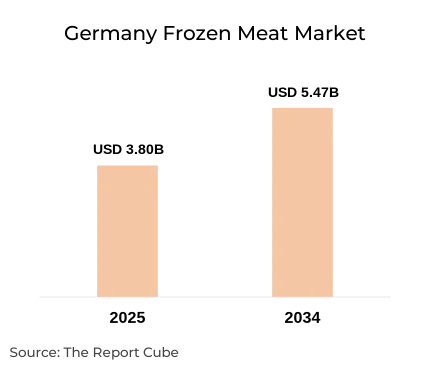
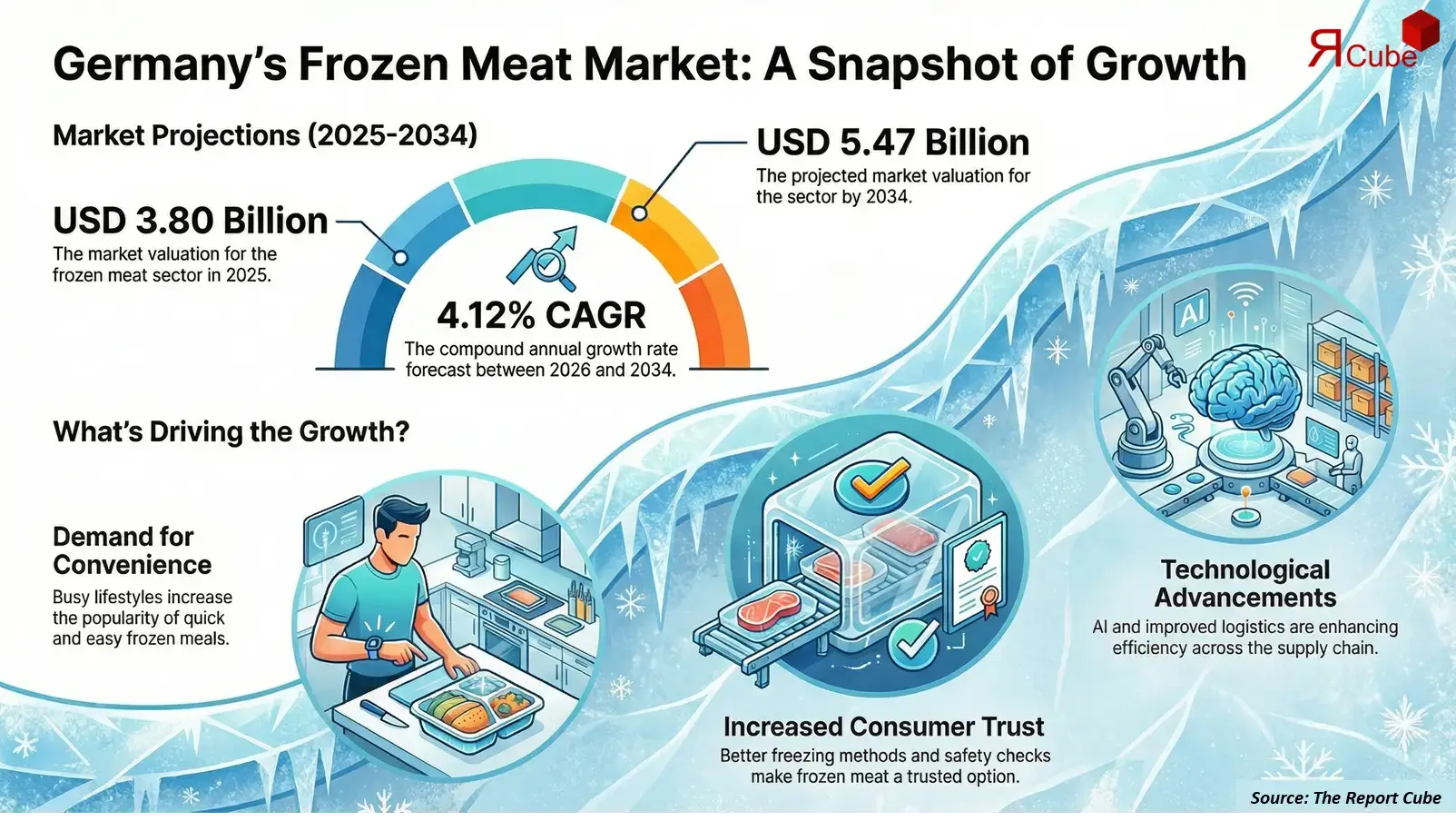
The Germany Frozen Meat Market is anticipated to register a CAGR of 4.12% during 2026-2034. The market size was valued at USD 3.80 billion in 2025 and is projected to reach USD 5.47 billion by 2034. The market is expanding steadily, supported by changing dietary habits, increasing demand for convenient protein sources, and the strong penetration of cold-chain infrastructure across Germany. Frozen meat products are gaining traction among both households and foodservice operators due to extended shelf life, consistent quality, and reduced food waste.
This growth is further reinforced by rising urbanization and the increasing participation of working professionals, which has heightened demand for easy-to-prepare frozen food options. Pork and poultry remain dietary staples in Germany, while frozen formats enable consumers to manage portion sizes efficiently. Moreover, advancements in freezing technology have improved taste retention and nutritional value, strengthening consumer confidence in frozen meat products.
Additionally, sustainability considerations and price stability during inflationary periods are driving consumers toward frozen meat over fresh alternatives. Retailers are expanding private-label frozen meat offerings, enhancing affordability and accessibility. These interconnected factors collectively position the Germany Frozen Meat Market for resilient growth through 2034.
Germany Frozen Meat Market Recent Developments
- 2025: Frostkrone Food Group extended frozen finger food portfolio in Germany with globally inspired, convenience-focused snack concepts.
- 2025: Lidl in Germany broadened Vemondo frozen plant-based protein range, reducing reliance on conventional frozen meat offerings.
Government Initiatives & Policies
- German Food Safety and Cold Chain Regulation Program: Strengthens quality control and traceability in frozen food distribution.
- National Nutrition Strategy: Promotes balanced protein consumption and sustainable food processing.
Germany Frozen Meat Market Dynamics
Key Driver: Growing Demand for Convenient and Long-Shelf-Life Protein Products
The increasing preference for convenient food options with longer shelf life is a major driver of the Germany Frozen Meat Market. Busy lifestyles and smaller household sizes are encouraging consumers to stock frozen meat for flexible meal planning. Nearly 55% of German households purchased frozen meat products at least once a month in 2025, reflecting strong adoption. Frozen meat allows consumers to reduce frequent shopping trips while ensuring consistent protein intake. This driver is further amplified by the foodservice sector, where frozen meat ensures cost control, portion standardization, and reduced spoilage, reinforcing overall market demand.
Book your FREE 30-minute expert consultation today
Contact UsIndustry Trends: Rising Popularity of Processed and Ready-to-Cook Frozen Meat
A key trend shaping the market is the growing popularity of processed and ready-to-cook frozen meat products. Consumers increasingly seek value-added formats such as marinated cuts, seasoned portions, and frozen meal components that reduce preparation time. Processed frozen meat products recorded strong retail sales growth in 2025, supported by innovative packaging and improved freezing techniques. This trend aligns with the expansion of private-label offerings by retailers, which provide competitively priced alternatives without compromising quality. As consumer expectations evolve, manufacturers are focusing on flavor innovation and portion control.
Major Challenge: Rising Energy Costs Impacting Cold Storage Economics
High energy costs present a significant challenge for the Germany Frozen Meat Market, particularly due to the energy-intensive nature of freezing, storage, and transportation. Cold chain operations require continuous temperature control, making producers and distributors vulnerable to electricity price volatility. These rising costs exert pressure on margins and may lead to higher retail prices, impacting price-sensitive consumers. Smaller processors face greater financial strain, potentially limiting their ability to compete with larger, vertically integrated players.
Opportunity: Expansion of Retail Private Labels and Sustainable Packaging
The growing focus on private-label expansion and sustainable packaging offers a promising opportunity for the market. German retailers are investing in eco-friendly packaging solutions and transparent sourcing practices, which resonate strongly with environmentally conscious consumers. Private-label frozen meat products allow retailers to control pricing and quality while enhancing brand loyalty. This opportunity supports volume growth and margin stability, particularly as consumers increasingly trust retailer-owned brands for everyday food purchases.
Germany Frozen Meat Market Segment-wise Analysis
By Meat Type:
- Beef
- Pork
- Poultry
- Lamb and Mutton
- Others
Pork is the leading meat type in the Germany Frozen Meat Market, accounting for approximately 41% of total market share in 2025. Its dominance reflects long-standing dietary preferences and strong availability across retail and foodservice channels. Frozen pork benefits from consistent demand, competitive pricing, and versatile usage in traditional and modern cuisines. Poultry follows as a fast-growing segment due to its perception as a lean protein option, while beef maintains steady demand driven by premium frozen cuts.
By Form:
- Whole Cuts
- Processed Meat
- Ready Meals
- Meat Snacks
- Others
Processed meat leads the market by form, capturing nearly 36% market share in 2025. This leadership is driven by consumer preference for convenience, flavor variety, and quick preparation. Processed frozen meat products offer extended usability and consistent taste, making them popular in both households and institutional kitchens. Ready meals are also gaining traction, supported by rising demand for time-saving food solutions, while whole cuts remain essential for traditional home cooking.
Regional Projection of Germany Frozen Meat Industry
- Western
- Southern
- Eastern
- Northern
The Western region leads the Germany Frozen Meat Market, contributing approximately 38% of total market revenue in 2025. This dominance is supported by dense population centers, strong retail infrastructure, and high purchasing power. Western Germany hosts a large concentration of supermarkets and cold storage facilities, enabling efficient distribution and higher consumption levels. While Western Germany remains the largest market, Eastern regions are showing gradual growth due to improving retail penetration and evolving dietary habits.
Need insights for a specific region within this market?
Request Regional DataWhy Choose This Report?
- Provides a comprehensive overview of the overall market analysis, encompassing key trends, consumer behavior analysis, and risk assessment to support strategic decision-making.
- Provides accurate, up-to-date insights into market size, segmentation, and emerging opportunities, helping to minimize risk & capitalizing on growth.
- Gives deep understanding of target audience preferences, investment habits, and communication channels for enhanced product development & marketing effectiveness.
- Delivers competitive analysis & benchmarking, uncovering the strengths & weaknesses of market competitors to guide strategies.
- Consolidate comprehensive market intelligence, reducing reasoning & streamlining research efforts.
- Facilitates customized market segmentation & risk mitigation strategies, fine-tuned to the business objectives.
- Aids in identifying both market challenges & untapped opportunities within the industry to drive long-term business growth.
- Provides valuable information based on actual customer data & search trends.
Table of Contents
- Introduction
- Objective of the Study
- Product and Category Definition
- Market Segmentation
- Study Variables
- Research Methodology
- Secondary Data Points
- Breakdown of Secondary Sources
- Primary Data Points
- Breakdown of Primary Interviews
- Secondary Data Points
- Executive Summary
- Market Dynamics
- Drivers
- Restraints
- Opportunity Assessment
- Regulatory and Policy Landscape
- Germany Frozen Meat Market Overview (2020-2034)
- Market Size, By Value (USD Million)
- Market Share, By Meat Type
- Beef
- Pork
- Poultry
- Lamb and Mutton
- Others
- Market Share, By Form
- Whole Cuts
- Processed Meat
- Ready Meals
- Meat Snacks
- Others
- Market Share, By Packaging
- Boxes
- Bags and Pouches
- Trays
- Others
- Market Share, By End User
- Retail Households
- Foodservice
- Institutional Buyers
- Market Share, By Distribution Channel
- Supermarkets and Hypermarkets
- Convenience Stores
- Butcher Chains
- Online Retail
- Other Channels
- Market Share, By Region
- Western
- Southern
- Eastern
- Northern
- Market Share, By Company
- Competition Characteristics
- Revenue Shares & Analysis
- Western Germany Frozen Meat Market
- Market Size, By Value (USD Million)
- Market Share, By Meat Type
- Market Share, By Form
- Market Share, By Packaging
- Market Share, By End User
- Market Share, By Distribution Channel
- Southern Germany Frozen Meat Market
- Market Size, By Value (USD Million)
- Market Share, By Meat Type
- Market Share, By Form
- Market Share, By Packaging
- Market Share, By End User
- Market Share, By Distribution Channel
- Eastern Germany Frozen Meat Market
- Market Size, By Value (USD Million)
- Market Share, By Meat Type
- Market Share, By Form
- Market Share, By Packaging
- Market Share, By End User
- Market Share, By Distribution Channel
- Northern Germany Frozen Meat Market
- Market Size, By Value (USD Million)
- Market Share, By Meat Type
- Market Share, By Form
- Market Share, By Packaging
- Market Share, By End User
- Market Share, By Distribution Channel
- Competitive Outlook and Company Profiles
- Lidl
- Company Overview
- Product Portfolio
- Strategic Alliances Partnerships
- Recent Developments
- Aldi
- Company Overview
- Product Portfolio
- Strategic Alliances Partnerships
- Recent Developments
- Edeka
- Company Overview
- Product Portfolio
- Strategic Alliances Partnerships
- Recent Developments
- Rewe Group
- Company Overview
- Product Portfolio
- Strategic Alliances Partnerships
- Recent Developments
- Nestle Germany
- Company Overview
- Product Portfolio
- Strategic Alliances Partnerships
- Recent Developments
- Tönnies Group
- Company Overview
- Product Portfolio
- Strategic Alliances Partnerships
- Recent Developments
- FRoSTA AG
- Company Overview
- Product Portfolio
- Strategic Alliances Partnerships
- Recent Developments
- Frostkrone Food Group
- Company Overview
- Product Portfolio
- Strategic Alliances Partnerships
- Recent Developments
- Frozen Fish International GmbH
- Company Overview
- Product Portfolio
- Strategic Alliances Partnerships
- Recent Developments
- NORDFROST GmbH & Co. KG
- Company Overview
- Product Portfolio
- Strategic Alliances Partnerships
- Recent Developments
- Others
- Lidl
- Contact Us and Disclaimer
Top Key Players & Market Share Outlook
- Lidl
- Aldi
- Edeka
- Rewe Group
- Nestle Germany
- Tönnies Group
- FRoSTA AG
- Frostkrone Food Group
- Frozen Fish International GmbH
- NORDFROST GmbH & Co. KG
- Others
Frequently Asked Questions






