



Build Your Custom Market Intelligence Report
Customize Your ReportGermany Compound Feed Market Insights & Analysis
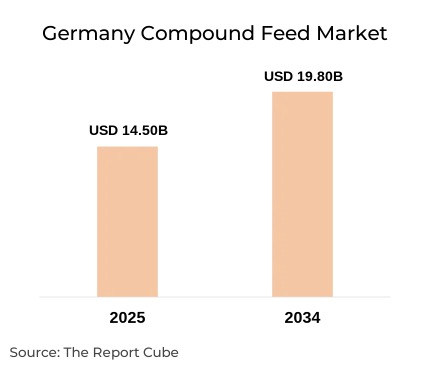
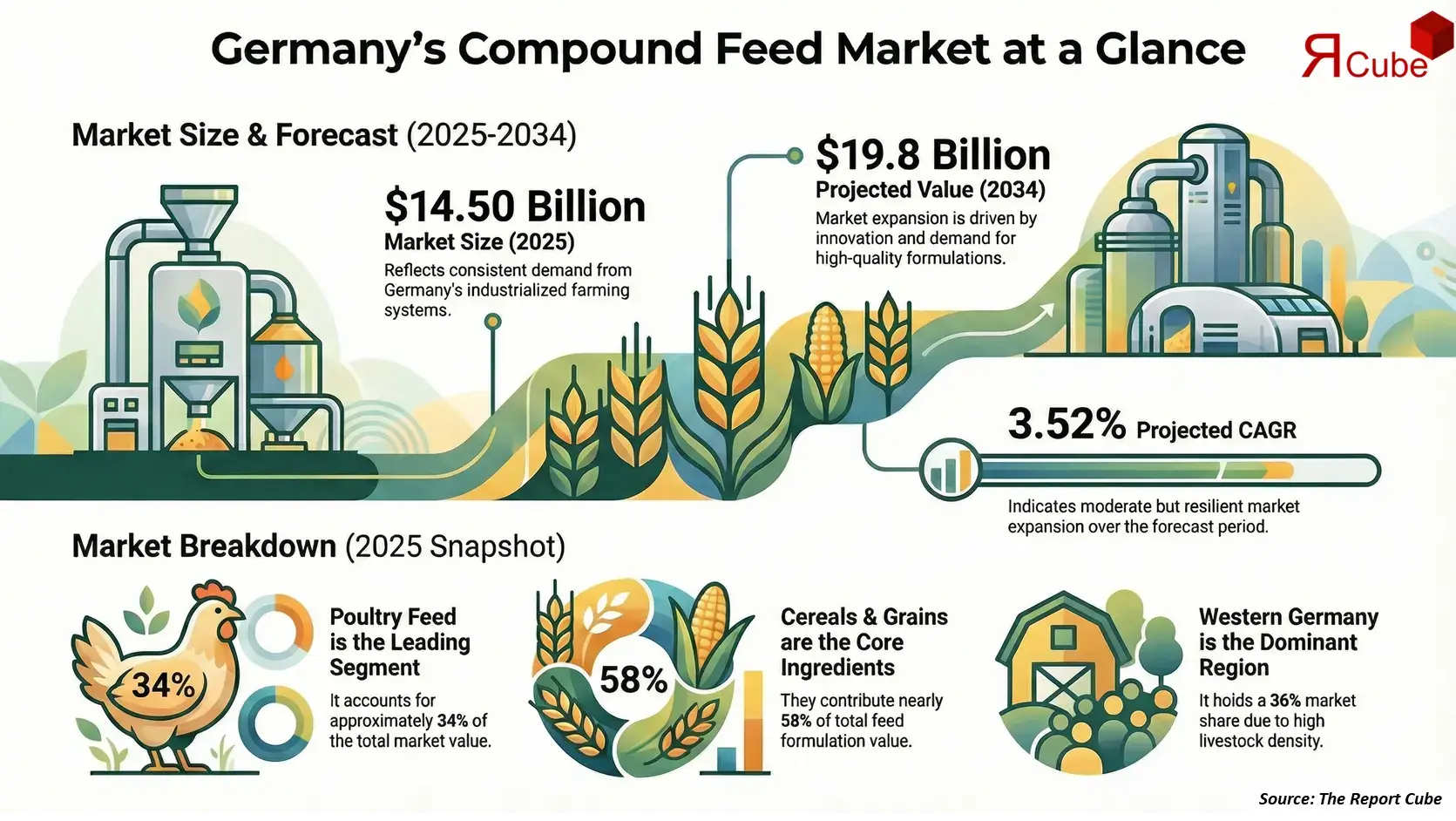
The Germany Compound Feed Market is anticipated to register a CAGR of 3.52% during 2026-2034. The market size was valued at USD 14.50 billion in 2025 and is projected to reach USD 19.8 billion by 2034. the market represents one of the most mature and structured feed markets in Europe, underpinned by the country’s large-scale livestock production, advanced agricultural practices, and strong regulatory oversight. Germany is among the leading producers of animal protein in the European Union, with poultry, swine, and dairy farming forming the backbone of domestic feed demand. In 2025, compound feed production exceeded 23 million metric tons, reflecting consistent demand from industrialized farming systems that rely heavily on nutritionally balanced, commercially formulated feed. Feed manufacturers in Germany emphasize precision nutrition, traceability, and compliance with strict EU feed safety regulations, which has elevated compound feed quality standards across the market. Rising efficiency requirements, combined with pressure to reduce environmental impact and improve animal health outcomes, continue to support steady demand for compound feed solutions across livestock categories.
Market growth is further influenced by structural shifts within the livestock sector, including gradual consolidation of farms, higher productivity per animal, and increased adoption of performance-enhancing feed formulations. Although livestock numbers in some segments have stabilized or marginally declined, feed value growth remains supported by higher-quality formulations, functional additives, and optimized feed conversion ratios. In 2025, poultry and swine feed together accounted for nearly 62% of total compound feed consumption, highlighting their importance to overall market dynamics. Additionally, growing emphasis on animal welfare, antibiotic reduction, and sustainability is encouraging feed producers to innovate with alternative protein sources and improved ingredient sourcing strategies. These factors collectively sustain moderate but resilient market expansion over the forecast period.
Germany Compound Feed Market Recent Developments
- 2025: AGRAVIS Raiffeisen AG expanded specialty feed formulations targeting antibiotic-free poultry production.
- 2025: Deutsche Tiernahrung Cremer GmbH invested in digital feed optimization systems for large livestock farms.
Government Initiatives & Policies
- German Animal Welfare Act (Tierschutzgesetz): Regulatory framework promoting animal health, welfare, and responsible feeding practices.
- EU Farm to Fork Strategy: Policy initiative influencing sustainable feed sourcing, reduced antibiotic use, and improved feed efficiency.
Germany Compound Feed Market Dynamics
Key Driver: Industrialized Livestock Farming and Nutritional Efficiency
The primary driver of the Germany compound feed market is the country’s highly industrialized and efficiency-driven livestock farming system. German farmers prioritize consistent animal performance, feed conversion efficiency, and predictable output, which strongly favors commercially produced compound feed over on-farm feed mixing. Compound feeds enable precise nutrient delivery tailored to species, growth stage, and production objectives, reducing waste and improving productivity. In 2025, professionally formulated compound feed was used by more than 80% of medium-to-large livestock operations in Germany. Additionally, increasing focus on animal health management and reduced antibiotic usage is driving demand for functional feed solutions enriched with enzymes, probiotics, and tailored mineral blends. These factors collectively sustain stable compound feed demand despite broader structural changes in the agricultural sector.
Major Challenge: Raw Material Price Volatility and Regulatory Pressure
A major challenge facing the Germany compound feed market is volatility in raw material prices, particularly cereals, oilseed meals, and imported protein sources. Feed manufacturers are highly exposed to global commodity price movements influenced by weather events, geopolitical developments, and trade disruptions. In 2024–2025, grain price fluctuations of over 12% year-on-year directly impacted feed production costs and margin stability. At the same time, stringent EU regulations on feed additives, emissions, and sustainability increase compliance costs for manufacturers. Balancing cost competitiveness with regulatory adherence and product quality remains a persistent challenge, especially for small and mid-sized feed producers operating on tight margins.
Industry Trends: Functional Feed and Sustainable Sourcing
An important industry trend is the growing adoption of functional and value-added compound feed formulations designed to improve animal health, welfare, and environmental performance. Feed producers are increasingly incorporating enzymes, amino acids, and alternative protein sources to enhance nutrient utilization and reduce nitrogen and phosphorus excretion. In 2025, functional feed products accounted for approximately 27% of compound feed value, reflecting rising adoption across poultry and swine operations. Sustainability is also shaping sourcing strategies, with greater emphasis on certified grains, responsibly sourced soy alternatives, and regional supply chains. These trends support incremental value growth and differentiation in a mature market environment.
Opportunity Ahead: Precision Feeding and Digital Integration
Future opportunities lie in precision feeding solutions and digital integration across livestock operations. Advanced feed formulation software, data-driven ration optimization, and farm-level monitoring systems allow producers to tailor feed programs more accurately to animal needs. Feed manufacturers that integrate advisory services and digital tools alongside product offerings can strengthen customer relationships and improve retention. Additionally, growing demand for companion animal feed and niche livestock segments provides diversification opportunities beyond traditional farm animals. These developments position the market for steady, innovation-led growth over the forecast period.
Germany Compound Feed Market Segment-wise Analysis
By Feed Type:
- Poultry Feed
- Swine Feed
- Ruminant Feed
- Aquatic Feed
- Companion Animal Feed
- Others
Poultry feed is the leading feed type segment, accounting for approximately 34% of total compound feed market value in 2025. This dominance reflects Germany’s strong poultry meat and egg production industry, which relies heavily on nutritionally optimized feed for rapid growth and feed efficiency. Swine feed follows closely, supported by large-scale pig farming operations, while ruminant feed maintains stable demand from the dairy sector. Companion animal feed represents a smaller but faster-growing segment, driven by pet humanization trends.
By Ingredient:
- Cereals & Grains
- Oilseed Meals
Cereals and grains dominate the ingredient mix, contributing nearly 58% of total feed formulation value in 2025 due to their role as primary energy sources. Wheat, barley, and corn are widely used, supported by domestic production and established supply chains. Oilseed meals, particularly soybean meal and rapeseed meal, account for around 32% share and serve as key protein sources. Ongoing research into alternative proteins is expected to gradually diversify the ingredient base.
Regional Projection of Germany Compound Feed Industry
- North
- South
- East
- West
Western Germany leads the compound feed market with approximately 36% share in 2025, supported by high livestock density, strong dairy and poultry production, and proximity to major feed manufacturing hubs. Northern Germany follows closely, driven by intensive poultry and pig farming operations. Southern and Eastern regions contribute moderate demand, supported by dairy farming and gradual modernization of livestock practices. Regional demand closely aligns with livestock concentration and farm size distribution.
Why Choose This Report?
- Provides a comprehensive overview of the overall market analysis, encompassing key trends, consumer behavior analysis, and risk assessment to support strategic decision-making.
- Provides accurate, up-to-date insights into market size, segmentation, and emerging opportunities, helping to minimize risk & capitalizing on growth.
- Gives deep understanding of target audience preferences, investment habits, and communication channels for enhanced product development & marketing effectiveness.
- Delivers competitive analysis & benchmarking, uncovering the strengths & weaknesses of market competitors to guide strategies.
- Consolidate comprehensive market intelligence, reducing reasoning & streamlining research efforts.
- Facilitates customized market segmentation & risk mitigation strategies, fine-tuned to the business objectives.
- Aids in identifying both market challenges & untapped opportunities within the industry to drive long-term business growth.
- Provides valuable information based on actual customer data & search trends.
Table of Contents
- Introduction
- Objective of the Study
- Product/Category Definition
- Market Segmentation
- Study Variables
- Research Methodology
- Secondary Data Points
- Breakdown of Secondary Sources
- Primary Data Points
- Breakdown of Primary Interviews
- Secondary Data Points
- Executive Summary
- Market Dynamics
- Drivers
- Challenges
- Opportunity Assessment
- Recent Trends and Developments
- Policy and Regulatory Landscape
- Germany Compound Feed Market Overview (2020-2034)
- Market Size, By Volume (Million Tons) & Value (EUR Million)
- Market Share, By Feed Type
- Poultry Feed
- Swine Feed
- Ruminant Feed
- Aquatic Feed
- Companion Animal Feed
- Others
- Market Share, By Ingredient
- Cereals & Grains
- Oilseed Meals
- By-Products
- Vitamins & Minerals
- Additives & Enzymes
- Market Share, By Formulation
- Mash
- Pellets
- Crumbles
- Others
- Market Share, By Distribution Channel
- Direct Sales
- Distributors & Dealers
- Online Retail
- Others
- Market Share, By Region
- North
- South
- East
- West
- Market Share, By Company
- Revenue Shares
- Competitive Landscape
- Segment-wise & Industry-wise Market Forecast (2026-2034)
- By Feed Type
- By Ingredient
- By Formulation
- By Distribution Channel
- By Region
- North Germany Compound Feed Market
- Market Size, By Volume & Value (EUR Million)
- Market Share, By Feed Type
- Market Share, By Ingredient
- Market Share, By Distribution Channel
- Market Share, By Key Cities
- South Germany Compound Feed Market
- Market Size, By Volume & Value (EUR Million)
- Market Share, By Feed Type
- Market Share, By Ingredient
- Market Share, By Distribution Channel
- Market Share, By Key Cities
- East Germany Compound Feed Market
- Market Size, By Volume & Value (EUR Million)
- Market Share, By Feed Type
- Market Share, By Ingredient
- Market Share, By Distribution Channel
- Market Share, By Key Cities
- West Germany Compound Feed Market
- Market Size, By Volume & Value (EUR Million)
- Market Share, By Feed Type
- Market Share, By Ingredient
- Market Share, By Distribution Channel
- Market Share, By Key Cities
- Competitive Outlook & Company Profiles
- AGRAVIS Raiffeisen AG
- Company Overview
- Product Portfolio
- Strategic Alliances/Partnerships
- Recent Developments
- Deutsche Tiernahrung Cremer GmbH & Co. KG
- Company Overview
- Product Portfolio
- Strategic Alliances/Partnerships
- Recent Developments
- ForFarmers N.V.
- Company Overview
- Product Portfolio
- Strategic Alliances/Partnerships
- Recent Developments
- DLG Service GmbH
- Company Overview
- Product Portfolio
- Strategic Alliances/Partnerships
- Recent Developments
- WEPA Tiernahrung GmbH
- Company Overview
- Product Portfolio
- Strategic Alliances/Partnerships
- Recent Developments
- HaGe Kielce GmbH
- Company Overview
- Product Portfolio
- Strategic Alliances/Partnerships
- Recent Developments
- Deuka GmbH
- Company Overview
- Product Portfolio
- Strategic Alliances/Partnerships
- Recent Developments
- Austrian Lifestock Feed
- Company Overview
- Product Portfolio
- Strategic Alliances/Partnerships
- Recent Developments
- Others
- AGRAVIS Raiffeisen AG
- Contact Us / Disclaimer
Top Key Players & Market Share Outlook
- AGRAVIS Raiffeisen AG
- Deutsche Tiernahrung Cremer GmbH & Co. KG
- ForFarmers N.V.
- DLG Service GmbH
- WEPA Tiernahrung GmbH
- HaGe Kielce GmbH
- Deuka GmbH
- Austrian Lifestock Feed
- Others
Frequently Asked Questions






