




Build Your Custom Market Intelligence Report
Customize Your ReportSouth Korea Frozen Meat Market Insights & Analysis
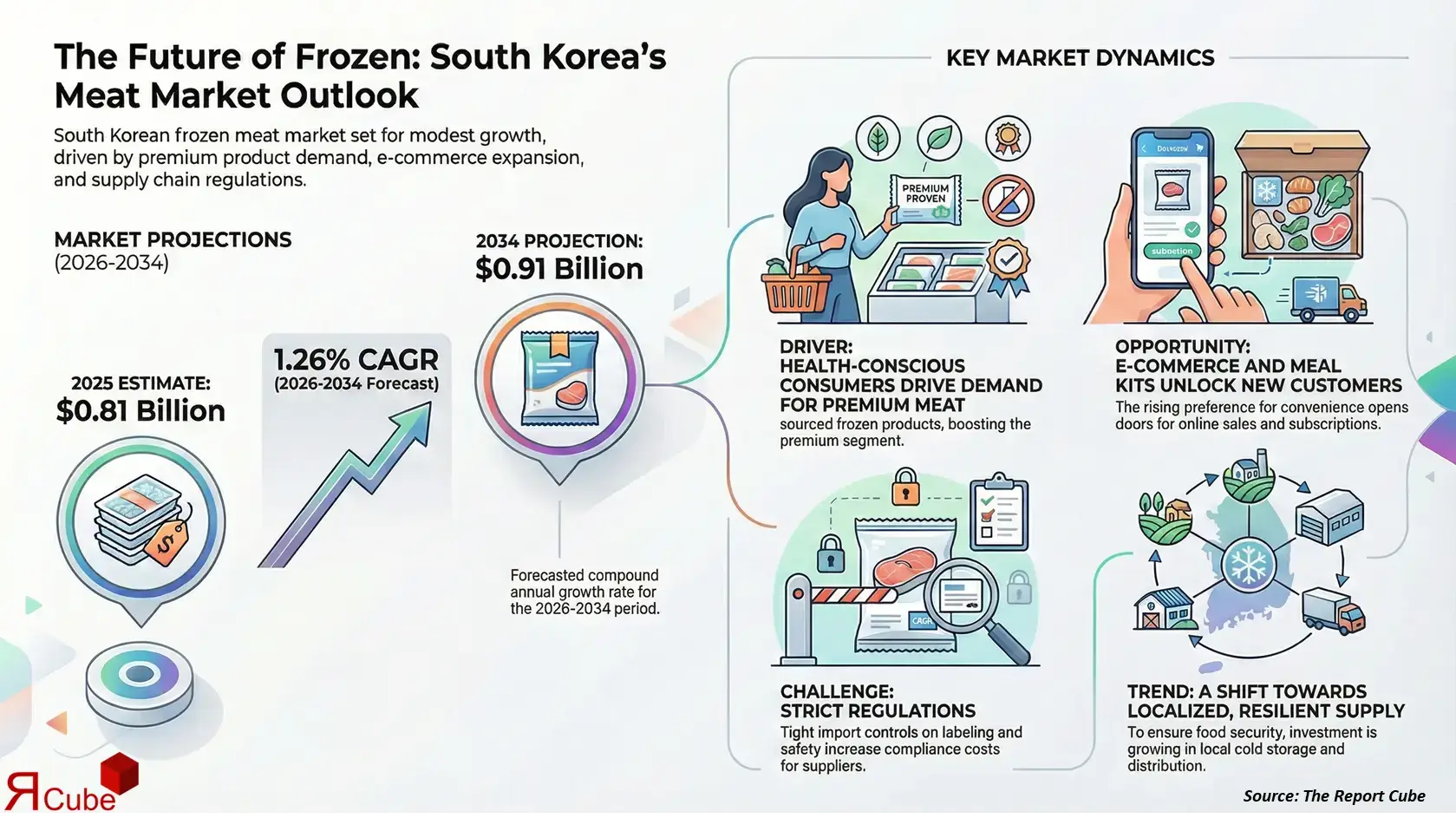
The South Korea Frozen Meat Market is anticipated to register a CAGR of 1.26% during 2026-2034. The market size was valued at USD 0.81 billion in 2025 and is projected to reach USD 0.91 billion by 2034. The market demonstrates stable but modest growth, largely reflecting South Korea’s mature food consumption patterns and high penetration of fresh and chilled meat alternatives. However, frozen meat continues to play a vital role in ensuring year-round availability, price stability, and food security across both household and commercial foodservice channels.
Urban lifestyles, longer working hours, and rising single-person households are steadily influencing frozen meat consumption patterns. Consumers increasingly prioritize convenience, portion control, and extended shelf life, all of which support frozen meat demand. Pork and chicken remain the most consumed frozen meats due to affordability and cultural preference, while frozen beef maintains a niche presence driven by foodservice and premium retail offerings.
Additionally, South Korea’s advanced cold-chain infrastructure and widespread availability of modern retail formats such as hypermarkets and online grocery platforms strengthen market stability. While growth remains moderate, continuous product innovation, improved packaging technologies, and rising demand from foodservice operators are expected to sustain the market’s gradual expansion through 2034.
South Korea Frozen Meat Market Recent Developments
- 2025: CJ CheilJedang expanded its premium frozen pork lineup targeting home meal replacement consumers.
- 2025: Lotte Foods introduced portion-controlled frozen chicken products for single-person households.
Government Initiatives & Policies
- Cold Chain Logistics Advancement Policy: Supports modernization of frozen food storage and transportation systems.
- Food Safety Management Act Enhancement: Strengthens frozen meat quality and traceability standards.
South Korea Frozen Meat Market Dynamics
Key Driver: Growing Demand for Convenient and Long-Shelf-Life Protein Options
The increasing demand for convenient protein solutions is a primary driver of the South Korea Frozen Meat Market. Rapid urbanization, a growing number of dual-income households, and longer working hours have reduced time spent on daily grocery shopping and meal preparation. Frozen meat offers extended shelf life without compromising nutritional value, making it a practical choice for modern consumers. Approximately 48% of urban households purchase frozen meat at least once per month, reflecting its role as a staple backup protein. Furthermore, foodservice operators rely heavily on frozen meat for consistent quality, portion control, and cost management, reinforcing demand across commercial channels.
Book your FREE 30-minute expert consultation today
Contact UsIndustry Trends: Expansion of Ready-to-Cook and Value-Added Frozen Meat Products
A key trend shaping the market is the growing popularity of ready-to-cook and value-added frozen meat products. Consumers increasingly seek pre-marinated, seasoned, or partially cooked options that reduce preparation time while maintaining taste and quality. Ready-to-cook frozen meat products recorded an estimated 3% year-on-year volume growth in 2025, outperforming traditional whole cuts. This trend aligns with the broader home meal replacement movement, where frozen meat serves as a core ingredient. Retailers are responding by allocating more freezer space to differentiated and premium frozen meat offerings.
Major Challenge: Strong Consumer Preference for Fresh and Chilled Meat
Despite its advantages, frozen meat faces persistent challenges from South Korea’s strong cultural preference for fresh and chilled meat. Consumers often associate freshness with superior taste and quality, limiting frozen meat’s appeal in certain segments. Well-developed fresh meat distribution networks and frequent shopping habits further intensify competition. Additionally, price sensitivity in frozen meat categories restricts margin expansion, particularly as energy and cold storage costs rise. These factors collectively constrain faster market growth.
Opportunity: Rising Online Grocery and Cold-Chain E-Commerce Penetration
The rapid expansion of online grocery platforms presents a promising opportunity for the frozen meat market. E-commerce players leverage advanced cold-chain delivery systems to ensure product integrity, making frozen meat well-suited for online sales. Online grocery penetration in South Korea exceeded 30% of total food retail sales in 2025, with frozen products among the top-performing categories. This channel allows brands to offer wider product assortments, subscription models, and bulk discounts, supporting incremental demand growth through 2034.
South Korea Frozen Meat Market Segment-wise Analysis
By Meat Type:
- Beef
- Pork
- Chicken
- Mutton
Pork dominates the South Korea Frozen Meat Market by meat type, accounting for approximately 44% of total market share in 2025. Pork’s leadership is driven by affordability, cultural relevance, and extensive use in both household and foodservice applications. Frozen chicken follows closely due to its versatility and growing use in ready-to-cook products. Frozen beef remains a smaller but premium segment, supported by imported offerings catering to restaurants and upscale retailers.
By Product Form:
- Whole Cuts
- Processed Cuts
- Ready-to-Cook
- Ready-to-Eat
Ready-to-cook products represent the leading product form, holding nearly 36% market share in 2025. Their popularity reflects changing consumer lifestyles and demand for time-saving meal solutions. Processed cuts also maintain steady demand from foodservice operators seeking consistency and cost efficiency. Ready-to-eat frozen meat products, while smaller in share, are gaining traction among younger consumers and single-person households.
Regional Projection of South Korea Frozen Meat Industry
- Seoul Capital Area
- Yeongnam
- Honam
- Hoseo
- East Coastal
The Seoul Capital Area leads the South Korea Frozen Meat Market, contributing approximately 46% of total revenue in 2025. High population density, strong purchasing power, and widespread availability of modern retail outlets support regional dominance. The region also leads in online grocery adoption, further boosting frozen meat consumption. Yeongnam follows as a key regional market, driven by urban centers and growing foodservice demand.
Need insights for a specific region within this market?
Request Regional DataWhy Choose This Report?
- Provides a comprehensive overview of the overall market analysis, encompassing key trends, consumer behavior analysis, and risk assessment to support strategic decision-making.
- Provides accurate, up-to-date insights into market size, segmentation, and emerging opportunities, helping to minimize risk & capitalizing on growth.
- Gives deep understanding of target audience preferences, investment habits, and communication channels for enhanced product development & marketing effectiveness.
- Delivers competitive analysis & benchmarking, uncovering the strengths & weaknesses of market competitors to guide strategies.
- Consolidate comprehensive market intelligence, reducing reasoning & streamlining research efforts.
- Facilitates customized market segmentation & risk mitigation strategies, fine-tuned to the business objectives.
- Aids in identifying both market challenges & untapped opportunities within the industry to drive long-term business growth.
- Provides valuable information based on actual customer data & search trends.
Table of Contents
- Introduction
- Objective of the Study
- Product and Category Definition
- Market Segmentation
- Study Variables
- Research Methodology
- Secondary Data Points
- Breakdown of Secondary Sources
- Primary Data Points
- Breakdown of Primary Interviews
- Secondary Data Points
- Executive Summary
- Market Dynamics
- Drivers
- Challenges
- Opportunity Assessment
- Recent Trends and Developments
- Regulatory and Policy Landscape
- South Korea Frozen Meat Market Overview (2020-2034)
- Market Size, By Value (USD Billion)
- Market Share, By Meat Type
- Beef
- Pork
- Chicken
- Mutton
- Other Meats
- Market Share, By Product Form
- Whole Cuts
- Processed Cuts
- Ready‑to‑Cook
- Ready‑to‑Eat
- Market Share, By Packaging
- Bagged
- Tray Packed
- Vacuum Packed
- Bulk Packed
- Market Share, By Distribution Channel
- Supermarkets
- Hypermarkets
- Convenience Stores
- Online Retail
- Foodservice
- HoReCa
- Other Channels
- Market Share, By Consumer
- Household
- Institutional
- Quick‑Service Restaurants
- Full‑Service Restaurants
- Market Share, By Region
- Seoul Capital Area
- Yeongnam
- Honam
- Hoseo
- East Coastal
- Market Share, By Company
- Competition Characteristics
- Revenue Shares & Analysis
- North Region Frozen Meat Market
- Market Size, By Value (USD Billion)
- Market Share, By Meat Type
- Market Share, By Product Form
- Market Share, By Packaging
- Market Share, By Distribution Channel
- Market Share, By Consumer
- South Region Frozen Meat Market
- Market Size, By Value (USD Billion)
- Market Share, By Meat Type
- Market Share, By Product Form
- Market Share, By Packaging
- Market Share, By Distribution Channel
- Market Share, By Consumer
- East Region Frozen Meat Market
- Market Size, By Value (USD Billion)
- Market Share, By Meat Type
- Market Share, By Product Form
- Market Share, By Packaging
- Market Share, By Distribution Channel
- Market Share, By Consumer
- West Region Frozen Meat Market
- Market Size, By Value (USD Billion)
- Market Share, By Meat Type
- Market Share, By Product Form
- Market Share, By Packaging
- Market Share, By Distribution Channel
- Market Share, By Consumer
- Competitive Outlook and Company Profiles
- CJ CheilJedang
- Company Overview
- Product Portfolio
- Strategic Alliances/Partnerships
- Recent Developments
- Lotte Foods
- Company Overview
- Product Portfolio
- Strategic Alliances/Partnerships
- Recent Developments
- Hanil Frozen Food
- Company Overview
- Product Portfolio
- Strategic Alliances/Partnerships
- Recent Developments
- Daesang Corporation
- Company Overview
- Product Portfolio
- Strategic Alliances/Partnerships
- Recent Developments
- NongHyup (NH)
- Company Overview
- Product Portfolio
- Strategic Alliances/Partnerships
- Recent Developments
- Homeplus
- Company Overview
- Product Portfolio
- Strategic Alliances/Partnerships
- Recent Developments
- GS Retail
- Company Overview
- Product Portfolio
- Strategic Alliances/Partnerships
- Recent Developments
- Dongwon F&B
- Company Overview
- Product Portfolio
- Strategic Alliances/Partnerships
- Recent Developments
- EMart
- Company Overview
- Product Portfolio
- Strategic Alliances/Partnerships
- Recent Developments
- Sajo Daerim
- Company Overview
- Product Portfolio
- Strategic Alliances/Partnerships
- Recent Developments
- Others
- CJ CheilJedang
- Contact Us and Disclaimer
Top Key Players & Market Share Outlook
- CJ CheilJedang
- Lotte Foods
- Hanil Frozen Food
- Daesang Corporation
- NongHyup (NH)
- Homeplus
- GS Retail
- Dongwon F&B
- EMart
- Sajo Daerim
- Others
Frequently Asked Questions






