



Build Your Custom Market Intelligence Report
Customize Your ReportUS Graphene Market Key Highlights
By Type:
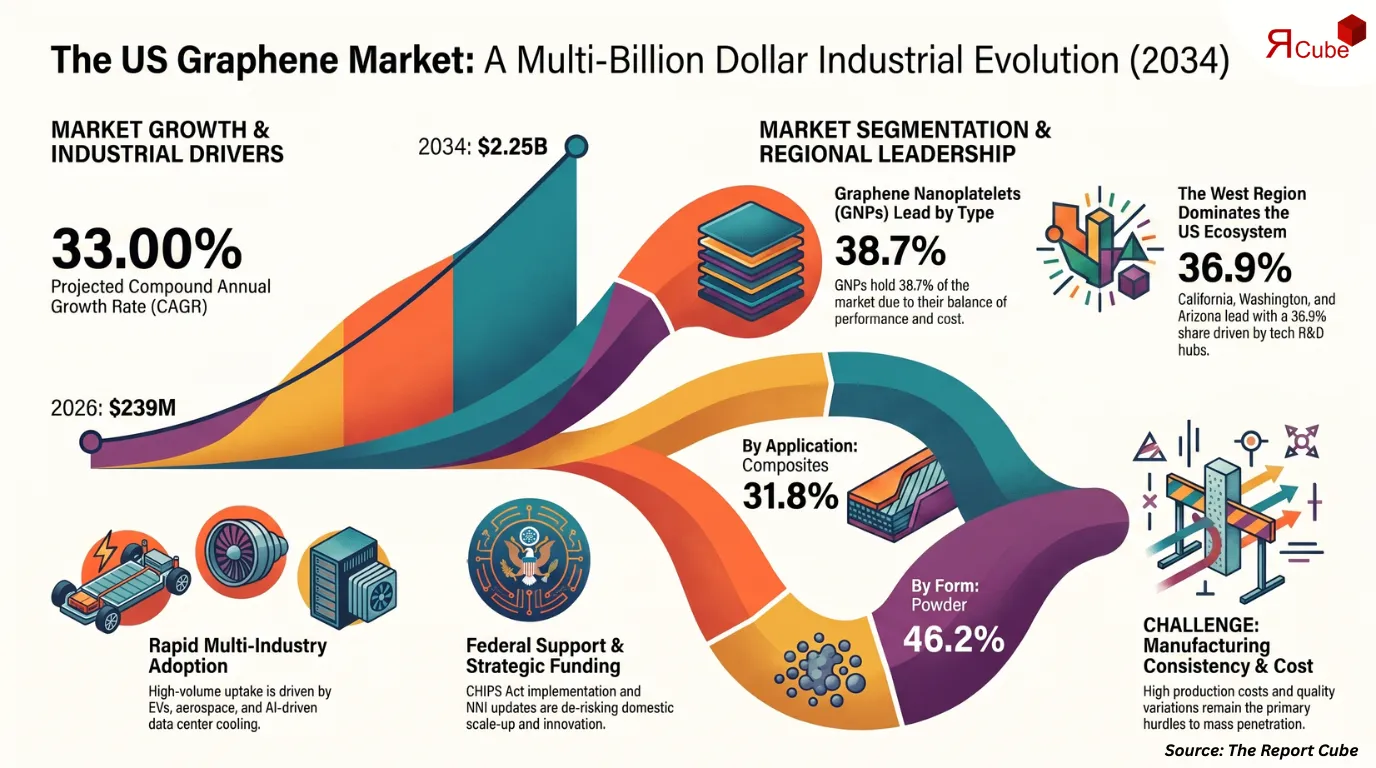
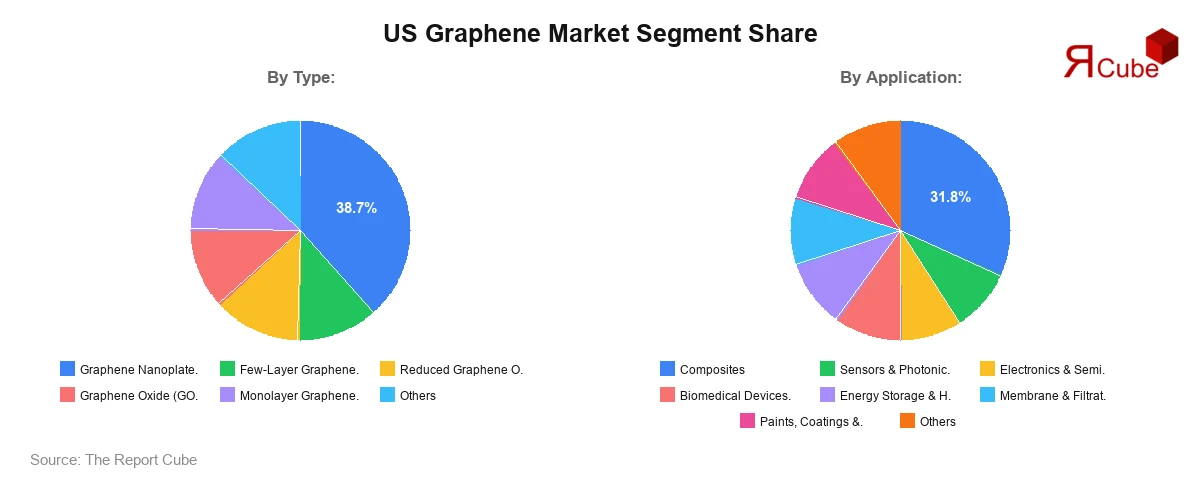
Graphene Nanoplatelets (GNPs) segment leads the market with approximately 38.7% share.
By Application:
Composites segment dominates the market with nearly 31.8% of total revenue.
By Form:
Powder segment accounts for the highest market revenue with around 46.2% share.
Regional Outlook:
West region dominates the US Graphene Market with approximately 36.9% market share.
US Graphene Market Insights & Analysis
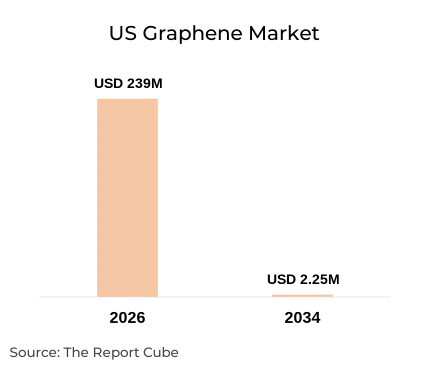
The US Graphene Market is anticipated to register a CAGR of around 33.00% during the forecast period 2026-2034. The market size is valued at USD 239.0 million in 2026 and is projected to reach USD 2.25 billion by 2034. Commercial adoption of graphene is gaining momentum as manufacturers move beyond research-scale production toward high-value industrial applications. Demand is increasing across electric vehicles, aerospace, advanced electronics, biomedical technologies, defense systems, and energy storage, where graphene's exceptional electrical conductivity, thermal performance, and mechanical strength deliver measurable performance improvements. Domestic manufacturers are also expanding production capabilities to supply high-quality graphene materials with consistent specifications, supporting broader commercialization across the United States. Continuous innovation in scalable production methods, including graphene nanoplatelets and graphene oxide, is improving product availability while gradually reducing manufacturing costs, strengthening the overall outlook for the US Graphene Market.
Federal support for advanced manufacturing and strategic investments in domestic semiconductor production continue to create favorable conditions for graphene commercialization. Research organizations, national laboratories, and private companies are accelerating the development of graphene-enabled batteries, thermal interface materials, conductive inks, sensors, filtration membranes, and protective coatings that address performance requirements across critical industries. The rapid expansion of artificial intelligence infrastructure, hyperscale data centers, and next-generation communication networks is further increasing demand for efficient thermal management materials, creating new opportunities for graphene-based technologies. In parallel, strategic collaborations between material developers, automotive manufacturers, electronics companies, and research institutions are shortening product development cycles and encouraging faster industrial adoption. As production quality continues to improve and commercial validation expands, graphene is expected to become an increasingly important material supporting the next generation of advanced manufacturing in the United States.
US Graphene Market Impact Analysis
| Factor | Type | Specific Impact on Market | Magnitude | Business Implication |
|---|---|---|---|---|
| Rapid Multi‑Industry Adoption | Market | Strong uptake in electronics, energy, aerospace and automotive drives volume growth. | High | Prioritize scalable grades for high‑volume end uses like composites and coatings. |
| Superior Material Performance | Technological | High strength, conductivity and light weight enable premium pricing versus legacy materials. | High | Position products as performance enablers in advanced composites and electronics. |
| High Production Cost Structure | Market | Complex, costly manufacturing keeps prices elevated and slows mass penetration. | Medium | Invest in process efficiency and scale to defend margins while expanding access. |
| Environmental And Toxicity Concerns | Regulatory | Potential ecological and health risks invite tighter oversight and testing needs. | Medium | Build strong compliance, safety data and certifications to reassure key buyers. |
| Intense R&D And Innovation | Technological | Ongoing research accelerates new graphene forms and high‑value applications. | High | Form alliances with universities and labs to secure pipeline of differentiated IP. |
| Fragmented Competitive Landscape | Competitive | Presence of many niche players intensifies rivalry and specialization. | Medium | Focus on defensible niches, partnerships and branding to avoid pure price play. |
| Supportive US Funding Climate | Regulatory | Government and private programs back advanced materials and clean‑tech usage. | Medium | Leverage grants and incentives to de‑risk scale‑up and demonstration projects. |
US Graphene Market Dynamics
Key Driver: Rising investment in advanced manufacturing and high-performance materials
Manufacturers across the United States are increasing their use of graphene to improve product durability, thermal conductivity, electrical performance, and weight reduction. Industries such as aerospace, automotive, electronics, defense, and renewable energy require materials capable of meeting demanding performance standards without compromising efficiency. Graphene addresses these requirements by enhancing composite strength, improving heat dissipation, and extending the service life of industrial components. Electric vehicle manufacturers are integrating graphene into battery systems, conductive coatings, and structural composites to improve charging performance and energy efficiency, while aerospace companies continue evaluating graphene-reinforced materials for lightweight aircraft structures and advanced defense platforms.
Investment in domestic manufacturing facilities is also supporting market expansion. New semiconductor fabrication plants, battery manufacturing projects, and advanced material production facilities are increasing demand for graphene across multiple value chains. Material suppliers are scaling production technologies to deliver consistent quality while meeting stringent industrial specifications. As commercialization progresses, graphene is transitioning from a specialty nanomaterial to a commercially viable engineering material with expanding applications in high-value manufacturing sectors throughout the United States.
Industry Trends: Expansion of graphene applications in energy storage and thermal management
Graphene is becoming an important enabling material for next-generation energy storage and thermal management technologies. Battery manufacturers are exploring graphene-enhanced electrodes to improve charging speed, cycle life, and energy density, while developers of supercapacitors are utilizing graphene to achieve higher power output and faster energy transfer. Demand for advanced cooling materials has also increased significantly with the rapid expansion of hyperscale data centers, artificial intelligence computing infrastructure, electric vehicles, and high-performance semiconductor devices. These industries require materials capable of efficiently dissipating heat while maintaining long-term operational reliability.
Commercial activity is also expanding in graphene-based conductive inks, printed electronics, flexible sensors, smart textiles, and high-performance coatings. Companies are investing in scalable production technologies that improve material consistency and reduce manufacturing costs, making graphene increasingly suitable for large-volume industrial applications. Strategic partnerships among universities, national laboratories, technology developers, and industrial manufacturers continue accelerating product validation and commercialization, creating a broader portfolio of graphene-enabled products entering the U.S. market.
Book your FREE 30-minute expert consultation today
Contact UsMajor Challenge: Manufacturing consistency and cost competitiveness
Although graphene offers exceptional physical and electrical properties, achieving uniform product quality at commercial scale remains a significant challenge. Different production techniques can produce variations in layer thickness, purity, defect density, and conductivity, which directly influence product performance. Industries such as aerospace, healthcare, electronics, and defense require highly consistent material specifications before integrating graphene into commercial products, resulting in lengthy qualification and testing processes.
Cost remains another important consideration for wider market adoption. While production technologies have advanced considerably, high-quality graphene still commands a premium compared with conventional engineering materials. Manufacturers continue investing in process automation, quality assurance systems, and large-scale production facilities to improve manufacturing efficiency and reduce unit costs. As production capacity expands and standardization improves, the economic case for graphene adoption is expected to strengthen across a broader range of industrial applications.
Opportunity: Domestic semiconductor expansion and infrastructure modernization
Ongoing investment in domestic semiconductor manufacturing presents substantial opportunities for graphene suppliers. The United States continues to strengthen its semiconductor ecosystem through new fabrication facilities and advanced packaging investments, creating demand for materials that improve thermal conductivity, electrical performance, and device reliability. Graphene's exceptional electron mobility and heat dissipation characteristics make it well suited for advanced electronic components, sensors, photonic devices, and next-generation semiconductor technologies.
Infrastructure modernization is creating additional avenues for commercial growth. Graphene-enhanced concrete additives, corrosion-resistant coatings, water treatment membranes, and energy-efficient construction materials are attracting increasing attention as public and private organizations seek durable, sustainable infrastructure solutions. At the same time, expanding renewable energy capacity, electric grid modernization, and industrial decarbonization initiatives are encouraging the adoption of advanced materials capable of improving operational efficiency. These developments position graphene as a strategic material supporting long-term industrial innovation across the United States.
US Graphene Market Segment-wise Analysis
By Type:
- Graphene Nanoplatelets (GNPs)
- Few-Layer Graphene (FLG)
- Reduced Graphene Oxide (rGO)
- Graphene Oxide (GO)
- Monolayer Graphene
- Others
Graphene Nanoplatelets (GNPs) hold the leading position in the US Graphene Market, accounting for approximately 38.7% of total revenue in 2026. Their commercial leadership is supported by an attractive balance of performance, scalability, and manufacturing economics compared with other graphene materials. GNPs are extensively incorporated into polymer composites, lithium-ion batteries, thermal interface materials, conductive plastics, elastomers, industrial lubricants, and protective coatings because they improve mechanical strength, electrical conductivity, and heat transfer without substantially increasing product weight.
Demand continues to rise from automotive suppliers, aerospace manufacturers, electronics producers, and construction material companies seeking durable, lightweight alternatives to conventional fillers. Continuous improvements in exfoliation technologies and quality control have enhanced production consistency, enabling broader industrial qualification. As domestic manufacturing capacity expands and downstream industries prioritize high-performance materials, Graphene Nanoplatelets are expected to retain their dominant market position throughout the forecast period.
By Application:
- Composites
- Sensors & Photonics
- Electronics & Semiconductors
- Biomedical Devices
- Energy Storage & Harvesting
- Membrane & Filtration
- Paints, Coatings & Inks
- Others
The Composites segment represents the largest application category, contributing nearly 31.8% of the US Graphene Market revenue. Manufacturers are increasingly integrating graphene into advanced composite materials to enhance structural strength, impact resistance, fatigue performance, and corrosion protection while reducing overall material weight. These performance advantages are particularly valuable across aerospace, automotive, defense, marine, sporting equipment, and industrial manufacturing applications. Electric vehicle manufacturers are expanding the use of graphene-reinforced composites to improve vehicle efficiency and extend battery range through lightweight structural components.
Aerospace companies are also evaluating graphene-enhanced composite structures that support fuel efficiency while maintaining strict safety standards. Increasing investment in infrastructure modernization and advanced manufacturing continues to create additional opportunities for graphene composites in construction materials, industrial equipment, and protective structures. Continued product validation across multiple industries is expected to sustain the segment's market leadership over the coming years.
By Form:
- Dispersions & Inks
- Films & Sheets
- Powder
- Others
Powder remains the most widely commercialized graphene form, capturing approximately 46.2% of the US Graphene Market in 2026. Its leadership reflects excellent compatibility with existing manufacturing processes and broad applicability across numerous industrial sectors. Powder graphene can be readily incorporated into thermoplastics, thermoset resins, cement, coatings, conductive compounds, rubber products, battery electrodes, and additive manufacturing materials, making it an efficient solution for large-scale production. Material suppliers continue introducing higher-purity powder grades designed for specialized applications requiring superior electrical and thermal performance.
Improvements in production technology have also strengthened supply reliability while gradually lowering production costs, encouraging wider industrial adoption. As manufacturers continue developing graphene-enabled products for transportation, electronics, renewable energy, healthcare, and industrial equipment, powder graphene is expected to remain the preferred commercial form due to its versatility, storage stability, and ease of processing.
Regional Projection of US Graphene Industry
- West
- East
- South
- Midwest
- Others
The West region accounts for the largest share of the US Graphene Market, representing approximately 36.9% of total industry revenue. California, Arizona, Washington, and neighboring states have developed a highly competitive ecosystem combining advanced manufacturing, semiconductor production, aerospace engineering, clean energy innovation, and world-class research institutions. The concentration of technology companies, venture capital investment, national laboratories, and university-led materials research continues to accelerate commercialization of graphene across multiple industries. Regional manufacturers are actively developing graphene-enhanced batteries, thermal management solutions, flexible electronics, conductive coatings, biomedical devices, and next-generation sensors to meet evolving industrial requirements.
Strong public and private investment in semiconductor fabrication facilities, electric vehicle manufacturing, renewable energy infrastructure, and artificial intelligence computing has further strengthened regional demand for advanced nanomaterials. The West also benefits from close collaboration between research organizations and commercial manufacturers, allowing laboratory innovations to progress more rapidly toward industrial-scale production. This integrated innovation ecosystem supports faster product development, greater investment activity, and improved manufacturing capabilities compared with other regions. As industrial adoption continues expanding, the West is expected to maintain its leadership position while serving as the primary hub for graphene research, production, and commercialization across the United States.
Need insights for a specific region within this market?
Request Regional DataUS Graphene Market Regional Analysis
The US graphene market shows varied growth across regions, led by R&D hubs, tech clusters, and advanced manufacturing centers.
| Region | Demand Level | Key Areas | System Dominance | Core Demand Logic | Growth Nature |
|---|---|---|---|---|---|
| West | Very High | Silicon Valley, LA, Seattle | Electronics & Energy Storage | Tech R&D and EV battery pilots | Innovation-led, fast scaling |
| East | High | Boston, NYC, DC corridor | Advanced Materials & Coatings | University labs and startups | Research-to-commercial shift |
| South | High | Texas, Atlanta, Florida | Energy, Petrochem & Composites | Oil, gas and grid modernization | Infrastructure-driven growth |
| Midwest | Medium | Chicago, Detroit, Ohio | Auto, Aerospace & Additive | Lightweighting and 3D printing | OEM-partnered expansion |
| Others | Low to Medium | Mountain states, Alaska, Hawaii | Niche Sensors & Defense | Small pilots and defense trials | Opportunity-based, fragmented |
Government Initiatives & Policies
- National Nanotechnology Initiative (NNI) Strategic Plan (2026 Update): The initiative continues supporting advanced nanomaterial research, including graphene, through coordinated federal investments in manufacturing innovation, commercialization, and workforce development across multiple agencies.
- CHIPS and Science Act Implementation (2025-2026): Continued federal funding under the CHIPS and Science Act supports domestic semiconductor manufacturing and advanced material innovation, creating significant opportunities for graphene adoption in electronics, photonics, and next-generation semiconductor technologies.
US Graphene Industry Recent Developments
- 2026: Graphene Manufacturing Group (GMG) received approval from the U.S. Environmental Protection Agency (EPA) for its THERMAL-XR® graphene coating system. The approval authorizes commercial sales across the United States for HVAC systems, automotive components, data centers, LNG facilities, and industrial infrastructure. This regulatory milestone significantly strengthens graphene commercialization opportunities and supports wider adoption of advanced thermal management coatings across multiple end-use industries.
Why Choose This Report?
- Provides a comprehensive overview of the overall market analysis, encompassing key trends, consumer behavior analysis, and risk assessment to support strategic decision-making.
- Provides accurate, up-to-date insights into market size, segmentation, and emerging opportunities, helping to minimize risk & capitalizing on growth.
- Gives deep understanding of target audience preferences, investment habits, and communication channels for enhanced product development & marketing effectiveness.
- Delivers competitive analysis & benchmarking, uncovering the strengths & weaknesses of market competitors to guide strategies.
- Consolidate comprehensive market intelligence, reducing reasoning & streamlining research efforts.
- Facilitates customized market segmentation & risk mitigation strategies, fine-tuned to the business objectives.
- Aids in identifying both market challenges & untapped opportunities within the industry to drive long-term business growth.
- Provides valuable information based on actual customer data & search trends.
Table of Contents
- Introduction
- Objective of the Study
- Product and Category Definition
- Market Segmentation
- Study Variables
- Research Methodology
- Secondary Data Points
- Breakdown of Secondary Sources
- Primary Data Points
- Breakdown of Primary Interviews
- Secondary Data Points
- Executive Summary
- Market Dynamics
- Emerging Opportunities
- Adoption Trends
- Demand Drivers
- Disruption Analysis (Challenges)
- Industry Analysis & Strategic Insights
- Supply/Value Chain Analysis
- Pricing Analysis
- Go-To-Market (GTM) Strategy
- BCG Matrix
- Recent Trends and Developments
- Import and Export Analysis
- Regulatory and Policy Landscape
- Region-wise Policies
- Government Initiatives
- US Graphene Market Overview and Forecast Analysis (2021-2034)
- Market Size, By Value, By Growth Rate (CAGR/USD Million)
- Market Share, By Type
- Graphene Nanoplatelets (GNPs)
- Few-Layer Graphene (FLG)
- Reduced Graphene Oxide (rGO)
- Graphene Oxide (GO)
- Monolayer Graphene
- Others
- Market Share, By Application
- Composites
- Sensors & Photonics
- Electronics & Semiconductors
- Biomedical Devices
- Energy Storage & Harvesting
- Membrane & Filtration
- Paints, Coatings & Inks
- Others
- Market Share, By Form
- Dispersions & Inks
- Films & Sheets
- Powder
- Others
- Market Share, By Region
- West
- East
- South
- Midwest
- Others
- Market Share, By Company
- Revenue Shares & Analysis
- Competitive Landscape
- West US Graphene Market Overview and Forecast Analysis (2021-2034)
- Market Size, By Value, By Growth Rate (CAGR/USD Million)
- Market Share, By Type
- Market Share, By Application
- Market Share, By Form
- East US Graphene Market Overview and Forecast Analysis (2021-2034)
- Market Size, By Value, By Growth Rate (CAGR/USD Million)
- Market Share, By Type
- Market Share, By Application
- Market Share, By Form
- South US Graphene Market Overview and Forecast Analysis (2021-2034)
- Market Size, By Value, By Growth Rate (CAGR/USD Million)
- Market Share, By Type
- Market Share, By Application
- Market Share, By Form
- Midwest US Graphene Market Overview and Forecast Analysis (2021-2034)
- Market Size, By Value, By Growth Rate (CAGR/USD Million)
- Market Share, By Type
- Market Share, By Application
- Market Share, By Form
- Competitive Analysis, 2026
- Market Share of Key Players
- Competitive Mapping for Each Segment and Companies Operating Regionally
- West US Graphene Companies Share & Competitive Analysis, 2026
- East US Graphene Companies Share & Competitive Analysis, 2026
- South US Graphene Companies Share & Competitive Analysis, 2026
- Midwest US Graphene Companies Share & Competitive Analysis, 2026
- Company Profile (Partial List)
- Talga Group Ltd.
- Company Overview
- Product Portfolio
- Strategic Alliances/Partnerships
- Recent Developments
- ACS Material LLC
- Company Overview
- Product Portfolio
- Strategic Alliances/Partnerships
- Recent Developments
- Thomas Swan & Co. Ltd.
- Company Overview
- Product Portfolio
- Strategic Alliances/Partnerships
- Recent Developments
- Graphenea S.A.
- Company Overview
- Product Portfolio
- Strategic Alliances/Partnerships
- Recent Developments
- Graphene Manufacturing Group (GMG)
- Company Overview
- Product Portfolio
- Strategic Alliances/Partnerships
- Recent Developments
- Versarien Plc
- Company Overview
- Product Portfolio
- Strategic Alliances/Partnerships
- Recent Developments
- Global Graphene Group
- Company Overview
- Product Portfolio
- Strategic Alliances/Partnerships
- Recent Developments
- First Graphene
- Company Overview
- Product Portfolio
- Strategic Alliances/Partnerships
- Recent Developments
- NanoXplore Inc.
- Company Overview
- Product Portfolio
- Strategic Alliances/Partnerships
- Recent Developments
- Haydale PLC
- Company Overview
- Product Portfolio
- Strategic Alliances/Partnerships
- Recent Developments
- Applied Graphene Materials Plc (Universal Matter)
- Company Overview
- Product Portfolio
- Strategic Alliances/Partnerships
- Recent Developments
- Directa Plus S.p.A.
- Company Overview
- Product Portfolio
- Strategic Alliances/Partnerships
- Recent Developments
- Others (Partial List)
- Talga Group Ltd.
- Contact Us and Disclaimer
Top Key Players & Market Share Outlook
- Talga Group Ltd.
- ACS Material LLC
- Thomas Swan & Co. Ltd.
- Graphenea S.A.
- Graphene Manufacturing Group (GMG)
- Versarien Plc
- Global Graphene Group
- First Graphene
- NanoXplore Inc.
- Haydale PLC
- Applied Graphene Materials Plc (Universal Matter)
- Directa Plus S.p.A.
- Others
Frequently Asked Questions






