



Build Your Custom Market Intelligence Report
Customize Your ReportAsia-Pacific Electric Vehicle (EV) Market Insights & Analysis
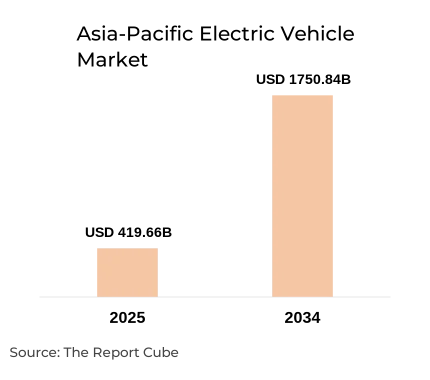
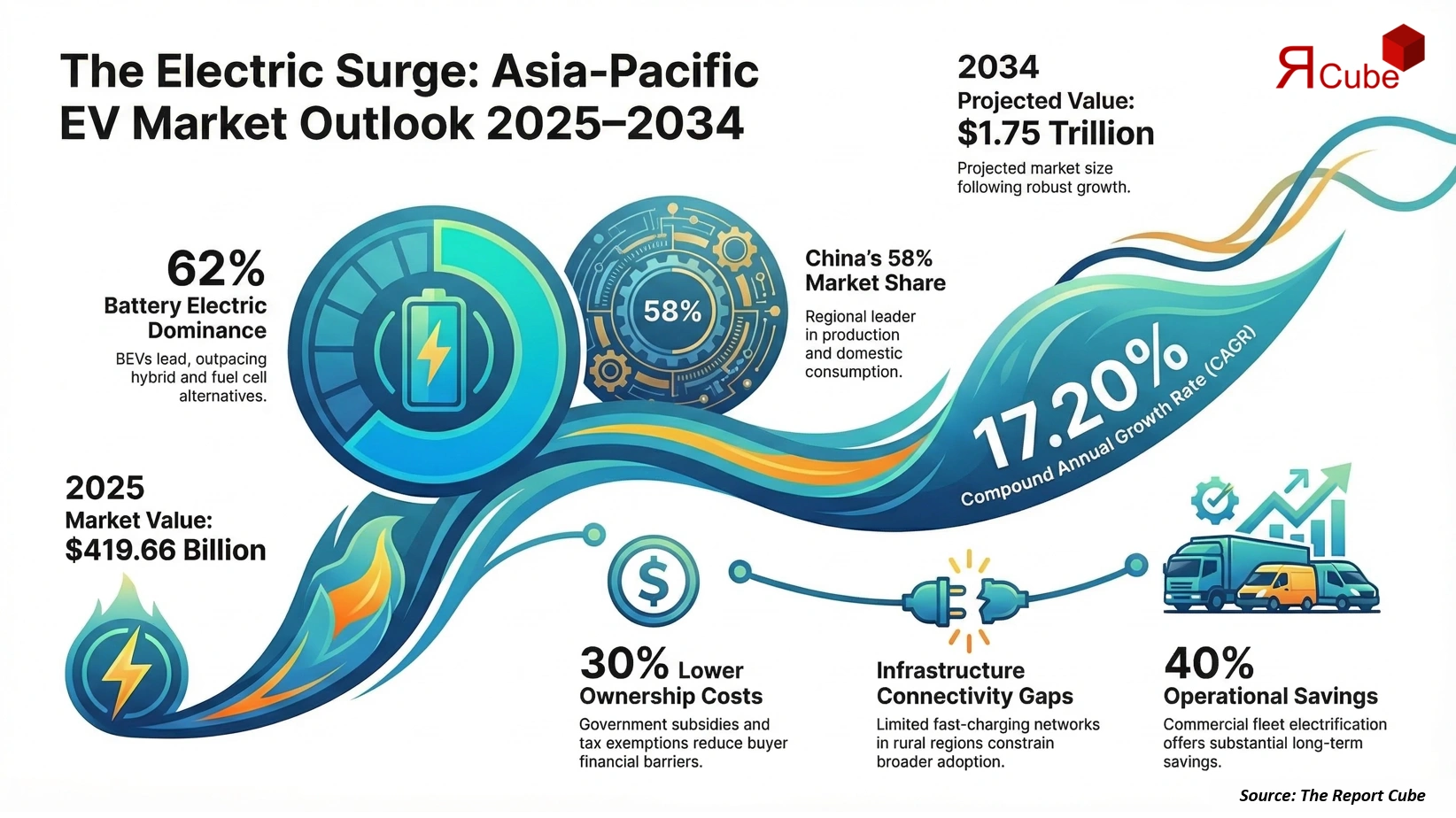
The Asia-Pacific Electric Vehicle (EV) Market is anticipated to register a CAGR of 17.20% during the forecast period 2026-2034. The market size was valued at USD 419.66 billion in 2025 and is projected to reach USD 1,750.84 billion by 2034. The Asia-Pacific region represents the global epicenter of EV adoption, driven by large-scale manufacturing capabilities, proactive government policies, and rising consumer demand for sustainable mobility solutions.
China dominates regional EV production and consumption, supported by a mature supply chain, advanced battery manufacturing ecosystem, and strong domestic demand. India, Japan, and South Korea are emerging as high-growth markets due to expanding charging infrastructure, favorable policy frameworks, and growing investments by global automakers. Rapid urbanization, rising fuel prices, and increasing environmental awareness are accelerating the shift from internal combustion engines to electric alternatives across both passenger and commercial vehicle categories.
Technological advancements in battery energy density, declining lithium-ion battery costs, and software-enabled vehicle architectures have improved EV affordability and performance. Additionally, automakers are increasingly localizing production to reduce costs and comply with regional content regulations. With expanding applications across personal mobility, logistics, public transportation, and shared mobility, the Asia-Pacific Electric Vehicle Market is expected to remain the fastest-growing EV market globally through 2034.
Asia-Pacific Electric Vehicle Market Recent Developments
- 2025: BYD Company Ltd. expanded its next-generation Blade Battery EV lineup across China and Southeast Asia.
- 2025: Tata Motors launched new mass-market electric passenger vehicles targeting urban and semi-urban India.
Government Initiatives & Policies
- China NEV Development Plan: Supports EV adoption through subsidies, charging infrastructure, and domestic manufacturing incentives.
- India National Electric Mobility Mission: Promotes EV manufacturing, adoption, and charging infrastructure development.
Asia-Pacific Electric Vehicle (EV) Market Dynamics
Key Driver: Strong Government Support and Emission Reduction Targets
Government-led initiatives remain the most influential driver of the Asia-Pacific EV Market. Countries such as China, India, Japan, and South Korea have implemented stringent emission regulations and ambitious net-zero targets, directly accelerating EV adoption. Financial incentives including purchase subsidies, tax exemptions, and reduced registration fees have lowered ownership costs by up to 30% in select markets. Public investments in charging infrastructure and battery manufacturing are further strengthening market growth. Additionally, mandates for electric buses and fleet electrification are creating consistent demand from commercial and public transport sectors.
Book your FREE 30-minute expert consultation today
Contact UsIndustry Trends: Rapid Expansion of Battery Electric Vehicles and Platform Localization
Battery Electric Vehicles (BEVs) are emerging as the dominant propulsion type, accounting for over 62% of EV sales in the region in 2025. Automakers are increasingly developing region-specific EV platforms to optimize cost structures and address local driving conditions. Software-defined vehicles, over-the-air updates, and advanced driver assistance systems are becoming standard features. Battery technology innovations, including solid-state research and high-nickel cathodes, are further improving driving range and safety, positioning EVs as mainstream mobility solutions.
Major Challenge: Charging Infrastructure Gaps and Grid Constraints
Despite rapid growth, uneven charging infrastructure deployment remains a critical challenge across Asia-Pacific. Rural and semi-urban regions face limited access to fast-charging networks, constraining broader adoption. Power grid readiness and peak-load management also pose challenges as EV penetration increases. Additionally, high upfront costs of EVs compared to conventional vehicles remain a concern in price-sensitive markets, particularly for commercial buyers and small fleet operators.
Opportunity: Electrification of Commercial Fleets and Public Transportation
The electrification of commercial vehicles, buses, and shared mobility fleets presents a substantial growth opportunity. Logistics companies and public transport authorities are increasingly adopting EVs to reduce fuel costs and meet sustainability mandates. Electric buses and delivery vans offer operational savings of up to 40% over vehicle lifecycles. Government-backed procurement programs and public-private partnerships are expected to accelerate fleet electrification, creating long-term demand stability across the region.
Asia-Pacific Electric Vehicle (EV) Market Segment-wise Analysis
By Propulsion Type:
- Battery Electric
- Hybrid Electric
- Plug-in Hybrid
- Fuel Cell
Battery Electric Vehicles lead the propulsion segment, accounting for approximately 62% market share in 2025. This dominance is driven by declining battery costs, zero-emission benefits, and strong policy support. Hybrid and plug-in hybrid vehicles continue to attract consumers seeking transitional solutions, particularly in Japan and South Korea. Fuel cell vehicles remain niche due to high infrastructure costs and limited hydrogen availability.
By Vehicle Type:
- Passenger Cars
- Commercial Vehicles
- Two Wheelers
- Three Wheelers
Passenger cars represent the largest vehicle type segment, holding nearly 55% of the market share in 2025. Strong demand from urban consumers and expanding model availability are key growth factors. Commercial vehicles are the fastest-growing segment, supported by fleet electrification initiatives. Two and three wheelers remain crucial in India and Southeast Asia due to affordability and high daily usage patterns.
Regional Projection of Asia-Pacific Electric Vehicle Industry
- China
- Japan
- India
- South Korea
China leads the Asia-Pacific EV Market with approximately 58% regional market share in 2025, supported by strong domestic demand and export-oriented manufacturing. India is the fastest-growing market, driven by policy incentives and rising urban mobility needs. Japan and South Korea focus on technology innovation, hybrid transitions, and next-generation battery research. Australia is witnessing gradual adoption supported by renewable energy integration and charging network expansion.
Need insights for a specific region within this market?
Request Regional DataWhy Choose This Report?
- Provides a comprehensive overview of the overall market analysis, encompassing key trends, consumer behavior analysis, and risk assessment to support strategic decision-making.
- Provides accurate, up-to-date insights into market size, segmentation, and emerging opportunities, helping to minimize risk & capitalizing on growth.
- Gives deep understanding of target audience preferences, investment habits, and communication channels for enhanced product development & marketing effectiveness.
- Delivers competitive analysis & benchmarking, uncovering the strengths & weaknesses of market competitors to guide strategies.
- Consolidate comprehensive market intelligence, reducing reasoning & streamlining research efforts.
- Facilitates customized market segmentation & risk mitigation strategies, fine-tuned to the business objectives.
- Aids in identifying both market challenges & untapped opportunities within the industry to drive long-term business growth.
- Provides valuable information based on actual customer data & search trends.
Table of Contents
- Introduction
- Objective of the Study
- Product and Category Definition
- Market Segmentation
- Study Variables
- Research Methodology
- Secondary Data Points
- Breakdown of Secondary Sources
- Primary Data Points
- Breakdown of Primary Interviews
- Secondary Data Points
- Executive Summary
- Market Dynamics
- Drivers
- Challenges
- Opportunity Assessment
- Recent Trends and Developments
- Regulatory and Policy Landscape
- Asia-Pacific Electric Vehicle Market Overview (2020-2034)
- Market Size, By Value (USD Billion)
- Market Share, By Propulsion Type
- Battery Electric
- Hybrid Electric
- Plug-in Hybrid
- Fuel Cell
- Market Share, By Vehicle Type
- Passenger Cars
- Commercial Vehicles
- Two Wheelers
- Three Wheelers
- Market Share, By Charging Type
- Normal Charging
- Fast Charging
- Market Share, By End User
- Private Use
- Fleet Services
- Public Transit
- Market Share, By Country
- China
- Japan
- India
- South Korea
- Australia
- Rest of Asia-Pacific
- Market Share, By Company
- Market Share, By Company
- Competition Characteristics
- Revenue Shares & Analysis
- China Electric Vehicle Market
- Market Size, By Value (USD Billion)
- Market Share, By Propulsion Type
- Market Share, By Vehicle Type
- Market Share, By Charging Type
- Market Share, By End User
- Market Share, By Region/Province Group
- Japan Electric Vehicle Market
- Market Size, By Value (USD Billion)
- Market Share, By Propulsion Type
- Market Share, By Vehicle Type
- Market Share, By Charging Type
- Market Share, By End User
- Market Share, By Region/Prefecture Group
- India Electric Vehicle Market
- Market Size, By Value (USD Billion)
- Market Share, By Propulsion Type
- Market Share, By Vehicle Type
- Market Share, By Charging Type
- Market Share, By End User
- Market Share, By Region/State Group
- South Korea Electric Vehicle Market
- Market Size, By Value (USD Billion)
- Market Share, By Propulsion Type
- Market Share, By Vehicle Type
- Market Share, By Charging Type
- Market Share, By End User
- Market Share, By Region/Province Group
- Australia Electric Vehicle Market
- Market Size, By Value (USD Billion)
- Market Share, By Propulsion Type
- Market Share, By Vehicle Type
- Market Share, By Charging Type
- Market Share, By End User
- Market Share, By Region/State Group
- Rest of Asia-Pacific Electric Vehicle Market
- Market Size, By Value (USD Billion)
- Market Share, By Propulsion Type
- Market Share, By Vehicle Type
- Market Share, By Charging Type
- Market Share, By End User
- Market Share, By Country
- Indonesia Electric Vehicle Market
- Thailand Electric Vehicle Market
- Vietnam Electric Vehicle Market
- Malaysia EV Market
- Singapore EV Market
- Philippines EV Market
- Others
- Competitive Outlook and Company Profiles
- BYD Company Ltd.
- Company Overview
- Product Portfolio
- Strategic Alliances/Partnerships
- Recent Developments
- Tesla Inc.
- Company Overview
- Product Portfolio
- Strategic Alliances/Partnerships
- Recent Developments
- SAIC Motor Corporation
- Company Overview
- Product Portfolio
- Strategic Alliances/Partnerships
- Recent Developments
- Geely Auto Group
- Company Overview
- Product Portfolio
- Strategic Alliances/Partnerships
- Recent Developments
- Hyundai Motor Company
- Company Overview
- Product Portfolio
- Strategic Alliances/Partnerships
- Recent Developments
- Kia Corporation
- Company Overview
- Product Portfolio
- Strategic Alliances/Partnerships
- Recent Developments
- Toyota Motor Corporation
- Company Overview
- Product Portfolio
- Strategic Alliances/Partnerships
- Recent Developments
- Nissan Motor Co. Ltd.
- Company Overview
- Product Portfolio
- Strategic Alliances/Partnerships
- Recent Developments
- Honda Motor Co. Ltd.
- Company Overview
- Product Portfolio
- Strategic Alliances/Partnerships
- Recent Developments
- Tata Motors Limited
- Company Overview
- Product Portfolio
- Strategic Alliances/Partnerships
- Recent Developments
- Others
- BYD Company Ltd.
- Contact Us and Disclaimer
Top Key Players & Market Share Outlook
- BYD Company Ltd.
- Tesla Inc.
- SAIC Motor Corporation
- Geely Auto Group
- Hyundai Motor Company
- Kia Corporation
- Toyota Motor Corporation
- Nissan Motor Co. Ltd.
- Honda Motor Co. Ltd.
- Tata Motors Limited
- Others
Frequently Asked Questions






