



Build Your Custom Market Intelligence Report
Customize Your ReportKey Takeaways
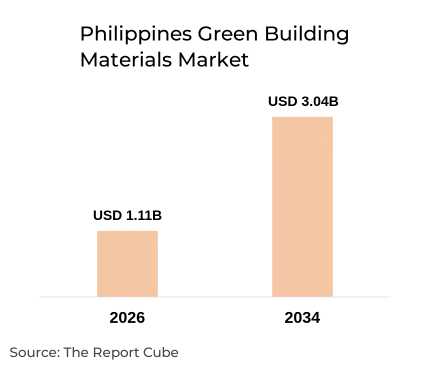
- A comprehensive Philippines Green Building Materials Market Analysis reveals the market was valued at USD 1.11 billion in 2026, reflecting robust demand growth.
- The Philippines Green Building Materials Market is projected to reach USD 3.04 billion by 2034, registering a 13.40% CAGR during the forecast period.
- Market expanding at an industry-leading 13.40% CAGR through the 2034 forecast period, outpacing broader ASEAN construction sector averages.
- Framing and structural applications lead the By Application segment, underpinned by rapid residential and commercial construction activity.
- Residential end-use dominates procurement as urban housing demand and green building certification programs expand across Philippine cities.
- Commercial infrastructure is the fastest-growing end-use category driven by corporate sustainability mandates and LEED certification adoption.
- Saint-Gobain Philippines, SCG, Philippine GeoGreen Inc., and RiverRecycle are among the leading suppliers serving the domestic market.
- Circular economy adoption and bamboo composite integration are reshaping green material procurement across the Philippines construction sector.
Market Overview
The Philippines Green Building Materials Market is anticipated to register a 13.40% CAGR during 2026–2034. The market size was valued at USD 1.11 billion in 2026 and is projected to reach USD 3.04 billion by 2034. Rapid urbanization, intensifying government focus on sustainable construction, and rising adoption of green building certification programs including BERDE and LEED are collectively sustaining demand across residential, commercial, and infrastructure development segments. Government infrastructure investments under the Build Better More program and mandatory environmental compliance standards are enabling broader uptake of energy-efficient and low-carbon building materials. International suppliers including Saint-Gobain Philippines and Siam Cement Group (SCG) have strengthened regional logistics and local distribution networks, ensuring consistent material availability to developers, contractors, and institutional project owners.
Growing commercial real estate development and expanding public infrastructure spending continue generating sustained demand for certified green building materials across Metro Manila and major regional centers. The Philippines' archipelagic geography and vulnerability to extreme weather events are reinforcing demand for resilient, climate-adapted building solutions that align with green material specifications. Increasing developer awareness of lifecycle cost advantages associated with sustainable construction materials has encouraged premium positioning by both local producers and multinational ingredient suppliers. Philippine GeoGreen Inc. and RiverRecycle have intensified market engagement through product innovation initiatives and circular economy supply programs targeting Philippine architects, developers, and infrastructure contractors seeking locally sourced, sustainably certified building material formulations.
Market Size & Forecast
|
Metric |
Details |
|---|---|
|
Market Size (2026) |
USD 1.11 Billion |
|
Market Size (2034) |
USD 3.04 Billion |
|
CAGR (2026–2034) |
13.40% |
|
Base Year |
2026 |
|
Historical Years |
2021–2025 |
|
Forecast Years |
2026–2034 |
This Philippines Green Building Materials Market Size assessment values the industry at USD 1.11 billion in 2026, projected to reach USD 3.04 billion by 2034 at a 13.40% CAGR. This trajectory significantly outpaces ASEAN regional construction sector averages, driven by mandatory green building compliance policies, accelerating commercial real estate development, and expanding government-supported affordable green housing programs across Luzon, Visayas, and Mindanao.
Market Dynamics
The Philippines green building materials sector is expanding at an accelerated pace as construction activity intensifies across urban centers, regulatory compliance requirements tighten, and developer preferences shift decisively toward certified sustainable materials. Rising government infrastructure allocations, expanding BERDE certification adoption, and increasing foreign direct investment into Philippine real estate are reinforcing demand for energy-efficient insulation, structural composites, low-emission interior materials, and climate-resilient exterior solutions across all construction verticals. The Philippines Green Building Materials Market Growth is primarily driven by strengthening green building policy frameworks and rapidly rising construction output across residential and commercial segments.
|
Factor |
Type |
Specific Impact on Market |
Magnitude |
|---|---|---|---|
|
Government green building mandates and BERDE standards |
Driver |
Accelerates mandatory adoption of certified sustainable construction materials across public and private projects |
High |
|
Rising urban residential construction demand |
Driver |
Increases procurement volumes for green framing, insulation, and interior finishing materials |
High |
|
High initial cost premium of certified green materials |
Challenge |
Limits adoption among mid-market residential developers and small contractors |
Medium |
|
Circular economy and recycled material innovation |
Opportunity |
Enables locally sourced sustainable material supply and reduces import dependency |
High |
|
EUDR and international sustainable sourcing compliance |
Trend |
Reshapes procurement practices for timber-based and bio-composite construction materials |
Medium |
- Growth Drivers - Government Infrastructure Investment and Green Certification Adoption: The Philippine government's Build Better More program and expanding BERDE (Building for Ecologically Responsive Design Excellence) certification framework are directly stimulating green building material demand. Mandatory energy efficiency standards for commercial buildings, combined with developer incentives for certified sustainable projects, have materially increased procurement of insulation systems, green framing products, and low-emission interior finishing materials across Luzon's major urban markets.
- Market Restraints - Cost Premium and Supply Chain Fragmentation: Certified green building materials typically carry a 15–30% cost premium over conventional alternatives, representing a structural barrier for mid-tier residential developers and small construction contractors operating on constrained budgets. Import dependency for certain high-performance insulation and specialized composite materials introduces supply chain fragmentation risks, particularly for provincial project sites distant from Metro Manila distribution centers, further constraining market penetration at scale.
- Market Opportunities - Circular Economy Materials and Local Innovation: The Philippines' expanding recycled material sector, anchored by producers including RiverRecycle and Philippine GeoGreen Inc., presents a significant opportunity to develop domestically sourced, cost-competitive green building materials from industrial and agricultural waste streams. Bamboo composite structural materials, recycled plastic lumber, and upcycled aggregate products are emerging as commercially viable alternatives with strong sustainability credentials and growing acceptance among Philippine architects and institutional project developers.
- Industry Challenges - Climate Resilience Standards and Regulatory Complexity: The Philippines' exposure to typhoons, seismic activity, and flooding creates demanding performance requirements for green building materials that must simultaneously meet sustainability certifications and structural resilience standards. Evolving regulatory frameworks across multiple national agencies - including the Department of Public Works and Highways, DENR, and the Philippine Green Building Council - create compliance complexity that increases procurement lead times and documentation burdens for developers integrating certified green material solutions.
Need Specific Data, Let’s Customize the Report for You
Request CustomizationMarket Trends
- Emerging Trends: Among the most significant Philippines Green Building Materials Market Trends is the integration of bamboo composites, recycled plastic structural panels, and agricultural fiber-based boards into mainstream construction specifications. Philippine developers and architects are increasingly specifying locally produced circular economy materials as sustainable alternatives, reducing import costs while meeting green certification thresholds across BERDE and internationally recognized LEED rating systems.
- Technology Trends: Advanced manufacturing technologies including fiber-reinforced polymer composite production, nanotechnology-enhanced insulation systems, and digital material traceability platforms are entering the Philippine green construction supply chain. Building Information Modelling (BIM) integration with green material databases is enabling Philippine architects and contractors to specify, simulate, and procure certified sustainable materials with greater precision and reduced project cycle times through the 2034 forecast horizon.
- Consumer / Buyer Trends: Corporate and institutional property developers are increasingly requiring green building certification as a non-negotiable project specification, driven by ESG reporting obligations, tenant demand for sustainable office environments, and long-term operating cost reduction targets. Over 70% of major commercial real estate developers active in Metro Manila now include LEED or BERDE certification targets in project briefs, directly shaping procurement specifications for insulation, exterior siding, and low-emission interior finishing materials.
- Regulatory Trends: The Philippine Green Building Code, enforced through the Department of Public Works and Highways, continues to evolve its minimum energy efficiency and material sustainability requirements for commercial and residential buildings above specified floor area thresholds. Enhanced environmental impact assessment requirements from the DENR and strengthening GHG emission disclosure obligations from the Securities and Exchange Commission for listed developers are progressively raising baseline green material adoption across the Philippines construction sector.
Philippines Green Building Materials Market Segment Analysis
The Philippines green building materials market serves distinct application categories and end-use verticals, each characterized by unique procurement drivers, material performance requirements, and green certification standards that shape supplier positioning and product development strategies.
By Application
- Framing & Structural
- Roofing
- Insulation
- Interior Finishing & Flooring
- Exterior Siding
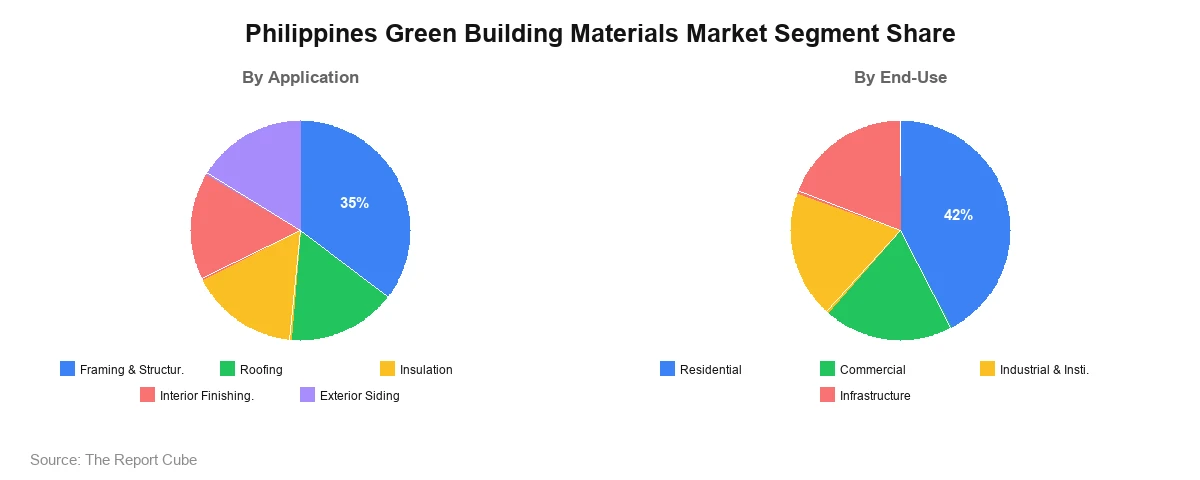
Framing and structural applications lead the By Application segment, commanding an estimated 35% Philippines Green Building Materials Market Share in 2026. Saint-Gobain Philippines and Siam Cement Group (SCG) supply the majority of certified structural and framing materials consumed across residential and commercial construction projects. Roofing materials, representing approximately 22% of application demand, are supplied by SCG and Philippine GeoGreen Inc. through energy-reflective and recycled-content roofing product lines. Insulation accounts for an estimated 18%, serving energy efficiency compliance requirements across commercial buildings, with Saint-Gobain Philippines the leading supplier of certified thermal and acoustic insulation solutions. Interior finishing and flooring collectively represent 15%, while exterior siding captures approximately 10% of total application market demand, serving climate-resilient facade specifications across commercial and institutional projects.
By End-Use
- Residential
- Commercial
- Industrial & Institutional
- Infrastructure
Residential end-use represents the dominant procurement category at an estimated 42% market share in 2026, driven by expanding government affordable housing programs and private condominium development across Metro Manila and key provincial urban centers. Olam-affiliated local distributors and SCG supply volume residential green material requirements. The commercial segment, at approximately 28%, is the fastest-growing end-use category as corporate real estate developers pursue LEED and BERDE certifications. Industrial and institutional buyers account for an estimated 18%, procuring heavy-duty green structural and insulation materials from Saint-Gobain Philippines. Infrastructure end-use, representing approximately 12% of demand, is expanding through government Build Better More program investments in sustainable public construction.
Regional Analysis
|
Region |
Estimated Market Share |
Key Growth Factors |
Consumer Trends |
|---|---|---|---|
|
Metro Manila |
45% |
Dense commercial and residential construction activity, regulatory compliance concentration |
High LEED and BERDE certification adoption, premium green material specifications |
|
Central Luzon |
22% |
Industrial corridor expansion, government infrastructure investment, suburban residential growth |
Mid-market green framing and insulation procurement growth |
|
Southern Luzon |
20% |
Industrial estates, eco-zone development, CALABARZON residential expansion |
Increasing institutional and commercial green building activity |
|
Northern Luzon |
13% |
Tourism infrastructure, regional government buildings, agri-industrial development |
Emerging green building adoption, roofing and insulation demand growth |
- Metro Manila - Accounting for approximately 45% of total market demand, Metro Manila concentrates the Philippines' highest density of commercial real estate development, institutional construction, and certified green building projects. Premium green insulation, structural composites, and low-emission interior finishing materials are in consistent procurement across Makati, Bonifacio Global City, and Ortigas Center development corridors, where LEED and BERDE certification has become a standard developer commitment.
- Central Luzon - Expanding industrial corridors across Pampanga and Bulacan, combined with rapid suburban residential growth spilling outward from Metro Manila, are driving increasing mid-market green building material demand across the Clark Freeport Zone and adjacent economic development areas. Government infrastructure investments in the region include multiple green-specified public building projects that support certified material procurement.
- Southern Luzon - CALABARZON's dense industrial estate and residential development activity positions Southern Luzon as a significant and growing green building materials market. Eco-zone industrial facilities and expanding private residential subdivisions in Laguna, Batangas, and Cavite are increasingly incorporating green insulation, exterior siding, and low-emission interior materials to meet corporate sustainability and national building code compliance requirements.
- Northern Luzon - Tourism infrastructure development across Ilocos Norte, Cordillera, and Cagayan Valley, combined with regional government building programs, are generating early-stage green building material demand. Roofing and insulation applications dominate Northern Luzon procurement as climate resilience and energy efficiency requirements gain traction among regional developers and public sector construction managers.
Market Share & Competitive Landscape
The Philippines green building materials market's competitive landscape combines established multinational suppliers with locally innovative circular economy producers, with competitive differentiation anchored on certification credentials, distribution reach, technical support capability, and sustainable sourcing transparency.
|
Company |
Competitive Strength |
Primary Segment Served |
|---|---|---|
|
Philippine GeoGreen Inc. |
Local sourcing, circular economy innovation, sustainable certification |
Residential and commercial framing, interior finishing |
|
RiverRecycle |
Recycled content materials, environmental compliance positioning |
Residential, infrastructure, sustainable procurement |
|
Saint-Gobain Philippines |
Global product portfolio, energy efficiency certification, technical expertise |
Commercial insulation, interior finishing, exterior siding |
|
Siam Cement Group (SCG) |
Regional manufacturing scale, diversified green product lines, ASEAN distribution |
Roofing, framing, commercial construction |
|
Others |
Various local producers and distributors serving niche segments |
Mixed residential and regional commercial |
Key Companies in the Philippines Green Building Materials Market
Saint-Gobain Philippines
Saint-Gobain Philippines, the local operating entity of France-headquartered Saint-Gobain S.A. - one of the world's largest building materials groups - supplies a comprehensive range of green-certified insulation, interior drylining, and exterior facade solutions across the Philippine construction market. In 2025, the company expanded its technical support programs targeting Philippine green building specifiers and architects, reinforcing its leadership in certified sustainable insulation and low-emission interior finishing material supply across commercial and institutional projects.
Siam Cement Group (SCG)
Siam Cement Group, headquartered in Bangkok, Thailand, is one of ASEAN's largest diversified building materials conglomerates with a significant manufacturing and distribution presence in the Philippines. In 2025, SCG Philippines advanced its green product portfolio by introducing expanded eco-series roofing and framing material lines designed to meet Philippine Green Building Code compliance requirements. Its integrated regional supply chain and established Philippine distribution network position it as a structurally important supplier across residential, commercial, and infrastructure end-use segments.
Recent Developments
|
Year |
Company |
Development |
|---|---|---|
|
2025 |
Saint-Gobain Philippines |
Expanded technical support and green building specification programs targeting Philippine architects and commercial contractors |
|
2025 |
Siam Cement Group (SCG) |
Launched expanded eco-series roofing and framing product lines aligned with Philippine Green Building Code requirements |
|
2025 |
Philippine GeoGreen Inc. |
Introduced new circular economy-based structural panels incorporating agricultural fiber and recycled industrial material inputs |
Future Outlook
The Philippines Green Building Materials Market Forecast projects a 13.40% CAGR through 2034, with the market expanding from USD 1.11 billion in 2026 to USD 3.04 billion by the forecast year. Sustained commercial real estate development, government-mandated green building compliance, and rising residential developer adoption of certified sustainable materials will collectively drive procurement expansion across all application and end-use categories. Saint-Gobain Philippines, SCG, and locally innovative producers including Philippine GeoGreen Inc. are expected to deepen market penetration by developing climate-adapted, certification-compliant material formulations aligned with evolving Philippine Green Building Code requirements and developer sustainability commitments through 2034.
Technological advancement in green building material manufacturing - including bamboo composite processing, fiber-reinforced polymer systems, and bio-based insulation production - will increasingly become commercially accessible to Philippine mid-market residential and regional commercial developers. Sustainable sourcing standards aligned with international frameworks including ISO 14001 and emerging ASEAN green building benchmarks will become foundational procurement requirements as Philippine commercial developers, institutional owners, and infrastructure agencies respond to intensifying regulatory expectations and ESG disclosure obligations through the forecast period.
Philippines Green Building Materials Market Report Coverage
This Philippines Green Building Materials Market Report covers the full forecast period from 2026 through 2034, providing complete segmentation, competitive landscape analysis, and regional demand assessment.
|
Report Attribute |
Details |
|---|---|
|
Market Name |
Philippines Green Building Materials Market |
|
Market Size (2026) |
USD 1.11 Billion |
|
Market Size (2034) |
USD 3.04 Billion |
|
Forecast Period |
2026–2034 |
|
CAGR |
13.40% |
|
Base Year |
2026 |
|
Historical Years |
2021–2025 |
|
Forecast Years |
2026–2034 |
|
Segments Covered |
By Material Type, By Application, By End-Use |
|
Regions Covered |
Metro Manila, Central Luzon, Southern Luzon, Northern Luzon |
|
Key Companies |
Philippine GeoGreen Inc., RiverRecycle, Saint-Gobain Philippines, Siam Cement Group (SCG), Others |
|
Report Format |
PDF, Excel, PPT |
|
Customization |
Available as per client requirements |
Why Choose This Philippines Green Building Materials Market Report?
- Comprehensive coverage of the Philippines' rapidly expanding green building materials sector across all major application and end-use categories.
- Accurate market sizing from USD 1.11 billion in 2026 through USD 3.04 billion in 2034 with a verified 13.40% CAGR.
- Detailed segmentation by application type (Framing, Roofing, Insulation, Interior Finishing, Exterior Siding) and end-use industry vertical.
- Regional insights covering Metro Manila, Central Luzon, Southern Luzon, and Northern Luzon with estimated demand share percentages.
- Competitive profiling of leading multinational and locally innovative green building material suppliers active in the Philippine market.
- Analysis of circular economy, bamboo composite, and recycled material trends reshaping sustainable construction procurement in the Philippines.
- Forecast data supporting strategic investment, market entry, and supplier partnership planning for the 2026–2034 period.
- Research aligned with Philippine Green Building Code, BERDE certification standards, and the government's Build Better More infrastructure program.
Table of Contents
- Introduction
- Objective of the Study
- Product Definition
- Market Segmentation
- Study Variables
- Research Methodology
- Secondary Data Points
- Companies Interviewed
- Primary Data Points
- Breakdown of Primary Interviews
- Secondary Data Points
- Executive Summary
- Market Dynamics
- Drivers
- Challenges
- Opportunity Assessment
- Recent Trends and Developments
- Policy and Regulatory Landscape
- Philippines Green Building Materials Market Overview and Forecast Analysis (2021-2034)
- Market Size, By Value, By Growth Rate (CAGR/USD Billions)
- Demand – Supply Trends
- Market Share, By Material Type
- Low-Carbon Concrete & Cement
- Recycled-Plastic Composites
- Engineered & Reclaimed Wood
- Recycled Metals
- Insulation Materials
- Eco-Coatings
- Market Share, By Application
- Framing & Structural
- Roofing
- Insulation
- Interior Finishing & Flooring
- Exterior Siding
- Market Share, By End-Use
- Residential
- Commercial
- Industrial & Institutional
- Infrastructure
- Market Share, By Region
- Metro Manila
- Northern Luzon
- Central Luzon
- Southern Luzon
- Market Share, By Competitors
- Competition Characteristics
- Revenue Shares
- Low-Carbon Concrete & Cement Philippines Green Building Materials Market Overview, 2021-2034F
- By Value (USD Million)
- By Application – Market Size & Forecast 2021-2034, USD Million
- Framing & Structural
- Roofing
- Insulation
- Interior Finishing & Flooring
- Exterior Siding
- Recycled-Plastic Composites Philippines Green Building Materials Market Overview, 2021-2034F
- By Value (USD Million)
- By Application – Market Size & Forecast 2021-2034, USD Million
- Framing & Structural
- Roofing
- Insulation
- Interior Finishing & Flooring
- Exterior Siding
- Engineered & Reclaimed Wood Philippines Green Building Materials Market Overview, 2021-2034F
- By Value (USD Million)
- By Application – Market Size & Forecast 2021-2034, USD Million
- Framing & Structural
- Roofing
- Insulation
- Interior Finishing & Flooring
- Exterior Siding
- Recycled Metals Philippines Green Building Materials Market Overview, 2021-2034F
- By Value (USD Million)
- By Application – Market Size & Forecast 2021-2034, USD Million
- Framing & Structural
- Roofing
- Insulation
- Interior Finishing & Flooring
- Exterior Siding
- Insulation Materials Philippines Green Building Materials Market Overview, 2021-2034F
- By Value (USD Million)
- By Application – Market Size & Forecast 2021-2034, USD Million
- Framing & Structural
- Roofing
- Insulation
- Interior Finishing & Flooring
- Exterior Siding
- Eco-Coatings Philippines Green Building Materials Market Overview, 2021-2034F
- By Value (USD Million)
- By Application – Market Size & Forecast 2021-2034, USD Million
- Framing & Structural
- Roofing
- Insulation
- Interior Finishing & Flooring
- Exterior Siding
- Competitive Outlook (Company Profile - Partial List)
- Philippine GeoGreen Inc.
- Company Overview
- Business Segments
- Strategic Alliances/Partnerships
- Recent Developments
- RiverRecycle
- Company Overview
- Business Segments
- Strategic Alliances/Partnerships
- Recent Developments
- Saint-Gobain Philippines
- Company Overview
- Business Segments
- Strategic Alliances/Partnerships
- Recent Developments
- Siam Cement Group (SCG)
- Company Overview
- Business Segments
- Strategic Alliances/Partnerships
- Recent Developments
- Others
- Philippine GeoGreen Inc.
- Contact Us & Disclaimer
Top Key Players & Market Share Outlook
- Philippine GeoGreen Inc.
- RiverRecycle
- Saint-Gobain Philippines
- Siam Cement Group (SCG)
- Others
Frequently Asked Questions






