



Build Your Custom Market Intelligence Report
Customize Your ReportVietnam Green Building Materials Market Key Takeaways
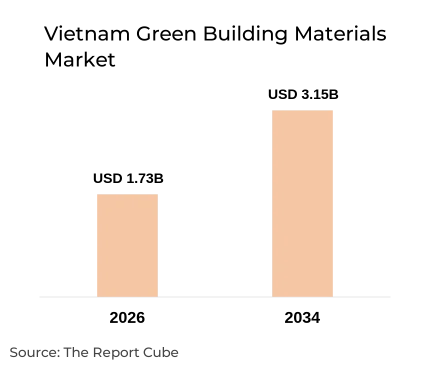
- Vietnam Green Building Materials Market valued at USD 1.73 billion in 2026.
- Market projected to reach USD 3.15 billion by 2034 at 7.78% CAGR.
- Insulation segment leads application-based demand across Vietnam's construction sector.
- Low-carbon cement and concrete dominate material type with substantial adoption share.
- Southern Vietnam maintains regional leadership driven by rapid urban infrastructure expansion.
- Central Vietnam emerges as fastest-growing region supported by coastal development initiatives.
- Key players include Saint-Gobain Vietnam, Knauf Vietnam, Mapei Vietnam, and Siam City Cement.
- Green building codes and LEED certification adoption are accelerating sustainable materials demand.
Vietnam Green Building Materials Market Insights & Analysis
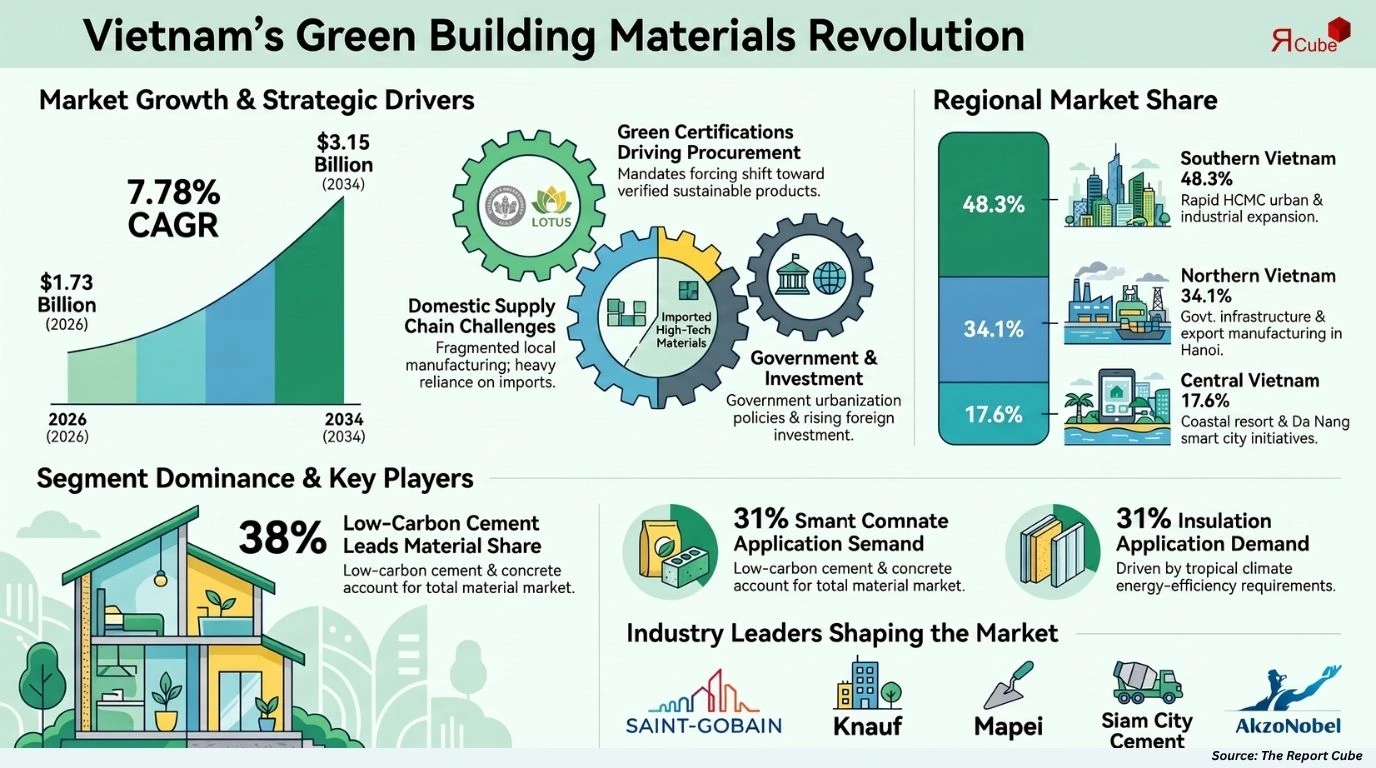
The Vietnam Green Building Materials Market is anticipated to register a 7.78% CAGR during 2026–2034. The market size was valued at USD 1.73 billion in 2026 and is projected to reach USD 3.15 billion by 2034. Vietnam's construction industry is undergoing a structural transformation driven by government-backed green urbanization policies, rising foreign direct investment in sustainable infrastructure, and expanding compliance requirements under the Vietnam Green Building Standard (QCVN 09:2017). The Ministry of Construction's Green Building Program and LOTUS certification framework are compelling developers, contractors, and material suppliers to accelerate adoption of environmentally responsible construction inputs.
Demand is accelerating across residential, commercial, and industrial construction as developers target green certifications to attract institutional investors and foreign tenants. Vietnam's National Green Growth Strategy 2021–2030 has allocated targeted subsidies for sustainable building projects, while international financing institutions including the Asian Development Bank have committed over USD 500 million toward green infrastructure across Southeast Asia, a portion of which directly supports Vietnam's building material supply chain modernization and low-emission construction practices.
Vietnam Green Building Materials Market Dynamics
Vietnam's green building materials sector is expanding at a consistent pace as urbanization pressures, tightening regulatory frameworks, and shifting developer preferences converge to create durable demand. Construction activity in Ho Chi Minh City, Hanoi, and emerging industrial corridors continues to scale, reinforcing procurement of sustainable insulation, structural materials, and interior finishing products that meet evolving national environmental performance thresholds.
|
Factor |
Type |
Specific Impact on Market |
Magnitude |
|---|---|---|---|
|
Green building certification growth |
Driver |
Increases demand for LOTUS and LEED-compliant materials |
Very High |
|
Vietnam's National Green Growth Strategy |
Driver |
Supports procurement of low-carbon cement and eco-materials |
High |
|
Industrial zone expansion |
Opportunity |
Elevates demand for sustainable roofing and exterior cladding |
High |
|
Fragmented domestic supply base |
Challenge |
Limits consistent quality and availability of green inputs |
Medium |
|
Circular economy regulations |
Trend |
Promotes recycled metals, composites, and non-fired bricks |
High |
Key Market Driver: Green Certification Standards Boosting Procurement
Vietnam's green building materials market is benefiting directly from rising developer adoption of LOTUS, LEED, and EDGE certifications, which mandate specific performance thresholds for insulation, glazing, structural products, and interior finishes. As of 2025, over 250 certified green buildings operate across Vietnam, with the pipeline expanding sharply in Ho Chi Minh City and Hanoi's commercial real estate sectors. Certification requirements are compelling procurement teams to shift toward sustainable construction materials in Vietnam, creating sustained institutional demand for verified low-emission and recycled-content products from established multinational and domestic manufacturers.
Major Industry Challenge: Inconsistent Domestic Supply Chain Infrastructure
A fragmented and uneven domestic supply base continues constraining market scalability. Many local manufacturers lack the technical capacity to produce certified green materials at scale, creating quality consistency gaps that prompt large contractors to rely heavily on imported products. This import dependency increases procurement costs and extends lead times, particularly for engineered wood, eco-insulation, and specialty composites. Certification verification processes remain underdeveloped across several provincial markets, making it difficult for buyers outside major urban centers to access reliable green product inventories and supplier documentation.
Emerging Trend Shaping Outlook: Circular Economy Materials Gaining Ground
Vietnam's Ministry of Natural Resources and Environment is advancing circular economy frameworks that directly influence construction material selection. Non-fired bricks, recycled metal composites, and reclaimed aggregate concrete are gaining traction as both regulatory and corporate sustainability pressures mount. Industrial zones in Binh Duong, Long An, and Da Nang are piloting circular construction procurement standards, with several major project developers committing to minimum recycled content thresholds for structural and finishing materials. This regulatory momentum is expected to accelerate demand for recycled and low-carbon building materials significantly through 2034.
Need Specific Data, Let’s Customize the Report for You
Request CustomizationVietnam Green Building Materials Market Segment-wise Analysis
Vietnam's green building materials sector spans a diverse set of application environments and material categories, reflecting the country's varied construction pipeline - from high-density urban residential towers and commercial complexes to industrial facilities and coastal resort infrastructure. Demand patterns differ meaningfully across application type and material composition, requiring targeted procurement strategies across each segment.
By Application
- Insulation
- Roofing
- Framing
- Interior Finishing
- Exterior Siding
- Others
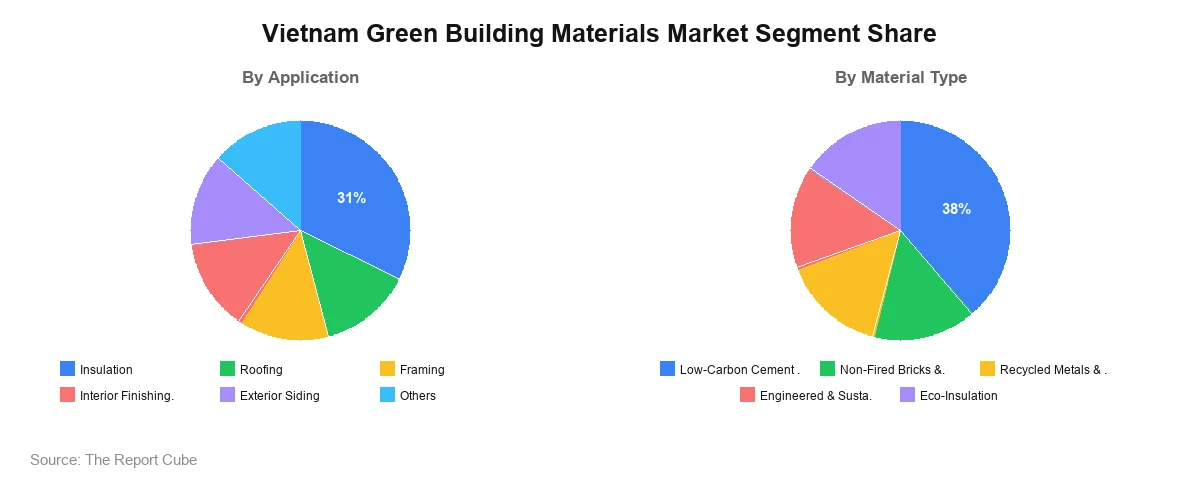
Insulation dominates the application segment, accounting for an estimated 31% market share, driven by Vietnam's tropical climate profile that creates consistent demand for thermal and acoustic insulation across both new construction and retrofit projects. Rising energy efficiency mandates under QCVN 09:2017 require minimum thermal resistance values in walls, ceilings, and roofing assemblies, making certified insulation products a non-negotiable procurement category for commercial developers and government-funded housing programs. Multinational suppliers including Knauf Vietnam and Saint-Gobain Vietnam hold strong positions in this segment through locally manufactured mineral wool and glass fiber product lines.
Roofing represents the second-largest application, supported by extensive industrial shed construction across Vietnam's rapidly expanding export manufacturing zones. Interior finishing is the fastest-growing application as hospitality, retail, and premium residential developers adopt low-VOC paints, recycled-content flooring, and certified panel systems to meet both green certification and tenant health standards. Exterior siding demand is rising alongside mixed-use urban development, with fiber cement and composite cladding systems gaining preference for their durability and reduced maintenance profiles compared to conventional alternatives.
By Material Type
- Low-Carbon Cement & Concrete
- Non-Fired Bricks & Blocks
- Recycled Metals & Composites
- Engineered & Sustainable Wood
- Eco-Insulation
Low-carbon cement and concrete commands the largest material type share at approximately 38%, underpinned by its central role in structural construction across residential, commercial, and infrastructure projects. Siam City Cement Vietnam and Mapei Vietnam are among the key suppliers advancing blended cement formulations - including fly ash and slag-substituted variants - that reduce embodied carbon by 20–35% compared to ordinary Portland cement. Government procurement specifications for public infrastructure increasingly reference low-carbon concrete performance standards, reinforcing institutional demand across the Southern and Northern regions.
Non-fired bricks and blocks are the fastest-growing material category as Vietnam's Ministry of Construction enforces a nationwide phase-out of clay-fired brick production under Decision No. 1686/QD-TTg. Engineered and sustainable wood demand is gaining momentum in hospitality and premium residential construction, where structural laminated timber and certified composite panels are replacing conventional hardwood. Eco-insulation products - including cellulose, recycled PET fiber, and aerogel-based systems - are penetrating high-specification commercial interiors as green certification targets become more stringent across Vietnam's Tier 1 development pipeline.
Regional Projection of Vietnam Green Building Materials Market
Vietnam's green building materials market exhibits distinct regional demand patterns shaped by construction activity density, industrial infrastructure concentration, economic growth trajectories, and government-led urbanization programs. Southern Vietnam anchors national market revenue, while the Central region is emerging as a high-growth corridor, and Northern Vietnam maintains a strong institutional and industrial procurement base.
|
Region |
Estimated Market Share |
Key Growth Factors |
Consumer Trends |
|---|---|---|---|
|
Southern Vietnam |
48.3% |
Ho Chi Minh City urban expansion, industrial zone growth, FDI-driven commercial construction |
High demand for insulation, low-carbon concrete, and green-certified interior finishes |
|
Northern Vietnam |
34.1% |
Hanoi government infrastructure projects, export manufacturing corridor development |
Strong procurement of non-fired bricks, eco-insulation, and certified roofing systems |
|
Central Vietnam |
17.6% |
Coastal resort development, Da Nang smart city initiatives, tourism infrastructure investment |
Rising adoption of exterior siding, engineered wood, and sustainable framing materials |
- Southern Vietnam: Southern Vietnam leads the market with approximately 48.3% share, anchored by Ho Chi Minh City's commercial real estate expansion, Binh Duong and Long An industrial zone construction, and growing FDI from multinational manufacturers requiring green-certified facilities. The region hosts the highest concentration of LOTUS and LEED-certified projects nationally, creating the most developed procurement ecosystem for verified sustainable building materials.
- Northern Vietnam: Northern Vietnam accounts for an estimated 34.1% of the market, driven by Hanoi's government-led urban renewal programs, expanding industrial parks in Hai Phong and Bac Ninh, and institutional construction projects requiring compliance with national green building standards. The region's demand for low-carbon cement and certified insulation continues to grow as public infrastructure procurement increasingly references sustainability benchmarks.
- Central Vietnam: Central Vietnam is the fastest-growing regional market, supported by Da Nang's smart city development program, expanding coastal tourism infrastructure, and resort and hospitality construction that demands high-specification sustainable materials. Green building development across Central Vietnam's coastal corridor is attracting both domestic and international material suppliers seeking to establish regional distribution footholds ahead of accelerating project pipelines through 2034.
Vietnam Green Building Materials Market: Recent Development (2025)
- Saint-Gobain Vietnam launched an expanded eco-insulation range targeting LOTUS-certified commercial building developers nationwide.
- Knauf Vietnam partnered with a local distributor to strengthen sustainable drywall supply across Northern Vietnam's industrial zones.
- Mapei Vietnam introduced a low-carbon tile adhesive system formulated specifically for Vietnam's tropical climate construction requirements.
- Siam City Cement Vietnam expanded blended cement production capacity to meet rising green infrastructure demand across Southern Vietnam.
Vietnam Green Building Materials Market Future Outlook (2034)
The Vietnam Green Building Materials Market is projected to expand at a 7.78% CAGR, reaching approximately USD 3.15 billion by 2034. Long-term growth will be supported by Vietnam's sustained urbanization momentum, the continued rollout of mandatory green building standards for public construction, and increasing institutional investor demand for certified green commercial assets. Industrial zone expansion across Northern and Southern Vietnam will sustain structural demand for low-carbon cement, eco-insulation, and certified roofing, while hospitality sector growth will amplify requirements for engineered wood and sustainable interior finishing systems.
Technology-driven advancements in material science - including aerogel insulation, geopolymer concrete, and bio-composite panels - will expand the premium segment of the market as developers prioritize both performance and lifecycle sustainability. AI-enabled energy modeling tools are beginning to influence material specification decisions in large commercial projects, accelerating adoption of high-performance insulation and glazing systems. Circular economy compliance, stricter embodied carbon reporting requirements, and growing awareness of end-of-life material recovery and recycling practices will further elevate demand for recycled-content products and position green building materials as a mainstream procurement category across Vietnam's construction industry by 2034.
Vietnam Green Building Materials Market Report Coverage
|
Report Attribute |
Details |
|---|---|
|
Market Name |
Vietnam Green Building Materials Market |
|
Market Size (2026) |
USD 1.73 Billion |
|
Market Size (2034) |
USD 3.15 Billion |
|
Forecast Period |
2026–2034 |
|
CAGR |
7.78% |
|
Base Year |
2026 |
|
Historical Years |
2021–2025 |
|
Forecast Years |
2026–2034 |
|
Segments Covered |
By Application, By Material Type |
|
Regions Covered |
Southern Vietnam, Northern Vietnam, Central Vietnam |
|
Key Companies |
Saint-Gobain Vietnam, Knauf Vietnam, Mapei Vietnam, Siam City Cement (Vietnam), AkzoNobel Vietnam, Others |
|
Report Format |
PDF, Excel, PPT |
|
Customization |
Available as per client requirements |
Why Choose This Report?
- Comprehensive analysis of Vietnam's evolving green building materials demand landscape.
- Accurate market sizing with reliable CAGR-backed forecast through 2034.
- Detailed segmentation across application type and material category dimensions.
- Regional insights covering Southern, Northern, and Central Vietnam markets.
- Competitive profiling of leading multinational and domestic material suppliers.
- Analysis of green certification trends and regulatory compliance impacts.
- Strategic intelligence supporting investment, sourcing, and market entry decisions.
- Data-driven research aligned with Vietnam's National Green Growth Strategy 2030.
Table of Contents
- Introduction
- Objective of the Study
- Product Definition
- Market Segmentation
- Study Variables
- Research Methodology
- Secondary Data Points
- Companies Interviewed
- Primary Data Points
- Breakdown of Primary Interviews
- Secondary Data Points
- Executive Summary
- Market Dynamics
- Drivers
- Challenges
- Opportunity Assessment
- Recent Trends and Developments
- Policy and Regulatory Landscape
- Vietnam Green Building Materials Market Overview and Forecast Analysis (2021-2034)
- Market Size, By Value, By Growth Rate (CAGR/USD Billions)
- Demand – Supply Trends
- Market Share, By Application
- Insulation
- Roofing
- Framing
- Interior Finishing
- Exterior Siding
- Others
- Market Share, By Material Type
- Low-Carbon Cement & Concrete
- Non-Fired Bricks & Blocks
- Recycled Metals & Composites
- Engineered & Sustainable Wood
- Eco-Insulation
- Market Share, By Region
- Southern
- Northern
- Central
- Market Share, By Competitors
- Competition Characteristics
- Revenue Shares
- Insulation Vietnam Green Building Materials Market Overview, 2021-2034F
- By Value (USD Million)
- By Material Type – Market Size & Forecast 2021-2034, USD Million
- Low-Carbon Cement & Concrete
- Non-Fired Bricks & Blocks
- Recycled Metals & Composites
- Engineered & Sustainable Wood
- Eco-Insulation
- Roofing Vietnam Green Building Materials Market Overview, 2021-2034F
- By Value (USD Million)
- By Material Type – Market Size & Forecast 2021-2034, USD Million
- Low-Carbon Cement & Concrete
- Non-Fired Bricks & Blocks
- Recycled Metals & Composites
- Engineered & Sustainable Wood
- Eco-Insulation
- Framing Vietnam Green Building Materials Market Overview, 2021-2034F
- By Value (USD Million)
- By Material Type – Market Size & Forecast 2021-2034, USD Million
- Low-Carbon Cement & Concrete
- Non-Fired Bricks & Blocks
- Recycled Metals & Composites
- Engineered & Sustainable Wood
- Eco-Insulation
- Interior Finishing Vietnam Green Building Materials Market Overview, 2021-2034F
- By Value (USD Million)
- By Material Type – Market Size & Forecast 2021-2034, USD Million
- Low-Carbon Cement & Concrete
- Non-Fired Bricks & Blocks
- Recycled Metals & Composites
- Engineered & Sustainable Wood
- Eco-Insulation
- Exterior Siding Vietnam Green Building Materials Market Overview, 2021-2034F
- By Value (USD Million)
- By Material Type – Market Size & Forecast 2021-2034, USD Million
- Low-Carbon Cement & Concrete
- Non-Fired Bricks & Blocks
- Recycled Metals & Composites
- Engineered & Sustainable Wood
- Eco-Insulation
- Others Vietnam Green Building Materials Market Overview, 2021-2034F
- By Value (USD Million)
- By Material Type – Market Size & Forecast 2021-2034, USD Million
- Low-Carbon Cement & Concrete
- Non-Fired Bricks & Blocks
- Recycled Metals & Composites
- Engineered & Sustainable Wood
- Eco-Insulation
- Competitive Outlook (Company Profile – Partial List)
- Saint-Gobain Vietnam
- Company Overview
- Business Segments
- Strategic Alliances/Partnerships
- Recent Developments
- Knauf Vietnam
- Company Overview
- Business Segments
- Strategic Alliances/Partnerships
- Recent Developments
- Mapei Vietnam
- Company Overview
- Business Segments
- Strategic Alliances/Partnerships
- Recent Developments
- Siam City Cement (Vietnam)
- Company Overview
- Business Segments
- Strategic Alliances/Partnerships
- Recent Developments
- AkzoNobel Vietnam
- Company Overview
- Business Segments
- Strategic Alliances/Partnerships
- Recent Developments
- Others
- Saint-Gobain Vietnam
- Contact Us & Disclaimer
Top Key Players & Market Share Outlook
- Saint-Gobain Vietnam
- Knauf Vietnam
- Mapei Vietnam
- Siam City Cement (Vietnam)
- AkzoNobel Vietnam
- Others
Frequently Asked Questions






