



Build Your Custom Market Intelligence Report
Customize Your ReportJapan Green Hydrogen Testing Market Key Highlights
By Testing Type:
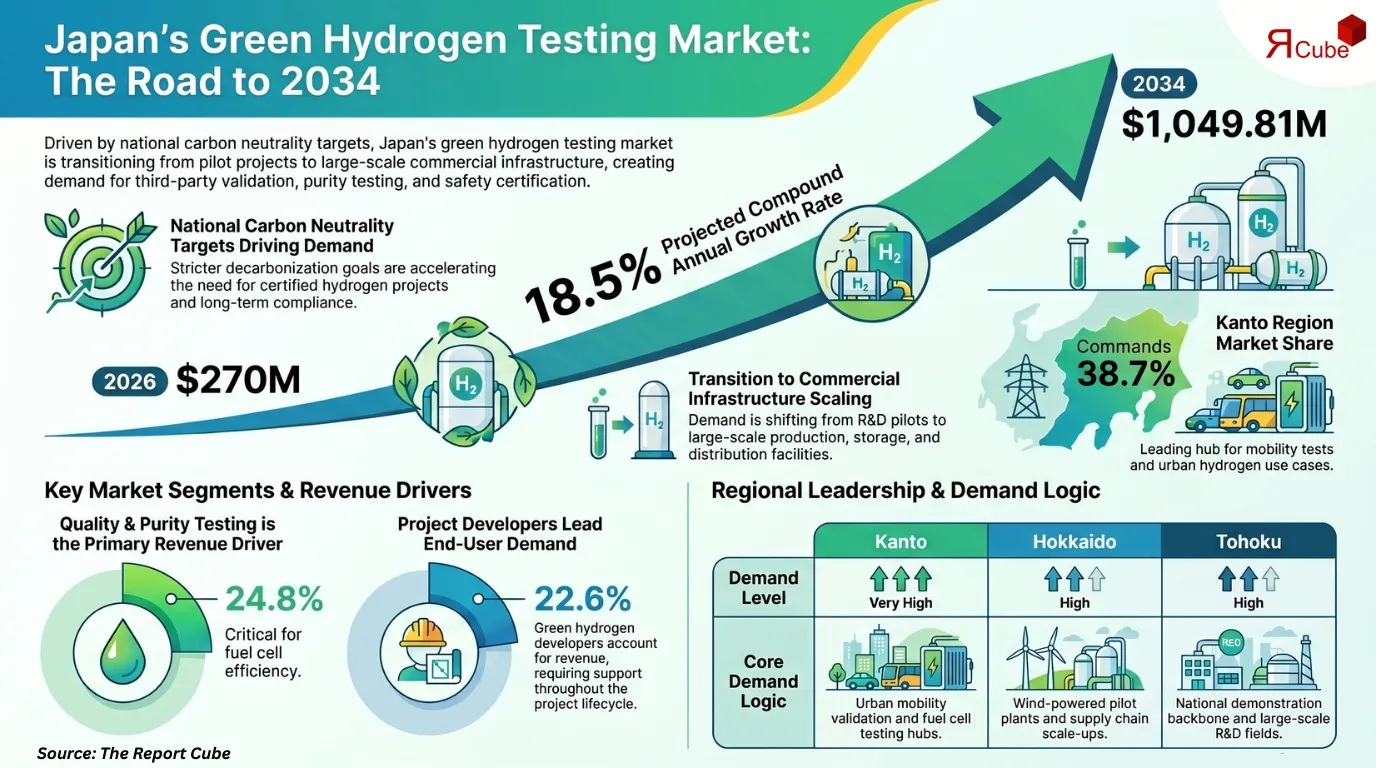
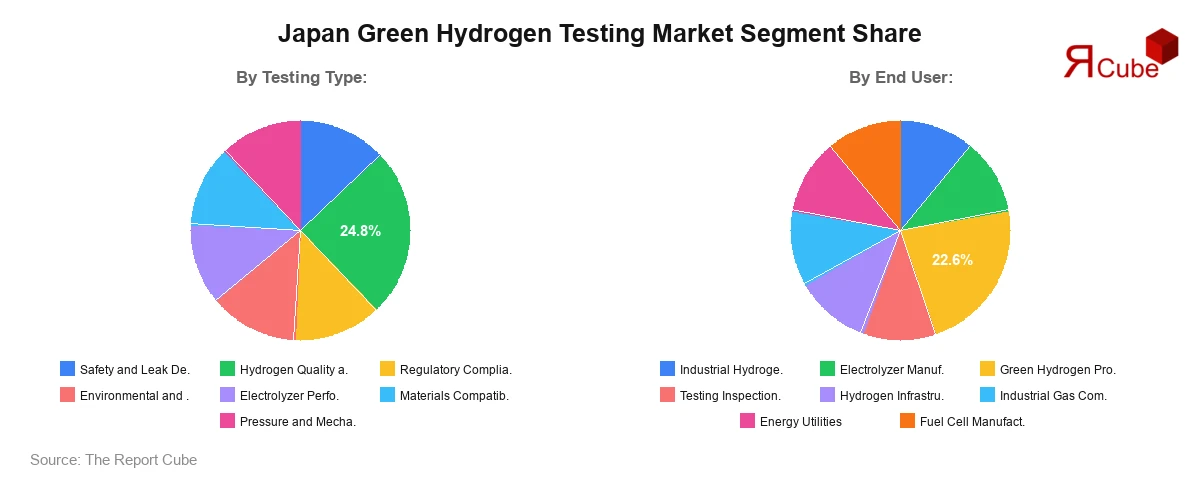
Hydrogen Quality and Purity Testing segment leads the market with nearly 24.8% share.
By End User:
Green Hydrogen Project Developers segment dominates the market with around 22.6% of revenue.
Regional Outlook:
Kanto region dominates the Japan Green Hydrogen Testing Market with approximately 38.7% share.
Japan Green Hydrogen Testing Market Insights & Analysis
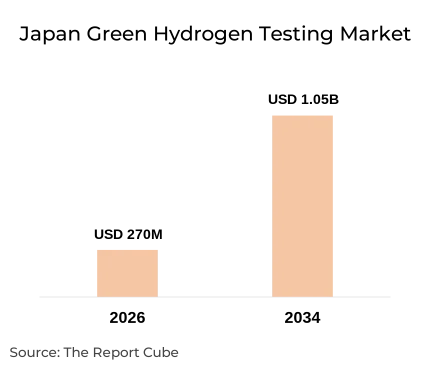
The Japan Green Hydrogen Testing Market is anticipated to register a CAGR of around 18.5% during the forecast period 2026-2034. The market size is valued at USD 270 million in 2026 and is projected to reach USD 1,049.81 million by 2034. The market is experiencing strong momentum as Japan’s long-term hydrogen commercialization roadmap, which prioritizes low-carbon hydrogen deployment across transportation, industrial manufacturing, power generation, and energy storage applications. As hydrogen projects move from pilot stages toward commercial implementation, the need for independent testing and verification services has become increasingly critical. Testing activities support safe operation of electrolyzers, hydrogen storage systems, transportation networks, fueling infrastructure, and industrial end-use facilities. Organizations involved in hydrogen production and utilization are placing greater emphasis on third-party validation to ensure compliance with evolving domestic and international standards.
Investment activity across Japan's hydrogen value chain continues to create substantial demand for specialized testing services. Large-scale renewable hydrogen projects, ammonia co-firing initiatives, hydrogen import terminals, and mobility infrastructure developments require rigorous performance assessment and certification procedures. Testing providers are expanding laboratory capabilities to evaluate hydrogen purity, materials compatibility, mechanical integrity, leak prevention, and system durability. Growing participation from utilities, industrial gas suppliers, engineering firms, and technology developers has further strengthened demand for technically advanced testing solutions. The market is also benefiting from increasing collaboration between certification bodies and industrial stakeholders seeking reliable pathways for commercialization and international market acceptance.
Japan Green Hydrogen Testing Market Impact Analysis
| Factor | Type | Specific Impact on Market | Magnitude | Business Implication |
|---|---|---|---|---|
| National Carbon Neutrality Targets | Regulatory | Stricter decarbonization goals accelerate certified hydrogen demand | High | Testing providers gain long term volumes from compliance driven projects |
| Scale Up of Green Hydrogen Projects | Market | New production and import hubs require extensive safety validation | High | Creates recurring inspection work across plants and logistics assets |
| Hydrogen Technology Complexity | Technological | Advanced electrolyzers and storage raise specialist testing needs | High | Drives demand for accredited labs with deep hydrogen engineering skills |
| International Safety and Certification Norms | Regulatory | Alignment with global standards increases formal verification scope | Medium | Firms must secure global accreditations to serve export linked projects |
| Cross Border Hydrogen Supply Chains | Environmental | Imports from partners require conformity checks at multiple nodes | Medium | Enables service growth in cargo inspection and purity certification |
| Rapid Market Growth and Investment | Market | Strong funding pipeline boosts demand for bankable quality reports | High | Testing data becomes critical input for project finance decisions |
| Global Competition in TIC Services | Competitive | Entry of large TIC groups intensifies pricing and service pressure | Medium | Local players need specialization and partnerships to defend share |
Japan Green Hydrogen Testing Market Dynamics
Key Driver: Rising Deployment of Commercial Hydrogen Infrastructure
Japan's hydrogen strategy has progressed beyond demonstration projects and entered a phase characterized by infrastructure scaling and industrial deployment. New hydrogen production facilities, storage terminals, distribution networks, and fueling stations require extensive testing throughout planning, commissioning, and operational stages. Testing services have become essential for validating system performance, confirming safety parameters, and ensuring regulatory compliance before assets enter commercial operation. As hydrogen applications become more integrated into critical industrial processes, stakeholders are increasing investment in quality assurance programs that reduce operational risks and improve long-term reliability.
The importance of independent testing is particularly evident in projects involving electrolyzer installations, fuel cell systems, and hydrogen transportation assets. Operators require detailed performance data to support financing decisions, insurance requirements, and stakeholder confidence. This growing dependence on verified operational performance is encouraging wider adoption of laboratory testing, field inspection, calibration, and certification services throughout Japan's hydrogen economy. Demand is expected to remain strong as new projects enter construction and existing facilities expand production capacity.
Industry Trends: Greater Focus on International Certification and Performance Benchmarking
Hydrogen project developers in Japan are increasingly aligning testing programs with internationally recognized technical standards to improve interoperability and market acceptance. Certification requirements have expanded beyond basic safety verification and now encompass hydrogen purity validation, electrolyzer efficiency measurement, durability assessment, and lifecycle performance evaluation. This trend reflects the growing maturity of the hydrogen sector and the need for transparent technical verification across increasingly complex hydrogen supply chains.
Testing organizations are investing in advanced analytical equipment capable of detecting trace contaminants and measuring performance under demanding operating conditions. Market participants are also integrating digital monitoring systems that support continuous data collection and real-time diagnostics. These developments enable more accurate performance benchmarking and help operators identify potential issues before they affect production efficiency. As hydrogen technologies become more sophisticated, demand for technically comprehensive testing programs is expected to increase significantly across Japan.
Book your FREE 30-minute expert consultation today
Contact UsMajor Challenge: Technical Complexity Across Hydrogen Value Chains
Green hydrogen projects involve multiple interconnected technologies, each requiring specialized testing methodologies and technical expertise. Electrolyzers, compressors, storage vessels, transportation systems, dispensing equipment, and fuel cell applications operate under different performance conditions and regulatory requirements. This diversity creates significant complexity for testing providers seeking to maintain comprehensive service capabilities across the entire hydrogen value chain.
Developing and operating advanced hydrogen testing facilities requires substantial investment in instrumentation, laboratory infrastructure, safety systems, and highly skilled personnel. Maintaining accreditation and adapting to evolving standards further increases operational requirements. In addition, project developers often face challenges when harmonizing domestic regulations with international certification frameworks, particularly for export-oriented hydrogen initiatives. These factors contribute to longer qualification processes and increased technical demands across the market.
Opportunity: Industrial Decarbonization Creating Long-Term Testing Demand
Japanese industries are actively evaluating green hydrogen as a pathway to reduce emissions from energy-intensive operations. Steel production, refining, chemicals, power generation, and heavy manufacturing facilities are conducting hydrogen integration projects that require extensive technical validation before commercial implementation. Each deployment stage generates demand for hydrogen quality verification, materials testing, equipment certification, and operational performance assessment.
Hydrogen mobility presents another significant growth avenue for testing service providers. Expansion of hydrogen fueling infrastructure and fuel cell vehicle ecosystems requires ongoing inspection, compliance verification, and safety assessment activities. As industrial users transition from pilot programs to larger commercial deployments, testing requirements are expected to become more frequent and technically demanding. This transition creates recurring revenue opportunities for testing, inspection, certification, and advisory service providers operating in Japan's hydrogen sector.
Japan Green Hydrogen Testing Market Segment-wise Analysis
By Testing Type:
- Safety and Leak Detection Testing
- Hydrogen Quality and Purity Testing
- Regulatory Compliance Testing
- Environmental and Durability Testing
- Electrolyzer Performance Validation
- Materials Compatibility Testing
- Pressure and Mechanical Integrity Testing
Hydrogen Quality and Purity Testing remains the largest testing category, accounting for approximately 24.8% of market revenue in 2026. High-purity hydrogen is fundamental for fuel cell efficiency, industrial process stability, and long-term equipment reliability. Even minor contaminant levels can affect performance outcomes and increase maintenance requirements across hydrogen systems. As a result, producers and end users increasingly rely on detailed laboratory analysis to verify compliance with stringent quality specifications.
Demand for purity testing is particularly strong among hydrogen producers supplying mobility applications, industrial consumers, and emerging export projects. Continuous monitoring protocols are becoming standard practice across commercial hydrogen facilities to ensure consistency throughout production and distribution processes. The segment's leadership position is expected to strengthen as Japan expands domestic hydrogen production and increases participation in regional hydrogen trade networks.
By End User:
- Industrial Hydrogen Consumers
- Electrolyzer Manufacturers
- Green Hydrogen Project Developers
- Testing Inspection and Certification Bodies
- Hydrogen Infrastructure Operators
- Industrial Gas Companies
- Energy Utilities
- Fuel Cell Manufacturers
Green Hydrogen Project Developers account for the largest share of market demand, representing approximately 22.6% of total revenue. These organizations require testing support throughout the entire project lifecycle, including feasibility assessment, engineering validation, commissioning, operational monitoring, and capacity expansion. Independent verification services help developers demonstrate technical reliability while satisfying regulatory, investor, and financing requirements.
Project developers are increasingly seeking integrated testing solutions covering electrolyzer performance, hydrogen output verification, storage system integrity, environmental durability, and compliance certification. Growing investment in large-scale hydrogen production facilities across Japan is further increasing reliance on specialized testing partners. As project sizes continue to expand and technical requirements become more sophisticated, developers are expected to remain the most significant consumers of green hydrogen testing services during the forecast period.
Regional Projection of Japan Green Hydrogen Testing Industry
- Hokkaido
- Tohoku
- Kanto
- Shikoku
- Others
Kanto accounts for approximately 38.7% of the Japan Green Hydrogen Testing Market and remains the country's leading regional hub for hydrogen-related activities. The region benefits from a concentration of industrial manufacturers, engineering companies, research institutions, utilities, and technology developers actively participating in hydrogen commercialization efforts. Significant investments in energy transition projects and advanced industrial infrastructure continue to support strong testing demand.
The region's leadership is reinforced by the presence of major certification bodies, testing laboratories, and technology validation centers capable of supporting complex hydrogen projects. Commercial deployments involving fuel cell systems, hydrogen mobility infrastructure, renewable hydrogen production, and industrial decarbonization initiatives are generating substantial requirements for testing and compliance services. Continued investment in clean energy technologies and infrastructure modernization is expected to preserve Kanto's dominant position throughout the forecast period.
Need insights for a specific region within this market?
Request Regional DataJapan Green Hydrogen Testing Market - Regional Analysis
The Japan green hydrogen testing market is shaped by regional renewables, industrial demand, and pilot verification projects.
| Cluster | Demand Level | Key Areas | System Dominance | Core Demand Logic | Growth Nature |
|---|---|---|---|---|---|
| Hokkaido | High | Tomakomai, Chitose | Electrolyzers & pipelines | Wind powered pilot plants | Scale up supply chains |
| Tohoku | High | Fukushima, Namie | Large test hydrogen fields | Grid balancing and R&D | National demo backbone |
| Kanto | Very High | Tokyo, Yokohama | Fuel cell and mobility tests | Urban use case validation | Market making and hubs |
| Shikoku | Medium | Port and utility sites | Small scale pilot systems | Port decarbonization trials | Selective niche growth |
| Others | High | Kansai, Chubu, Kyushu | Industrial cluster testing | Heavy industry fuel switch | Project based expansion |
Government Initiatives & Policies
- Japan Hydrogen Society Promotion Act (2025): The Japanese government introduced legislation supporting hydrogen production, supply chain development, infrastructure deployment, and investment incentives to accelerate commercialization of hydrogen technologies and strengthen national energy security.
- Green Innovation Fund Hydrogen Program (2025-2026): Administered through NEDO, the program supports hydrogen production, transportation, storage, and utilization projects while encouraging technology validation, testing activities, and commercialization of next-generation hydrogen solutions.
Japan Green Hydrogen Testing Industry Recent Developments
- 2026: UL Solutions Inc. launched new certification and testing services for hydrogen fueling station components, including valves and dispenser hoses. The program evaluates products against ISO 19880 standards while providing conformity assessment, performance testing, technical review, and certification support for Japan’s expanding hydrogen mobility infrastructure.
- 2025: TÜV Rheinland AG entered a strategic partnership with DENSO Corporation to provide verification, testing, and certification services for sustainable industrial products. The collaboration strengthens compliance, traceability, and product validation capabilities while enhancing support for hydrogen supply chains and clean energy infrastructure across Japan.
Why Choose This Report?
- Provides a comprehensive overview of the overall market analysis, encompassing key trends, consumer behavior analysis, and risk assessment to support strategic decision-making.
- Provides accurate, up-to-date insights into market size, segmentation, and emerging opportunities, helping to minimize risk & capitalizing on growth.
- Gives deep understanding of target audience preferences, investment habits, and communication channels for enhanced product development & marketing effectiveness.
- Delivers competitive analysis & benchmarking, uncovering the strengths & weaknesses of market competitors to guide strategies.
- Consolidate comprehensive market intelligence, reducing reasoning & streamlining research efforts.
- Facilitates customized market segmentation & risk mitigation strategies, fine-tuned to the business objectives.
- Aids in identifying both market challenges & untapped opportunities within the industry to drive long-term business growth.
- Provides valuable information based on actual customer data & search trends.
Table of Contents
- Introduction
- Objective of the Study
- Product and Category Definition
- Market Segmentation
- Study Variables
- Research Methodology
- Secondary Data Points
- Breakdown of Secondary Sources
- Primary Data Points
- Breakdown of Primary Interviews
- Secondary Data Points
- Executive Summary
- Market Dynamics
- Emerging Opportunities
- Adoption Trends
- Demand Drivers
- Disruption Analysis (Challenges)
- Industry Analysis and Strategic Insights
- Supply and Value Chain Analysis
- Pricing Analysis
- Go-to-Market Strategy
- BCG Matrix
- Recent Trends and Developments
- Regulatory and Policy Landscape
- Region-wise Policies
- Government Initiatives
- Japan Green Hydrogen Testing Market Overview and Forecast Analysis (2021-2034)
- Market Size, By Value, By Growth Rate (CAGR/USD Million)
- Market Share, By Testing Type
- Safety and Leak Detection Testing
- Hydrogen Quality and Purity Testing
- Regulatory Compliance Testing
- Environmental and Durability Testing
- Electrolyzer Performance Validation
- Materials Compatibility Testing
- Pressure and Mechanical Integrity Testing
- Market Share, By Value Chain Stage
- Storage and Handling
- Hydrogen Output Verification
- Feedwater and Input Assessment
- Transportation and Distribution
- Electrolysis Process Validation
- Dispensing and End-use Interface
- Compression and Conditioning
- Market Share, By Technology Tested
- Fuel Cell Systems
- Solid Oxide Electrolyzers
- Proton Exchange Membrane Electrolyzers
- Anion Exchange Membrane Electrolyzers
- Alkaline Electrolyzers
- Others
- Market Share, By Service Model
- Certification and Compliance Services
- Technical Advisory Services
- Laboratory Testing Services
- Failure Analysis and Root Cause Assessment
- Calibration and Measurement Services
- Field Testing and Inspection Services
- Market Share, By End User
- Industrial Hydrogen Consumers
- Electrolyzer Manufacturers
- Green Hydrogen Project Developer
- Testing Inspection and Certification Bodies
- Hydrogen Infrastructure Operators
- Industrial Gas Companies
- Energy Utilities
- Fuel Cell Manufacturers
- Market Share, By Application Area
- Hydrogen Export and Trading
- Renewable Energy Storage
- Industrial Process Decarbonization
- Power Generation and Grid Balancing
- Green Steel and Metals Production
- Hydrogen Mobility and Fuel Cells
- Refining and Chemical Processing
- Market Share, By Region
- Hokkaido
- Tohoku
- Kanto
- Shikoku
- Others
- Market Share, By Company
- Revenue Shares and Analysis
- Competitive Landscape
- Hokkaido Green Hydrogen Testing Market Overview and Forecast Analysis (2021-2034)
- Market Size, By Value, By Growth Rate (CAGR/USD Million)
- Market Share, By Testing Type
- Market Share, By Value Chain Stage
- Market Share, By Technology Tested
- Market Share, By Service Model
- Market Share, By End User
- Market Share, By Application Area
- Tohoku Green Hydrogen Testing Market Overview and Forecast Analysis (2021-2034)
- Market Size, By Value, By Growth Rate (CAGR/USD Million)
- Market Share, By Testing Type
- Market Share, By Value Chain Stage
- Market Share, By Technology Tested
- Market Share, By Service Model
- Market Share, By End User
- Market Share, By Application Area
- Kanto Green Hydrogen Testing Market Overview and Forecast Analysis (2021-2034)
- Market Size, By Value, By Growth Rate (CAGR/USD Million)
- Market Share, By Testing Type
- Market Share, By Value Chain Stage
- Market Share, By Technology Tested
- Market Share, By Service Model
- Market Share, By End User
- Market Share, By Application Area
- Shikoku Green Hydrogen Testing Market Overview and Forecast Analysis (2021-2034)
- Market Size, By Value, By Growth Rate (CAGR/USD Million)
- Market Share, By Testing Type
- Market Share, By Value Chain Stage
- Market Share, By Technology Tested
- Market Share, By Service Model
- Market Share, By End User
- Market Share, By Application Area
- Competitive Analysis, 2026
- Market Share of Key Players
- Competitive Mapping for Each Testing Type and Companies Operating Regionally
- Competitive Mapping for Each Value Chain Stage and Companies Operating Regionally
- Competitive Mapping for Each Technology Tested and Companies Operating Regionally
- Competitive Mapping for Each Service Model and Companies Operating Regionally
- Competitive Mapping for Each End User and Companies Operating Regionally
- Competitive Mapping for Each Application Area and Companies Operating Regionally
- Company Profile (Partial List)
- Intertek Group plc
- Company Overview
- Product Portfolio
- Strategic Alliances/Partnerships
- Recent Developments
- UL Solutions Inc.
- Company Overview
- Product Portfolio
- Strategic Alliances/Partnerships
- Recent Developments
- TUV NORD GROUP
- Company Overview
- Product Portfolio
- Strategic Alliances/Partnerships
- Recent Developments
- Bureau Veritas S.A.
- Company Overview
- Product Portfolio
- Strategic Alliances/Partnerships
- Recent Developments
- DNV AS
- Company Overview
- Product Portfolio
- Strategic Alliances/Partnerships
- Recent Developments
- TUV Rheinland AG
- Company Overview
- Product Portfolio
- Strategic Alliances/Partnerships
- Recent Developments
- SGS SA
- Company Overview
- Product Portfolio
- Strategic Alliances/Partnerships
- Recent Developments
- Element Materials Technology Group Limited
- Company Overview
- Product Portfolio
- Strategic Alliances/Partnerships
- Recent Developments
- TUV SUD AG
- Company Overview
- Product Portfolio
- Strategic Alliances/Partnerships
- Recent Developments
- DEKRA SE
- Company Overview
- Product Portfolio
- Strategic Alliances/Partnerships
- Recent Developments
- Others (Partial List)
- Intertek Group plc
- Contact Us and Disclaimer
Top Key Players & Market Share Outlook
- Intertek Group plc
- UL Solutions Inc.
- TUV NORD GROUP
- Bureau Veritas S.A.
- DNV AS
- TUV Rheinland AG
- SGS SA
- Element Materials Technology Group Limited
- TUV SUD AG
- DEKRA SE
- Others
Frequently Asked Questions






