



Build Your Custom Market Intelligence Report
Customize Your ReportGlobal Liquid Hydrogen Storage Tanks and Transportation Market Insights & Analysis
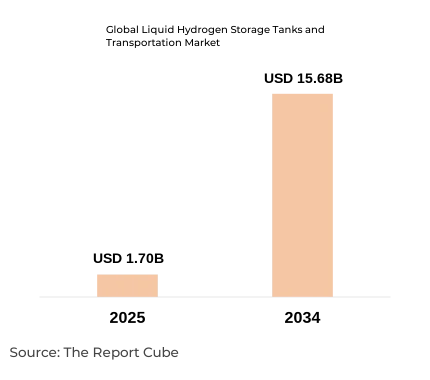
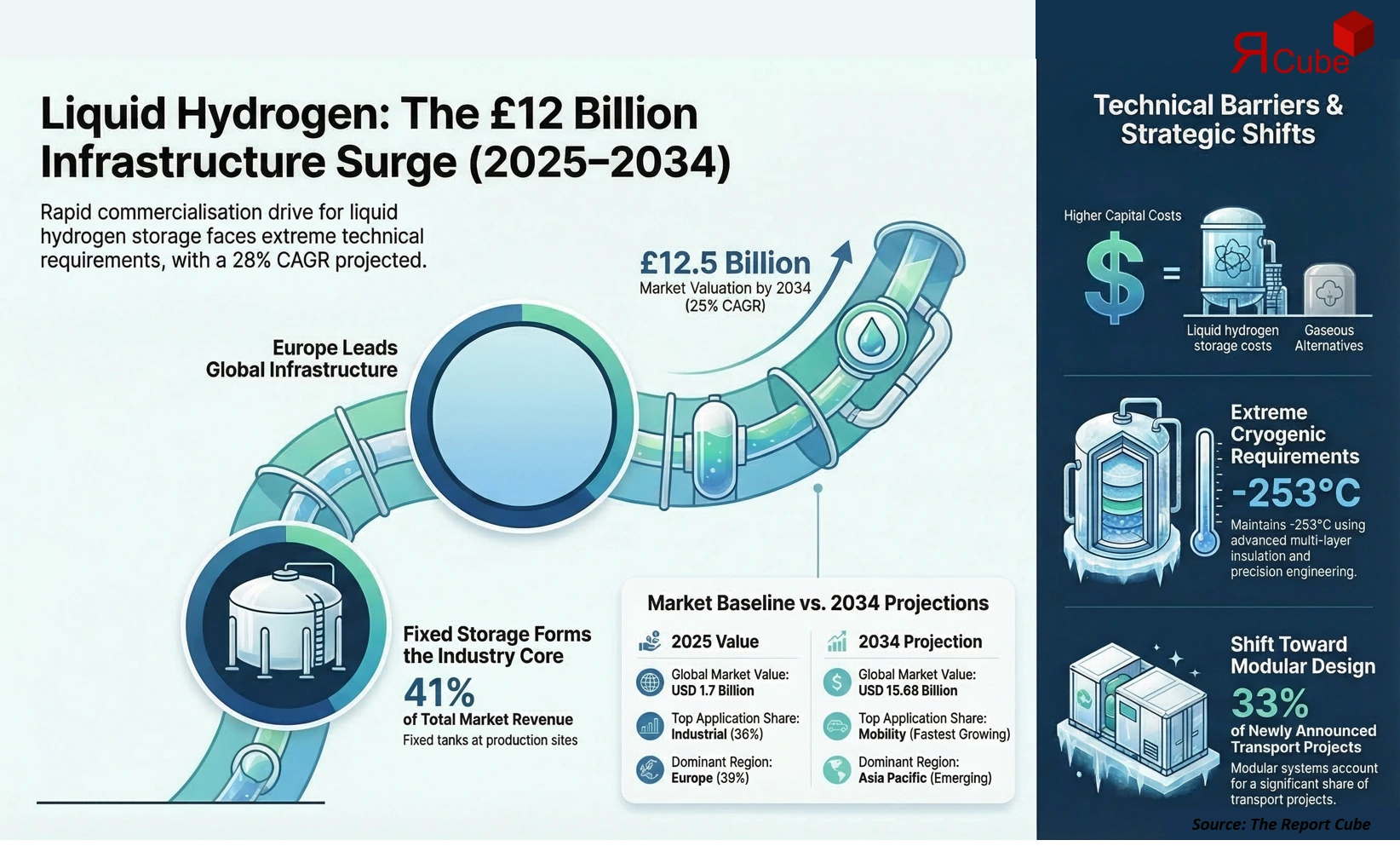
The Global Liquid Hydrogen Storage Tanks and Transportation Market is anticipated to register a CAGR of 28.00% during 2026-2034. The market size was valued at USD 1.7 Billion in 2025 and is projected to reach USD 15.68 Billion by 2034. This rapid expansion reflects the accelerating shift toward hydrogen-based energy systems across mobility, industrial, and aerospace sectors. Liquid hydrogen, with its high energy density by weight, is increasingly preferred for large-scale storage and long-distance transport, positioning specialized cryogenic tanks and transportation solutions as critical infrastructure within the hydrogen value chain.
As hydrogen adoption moves beyond pilot projects to early commercialization, demand for safe, efficient, and scalable storage and logistics solutions is rising sharply. Cryogenic storage tanks, insulated trailers, and containerized transport systems are becoming essential for linking hydrogen production sites with end-use applications. In 2024, global announced investments in hydrogen infrastructure exceeded USD 70 billion, with a growing share allocated to liquefaction, storage, and transport assets. The market is further supported by cross-border hydrogen trade discussions, expansion of hydrogen refueling networks, and increasing use of liquid hydrogen in space launch systems and heavy-duty mobility.
Global Liquid Hydrogen Storage Tanks and Transportation Market Recent Developments
- 2025: Linde commissioned a next-generation large-capacity liquid hydrogen storage facility in Europe.
- 2025: Air Products expanded its cryogenic hydrogen trailer fleet to support mobility projects.
Government Initiatives & Policies
- U.S. Hydrogen Infrastructure Program: Supports hydrogen storage and transport deployment nationwide.
- EU Hydrogen Strategy: Promotes cross-border hydrogen transport and storage infrastructure.
Global Liquid Hydrogen Storage Tanks and Transportation Market Dynamics
Key Driver: Rapid Expansion of Hydrogen Economy
The primary driver of this market is the rapid expansion of the global hydrogen economy, particularly in clean mobility, industrial decarbonization, and aerospace applications. Liquid hydrogen enables higher transport volumes compared to compressed gas, making it suitable for large-scale distribution. In 2025, over 40% of planned hydrogen mobility projects globally specified liquid hydrogen supply chains. This demand is driving investment in cryogenic storage tanks, insulated transport trailers, and containerized systems capable of maintaining extremely low temperatures while minimizing boil-off losses. As hydrogen hubs scale up, reliable storage and transportation solutions become indispensable.
Major Challenge: High Capital Costs and Technical Complexity
High capital costs and technical complexity remain significant challenges for market participants. Liquid hydrogen storage requires advanced materials, multi-layer insulation, and precision engineering to operate at temperatures near minus 253°C. These requirements result in higher manufacturing and maintenance costs compared to compressed hydrogen systems. In 2025, the cost of liquid hydrogen storage tanks was estimated to be nearly 2.5 times higher than equivalent gaseous storage solutions. Additionally, safety regulations and certification processes increase development timelines, particularly for cross-border transport applications.
Industry Trends: Standardization and Modular Tank Design
A key industry trend is the move toward standardized and modular liquid hydrogen storage and transport solutions. Manufacturers are increasingly designing modular tanks and container systems that can be scaled or combined based on application needs. This approach improves manufacturing efficiency and reduces deployment time for hydrogen infrastructure projects. Trailer-mounted and containerized systems are gaining popularity for flexibility and rapid deployment. In 2024, modular storage solutions accounted for nearly 33% of newly announced liquid hydrogen transport projects, highlighting strong market acceptance.
Opportunity Ahead: Growth in Mobility and Aerospace Applications
Mobility and aerospace applications represent major growth opportunities for liquid hydrogen storage and transportation systems. Heavy-duty trucks, buses, trains, and future aviation concepts increasingly favor liquid hydrogen due to range and refueling efficiency. The aerospace sector remains a stable demand base, with liquid hydrogen used extensively in space launch vehicles. As sustainable aviation fuel alternatives are explored, liquid hydrogen infrastructure may see expanded use. These emerging applications are expected to significantly increase demand for high-capacity tanks and specialized transport systems over the forecast period.
Global Liquid Hydrogen Storage Tanks and Transportation Market Segment-wise Analysis
By Storage Type:
- Fixed
- Trailer
- Container
- Other
The fixed storage segment dominates the market, accounting for approximately 41% of total revenue in 2025. Fixed tanks are widely used at hydrogen production plants, refueling stations, and industrial sites due to their high capacity and long-term storage capability. These systems support continuous supply and are critical for hydrogen hubs and export terminals. While trailers and containers are gaining momentum for transport flexibility, fixed storage remains the foundation of liquid hydrogen infrastructure.
By Application:
- Mobility
- Stationary
- Aerospace
- Industrial
- Other
The industrial application segment leads with nearly 36% market share in 2025, driven by hydrogen use in refining, chemicals, and advanced manufacturing. Mobility applications are the fastest-growing segment, supported by hydrogen-powered heavy transport and refueling networks. Aerospace continues to provide stable demand, while stationary energy storage and other applications contribute incremental growth as hydrogen adoption broadens.
Regional Projection of Global Liquid Hydrogen Storage Tanks and Transportation Industry
- North America
- Europe
- Asia Pacific
- Middle East
- South America
Europe leads the market with an estimated 39% share in 2025, supported by strong hydrogen policies, cross-border infrastructure planning, and early commercialization projects. North America follows closely, driven by federal funding programs and private sector investment. Asia Pacific is emerging rapidly due to large-scale hydrogen mobility initiatives and industrial demand, while the Middle East and South America show growing potential supported by renewable energy-based hydrogen production projects.
Why Choose This Report?
- Provides a comprehensive overview of the overall market analysis, encompassing key trends, consumer behavior analysis, and risk assessment to support strategic decision-making.
- Provides accurate, up-to-date insights into market size, segmentation, and emerging opportunities, helping to minimize risk & capitalizing on growth.
- Gives deep understanding of target audience preferences, investment habits, and communication channels for enhanced product development & marketing effectiveness.
- Delivers competitive analysis & benchmarking, uncovering the strengths & weaknesses of market competitors to guide strategies.
- Consolidate comprehensive market intelligence, reducing reasoning & streamlining research efforts.
- Facilitates customized market segmentation & risk mitigation strategies, fine-tuned to the business objectives.
- Aids in identifying both market challenges & untapped opportunities within the industry to drive long-term business growth.
- Provides valuable information based on actual customer data & search trends.
Table of Contents
- Introduction
- Objective of the Study
- Product and Category Definition
- Market Segmentation
- Study Variables
- Research Methodology
- Secondary Data Points
- Breakdown of Secondary Sources
- Primary Data Points
- Breakdown of Primary Interviews
- Secondary Data Points
- Executive Summary
- Market Dynamics
- Drivers
- Challenges
- Opportunity Assessment
- Recent Trends and Developments
- Regulatory and Policy Landscape
- Global Liquid Hydrogen Storage Tanks and Transportation Market Overview (2020-2034)
- Market Size, By Value (USD Billion)
- Market Share, By Storage Type
- Fixed
- Trailer
- Container
- Other
- Market Share, By Application
- Mobility
- Stationary
- Aerospace
- Industrial
- Other
- Market Share, By End Use
- Energy
- Chemical
- Transport
- Aerospace
- Other
- Market Share, By Transportation Mode
- Tanker
- Trailer
- Marine
- Rail
- Other
- Market Share, By Region
- North America
- Europe
- Asia Pacific
- Middle East
- South America
- Market Share, By Company
- Revenue Shares
- Competitive Landscape
- North America Liquid Hydrogen Storage Tanks and Transportation Market
- Market Size, By Value (USD Billion)
- Market Share, By Storage Type
- Market Share, By Application
- Market Share, By End Use
- Market Share, By Transportation Mode
- Market Share, By Region/Country Group
- Market Share, By Country
- United States
- Canada
- Mexico
- Europe Liquid Hydrogen Storage Tanks and Transportation Market
- Market Size, By Value (USD Billion)
- Market Share, By Storage Type
- Market Share, By Application
- Market Share, By End Use
- Market Share, By Transportation Mode
- Market Share, By Region/Country Group
- Market Share, By Country
- Germany
- France
- United Kingdom
- Italy
- Spain
- Northern and Nordic Countries
- Rest of Europe
- Asia Pacific Liquid Hydrogen Storage Tanks and Transportation Market
- Market Size, By Value (USD Billion)
- Market Share, By Storage Type
- Market Share, By Application
- Market Share, By End Use
- Market Share, By Transportation Mode
- Market Share, By Region/Country Group
- Market Share, By Country
- China
- Japan
- India
- South Korea
- Australia
- Rest of Asia Pacific
- Middle East and Africa Liquid Hydrogen Storage Tanks and Transportation Market
- Market Size, By Value (USD Billion)
- Market Share, By Storage Type
- Market Share, By Application
- Market Share, By End Use
- Market Share, By Transportation Mode
- Market Share, By Region/Country Group
- Market Share, By Country
- Saudi Arabia
- United Arab Emirates
- South Africa
- Rest of Middle East and Africa
- South America Liquid Hydrogen Storage Tanks and Transportation Market
- Market Size, By Value (USD Billion)
- Market Share, By Storage Type
- Market Share, By Application
- Market Share, By End Use
- Market Share, By Transportation Mode
- Market Share, By Region/Country Group
- Market Share, By Country
- Brazil
- Argentina
- Chile
- Rest of South America
- Competitive Outlook and Company Profiles
- Linde
- Company Overview
- Hydrogen Storage and Transport Portfolio
- Strategic Alliances and Partnerships
- Recent Developments
- Airliquide
- Company Overview
- Hydrogen Storage and Transport Portfolio
- Strategic Alliances and Partnerships
- Recent Developments
- Airproducts
- Company Overview
- Hydrogen Storage and Transport Portfolio
- Strategic Alliances and Partnerships
- Recent Developments
- Praxair
- Company Overview
- Hydrogen Storage and Transport Portfolio
- Strategic Alliances and Partnerships
- Recent Developments
- Inoxcva
- Company Overview
- Hydrogen Storage and Transport Portfolio
- Strategic Alliances and Partnerships
- Recent Developments
- Cryostar
- Company Overview
- Hydrogen Storage and Transport Portfolio
- Strategic Alliances and Partnerships
- Recent Developments
- Chart
- Company Overview
- Hydrogen Storage and Transport Portfolio
- Strategic Alliances and Partnerships
- Recent Developments
- Iwatani
- Company Overview
- Hydrogen Storage and Transport Portfolio
- Strategic Alliances and Partnerships
- Recent Developments
- Messer
- Company Overview
- Hydrogen Storage and Transport Portfolio
- Strategic Alliances and Partnerships
- Recent Developments
- Hylium
- Company Overview
- Hydrogen Storage and Transport Portfolio
- Strategic Alliances and Partnerships
- Recent Developments
- Others
- Linde
- Contact Us and Disclaimer
Top Key Players & Market Share Outlook
- Linde
- Airliquide
- Airproducts
- Praxair
- Inoxcva
- Cryostar
- Chart
- Iwatani
- Messer
- Hylium
- Others
Frequently Asked Questions






