




Build Your Custom Market Intelligence Report
Customize Your ReportUS Guns and Ammunition Market Key Highlights
By Product Type:
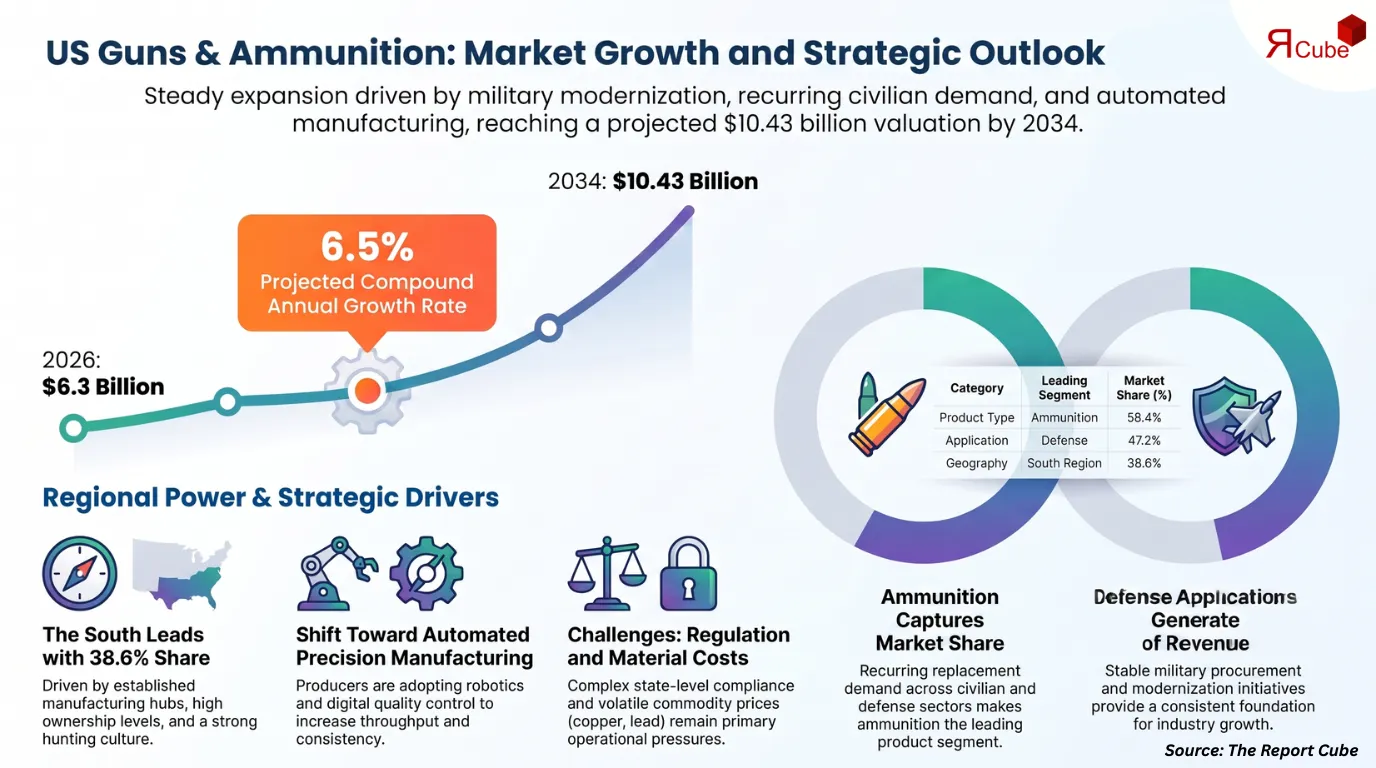
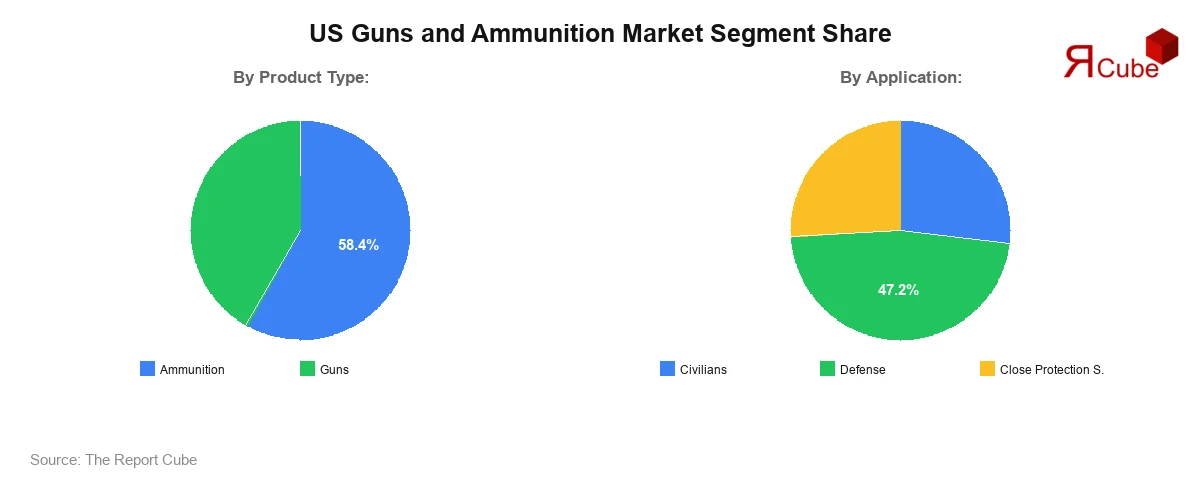
Ammunition segment leads the market with approximately 58.4% share owing to recurring replacement demand across civilian, defense, and law enforcement applications.
By Application:
Defense segment dominates the market with nearly 47.2% of total revenue, supported by military modernization, law enforcement procurement, and homeland security spending.
Regional Outlook:
South region dominates the US Guns and Ammunition Market with around 38.6% market share due to its large firearm ownership base, established manufacturing facilities, hunting culture, and defense-related demand.
US Guns and Ammunition Market Insights & Analysis
The US Guns and Ammunition Market is anticipated to register a CAGR of around 6.5% during the forecast period 2026-2034. The market size is valued at USD 6.3 billion in 2026 and is projected to reach USD 10.43 billion by 2034. Market growth is supported by stable procurement activities across military and law enforcement agencies, continuous civilian participation in recreational shooting and hunting, and increasing investments in domestic ammunition manufacturing. The United States remains one of the world's largest producers of firearms and ammunition, supported by a mature manufacturing ecosystem, advanced machining capabilities, and well-established defense procurement programs. Growth is being reinforced by ongoing investments in domestic ammunition production, modernization of manufacturing facilities, and greater adoption of automated production technologies that improve throughput and product consistency. Manufacturers are also strengthening vertical integration by expanding in-house production of brass cases, primers, and other critical components to improve supply stability and reduce dependence on external suppliers. These investments are enhancing production efficiency while enabling manufacturers to respond more effectively to long-term institutional contracts and recurring commercial demand.
Federal defense procurement continues to provide a stable foundation for industry growth through scheduled ammunition replenishment, military training requirements, and modernization initiatives across the armed forces. State and local law enforcement agencies also maintain regular procurement cycles for service firearms and ammunition, creating predictable demand for domestic manufacturers. On the commercial side, participation in recreational shooting, licensed hunting, and organized shooting competitions continues to support steady ammunition consumption across the country. Industry participants are increasingly allocating capital toward precision manufacturing equipment, digital quality control systems, and environmentally responsible production processes, including research into lead-free ammunition technologies. Strategic acquisitions and capacity expansion projects completed during recent years further reflect manufacturers' confidence in long-term market fundamentals and their commitment to strengthening domestic production capabilities.
US Guns and Ammunition Market Impact Analysis
| Factor | Type | Specific Impact on Market | Magnitude | Business Implication |
|---|---|---|---|---|
| Defense Budget and Procurement | Market | Stable military spending sustains demand for arms supplies | High | Supports long term contracts for guns and ammunition vendors |
| Civilian Firearms Ownership Levels | Consumer | Wide private ownership base drives recurring ammo purchases | High | Enables steady retail sales across sporting and self defense |
| Regulatory Scrutiny and Gun Control | Regulatory | Stricter rules may restrict access and slow new gun sales | Medium | Requires compliance focus and scenario planning for demand |
| Public Safety and Mass Shooting Concerns | Environmental | Incidents intensify calls for limits on firearm availability | High | Creates reputational risk and potential market contraction |
| Technological Advances in Smart Weapons | Technological | Innovation in targeting and safety features shifts product mix | Medium | Encourages investment in upgraded lines and premium pricing |
| Competitive Presence of Global Brands | Competitive | Multiple established players intensify price and feature rivalry | Medium | Pushes differentiation via quality, reliability, and branding |
| Hunting and Sports Shooting Activity | Consumer | Seasonal outdoor sports keep baseline ammunition demand firm | Medium | Supports targeted marketing and regional inventory planning |
US Guns and Ammunition Market Dynamics
Key Driver: Consistent Defense Procurement and Domestic Manufacturing Investments Support Long-Term Industry Growth
Long-term procurement programs from the U.S. military and federal law enforcement agencies remain one of the strongest growth drivers for the US Guns and Ammunition Market. Defense organizations regularly replenish operational inventories while maintaining extensive training programs that require large volumes of ammunition throughout the year. These procurement cycles provide manufacturers with stable production schedules and encourage continued investment in manufacturing infrastructure, advanced machining equipment, and quality assurance systems. Multi-year supply agreements also improve production planning and strengthen relationships between government agencies and domestic manufacturers.
Alongside institutional procurement, investments in domestic manufacturing capacity continue to reinforce market expansion. Leading producers are upgrading facilities with automated assembly lines, robotic inspection systems, and precision manufacturing technologies that increase productivity while maintaining strict quality standards. Capacity expansion projects have also focused on improving production of brass cases, primers, and cartridge components to strengthen supply chain resilience. These developments enable manufacturers to improve operational efficiency, shorten production lead times, and meet growing demand from both government and commercial customers.
Industry Trends: Production Modernization and Premium Ammunition Development Continue to Reshape the Competitive Landscape
Manufacturing modernization has become a defining trend across the US guns and ammunition industry. Producers are investing in automated cartridge assembly, digital process monitoring, and advanced inspection technologies to improve manufacturing precision while reducing production costs. Modern production facilities are increasingly incorporating predictive maintenance systems, real-time process monitoring, and data-driven quality management that minimize downtime and improve equipment utilization. These operational improvements allow manufacturers to increase output while maintaining consistent product quality across large production volumes.
Manufacturers are also expanding premium ammunition portfolios to address evolving performance requirements across professional and recreational applications. Product development efforts increasingly focus on enhanced ballistic consistency, improved projectile designs, cleaner-burning propellants, and corrosion-resistant materials. At the same time, several companies are investing in environmentally responsible manufacturing practices, including energy-efficient production systems, waste reduction initiatives, and research supporting alternative projectile materials. These investments strengthen product differentiation while improving the long-term competitiveness of domestic manufacturers.
Book your FREE 30-minute expert consultation today
Contact UsMajor Challenge: Regulatory Complexity and Volatile Raw Material Costs Continue to Pressure Industry Operations
Operating within the United States requires manufacturers to comply with an extensive framework of federal, state, and local regulations governing production, storage, transportation, recordkeeping, and distribution. Differences in state-level regulatory requirements often increase administrative complexity for companies serving nationwide markets. Maintaining compliance requires continuous investment in legal oversight, operational controls, and documentation systems, adding to overall operating expenses while increasing the complexity of long-term business planning.
The industry also remains exposed to fluctuations in the prices of copper, brass, lead, steel, propellants, packaging materials, and industrial energy. Rising labor expenses and transportation costs further influence manufacturing economics, particularly for producers operating under long-term supply contracts with predetermined pricing structures. While many manufacturers continue expanding domestic sourcing to improve supply security, commodity price volatility remains an important consideration for production planning, inventory management, and operating margins across the forecast period.
Opportunity: Capacity Expansion, Vertical Integration, and Manufacturing Innovation Create New Growth Prospects
Manufacturers are increasingly expanding production facilities to improve domestic manufacturing capacity and strengthen supply chain resilience. Investments in vertically integrated operations, including in-house production of cartridge cases, primers, and other essential components, reduce dependence on external suppliers while improving production flexibility. These initiatives also help manufacturers respond more efficiently to institutional procurement requirements and changing commercial demand without significant supply disruptions.
Further opportunities are emerging through continuous investment in precision engineering, advanced metallurgy, and production automation that support higher-value product offerings. Companies are also expanding research focused on environmentally responsible ammunition technologies and advanced manufacturing processes that improve operational efficiency while reducing waste. Combined with strategic acquisitions, facility modernization projects, and ongoing investment in skilled manufacturing capabilities, these developments position the US Guns and Ammunition Market for sustainable long-term growth throughout the forecast period.
US Guns and Ammunition Market Segment-wise Analysis
By Product Type:
- Ammunition
- Guns
The Ammunition segment held the leading position in the US Guns and Ammunition Market, accounting for approximately 58.4% of total revenue in 2026. Unlike firearms, ammunition requires continuous replenishment, creating recurring demand across military training, law enforcement qualification programs, licensed hunting, competitive shooting, and recreational target practice. This replacement cycle provides manufacturers with stable revenue opportunities throughout the year. Growing investments in domestic ammunition manufacturing facilities and improvements in production efficiency have further strengthened the segment's market position.
Manufacturers are expanding production capacity while introducing premium cartridges designed for greater ballistic consistency, reliability, and specialized applications. Federal procurement contracts, combined with regular purchasing by state and local law enforcement agencies, continue to support high production volumes. In addition, participation in organized shooting sports and hunting activities across the United States sustains commercial ammunition demand. These factors are expected to help the ammunition segment maintain its market leadership throughout the forecast period.
By Application:
- Civilians
- Self Defense
- Hunting
- Sport Shooting
- Defense
- Security Services
- Military Operation
- Law Enforcement
- Close Protection Services
- Secure Transportation
- Event Security
- Others (Industrial Security, Private Investigation, etc.)
The Defense segment represented approximately 47.2% of the total market revenue, making it the largest application segment. Continuous investments in military preparedness, ammunition replenishment, law enforcement modernization, and homeland security initiatives sustain procurement activity across federal, state, and local agencies. Military organizations require large quantities of ammunition for operational readiness and extensive training exercises, while law enforcement agencies regularly replace service firearms and accessories according to procurement schedules. Increased emphasis on domestic manufacturing capability has encouraged long-term supply agreements between government agencies and leading manufacturers, supporting stable production volumes.
In addition, modernization programs involving improved firearms, optics compatibility, lightweight materials, and advanced ammunition technologies continue to strengthen demand. While civilian applications remain an essential contributor to commercial sales, defense procurement provides greater purchasing consistency and long-term contractual stability, reinforcing its dominant position within the US guns and ammunition market.
Regional Projection of US Guns and Ammunition Industry
- South
- West
- East
- Midwest
- Others
The South accounted for nearly 38.6% of the US Guns and Ammunition Market and is expected to remain the leading regional market during the forecast period. The region benefits from a well-established firearm manufacturing ecosystem, a large licensed hunting community, widespread recreational shooting participation, and the presence of numerous ammunition distributors. Several major manufacturers operate production facilities across southern states, supported by favorable industrial infrastructure, skilled manufacturing workforces, and efficient transportation networks. Military installations, defense contractors, and law enforcement agencies across the region further contribute to stable institutional demand through ongoing procurement and training requirements.
The South also hosts numerous outdoor sporting events, shooting competitions, and hunting activities that generate recurring commercial ammunition demand. Continued investments in manufacturing expansion, logistics infrastructure, and supply chain integration are expected to reinforce the region's leadership while supporting production capacity for both domestic consumption and export markets throughout the forecast period.
Need insights for a specific region within this market?
Request Regional DataRegional Analysis of US Guns and Ammunition Market
The US guns and ammunition market shows sharp regional contrasts driven by ownership norms, hunting culture, regulation, and defense spending.
| Cluster | Demand Level | Key Areas | System Dominance | Core Demand Logic | Growth Nature |
|---|---|---|---|---|---|
| South | Very High | Texas, Florida, Georgia | Handguns & hunting rifles | High ownership; cultural acceptance | Steady, regulation‑resistant growth |
| West | High | Arizona, Colorado, Nevada | Sport rifles & tactical arms | Outdoor sports; rural protection | Mixed; policy‑driven volatility |
| East | Moderate | New York, New Jersey, Massachusetts | Self‑defense handguns | Urban security; strict controls | Slower, compliance‑led growth |
| Midwest | High | Ohio, Michigan, Wisconsin | Hunting rifles & shotguns | Strong hunting and sporting base | Seasonal but resilient demand |
| Others (Alaska & Mountain States) | Extremely High | Alaska, Montana, Wyoming | Long‑guns & high‑caliber arms | Remote living; very high ownership | Fastest growth in per‑capita terms |
Government Initiatives & Policies
- Department of Defense Industrial Base Modernization (2025): The U.S. Department of Defense continues investing in modernization of the defense industrial base, including ammunition production capacity, advanced manufacturing technologies, and supply chain resilience to strengthen national readiness and improve long-term production capabilities.
- Army Organic Industrial Base Modernization Program (2025): The U.S. Army continues upgrading government-owned ammunition plants through modernization initiatives focused on automation, production efficiency, infrastructure improvements, and manufacturing resilience to support future defense requirements.
US Guns and Ammunition Industry Recent Developments
- 2025: Winchester Ammunition, a business of Olin Corporation, announced the acquisition of AMMO, Inc.'s small-caliber ammunition manufacturing assets for approximately USD 75 million. The transaction includes a 185,000-square-foot production facility in Wisconsin, brass shellcase manufacturing capabilities, and related ammunition operations. The acquisition strengthens Winchester's production capacity, expands participation in specialty ammunition categories, improves supply chain integration, and supports long-term manufacturing expansion amid steady domestic ammunition demand.
Why Choose This Report?
- Provides a comprehensive overview of the overall market analysis, encompassing key trends, consumer behavior analysis, and risk assessment to support strategic decision-making.
- Provides accurate, up-to-date insights into market size, segmentation, and emerging opportunities, helping organizations minimize risk while capitalizing on growth opportunities.
- Gives a deep understanding of target end-user demand, procurement patterns, investment activities, and purchasing behavior to support product development and market expansion.
- Delivers competitive analysis and benchmarking, uncovering the strengths, strategic initiatives, and market positioning of leading industry participants.
- Consolidates extensive market intelligence into a single report, reducing research time and improving strategic planning efficiency.
- Facilitates customized market segmentation, investment evaluation, and risk mitigation strategies aligned with specific business objectives.
- Assists stakeholders in identifying emerging market challenges, growth opportunities, technological developments, and long-term investment potential.
- Provides valuable insights derived from industry trends, procurement activities, regulatory developments, and verified market intelligence.
Table of Contents
- Introduction
- Objective of the Study
- Product and Category Definition
- Market Segmentation
- Study Variables
- Research Methodology
- Secondary Data Points
- Breakdown of Secondary Sources
- Primary Data Points
- Breakdown of Primary Interviews
- Secondary Data Points
- Executive Summary
- Market Dynamics
- Emerging Opportunities
- Adoption Trends
- Demand Drivers
- Disruption Analysis (Challenges)
- Industry Analysis and Strategic Insights
- Supply and Value Chain Analysis
- Pricing Analysis
- Go-To-Market (GTM) Strategy
- BCG Matrix
- Recent Trends and Developments
- Import and Export Analysis
- Regulatory and Policy Landscape
- Region-wise Policies
- Government Initiatives
- US Guns and Ammunition Market Overview and Forecast Analysis (2021-2034)
- Market Size, By Value, By Growth Rate (CAGR/USD Billion)
- Market Share, By Product Type
- Ammunition
- Guns
- Market Share, By Lethality
- Non-Lethal
- Lethal
- Market Share, By Application
- Civilians
- Self Defense
- Hunting
- Sport Shooting
- Defense
- Security Services
- Military Operation
- Law Enforcement
- Close Protection Services
- Secure Transportation
- Event Security
- Others (Industrial Security, Private Investigation, etc.)
- Civilians
- Market Share, By Region
- West
- East
- South
- Midwest
- Others
- Market Share, By Company
- Revenue Shares and Analysis
- Competitive Landscape
- West US Guns and Ammunition Market Overview and Forecast Analysis (2021-2034)
- Market Size, By Value, By Growth Rate (CAGR/USD Billion/Million)
- Market Share, By Product Type
- Market Share, By Lethality
- Market Share, By Application
- East US Guns and Ammunition Market Overview and Forecast Analysis (2021-2034)
- Market Size, By Value, By Growth Rate (CAGR/USD Billion/Million)
- Market Share, By Product Type
- Market Share, By Lethality
- Market Share, By Application
- South US Guns and Ammunition Market Overview and Forecast Analysis (2021-2034)
- Market Size, By Value, By Growth Rate (CAGR/USD Billion/Million)
- Market Share, By Product Type
- Market Share, By Lethality
- Market Share, By Application
- Midwest US Guns and Ammunition Market Overview and Forecast Analysis (2021-2034)
- Market Size, By Value, By Growth Rate (CAGR/USD Billion/Million)
- Market Share, By Product Type
- Market Share, By Lethality
- Market Share, By Application
- Competitive Analysis, 2026
- Market Share of Key Players
- Competitive Mapping for Each Segment and Companies Operating Regionally
- West US Guns and Ammunition Companies Share and Competitive Analysis, 2026
- East US Guns and Ammunition Companies Share and Competitive Analysis, 2026
- South US Guns and Ammunition Companies Share and Competitive Analysis, 2026
- Midwest US Guns and Ammunition Companies Share and Competitive Analysis, 2026
- Company Profile (Partial List)
- FN Herstal S.A.
- Company Overview
- Product Portfolio
- Strategic Alliances/Partnerships
- Recent Developments
- Federal Cartridge Company
- Company Overview
- Product Portfolio
- Strategic Alliances/Partnerships
- Recent Developments
- Hornady Manufacturing Company
- Company Overview
- Product Portfolio
- Strategic Alliances/Partnerships
- Recent Developments
- Black Hills Ammunition, Inc.
- Company Overview
- Product Portfolio
- Strategic Alliances/Partnerships
- Recent Developments
- AMMO, Inc.
- Company Overview
- Product Portfolio
- Strategic Alliances/Partnerships
- Recent Developments
- Smith & Wesson Brands, Inc.
- Company Overview
- Product Portfolio
- Strategic Alliances/Partnerships
- Recent Developments
- SIG SAUER, Inc.
- Company Overview
- Product Portfolio
- Strategic Alliances/Partnerships
- Recent Developments
- Sturm, Ruger & Company, Inc.
- Company Overview
- Product Portfolio
- Strategic Alliances/Partnerships
- Recent Developments
- Taurielus International Manufacturing, Inc.
- Company Overview
- Product Portfolio
- Strategic Alliances/Partnerships
- Recent Developments
- Springfd Armory, Inc.
- Company Overview
- Product Portfolio
- Strategic Alliances/Partnerships
- Recent Developments
- Others (Partial List)
- FN Herstal S.A.
- Contact Us and Disclaimer
Top Key Players & Market Share Outlook
- FN Herstal S.A.
- Federal Cartridge Company
- Hornady Manufacturing Company
- Black Hills Ammunition, Inc.
- AMMO, Inc.
- Smith & Wesson Brands, Inc.
- SIG SAUER, Inc.
- Sturm, Ruger & Company, Inc.
- Taurielus International Manufacturing, Inc.
- Springfd Armory, Inc.
- Others
Frequently Asked Questions






