




Build Your Custom Market Intelligence Report
Customize Your ReportUS Avionics MRO Market Key Highlights
By Service Type:
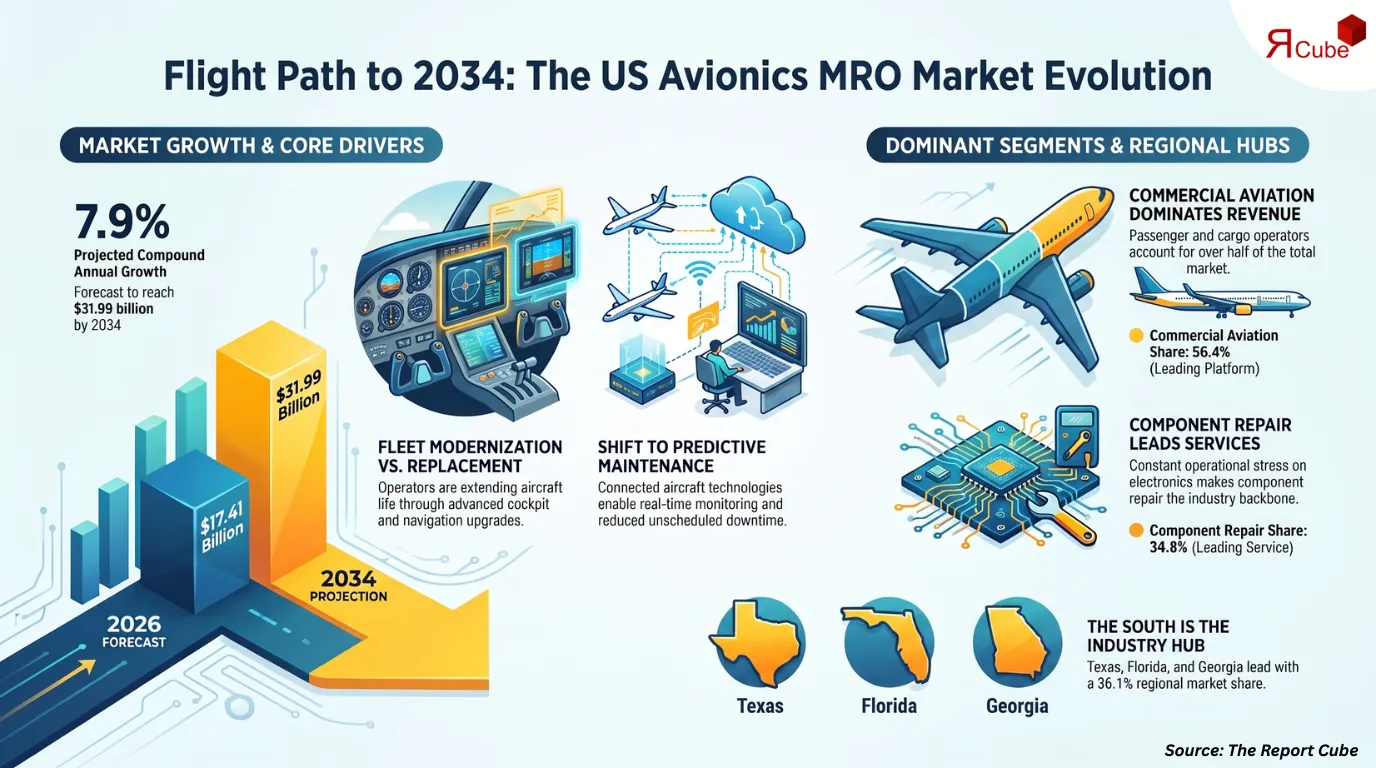
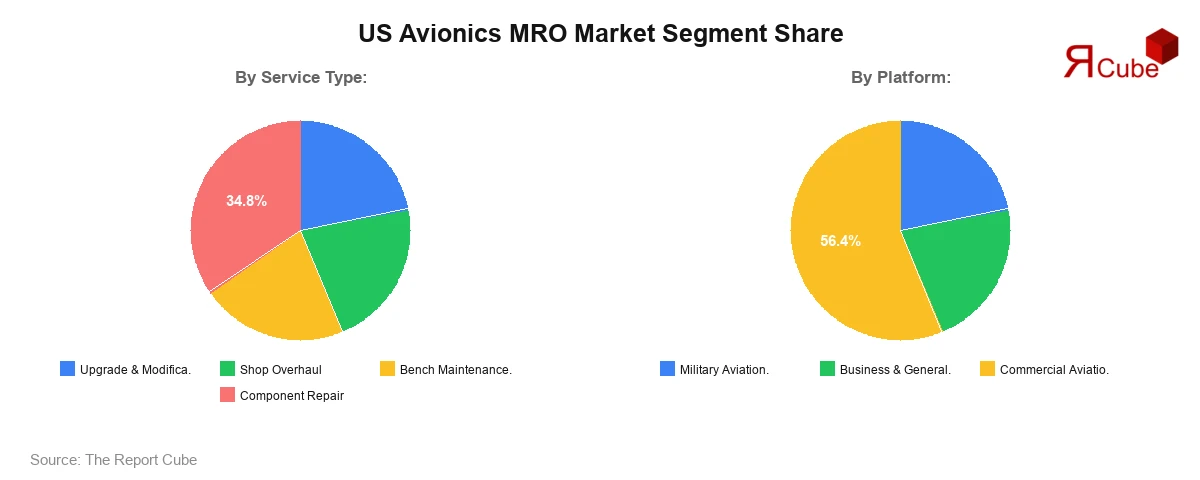
Component Repair segment leads the market with nearly 34.8% market share.
By Platform:
Commercial Aviation dominates the market with approximately 56.4% of total revenue.
Regional Outlook:
The South region dominates the US Avionics MRO Market with around 36.1% market share.
US Avionics MRO Market Insights & Analysis
The US Avionics MRO Market is anticipated to register a CAGR of around 7.9% during the forecast period from 2026 to 2034. The market size is valued at USD 17.41 billion in 2026 and is projected to reach USD 31.99 billion by 2034. Demand continues to strengthen as commercial airlines, cargo operators, business jet owners, and defense agencies prioritize avionics upgrades to enhance aircraft reliability, operational efficiency, and regulatory compliance. Rather than replacing existing fleets, operators are extending aircraft service life through scheduled modernization programs that include flight management systems, communication equipment, navigation technologies, cockpit displays, surveillance solutions, and weather radar upgrades. These long-term investments continue generating steady demand for inspection, repair, software updates, calibration, testing, and overhaul services across the United States.
Investment activity across the aviation ecosystem is further reinforcing market expansion. Aircraft manufacturers, avionics suppliers, and independent maintenance providers are expanding repair capabilities while incorporating digital diagnostics, predictive maintenance tools, and cloud-based maintenance management platforms to improve turnaround time and reduce operational costs. At the same time, ongoing FAA airspace modernization initiatives and defense fleet sustainment programs are accelerating avionics retrofit activities across multiple aircraft categories. Strategic collaborations between avionics manufacturers and semiconductor companies are also supporting the development of next-generation digital cockpit technologies, connected aircraft platforms, and advanced computing solutions. These developments continue to strengthen the long-term outlook for the United States Avionics Maintenance, Repair, and Overhaul Service industry34.
US Avionics MRO Market Impact Analysis
| Factor | Type | Specific Impact on Market | Magnitude | Business Implication |
|---|---|---|---|---|
| Growth in US flight activity | Market | More flight hours increase avionics inspection and repair | High | Supports recurring demand for line and heavy avionics MRO |
| Aging commercial and defense fleets | Market | Older aircraft require frequent avionics upgrades and checks | High | Drives stable retrofit and overhaul project pipelines |
| Advanced digital and connected avionics | Technological | Complex systems need specialized test and diagnostic capability | High | Necessitates investment in skilled staff and digital test tools |
| Stringent FAA safety and compliance norms | Regulatory | Avionics work must meet tight certification and documentation | High | Raises compliance cost but protects quality focused providers |
| Labor and component cost inflation | Environmental | Higher wages and parts prices compress avionics MRO margins | Medium | Requires pricing discipline and supply chain cost control |
| OEM participation in aftermarket services | Competitive | OEM service arms compete directly with independent MRO firms | Medium | Pushes independents to focus on niche or multi platform support |
| Shift toward predictive maintenance models | Technological | Data driven monitoring changes scheduling of avionics visits | Medium | Enables value based contracts tied to uptime and reliability |
US Avionics MRO Market Dynamics
Key Driver: Fleet Modernization Programs Continue to Increase Avionics Maintenance Requirements
Fleet modernization remains a major investment priority across the U.S. aviation industry as operators seek to improve aircraft performance while extending operational life. Commercial airlines are replacing legacy avionics with integrated digital systems that deliver greater navigation accuracy, enhanced situational awareness, improved communication capability, and better fuel efficiency. These modernization programs require extensive maintenance support, including system integration, certification, software validation, functional testing, and component overhaul. As retrofit activity continues across narrow-body, wide-body, regional, and cargo aircraft, certified avionics service providers are experiencing sustained demand for specialized maintenance capabilities.
Military aviation is following a similar trajectory as defense organizations continue upgrading transport aircraft, surveillance platforms, helicopters, and tactical aircraft with advanced mission systems and digital cockpit technologies. Modernization programs are designed to improve mission readiness while extending aircraft service life without the cost of fleet replacement. Each upgrade generates recurring requirements for inspection, troubleshooting, repair, calibration, engineering support, and lifecycle maintenance, creating a stable revenue base for avionics MRO providers operating throughout the United States.
Industry Trend: Connected Aircraft Technologies Are Reshaping Maintenance Operations
Aircraft maintenance practices are becoming increasingly data-driven as airlines and fleet operators deploy connected avionics capable of transmitting real-time operational information. Continuous monitoring of onboard systems enables maintenance teams to detect equipment degradation before operational failures occur, helping reduce unscheduled maintenance events and improving fleet availability. This operational model supports more efficient maintenance planning while lowering aircraft downtime and overall operating expenses.
Digital transformation is also changing the way avionics maintenance providers manage repair operations. Cloud-based maintenance platforms, advanced diagnostic software, electronic maintenance records, and remote system monitoring have become integral to modern MRO facilities. Service providers are expanding investments in software support, cybersecurity protection, predictive diagnostics, and digital inspection capabilities to meet evolving customer requirements. These technology-driven maintenance practices are expected to remain a defining trend across the United States Avionics Maintenance, Repair, and Overhaul Service market during the forecast period.
Book your FREE 30-minute expert consultation today
Contact UsMajor Challenge: Limited Availability of Certified Avionics Technicians
Maintaining advanced avionics systems requires highly trained professionals with expertise in aircraft electronics, software integration, digital communication systems, and regulatory compliance. However, many maintenance organizations continue facing workforce shortages as experienced technicians retire faster than new professionals enter the industry. Recruiting personnel with FAA certifications and hands-on experience in next-generation avionics remains a challenge for both original equipment manufacturers and independent repair organizations.
The shortage of qualified technical personnel can increase maintenance turnaround times and place additional pressure on repair capacity, particularly during periods of high aircraft utilization. Rapid advances in avionics software, cybersecurity requirements, and digital cockpit technologies also require continuous workforce training, increasing operating costs for maintenance providers. Addressing these workforce challenges will remain essential to sustaining service quality and supporting long-term growth across the U.S. avionics MRO industry.
Opportunity: Rising Adoption of Digital Cockpit Systems Creates Long-Term Service Demand
Airlines and aircraft operators are steadily investing in digital cockpit technologies to improve flight efficiency, operational awareness, and compliance with evolving aviation standards. Modern aircraft increasingly incorporate integrated flight management systems, satellite-based navigation, advanced communication equipment, multifunction cockpit displays, and enhanced surveillance technologies. These systems require regular software upgrades, certification, troubleshooting, and preventive maintenance throughout their operational life, creating recurring business opportunities for avionics MRO providers.
Growing investments in connected aircraft infrastructure are also expanding demand for software lifecycle management, cybersecurity protection, predictive diagnostics, and avionics system integration. Independent maintenance organizations with advanced engineering capabilities and certified repair facilities are well positioned to support these requirements as fleet modernization accelerates across commercial, business, and military aviation. Continued adoption of intelligent avionics platforms is expected to strengthen long-term demand for specialized maintenance, repair, and overhaul services across the United States.
US Avionics MRO Market Segment-wise Analysis
By Service Type:
- Upgrade & Modification
- Shop Overhaul
- Bench Maintenance
- Component Repair
Component Repair accounted for the largest share of the US Avionics MRO Market, representing approximately 34.8% of total revenue in 2026. The segment remains the backbone of avionics maintenance because electronic components are exposed to continuous operational stress throughout an aircraft's service life. Flight management computers, navigation modules, communication transceivers, weather radar processors, cockpit display units, and surveillance equipment require periodic inspection, fault isolation, calibration, and repair to ensure reliable aircraft performance. Repairing certified components instead of replacing complete assemblies enables operators to control maintenance costs while maintaining compliance with FAA airworthiness standards.
Steady aircraft utilization across commercial airlines, cargo operators, business aviation, and military fleets continues to generate recurring demand for component repair services. Airlines are increasingly adopting predictive maintenance programs that identify electronic faults before they affect flight operations, allowing repairs to be completed during scheduled maintenance intervals. In addition, avionics manufacturers and FAA-certified repair stations are expanding repair capabilities for complex digital systems to reduce turnaround time and improve fleet availability. These factors are expected to support the continued leadership of the Component Repair segment throughout the forecast period.
By Platform:
- Military Aviation
- Business & General Aviation
- Commercial Aviation
Commercial Aviation held the largest market share of nearly 56.4% in 2026, reflecting the United States' position as one of the world's largest commercial aviation markets. Major passenger airlines, regional carriers, and cargo operators collectively manage thousands of aircraft that require scheduled avionics inspections, software updates, system testing, and component overhauls to maintain operational reliability. Increasing passenger traffic, fleet expansion, and aircraft utilization continue driving demand for maintenance services that minimize downtime and ensure uninterrupted flight operations.
Fleet renewal and cockpit modernization programs are further strengthening this segment. Airlines continue investing in advanced flight management systems, satellite communication equipment, navigation technologies, digital cockpit displays, and surveillance solutions to improve fuel efficiency, flight safety, and regulatory compliance. As aircraft remain in service for longer periods, demand for certified avionics maintenance, engineering support, retrofit integration, and lifecycle management is expected to increase steadily, reinforcing Commercial Aviation as the leading platform segment of the United States Avionics Maintenance, Repair, and Overhaul Service market.
Regional Projection of US Avionics MRO Industry
- West
- East
- South
- Midwest
- Others
The South region accounted for approximately 36.1% of the US Avionics MRO Market in 2026 and continues to serve as the country's leading hub for aircraft maintenance and avionics support activities. States such as Texas, Florida, Georgia, and Alabama host extensive networks of commercial airline maintenance centers, FAA-certified repair stations, military aviation facilities, and aerospace manufacturing operations. The presence of major international airports and large airline maintenance bases enables service providers to deliver efficient repair, overhaul, testing, and certification services for both domestic and international aircraft operators.
Regional growth is further supported by ongoing defense modernization programs and sustained investments in aerospace infrastructure. Several military installations across the South routinely undertake avionics upgrades for transport aircraft, helicopters, and tactical fleets, creating consistent demand for system integration, electronic testing, software validation, and lifecycle maintenance. At the same time, leading avionics manufacturers and independent MRO organizations continue expanding repair capacity and technical capabilities across the region to support increasing commercial aviation activity. These advantages position the South as the largest regional contributor to the US Avionics MRO Market throughout the forecast period.
Need insights for a specific region within this market?
Request Regional DataRegional Analysis of US Avionics MRO Market
The US avionics MRO market is shaped by fleet density, defense bases, and regional tech ecosystems.
| Cluster | Demand Level | Key Areas | System Dominance | Core Demand Logic | Growth Nature |
|---|---|---|---|---|---|
| West | Very High | Seattle, LA, Phoenix | Narrow‑body & avionics | OEM proximity and tech fleets | Upgrade‑ and mod‑driven |
| East | High | New York, Boston, Atlanta | Line & component MRO | Dense hubs and legacy fleets | Traffic‑linked expansion |
| South | Very High | Dallas, Miami, Orlando | Wide‑body & mixed fleets | Heavy passenger and cargo flows | Capacity‑constrained growth |
| Midwest | Medium | Chicago, Kansas City | Heavy checks & avionics | Centralized heavy maintenance | Steady, contract‑based |
| Others | Emerging | Mountain & niche hubs | Specialized biz‑jet MRO | Regional jets and GA focus | Niche capability growth |
Government Initiatives & Policies
- FAA Continuous Lower Energy, Emissions, and Noise (CLEEN) Program: In 2025, the Federal Aviation Administration continued supporting the development and certification of advanced aircraft technologies, including next-generation avionics, digital flight systems, and safer aircraft operations. The program encourages modernization that increases long-term demand for avionics upgrades and certified maintenance services.
- FAA NextGen Air Transportation System: During 2025 and 2026, the FAA continued expanding the NextGen program to improve air traffic management through Performance Based Navigation, ADS-B implementation, digital communications, and advanced surveillance technologies. These initiatives increase the need for avionics retrofits, software upgrades, system calibration, and long-term MRO support across commercial and business aviation fleets.
US Avionics MRO Industry Recent Developments
- 2025: Honeywell International Inc. expanded its strategic partnership with NXP Semiconductors to accelerate the development of AI-enabled aviation technologies. The collaboration combines the Honeywell Anthem cloud-connected avionics platform with NXP's advanced computing technologies to support digital cockpits, autonomous flight capabilities, and enhanced aircraft connectivity. The initiative is expected to increase demand for avionics software maintenance, cybersecurity services, predictive diagnostics, system integration, and long-term maintenance support across commercial and business aviation fleets.
- 2025: L3Harris Technologies, Inc. secured a contract to modernize avionics systems across multiple C-130 aircraft. The program focuses on integrating advanced flight management technologies, upgraded mission systems, and improved cockpit capabilities to enhance aircraft performance and lifecycle sustainability. The contract is expected to strengthen demand for avionics integration, testing, certification, repair, and ongoing maintenance services within the U.S. military aviation sector.
Why Choose This Report?
- Provides a comprehensive overview of the overall market analysis, encompassing key trends, consumer behavior analysis, and risk assessment to support strategic decision-making.
- Provides accurate, up-to-date insights into market size, segmentation, and emerging opportunities, helping organizations minimize risk while capitalizing on future growth opportunities.
- Gives a deep understanding of target audience preferences, investment patterns, and technology adoption trends for improved product development and marketing effectiveness.
- Delivers competitive analysis and benchmarking, uncovering the strengths and weaknesses of leading market participants to guide strategic planning.
- Consolidates comprehensive market intelligence, reducing research efforts and enabling faster business decision-making.
- Facilitates customized market segmentation and risk mitigation strategies aligned with specific business objectives and investment priorities.
- Assists organizations in identifying both market challenges and untapped opportunities to support sustainable long-term business growth.
- Provides valuable information based on industry developments, customer demand patterns, regulatory trends, and verified market intelligence.
Table of Contents
- Introduction
- Objective of the Study
- Product and Category Definition
- Market Segmentation
- Study Variables
- Research Methodology
- Secondary Data Points
- Breakdown of Secondary Sources
- Primary Data Points
- Breakdown of Primary Interviews
- Secondary Data Points
- Executive Summary
- Market Dynamics
- Emerging Opportunities
- Adoption Trends
- Demand Drivers
- Disruption Analysis (Challenges)
- Industry Analysis & Strategic Insights
- Supply/Value Chain Analysis
- Pricing Analysis
- Go-To-Market (GTM) Strategy
- BCG Matrix
- Recent Trends and Developments
- Import and Export Analysis
- Regulatory and Policy Landscape
- Region-wise Policies
- Government Initiatives
- US Avionics MRO Market Overview and Forecast Analysis (2021-2034)
- Market Size, By Value, By Growth Rate (CAGR/USD Billion)
- Market Share, By Service Type
- Upgrade & Modification
- Shop Overhaul
- Bench Maintenance
- Component Repair
- Market Share, By Avionics System
- Weather Radar Systems
- Flight Control & Autopilot Systems
- Surveillance & Collision Avoidance Systems
- Flight Management Systems
- Cockpit Display Systems
- Navigation Systems
- Communication Systems
- Others
- Market Share, By Platform
- Military Aviation
- Business & General Aviation
- Commercial Aviation
- Market Share, By Region
- West
- East
- South
- Midwest
- Others
- Market Share, By Company
- Revenue Shares & Analysis
- Competitive Landscape
- West US Avionics MRO Market Overview and Forecast Analysis (2021-2034)
- Market Size, By Value, By Growth Rate (CAGR/USD Billion/Million)
- Market Share, By Service Type
- Market Share, By Avionics System
- Market Share, By Platform
- Market Share, By Region
- East US Avionics MRO Market Overview and Forecast Analysis (2021-2034)
- Market Size, By Value, By Growth Rate (CAGR/USD Billion/Million)
- Market Share, By Service Type
- Market Share, By Avionics System
- Market Share, By Platform
- Market Share, By Region
- South US Avionics MRO Market Overview and Forecast Analysis (2021-2034)
- Market Size, By Value, By Growth Rate (CAGR/USD Billion/Million)
- Market Share, By Service Type
- Market Share, By Avionics System
- Market Share, By Platform
- Market Share, By Region
- Midwest US Avionics MRO Market Overview and Forecast Analysis (2021-2034)
- Market Size, By Value, By Growth Rate (CAGR/USD Billion/Million)
- Market Share, By Service Type
- Market Share, By Avionics System
- Market Share, By Platform
- Market Share, By Region
- Competitive Analysis, 2026
- Market Share of Key Players
- Competitive Mapping for Each Service Type, Avionics System, Platform, and Companies Operating Regionally
- West US Avionics MRO Companies Share & Competitive Analysis, 2026
- East US Avionics MRO Companies Share & Competitive Analysis, 2026
- South US Avionics MRO Companies Share & Competitive Analysis, 2026
- Midwest US Avionics MRO Companies Share & Competitive Analysis, 2026
- Company Profile (Partial List)
- Northrop Grumman Corporation
- Company Overview
- Product Portfolio
- Strategic Alliances/Partnerships
- Recent Developments
- RTX Corporation
- Company Overview
- Product Portfolio
- Strategic Alliances/Partnerships
- Recent Developments
- Boeing Global Services
- Company Overview
- Product Portfolio
- Strategic Alliances/Partnerships
- Recent Developments
- StandardAero, Inc.
- Company Overview
- Product Portfolio
- Strategic Alliances/Partnerships
- Recent Developments
- Garmin Ltd.
- Company Overview
- Product Portfolio
- Strategic Alliances/Partnerships
- Recent Developments
- Honeywell International Inc.
- Company Overview
- Product Portfolio
- Strategic Alliances/Partnerships
- Recent Developments
- GE Aerospace
- Company Overview
- Product Portfolio
- Strategic Alliances/Partnerships
- Recent Developments
- L3Harris Technologies, Inc.
- Company Overview
- Product Portfolio
- Strategic Alliances/Partnerships
- Recent Developments
- AAR CORP.
- Company Overview
- Product Portfolio
- Strategic Alliances/Partnerships
- Recent Developments
- Others (Partial List)
- Northrop Grumman Corporation
- Contact Us and Disclaimer
Top Key Players & Market Share Outlook
- Northrop Grumman Corporation
- RTX Corporation
- Boeing Global Services
- StandardAero, Inc.
- Garmin Ltd.
- Honeywell International Inc.
- GE Aerospace
- L3Harris Technologies, Inc.
- AAR CORP.
- Others
Frequently Asked Questions