




Build Your Custom Market Intelligence Report
Customize Your ReportAsia Pacific Aircraft MRO Market Insights & Analysis
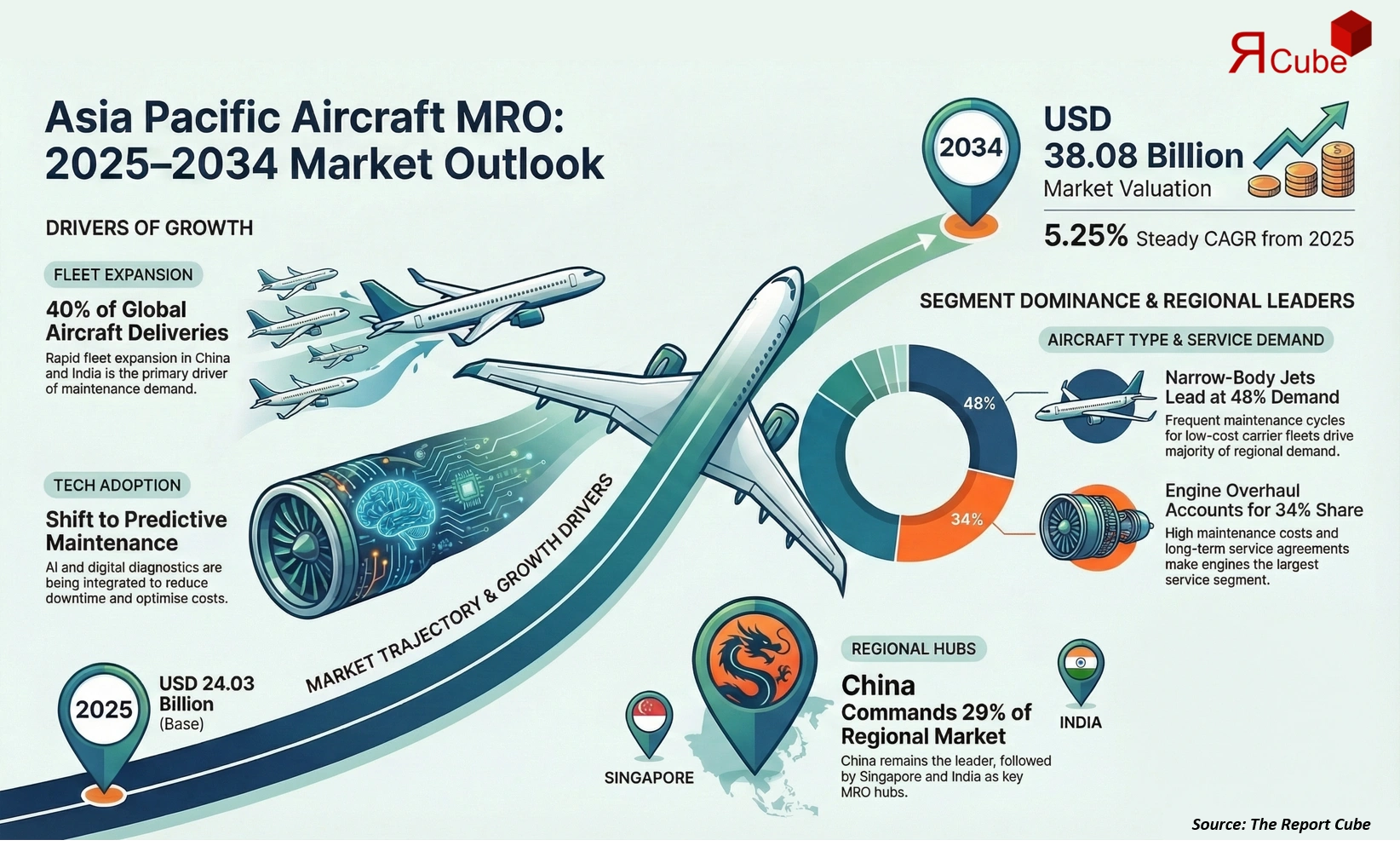
The Asia Pacific Aircraft MRO Market is anticipated to register a CAGR of 5.25% during the forecast period. The market size was valued at USD 24.03 billion and is projected to reach USD 38.08 billion by 2034. The market’s growth is strongly supported by the rapid expansion of commercial aviation fleets, increasing air passenger traffic, and the region’s rising importance as a global aviation hub.
Asia Pacific continues to witness faster fleet additions compared to mature aviation markets, driven by rising middle-class income levels, growing tourism, and expanding low-cost carrier networks. As aircraft utilization rates rise, airlines are prioritizing scheduled maintenance, engine overhauls, and component replacements to ensure safety and operational efficiency. This directly strengthens demand for third-party and in-house MRO service providers across the region.
Moreover, governments across Asia Pacific are investing heavily in airport infrastructure and aviation safety regulations, further increasing compliance-driven maintenance activities. The growing adoption of technologically advanced aircraft, including fuel-efficient narrow-body and wide-body jets, is also reshaping MRO service requirements. Collectively, these factors position the Asia Pacific Aircraft MRO Market as one of the fastest-growing aviation services segments globally.
Asia Pacific Aircraft MRO Market Recent Developments
- 2025: ST Engineering expanded engine MRO capacity in Asia to support growing narrow-body and wide-body fleets.
- 2025: Lufthansa Technik strengthened partnerships with Asia-based airlines for component and digital MRO solutions.
Government Initiatives & Policies
- India UDAN & Aviation Maintenance Policy: Supports domestic MRO development and cost competitiveness.
- China Civil Aviation Development Plan: Promotes aviation safety, MRO infrastructure, and fleet expansion.
Asia Pacific Aircraft MRO Market Dynamics
Key Driver: Rapid Expansion of Commercial Aircraft Fleets
The primary driver of the Asia Pacific Aircraft MRO Market is the rapid expansion of commercial aircraft fleets across emerging and developed economies. Airlines in China, India, Southeast Asia, and Oceania continue to add new aircraft to meet rising passenger demand. Fleet growth directly increases the frequency of routine inspections, engine checks, and component replacements. In 2024, Asia Pacific accounted for over 40% of global aircraft deliveries, significantly boosting long-term MRO demand. As utilization rates remain high, airlines increasingly rely on specialized MRO providers to minimize downtime and control maintenance costs. This strong correlation between fleet size and maintenance needs makes fleet expansion a sustainable growth driver for the market.
Book your FREE 30-minute expert consultation today
Contact UsIndustry Trends: Shift Toward Engine and Component-Focused MRO
A key trend shaping the market is the growing focus on engine overhaul and component MRO services. Modern aircraft engines represent nearly 45% of total maintenance costs, prompting airlines to adopt predictive maintenance and long-term service agreements. Digital diagnostics, data analytics, and condition-based monitoring are increasingly integrated into MRO workflows to improve reliability. Additionally, airlines are outsourcing complex component repairs to specialized providers to reduce capital investments. This trend is particularly strong among low-cost carriers seeking lean operational models. As aircraft technology evolves, MRO providers offering advanced engine and component capabilities are gaining competitive advantage across Asia Pacific.
Major Challenge: High Operational and Regulatory Complexity
Despite strong growth prospects, the Asia Pacific Aircraft MRO Market faces challenges related to operational complexity and regulatory compliance. MRO providers must adhere to varying aviation safety standards across multiple countries, increasing certification and training costs. Skilled labor shortages further add pressure, as experienced technicians and engineers are in high demand. Additionally, fluctuations in spare parts availability and supply chain disruptions can impact turnaround times. These challenges raise operating costs for service providers and may limit capacity expansion, particularly for smaller MRO players competing with global leaders.
Opportunity: Rising Demand for Localized MRO Facilities
The growing emphasis on localized MRO facilities presents a major opportunity for the market. Governments and airlines are increasingly encouraging domestic maintenance capabilities to reduce reliance on overseas service centers. Countries such as India, China, and Thailand are offering incentives to attract MRO investments. Localized facilities reduce ferry flight costs, improve turnaround times, and enhance fleet availability. As a result, both global and regional players are expanding their footprints across Asia Pacific, creating long-term growth opportunities for engine, airframe, and component MRO services.
Asia Pacific Aircraft MRO Market Segment-wise Analysis
By Service:
- Engine Overhaul
- Airframe Maintenance
- Component MRO
- Line Maintenance
- Modification Services
Engine Overhaul dominates the service segment, accounting for approximately 34% of the market share. This leadership is driven by high engine maintenance costs and increasing adoption of long-term engine service agreements. Airframe Maintenance follows closely, supported by aging fleets and strict safety regulations. Component MRO is also expanding steadily as airlines seek cost-efficient repair solutions. Line Maintenance remains essential for daily operational reliability, while Modification Services are gaining importance due to cabin upgrades and fleet reconfiguration needs.
By Aircraft Type:
- Narrow-Body
- Wide-Body
- Regional Jets
- Business Jets
Narrow-Body aircraft represent the largest share, contributing nearly 48% of total MRO demand. The dominance of narrow-body fleets among low-cost carriers and regional airlines drives frequent maintenance cycles. Wide-Body aircraft follow, supported by long-haul operations and higher per-aircraft maintenance spending. Regional Jets account for a moderate share, particularly in domestic connectivity markets. Business Jets remain a niche segment but are witnessing steady growth due to rising corporate aviation activity in Asia Pacific.
Regional Projection of Asia Pacific Aircraft MRO Industry
- China
- India
- Japan
- South Korea
- Australia
- Singapore
- Thailand
- Rest of Asia Pacific
China leads the Asia Pacific Aircraft MRO Market with an estimated 29% market share, driven by the world’s second-largest commercial aircraft fleet. Strong government support, expanding domestic MRO capabilities, and high aircraft utilization rates reinforce China’s leadership. Singapore and India follow as key hubs, supported by favorable policies and skilled labor availability. Japan, South Korea, and Australia contribute steady demand through mature aviation markets, while Southeast Asian countries are emerging as cost-competitive MRO destinations.
Need insights for a specific region within this market?
Request Regional DataWhy Choose This Report?
- Provides a comprehensive overview of the overall market analysis, encompassing key trends, consumer behavior analysis, and risk assessment to support strategic decision-making.
- Provides accurate, up-to-date insights into market size, segmentation, and emerging opportunities, helping to minimize risk & capitalizing on growth.
- Gives deep understanding of target audience preferences, investment habits, and communication channels for enhanced product development & marketing effectiveness.
- Delivers competitive analysis & benchmarking, uncovering the strengths & weaknesses of market competitors to guide strategies.
- Consolidate comprehensive market intelligence, reducing reasoning & streamlining research efforts.
- Facilitates customized market segmentation & risk mitigation strategies, fine-tuned to the business objectives.
- Aids in identifying both market challenges & untapped opportunities within the industry to drive long-term business growth.
- Provides valuable information based on actual customer data & search trends.
Table of Contents
- Introduction
- Objective of the Study
- Product and Category Definition
- Market Segmentation
- Study Variables
- Research Methodology
- Secondary Data Points
- Breakdown of Secondary Sources
- Primary Data Points
- Breakdown of Primary Interviews
- Secondary Data Points
- Executive Summary
- Market Dynamics
- Drivers
- Challenges
- Opportunity Assessment
- Recent Trends and Developments
- Regulatory and Policy Landscape
- Asia Pacific Aircraft MRO Market Overview (2020-2034)
- Market Size, By Value (USD Billion)
- Market Share, By Service
- Engine Overhaul
- Airframe Maintenance
- Component MRO
- Line Maintenance
- Modification Services
- Market Share, By Aircraft Type
- Narrow-Body
- Wide-Body
- Regional Jets
- Business Jets
- Market Share, By End User
- Commercial Aviation
- Military Aviation
- General Aviation
- Market Share, By Organization
- Airline MRO
- Independent MRO
- OEM MRO
- Market Share, By Country
- China
- India
- Japan
- South Korea
- Australia
- Singapore
- Thailand
- Rest of Asia Pacific
- Market Share, By Company
- Competition Characteristics
- Revenue Shares & Analysis
- China Aircraft MRO Market
- Market Size, By Value (USD Billion)
- Market Share, By Service
- Market Share, By Aircraft Type
- Market Share, By End User
- Market Share, By Organization
- India Aircraft MRO Market
- Market Size, By Value (USD Billion)
- Market Share, By Service
- Market Share, By Aircraft Type
- Market Share, By End User
- Market Share, By Organization
- Japan Aircraft MRO Market
- Market Size, By Value (USD Billion)
- Market Share, By Service
- Market Share, By Aircraft Type
- Market Share, By End User
- Market Share, By Organization
- South Korea Aircraft MRO Market
- Market Size, By Value (USD Billion)
- Market Share, By Service
- Market Share, By Aircraft Type
- Market Share, By End User
- Market Share, By Organization
- Australia Aircraft MRO Market
- Market Size, By Value (USD Billion)
- Market Share, By Service
- Market Share, By Aircraft Type
- Market Share, By End User
- Market Share, By Organization
- Singapore Aircraft MRO Market
- Market Size, By Value (USD Billion)
- Market Share, By Service
- Market Share, By Aircraft Type
- Market Share, By End User
- Market Share, By Organization
- Competitive Outlook and Company Profiles
- ST Engineering
- Company Overview
- Service Portfolio
- Strategic Alliances/Partnerships
- Recent Developments
- SIA Engineering
- Company Overview
- Service Portfolio
- Strategic Alliances/Partnerships
- Recent Developments
- HAECO Group
- Company Overview
- Service Portfolio
- Strategic Alliances/Partnerships
- Recent Developments
- Lufthansa Technik
- Company Overview
- Service Portfolio
- Strategic Alliances/Partnerships
- Recent Developments
- AAR CORP
- Company Overview
- Service Portfolio
- Strategic Alliances/Partnerships
- Recent Developments
- GE Aerospace
- Company Overview
- Service Portfolio
- Strategic Alliances/Partnerships
- Recent Developments
- Rolls-Royce
- Company Overview
- Service Portfolio
- Strategic Alliances/Partnerships
- Recent Developments
- Delta TechOps
- Company Overview
- Service Portfolio
- Strategic Alliances/Partnerships
- Recent Developments
- Air France KLM MRO
- Company Overview
- Service Portfolio
- Strategic Alliances/Partnerships
- Recent Developments
- Korean Air MRO
- Company Overview
- Service Portfolio
- Strategic Alliances/Partnerships
- Recent Developments
- Others
- ST Engineering
- Contact Us and Disclaimer
Top Key Players & Market Share Outlook
- ST Engineering
- SIA Engineering
- HAECO Group
- Lufthansa Technik
- AAR CORP
- GE Aerospace
- Rolls-Royce
- Delta TechOps
- Air France KLM MRO
- Korean Air MRO
- Others
Frequently Asked Questions






