




Build Your Custom Market Intelligence Report
Customize Your ReportAsia Pacific Helicopter Services Market Insights & Analysis
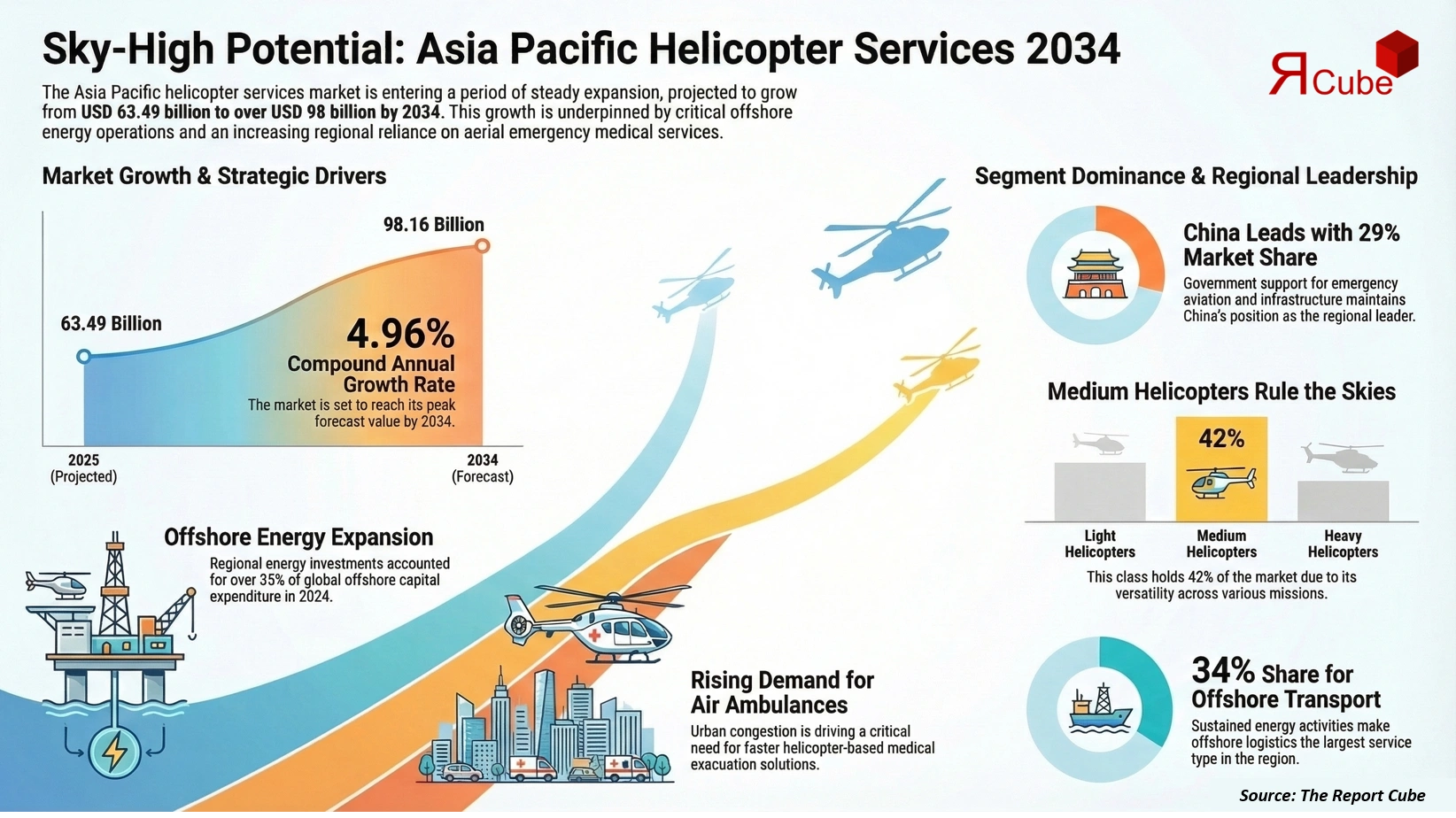
The Asia Pacific Helicopter Services Market is anticipated to register a CAGR of 4.96% during the forecast period. The market size was valued at USD 63.49 billion and is projected to reach USD 98.16 billion by 2034. This steady expansion reflects the region’s growing reliance on rotary-wing aviation for critical transportation, emergency response, and specialized commercial operations across diverse geographies.
The Asia Pacific region presents a unique operating environment characterized by offshore energy assets, remote islands, mountainous terrains, and rapidly expanding urban centers. Helicopter services play a vital role in connecting inaccessible locations, supporting offshore oil and gas platforms, and enabling time-sensitive medical evacuations. Rising investments in offshore wind farms, coastal energy exploration, and maritime surveillance have significantly increased demand for reliable helicopter transport services across the region.
Moreover, governments across Asia Pacific are strengthening disaster preparedness frameworks due to increasing climate-related events, including cyclones, floods, and earthquakes. Helicopters are central to disaster relief and search-and-rescue missions, driving consistent utilization. Simultaneously, growth in high-net-worth individuals, corporate travel, and tourism flights in countries such as Australia, Japan, and Southeast Asia is supporting diversified revenue streams. These interconnected demand drivers collectively position the Asia Pacific Helicopter Services Market as a resilient and strategically important aviation segment.
Asia Pacific Helicopter Services Market Recent Developments
- 2025: Bristow Group expanded offshore helicopter contracts supporting new wind energy projects in Asia Pacific waters.
- 2025: Pawan Hans Limited strengthened its air ambulance fleet to enhance emergency medical response coverage.
Government Initiatives & Policies
- India National Aviation Policy: Promotes regional connectivity and emergency aviation services expansion.
- China Emergency Aviation Development Plan: Supports helicopter deployment for disaster management and medical services.
Asia Pacific Helicopter Services Market Dynamics
Key Driver: Rising Offshore Energy and Infrastructure Activities
The primary driver of the Asia Pacific Helicopter Services Market is the expansion of offshore energy and infrastructure projects. Countries such as Australia, China, and India continue to invest heavily in offshore oil, gas, and renewable energy installations, which rely extensively on helicopter services for crew transport, logistics, and emergency support. Helicopters provide unmatched efficiency for reaching offshore platforms, particularly in rough sea conditions where marine transport is less reliable. In 2024, offshore energy investments in Asia Pacific accounted for over 35% of global offshore capital expenditure, directly boosting demand for helicopter services. This reliance on rotary-wing aviation ensures consistent utilization rates and long-term service contracts, making offshore transport a cornerstone of market growth.
Book your FREE 30-minute expert consultation today
Contact UsIndustry Trends: Growing Adoption of Helicopters for Medical and Emergency Services
An important trend reshaping the market is the increasing adoption of helicopters for air ambulance and emergency response services. Rapid urbanization and traffic congestion in major Asia Pacific cities have highlighted the need for faster medical evacuation solutions. Helicopter-based emergency medical services significantly reduce response times, improving patient survival rates in critical cases. Governments and private healthcare providers are expanding helicopter ambulance fleets, particularly in India, Japan, and Australia. Additionally, integration of advanced medical equipment and digital communication systems onboard helicopters is improving service quality. This trend aligns with broader healthcare infrastructure upgrades, reinforcing helicopters as essential assets in regional emergency response systems.
Major Challenge: High Operational and Maintenance Costs
Despite strong demand fundamentals, high operational and maintenance costs present a major challenge for the Asia Pacific Helicopter Services Market. Helicopter operations involve significant expenses related to fuel, skilled personnel, maintenance, and regulatory compliance. Aging fleets in some countries further increase maintenance burdens and downtime risks. Smaller operators often face financial strain in sustaining profitability, particularly in price-sensitive markets. Additionally, varying regulatory standards across countries complicate cross-border operations and fleet standardization. These cost pressures can limit fleet expansion and create barriers for new entrants, moderating overall market growth.
Opportunity: Expansion of Disaster Relief and Tourism Flight Services
The growing frequency of natural disasters and rising demand for experiential tourism present strong opportunities for market expansion. Helicopters are indispensable in disaster relief operations, providing rapid access to affected areas for rescue, medical aid, and supply delivery. Governments are increasingly allocating budgets to strengthen aerial disaster response capabilities. At the same time, tourism flights are gaining popularity in scenic destinations such as Australia, Japan, and island regions across Asia Pacific. Aerial sightseeing offers premium experiences, attracting high-margin customers. The dual growth of disaster relief preparedness and tourism flights creates diversified revenue opportunities, enhancing market resilience.
Asia Pacific Helicopter Services Market Segment-wise Analysis
By Service Type:
- Offshore Transport
- Air Ambulance
- Business Travel
- Disaster Relief
- Aerial Imaging
- Tourism Flights
Offshore Transport dominates the market, accounting for approximately 34% of total market share, driven by sustained offshore energy activities. This segment benefits from long-term contracts and high utilization rates. Air Ambulance services follow, holding nearly 21% share, supported by healthcare infrastructure investments and emergency response needs. Disaster Relief and Aerial Imaging services are expanding steadily, while Tourism Flights are emerging as a high-growth niche, particularly in developed travel destinations. The balanced contribution of critical and commercial services ensures stable market dynamics.
By Helicopter Class:
- Light Helicopters
- Medium Helicopters
- Heavy Helicopters
Medium Helicopters lead this segment with an estimated 42% market share due to their versatility across offshore transport, emergency services, and business travel. They offer an optimal balance between payload capacity and operating cost. Heavy Helicopters account for around 28% share, primarily used for offshore and heavy-lift operations. Light Helicopters hold the remaining share, widely deployed in tourism, aerial imaging, and short-range medical services. Fleet diversification across helicopter classes allows operators to address varied mission requirements efficiently.
Regional Projection of Asia Pacific Helicopter Services Industry
- China
- India
- Japan
- South Korea
- Australia
- Rest of Asia Pacific
China leads the Asia Pacific Helicopter Services Market, contributing approximately 29% of regional revenue. Strong government support for emergency aviation, offshore energy logistics, and infrastructure development underpins this leadership. Australia follows closely, driven by offshore energy operations and mature air ambulance networks. India is emerging as a high-growth market due to expanding medical services and disaster response initiatives. Japan and South Korea maintain steady demand supported by advanced healthcare systems and disaster preparedness programs. Overall, China is expected to retain its dominant position through 2034.
Need insights for a specific region within this market?
Request Regional DataWhy Choose This Report?
- Provides a comprehensive overview of the overall market analysis, encompassing key trends, consumer behavior analysis, and risk assessment to support strategic decision-making.
- Provides accurate, up-to-date insights into market size, segmentation, and emerging opportunities, helping to minimize risk & capitalizing on growth.
- Gives deep understanding of target audience preferences, investment habits, and communication channels for enhanced product development & marketing effectiveness.
- Delivers competitive analysis & benchmarking, uncovering the strengths & weaknesses of market competitors to guide strategies.
- Consolidate comprehensive market intelligence, reducing reasoning & streamlining research efforts.
- Facilitates customized market segmentation & risk mitigation strategies, fine-tuned to the business objectives.
- Aids in identifying both market challenges & untapped opportunities within the industry to drive long-term business growth.
- Provides valuable information based on actual customer data & search trends.
Table of Contents
- Introduction
- Objective of the Study
- Product and Service Definition
- Market Segmentation
- Study Variables
- Research Methodology
- Secondary Data Points
- Breakdown of Secondary Sources
- Primary Data Points
- Breakdown of Primary Interviews
- Secondary Data Points
- Executive Summary
- Market Dynamics
- Drivers
- Challenges
- Opportunity Assessment
- Recent Trends and Developments
- Regulatory and Policy Landscape
- Asia Pacific Helicopter Services Market Overview (2020-2034)
- Market Size, By Value (USD Billion)
- Market Share, By Service Type
- Offshore Transport
- Air Ambulance
- Business Travel
- Disaster Relief
- Aerial Imaging
- Tourism Flights
- Market Share, By Helicopter Class
- Light Helicopters
- Medium Helicopters
- Heavy Helicopters
- Market Share, By End User
- Oil and Gas
- Defense and Security
- Healthcare EMS
- Corporate Clients
- Tourism Operators
- Market Share, By Operation
- Charter Services
- Scheduled Services
- Contract Services
- Market Share, By Country
- China
- India
- Japan
- South Korea
- Australia
- Rest of Asia Pacific
- Market Share, By Company
- Competition Characteristics
- Revenue Shares & Analysis
- China Helicopter Services Market
- Market Size, By Value (USD Billion)
- Market Share, By Service Type
- Market Share, By Helicopter Class
- Market Share, By End User
- Market Share, By Operation
- India Helicopter Services Market
- Market Size, By Value (USD Billion)
- Market Share, By Service Type
- Market Share, By Helicopter Class
- Market Share, By End User
- Market Share, By Operation
- Japan Helicopter Services Market
- Market Size, By Value (USD Billion)
- Market Share, By Service Type
- Market Share, By Helicopter Class
- Market Share, By End User
- Market Share, By Operation
- South Korea Helicopter Services Market
- Market Size, By Value (USD Billion)
- Market Share, By Service Type
- Market Share, By Helicopter Class
- Market Share, By End User
- Market Share, By Operation
- Australia Helicopter Services Market
- Market Size, By Value (USD Billion)
- Market Share, By Service Type
- Market Share, By Helicopter Class
- Market Share, By End User
- Market Share, By Operation
- Competitive Outlook and Company Profiles
- Bristow Group Inc.
- Company Overview
- Service Portfolio
- Strategic Alliances/Partnerships
- Recent Developments
- Petroleum Helicopters International Inc.
- Company Overview
- Service Portfolio
- Strategic Alliances/Partnerships
- Recent Developments
- CHC Helicopter Group
- Company Overview
- Service Portfolio
- Strategic Alliances/Partnerships
- Recent Developments
- Babcock International Group plc
- Company Overview
- Service Portfolio
- Strategic Alliances/Partnerships
- Recent Developments
- CITIC Offshore Helicopter Co. Ltd.
- Company Overview
- Service Portfolio
- Strategic Alliances/Partnerships
- Recent Developments
- Aero Asahi Corporation
- Company Overview
- Service Portfolio
- Strategic Alliances/Partnerships
- Recent Developments
- McDermott Aviation
- Company Overview
- Service Portfolio
- Strategic Alliances/Partnerships
- Recent Developments
- Pawan Hans Limited
- Company Overview
- Service Portfolio
- Strategic Alliances/Partnerships
- Recent Developments
- Shaanxi Helicopter Co. Ltd.
- Company Overview
- Service Portfolio
- Strategic Alliances/Partnerships
- Recent Developments
- Aero Asahi Corporation
- Company Overview
- Service Portfolio
- Strategic Alliances/Partnerships
- Recent Developments
- Others
- Bristow Group Inc.
- Contact Us and Disclaimer
Top Key Players & Market Share Outlook
- Bristow Group Inc.
- Petroleum Helicopters International Inc.
- CHC Helicopter Group
- Babcock International Group plc
- CITIC Offshore Helicopter Co. Ltd.
- Aero Asahi Corporation
- McDermott Aviation
- Pawan Hans Limited
- Shaanxi Helicopter Co. Ltd.
- Aero Asahi Corporation
- Others
Frequently Asked Questions






