




Build Your Custom Market Intelligence Report
Customize Your ReportAsia Pacific Air Freight Market Insights & Analysis
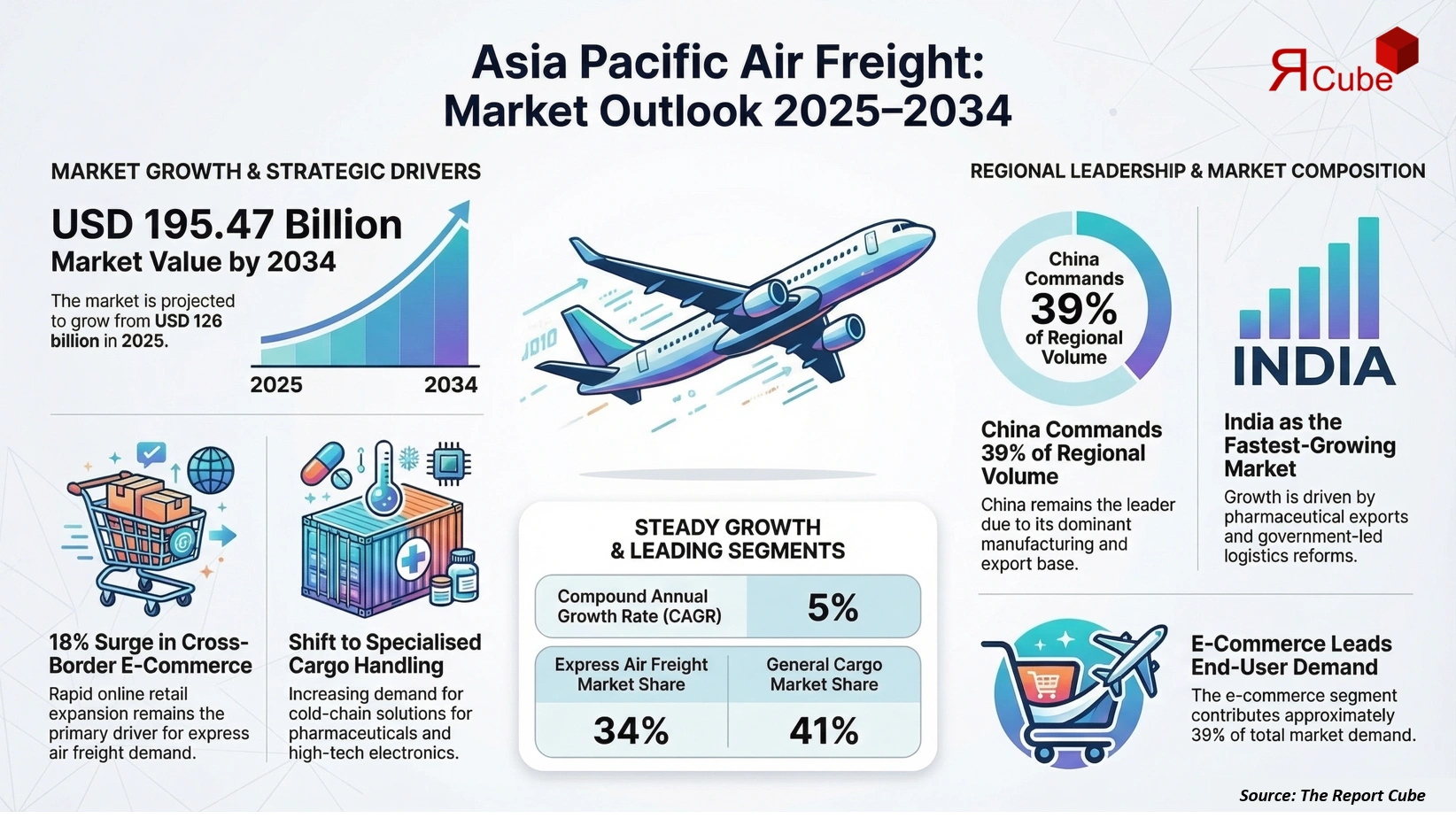
The Asia Pacific Air Freight Market is anticipated to register a CAGR of 5% during the forecast period. The market was valued at USD 126 billion and is projected to reach USD 195.47 billion by the end of the forecast timeline. This growth trajectory highlights the region’s expanding role as a global manufacturing, consumption, and logistics hub, driven by rising cross-border trade volumes and strong intra-regional connectivity.
The Asia Pacific region accounts for a significant share of global air cargo flows due to its concentration of export-oriented economies, high-tech manufacturing clusters, and rapidly growing e-commerce ecosystems. Countries such as China, Japan, South Korea, and India serve as critical nodes for electronics, automotive components, pharmaceuticals, and time-sensitive consumer goods. As global supply chains become more diversified, air freight continues to play a vital role in ensuring speed, reliability, and resilience.
Additionally, structural shifts such as the expansion of same-day and next-day delivery expectations, coupled with increasing pharmaceutical and perishable exports, are reinforcing long-term demand for air freight services. Investments in airport cargo infrastructure, digital freight platforms, and cold-chain capabilities further support market expansion. These interconnected factors position the Asia Pacific Air Freight Market as one of the fastest-growing and strategically important logistics segments globally.
Asia Pacific Air Freight Market Recent Developments
- 2025: DHL Aviation expanded Asia-Pacific air cargo capacity to support rising cross-border e-commerce volumes.
- 2025: Singapore Airlines Cargo enhanced pharmaceutical handling facilities across key regional hubs.
Government Initiatives & Policies
- National Logistics Policy - India: Aims to reduce logistics costs and improve multimodal cargo efficiency.
- China Civil Aviation Cargo Development Plan: Supports air cargo infrastructure expansion and smart logistics.
Asia Pacific Air Freight Market Dynamics
Key Driver: Rapid Expansion of Cross-Border E-Commerce
The primary driver of the Asia Pacific Air Freight Market is the rapid expansion of cross-border e-commerce across both developed and emerging economies. Online retail platforms increasingly rely on air freight to meet fast delivery commitments, particularly for electronics, fashion, and high-value consumer goods. In 2024, cross-border e-commerce volumes in Asia Pacific grew by more than 18%, significantly outpacing traditional trade growth. This surge has increased demand for express air freight and integrated logistics solutions. As consumer expectations for delivery speed continue to rise, air freight remains the preferred mode for time-critical shipments, reinforcing sustained market growth.
Book your FREE 30-minute expert consultation today
Contact UsIndustry Trends: Rising Demand for Specialized Cargo Handling
A key trend shaping the market is the growing demand for specialized cargo handling, particularly for pharmaceuticals, perishables, and high-tech goods. Asia Pacific has emerged as a major exporter of temperature-sensitive pharmaceuticals and fresh produce, requiring advanced cold-chain air freight solutions. Airlines and cargo operators are investing in temperature-controlled containers, digital monitoring systems, and dedicated pharma corridors. High-tech goods such as semiconductors and lithium batteries also require secure and compliant air transport. This trend is driving differentiation among service providers and increasing the value-added component of air freight services.
Major Challenge: Capacity Volatility and Cost Pressures
Despite strong demand, the market faces challenges related to capacity volatility and rising operating costs. Fluctuations in passenger belly-hold capacity, fuel price volatility, and airport congestion can disrupt supply-demand balance. Smaller shippers are particularly exposed to rate instability during peak seasons. Additionally, stricter environmental regulations and rising labor costs are increasing operational expenses for carriers. These factors can constrain profitability and create pricing uncertainty, especially for regular air freight services, potentially limiting short-term growth momentum.
Opportunity: Growth of Integrated Logistics and Digital Freight Platforms
The expansion of integrated logistics services presents a significant opportunity for the Asia Pacific Air Freight Market. Shippers increasingly prefer end-to-end solutions combining air transport, warehousing, customs clearance, and last-mile delivery. Digital freight platforms and data-driven capacity optimization tools are improving visibility and efficiency across the supply chain. Integrators and combination carriers are well-positioned to capitalize on this shift by offering seamless, technology-enabled logistics solutions. As supply chains prioritize resilience and transparency, integrated air freight services are expected to gain greater market share.
Asia Pacific Air Freight Market Segment-wise Analysis
By Service Type:
- Express Air Freight
- Regular Air Freight
- Mail & Parcel
- Charter Services
- Integrated Logistics
Express Air Freight leads the service type segment, accounting for approximately 34% of the market share. This dominance is driven by e-commerce shipments and urgent business consignments requiring guaranteed delivery timelines. Integrated Logistics is the fastest-growing sub-segment, supported by demand for end-to-end solutions. Regular Air Freight continues to serve bulk and less time-sensitive cargo, while charter services are increasingly used for oversized and project cargo. The interplay between speed, reliability, and service integration defines competitive positioning across service types.
By Cargo Type:
- General Cargo
- Express Parcels
- Perishable Goods
- Pharmaceuticals
- High-Tech Goods
General Cargo remains the largest cargo type, holding nearly 41% of market share, reflecting diversified manufacturing exports across Asia Pacific. However, Express Parcels and Pharmaceuticals are growing at a faster pace due to e-commerce and healthcare demand. Pharmaceutical cargo alone accounts for about 12% of total value, supported by vaccine distribution and biologics trade. High-tech goods further strengthen air freight demand due to their high value-to-weight ratio and time sensitivity.
By End User:
- E-Commerce
- Manufacturing
- Automotive
- Healthcare
- Retail & FMCG
E-Commerce is the leading end-user segment, contributing approximately 36% of market demand. Manufacturing follows closely, driven by electronics and industrial components. Healthcare is emerging as a high-growth segment due to rising pharmaceutical exports and medical device shipments. Automotive and Retail & FMCG continue to rely on air freight for urgent and high-value consignments, reinforcing diversified end-user demand.
By Carrier Type:
- Combination Carriers
- All-Cargo Airlines
- Integrators
Combination Carriers hold the largest share at around 44%, leveraging passenger networks and belly cargo capacity. All-Cargo Airlines account for approximately 32%, supported by dedicated freighter fleets and charter operations. Integrators are gaining share rapidly due to their control over the entire logistics chain, making them particularly attractive for express and e-commerce shipments.
Regional Projection of Asia Pacific Air Freight Industry
- China
- Japan
- South Korea
- India
- Australia
China leads the Asia Pacific Air Freight Market, accounting for nearly 39% of regional volume due to its dominant manufacturing base and e-commerce exports. Japan and South Korea follow, supported by high-tech and automotive supply chains. India is the fastest-growing market, driven by rising pharmaceutical exports and government-led logistics reforms. Australia plays a strategic role in perishables and express cargo. China’s extensive airport infrastructure and cargo airline network are expected to sustain its leadership throughout the forecast period.
Need insights for a specific region within this market?
Request Regional DataWhy Choose This Report?
- Provides a comprehensive overview of the overall market analysis, encompassing key trends, consumer behavior analysis, and risk assessment to support strategic decision-making.
- Provides accurate, up-to-date insights into market size, segmentation, and emerging opportunities, helping to minimize risk & capitalizing on growth.
- Gives deep understanding of target audience preferences, investment habits, and communication channels for enhanced product development & marketing effectiveness.
- Delivers competitive analysis & benchmarking, uncovering the strengths & weaknesses of market competitors to guide strategies.
- Consolidate comprehensive market intelligence, reducing reasoning & streamlining research efforts.
- Facilitates customized market segmentation & risk mitigation strategies, fine-tuned to the business objectives.
- Aids in identifying both market challenges & untapped opportunities within the industry to drive long-term business growth.
- Provides valuable information based on actual customer data & search trends.
Table of Contents
- Introduction
- Objective of the Study
- Product and Category Definition
- Market Segmentation
- Study Variables
- Research Methodology
- Secondary Data Points
- Breakdown of Secondary Sources
- Primary Data Points
- Breakdown of Primary Interviews
- Secondary Data Points
- Executive Summary
- Market Dynamics
- Drivers
- Challenges
- Opportunity Assessment
- Recent Trends and Developments
- Regulatory and Policy Landscape
- Asia Pacific Air Freight Market Overview (2020-2034)
- Market Size, By Value (USD Billion)
- Market Share, By Service Type
- Express Air Freight
- Regular Air Freight
- Mail & Parcel
- Charter Services
- Integrated Logistics
- Market Share, By Cargo Type
- General Cargo
- Express Parcels
- Perishable Goods
- Pharmaceuticals
- High-Tech Goods
- Market Share, By End User
- E-Commerce
- Manufacturing
- Automotive
- Healthcare
- Retail & FMCG
- Market Share, By Carrier Type
- Combination Carriers
- All-Cargo Airlines
- Integrators
- Market Share, By Countries
- China
- Japan
- South Korea
- India
- Australia
- Market Share, By Company
- Competition Characteristics
- Revenue Shares & Analysis
- China Air Freight Market
- Market Size, By Value (USD Billion)
- Market Share, By Service Type
- Market Share, By Cargo Type
- Market Share, By End User
- Market Share, By Carrier Type
- Market Share, By Region/Province
- Japan Air Freight Market
- Market Size, By Value (USD Billion)
- Market Share, By Service Type
- Market Share, By Cargo Type
- Market Share, By End User
- Market Share, By Carrier Type
- Market Share, By Region
- South Korea Air Freight Market
- Market Size, By Value (USD Billion)
- Market Share, By Service Type
- Market Share, By Cargo Type
- Market Share, By End User
- Market Share, By Carrier Type
- Market Share, By Region
- India Air Freight Market
- Market Size, By Value (USD Billion)
- Market Share, By Service Type
- Market Share, By Cargo Type
- Market Share, By End User
- Market Share, By Carrier Type
- Market Share, By Region
- Australia Air Freight Market
- Market Size, By Value (USD Billion)
- Market Share, By Service Type
- Market Share, By Cargo Type
- Market Share, By End User
- Market Share, By Carrier Type
- Market Share, By Region
- Competitive Outlook and Company Profiles
- FedEx Express
- Company Overview
- Service Portfolio
- Strategic Alliances/Partnerships
- Recent Developments
- UPS Airlines
- Company Overview
- Service Portfolio
- Strategic Alliances/Partnerships
- Recent Developments
- DHL Aviation
- Company Overview
- Service Portfolio
- Strategic Alliances/Partnerships
- Recent Developments
- Cathay Pacific Cargo
- Company Overview
- Service Portfolio
- Strategic Alliances/Partnerships
- Recent Developments
- Emirates SkyCargo
- Company Overview
- Service Portfolio
- Strategic Alliances/Partnerships
- Recent Developments
- Lufthansa Cargo
- Company Overview
- Service Portfolio
- Strategic Alliances/Partnerships
- Recent Developments
- Qatar Airways Cargo
- Company Overview
- Service Portfolio
- Strategic Alliances/Partnerships
- Recent Developments
- Singapore Airlines Cargo
- Company Overview
- Service Portfolio
- Strategic Alliances/Partnerships
- Recent Developments
- Korean Air Cargo
- Company Overview
- Service Portfolio
- Strategic Alliances/Partnerships
- Recent Developments
- Cargolux Airlines
- Company Overview
- Service Portfolio
- Strategic Alliances/Partnerships
- Recent Developments
- Others
- FedEx Express
- Contact Us and Disclaimer
Top Key Players & Market Share Outlook
- FedEx Express
- UPS Airlines
- DHL Aviation
- Cathay Pacific Cargo
- Emirates SkyCargo
- Lufthansa Cargo
- Qatar Airways Cargo
- Singapore Airlines Cargo
- Korean Air Cargo
- Cargolux Airlines
- Others
Frequently Asked Questions






