



Build Your Custom Market Intelligence Report
Customize Your ReportEurope Aircraft Seat Upholstery Market Insights & Analysis
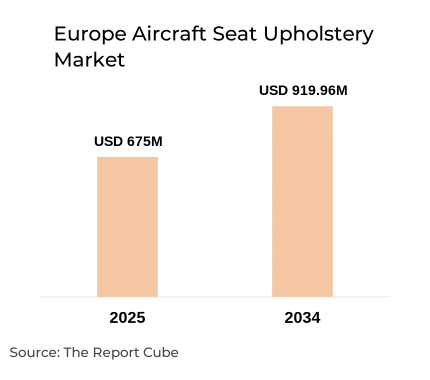
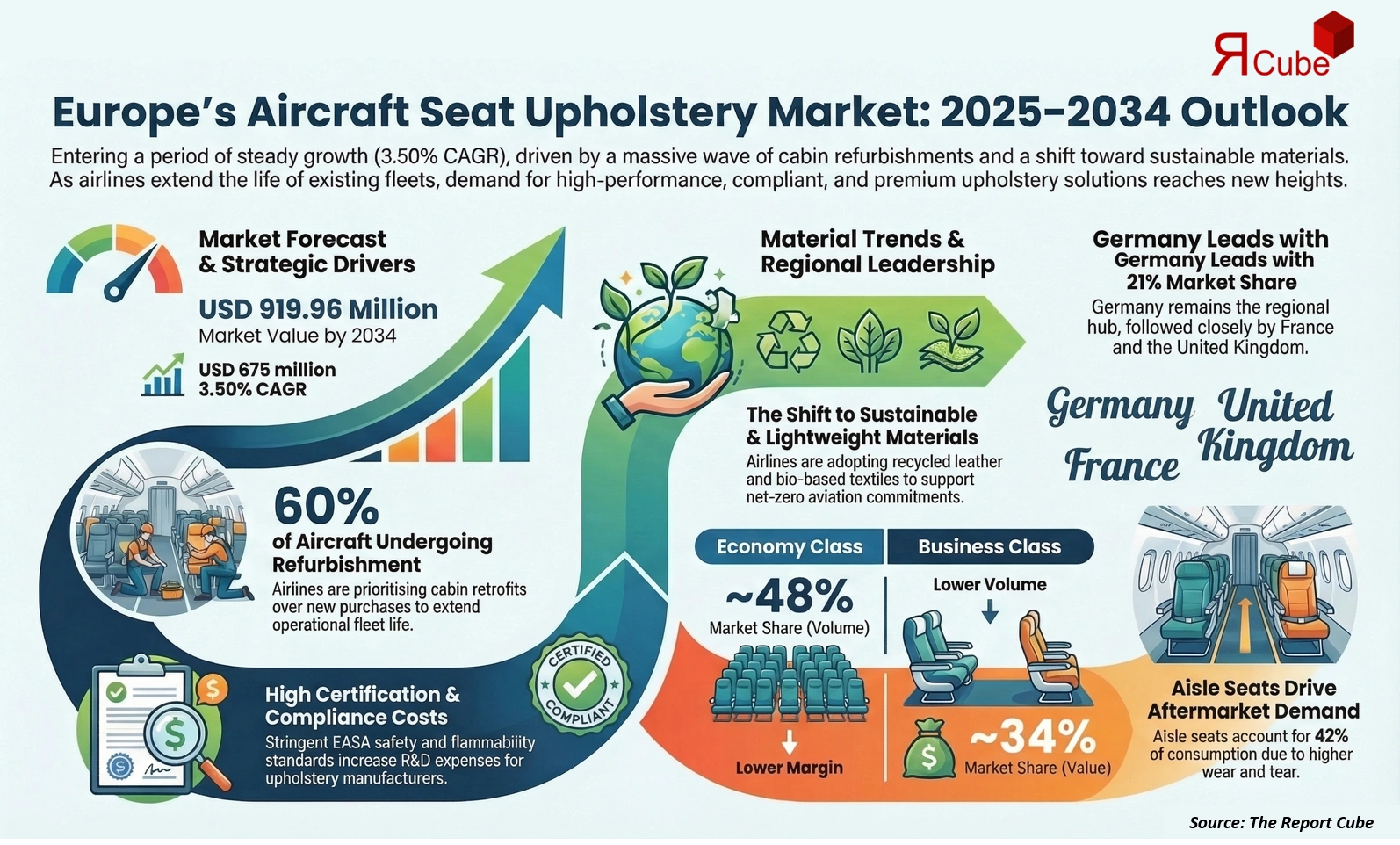
The Europe Aircraft Seat Upholstery Market is anticipated to register a CAGR of 3.50% during the forecast period 2026-2034. The market size was valued at USD 675 million in 2025 and is projected to reach USD 919.96 million by 2034. This steady growth reflects the gradual recovery of air travel across Europe, coupled with rising investments in aircraft cabin refurbishment and fleet modernization programs by major airlines.
European airlines are increasingly focusing on passenger comfort, brand differentiation, and regulatory compliance, all of which directly influence demand for high-quality seat upholstery solutions. Upholstery materials are being redesigned to balance durability, lightweight performance, fire resistance, and aesthetics, aligning with both safety standards and evolving passenger expectations. As airlines extend aircraft service life through cabin retrofitting rather than new aircraft purchases, the aftermarket for seat upholstery has gained notable traction.
Furthermore, sustainability has become a defining factor in procurement decisions. Airlines across Europe are adopting eco-friendly and recyclable upholstery materials to support net-zero commitments. This shift, combined with increasing premium cabin configurations on long-haul and regional routes, positions the Europe Aircraft Seat Upholstery Market for consistent, value-driven growth throughout the forecast period.
Europe Aircraft Seat Upholstery Market Recent Developments
- 2025: Lantal Textiles AG introduced lightweight, sustainable upholstery fabrics for European airline retrofit programs.
- 2025: ELeather Group expanded recycled leather upholstery supply for premium cabin seating across Europe.
Government Initiatives & Policies
- EU Aviation Safety Regulations (EASA): Standards governing aircraft interior materials, flammability, and passenger safety.
- EU Green Deal - Aviation Sustainability: Promotes sustainable materials and circular economy practices in aerospace manufacturing.
Europe Aircraft Seat Upholstery Market Dynamics
Key Driver: Rising Aircraft Cabin Refurbishment and Retrofit Activities
The primary driver of the Europe Aircraft Seat Upholstery Market is the increasing focus on aircraft cabin refurbishment and retrofit activities. European airlines are extending the operational life of existing fleets by upgrading interiors rather than investing in new aircraft amid cost pressures and delivery delays. Seat upholstery replacement is a critical component of these refurbishments, as worn materials directly impact passenger comfort and brand perception. In 2024, over 60% of European narrowbody and widebody aircraft underwent partial or full cabin upgrades, significantly boosting demand for upholstery materials. Additionally, regulatory requirements related to fire safety and durability necessitate periodic replacement, ensuring a stable aftermarket demand. These interconnected factors make refurbishment-driven consumption a strong and recurring growth driver for the market.
Book your FREE 30-minute expert consultation today
Contact UsIndustry Trends: Shift Toward Sustainable and Lightweight Upholstery Materials
A key trend shaping the market is the transition toward sustainable, lightweight, and high-performance upholstery materials. Airlines are prioritizing materials that reduce aircraft weight to improve fuel efficiency while maintaining durability and aesthetic appeal. Recycled leather, bio-based textiles, and advanced synthetic fabrics are increasingly replacing traditional materials. Sustainability credentials are now integral to supplier selection, with airlines favoring vendors that support circular economy initiatives. At the same time, customization and color consistency across cabin classes are gaining importance, allowing airlines to reinforce brand identity. This trend aligns environmental responsibility with operational efficiency, reinforcing long-term demand for innovative upholstery solutions across Europe.
Major Challenge: High Certification and Compliance Costs
High certification and compliance costs represent a major challenge for the Europe Aircraft Seat Upholstery Market. Upholstery materials must meet stringent European Aviation Safety Agency regulations related to flammability, smoke toxicity, and wear resistance. Achieving and maintaining certification requires continuous testing, documentation, and material validation, increasing costs for manufacturers. Smaller suppliers often struggle to absorb these expenses, limiting market entry and innovation. Additionally, airlines demand long-term performance guarantees, further raising development costs. These factors can slow product launches and place pricing pressure on suppliers, potentially restraining market growth despite healthy demand fundamentals.
Opportunity: Growth of Premium Seating and Cabin Differentiation
The expanding focus on premium seating and cabin differentiation presents a significant opportunity for the market. European airlines are investing heavily in premium economy, business, and first-class seating to enhance yield per passenger. These segments require higher-quality upholstery materials with superior comfort, texture, and visual appeal. Premium cabins account for nearly 35% of total upholstery value despite representing a smaller share of seats, highlighting their revenue importance. As airlines compete on passenger experience, demand for bespoke and premium upholstery solutions is expected to rise. This trend creates strong opportunities for suppliers specializing in high-end, customized materials.
Europe Aircraft Seat Upholstery Market Segment-wise Analysis
By Aircraft Class:
- Economy Class
- Premium Economy
- Business Class
- First Class
Economy Class dominates the market by volume, accounting for approximately 48% of total seat upholstery demand due to the high number of seats per aircraft. However, Business Class leads in value contribution, representing nearly 34% of market revenue, driven by premium materials and customization requirements. Airlines increasingly upgrade premium economy cabins, which are growing at a faster rate than traditional economy seating. This balanced growth across classes ensures steady demand while shifting value toward higher-margin premium segments.
By Seat Position:
- Window Seats
- Middle Seats
- Aisle Seats
Aisle Seats account for the largest share, approximately 42% of total upholstery consumption, due to higher wear and tear from passenger movement and crew interaction. Window Seats follow, benefiting from relatively lower replacement frequency, while Middle Seats contribute the smallest share. Airlines often prioritize aisle seat upholstery replacement during partial refurbishments, supporting consistent aftermarket demand. This segmentation highlights the operational factors influencing replacement cycles and material selection.
Regional Projection of Europe Aircraft Seat Upholstery Industry
- Germany
- France
- United Kingdom
- Italy
- Spain
- Netherlands
- Russia
- Rest of Europe
Germany leads the Europe Aircraft Seat Upholstery Market with an estimated 21% market share, supported by a strong aerospace manufacturing base and high fleet refurbishment activity. France and the United Kingdom follow closely, driven by major airline hubs and extensive MRO networks. Germany’s leadership is reinforced by close collaboration between airlines, OEMs, and interior component suppliers. Southern European countries such as Italy and Spain are also witnessing rising demand as tourism-driven air travel recovers. Overall, Western Europe remains the core demand center, while Eastern Europe shows gradual growth through fleet expansion and leasing activity.
Need insights for a specific region within this market?
Request Regional DataWhy Choose This Report?
- Provides a comprehensive overview of the overall market analysis, encompassing key trends, consumer behavior analysis, and risk assessment to support strategic decision-making.
- Provides accurate, up-to-date insights into market size, segmentation, and emerging opportunities, helping to minimize risk & capitalizing on growth.
- Gives deep understanding of target audience preferences, investment habits, and communication channels for enhanced product development & marketing effectiveness.
- Delivers competitive analysis & benchmarking, uncovering the strengths & weaknesses of market competitors to guide strategies.
- Consolidate comprehensive market intelligence, reducing reasoning & streamlining research efforts.
- Facilitates customized market segmentation & risk mitigation strategies, fine-tuned to the business objectives.
- Aids in identifying both market challenges & untapped opportunities within the industry to drive long-term business growth.
- Provides valuable information based on actual customer data & search trends.
Table of Contents
- Introduction
- Objective of the Study
- Product and Category Definition
- Market Segmentation
- Study Variables
- Research Methodology
- Secondary Data Points
- Breakdown of Secondary Sources
- Primary Data Points
- Breakdown of Primary Interviews
- Secondary Data Points
- Executive Summary
- Market Dynamics
- Drivers
- Challenges
- Opportunity Assessment
- Recent Trends and Developments
- Regulatory and Policy Landscape
- Europe Aircraft Seat Upholstery Market Overview (2020-2034)
- Market Size, By Value (USD Million)
- Market Share, By Aircraft Class
- Economy Class
- Premium Economy
- Business Class
- First Class
- Market Share, By Seat Position
- Window Seats
- Middle Seats
- Aisle Seats
- Market Share, By Cover Type
- Seat Bottom
- Seat Backrest
- Headrest Cover
- Armrest Cover
- Seat Pocket
- Market Share, By Material
- Natural Leather
- Synthetic Leather
- Fabric Textiles
- Recycled Composites
- Market Share, By End User
- OEM Programs
- Aftermarket Retrofits
- Market Share, By Country
- Germany
- France
- United Kingdom
- Italy
- Spain
- Netherlands
- Russia
- Rest of Europe
- Market Share, By Company
- Revenue Shares
- Competitive Landscape
- Germany Aircraft Seat Upholstery Market
- Market Size, By Value (USD Million)
- Market Share, By Aircraft Class
- Market Share, By Seat Position
- Market Share, By Cover Type
- Market Share, By Material
- Market Share, By End User
- France Aircraft Seat Upholstery Market
- Market Size, By Value (USD Million)
- Market Share, By Aircraft Class
- Market Share, By Seat Position
- Market Share, By Cover Type
- Market Share, By Material
- Market Share, By End User
- United Kingdom Aircraft Seat Upholstery Market
- Market Size, By Value (USD Million)
- Market Share, By Aircraft Class
- Market Share, By Seat Position
- Market Share, By Cover Type
- Market Share, By Material
- Market Share, By End User
- Italy Aircraft Seat Upholstery Market
- Market Size, By Value (USD Million)
- Market Share, By Aircraft Class
- Market Share, By Seat Position
- Market Share, By Cover Type
- Market Share, By Material
- Market Share, By End User
- Spain Aircraft Seat Upholstery Market
- Market Size, By Value (USD Million)
- Market Share, By Aircraft Class
- Market Share, By Seat Position
- Market Share, By Cover Type
- Market Share, By Material
- Market Share, By End User
- Netherlands Aircraft Seat Upholstery Market
- Market Size, By Value (USD Million)
- Market Share, By Aircraft Class
- Market Share, By Seat Position
- Market Share, By Cover Type
- Market Share, By Material
- Market Share, By End User
- Russia Aircraft Seat Upholstery Market
- Market Size, By Value (USD Million)
- Market Share, By Aircraft Class
- Market Share, By Seat Position
- Market Share, By Cover Type
- Market Share, By Material
- Market Share, By End User
- Competitive Outlook and Company Profiles
- Lantal Textiles AG
- Company Overview
- Product Portfolio
- Strategic Alliances/Partnerships
- Recent Developments
- Franklin Products Inc.
- Company Overview
- Product Portfolio
- Strategic Alliances/Partnerships
- Recent Developments
- ELeather Group
- Company Overview
- Product Portfolio
- Strategic Alliances/Partnerships
- Recent Developments
- Aircraft Cabin Modification GmbH
- Company Overview
- Product Portfolio
- Strategic Alliances/Partnerships
- Recent Developments
- Spectra Interior Products
- Company Overview
- Product Portfolio
- Strategic Alliances/Partnerships
- Recent Developments
- Aerotex Aircraft Interiors
- Company Overview
- Product Portfolio
- Strategic Alliances/Partnerships
- Recent Developments
- Tapis Corporation
- Company Overview
- Product Portfolio
- Strategic Alliances/Partnerships
- Recent Developments
- OmnAvia Interiors
- Company Overview
- Product Portfolio
- Strategic Alliances/Partnerships
- Recent Developments
- International Aero Services
- Company Overview
- Product Portfolio
- Strategic Alliances/Partnerships
- Recent Developments
- Aircraft Interior Products
- Company Overview
- Product Portfolio
- Strategic Alliances/Partnerships
- Recent Developments
- Others
- Lantal Textiles AG
- Contact Us and Disclaimer
Top Key Players & Market Share Outlook
- Lantal Textiles AG
- Franklin Products Inc.
- ELeather Group
- Aircraft Cabin Modification GmbH
- Spectra Interior Products
- Aerotex Aircraft Interiors
- Tapis Corporation
- OmnAvia Interiors
- International Aero Services
- Aircraft Interior Products
- Others
Frequently Asked Questions






