




Build Your Custom Market Intelligence Report
Customize Your ReportAsia Pacific Space Launch Services Market Insights & Analysis
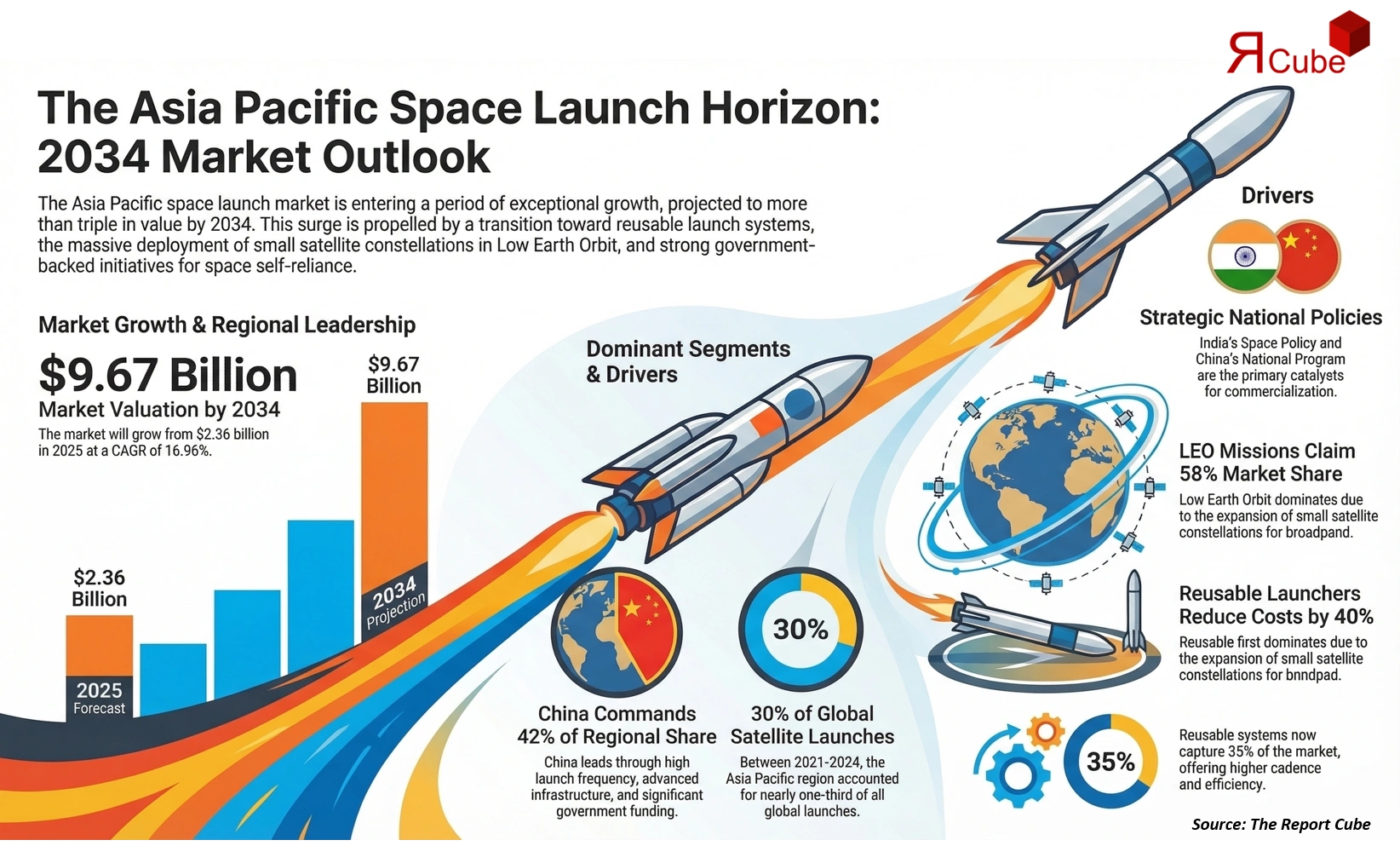
The Asia Pacific Space Launch Services Market is anticipated to register a CAGR of 16.96% during the forecast period. The market size was valued at USD 2.36 billion and is projected to reach USD 9.67 billion by the end of the forecast timeline. This exceptional growth trajectory reflects the region’s rapid expansion in satellite deployment, national space programs, and commercial launch activities across both government and private sectors.
The Asia Pacific region has emerged as one of the most dynamic hubs for space launch services, driven by rising investments in Earth observation, communication satellites, navigation systems, and defense-related space assets. Countries such as China, India, and Japan are scaling their launch capabilities to meet domestic satellite demand while positioning themselves as competitive global launch service providers. At the same time, the growing participation of private launch companies and public-private partnerships is reshaping the competitive landscape, enabling faster launch cycles and cost-efficient missions.
Furthermore, the surge in small satellite constellations, especially for broadband connectivity and climate monitoring, has significantly increased launch frequency requirements. Reusable launch technologies, supportive regulatory frameworks, and increasing commercialization of low Earth orbit missions are collectively strengthening the Asia Pacific Space Launch Services Market. As regional governments prioritize space self-reliance and commercial monetization, the market is expected to witness sustained momentum throughout the forecast period.
Asia Pacific Space Launch Services Market Recent Developments
- 2025: ISRO successfully expanded commercial launch capacity through Antrix to support international small satellite missions.
- 2025: Mitsubishi Heavy Industries advanced reusable launch system testing to improve launch cost efficiency.
Government Initiatives & Policies
- India Space Policy: Promotes private sector participation and commercialization of launch services.
- China National Space Program: Supports satellite deployment and indigenous launch vehicle development.
Asia Pacific Space Launch Services Market Dynamics
Key Driver: Rising Demand for Satellite Deployment Across Commercial and Government Sectors
The primary driver of the Asia Pacific Space Launch Services Market is the sharp increase in satellite deployment for communication, Earth observation, navigation, and defense applications. Governments across the region are expanding satellite constellations to strengthen digital infrastructure, disaster monitoring, and national security capabilities. In parallel, commercial operators are launching high-throughput communication satellites and large low Earth orbit constellations to meet growing broadband and IoT connectivity needs. Between 2021 and 2024, Asia Pacific accounted for over 30% of global satellite launches, highlighting the scale of demand. This surge directly translates into higher launch frequency requirements, creating sustained demand for reliable and cost-effective launch services throughout the forecast period.
Book your FREE 30-minute expert consultation today
Contact UsIndustry Trends: Shift Toward Reusable and Small Launch Vehicle Technologies
A defining trend in the market is the transition toward reusable launch systems and specialized small launch vehicles. Space agencies and private companies are increasingly focusing on reducing launch costs and turnaround times through reusability. This trend aligns with the rapid growth of small satellites, which typically require dedicated or rideshare launch solutions. Reusable launchers are estimated to reduce mission costs by up to 40% over traditional expendable systems, making space access more affordable. Additionally, technological collaboration between government agencies and private players is accelerating innovation in propulsion, materials, and launch automation. These advancements are reshaping the competitive dynamics of the Asia Pacific Space Launch Services Market.
Major Challenge: High Capital Intensity and Technical Complexity
Despite strong growth prospects, the market faces challenges related to high capital requirements and technical complexity. Developing and maintaining launch infrastructure demands substantial investment in launch pads, testing facilities, and safety systems. Launch failures, although infrequent, can result in significant financial losses and reputational risks. Moreover, regulatory compliance, insurance costs, and export control restrictions can delay project timelines. Smaller private companies often face barriers in scaling operations due to limited access to long-term funding. These factors collectively pose constraints on rapid market entry and expansion, particularly for emerging launch service providers.
Opportunity: Commercialization and International Launch Service Contracts
The growing commercialization of space presents a significant opportunity for the Asia Pacific Space Launch Services Market. Regional players are increasingly securing international launch contracts by offering competitive pricing and reliable mission performance. Countries such as India and China are positioning themselves as preferred launch destinations for emerging space nations lacking domestic launch capabilities. Additionally, the rise of space-based data services, including climate analytics and geospatial intelligence, is fueling demand for frequent satellite launches. These trends create long-term revenue opportunities for launch service providers that can deliver flexible, scalable, and cost-efficient solutions.
Asia Pacific Space Launch Services Market Segment-wise Analysis
By Orbit Type:
- Low Earth Orbit
- Medium Earth Orbit
- Geostationary Orbit
- Beyond Earth Orbit
Low Earth Orbit dominates the market, accounting for approximately 58% of total launches. This leadership is driven by the rapid expansion of small satellite constellations for communication and Earth observation. LEO missions offer lower launch costs and reduced latency, making them ideal for commercial applications. Geostationary Orbit follows with nearly 24% market share, supported by demand for broadcasting and weather monitoring satellites. Medium Earth Orbit and Beyond Earth Orbit missions, while smaller in volume, are gaining importance for navigation systems and deep-space exploration programs.
By Launch Vehicle:
- Small Launchers
- Medium Launchers
- Heavy Launchers
- Reusable Launchers
Reusable Launchers represent the leading segment, capturing close to 35% market share due to their cost efficiency and higher launch cadence. Medium and Heavy Launchers continue to play a critical role in deploying large satellites and interplanetary missions. Small Launchers are experiencing rapid growth, driven by dedicated launches for nanosatellites and microsatellites. The balanced demand across vehicle classes highlights the diverse mission requirements shaping the Asia Pacific Space Launch Services Market.
Regional Projection of Asia Pacific Space Launch Services Industry
- China
- India
- Japan
- South Korea
- Australia
- Rest of Asia Pacific
China leads the Asia Pacific Space Launch Services Market, accounting for approximately 42% of regional market share. The country benefits from a high launch frequency, strong government funding, and advanced launch infrastructure. India follows, driven by cost-competitive launch services and rising international demand. Japan maintains a strong position through technological expertise and high-reliability launch systems. Emerging markets such as South Korea and Australia are gradually expanding their launch capabilities, supported by government-backed space initiatives and private sector investments.
Need insights for a specific region within this market?
Request Regional DataWhy Choose This Report?
- Provides a comprehensive overview of the overall market analysis, encompassing key trends, consumer behavior analysis, and risk assessment to support strategic decision-making.
- Provides accurate, up-to-date insights into market size, segmentation, and emerging opportunities, helping to minimize risk & capitalizing on growth.
- Gives deep understanding of target audience preferences, investment habits, and communication channels for enhanced product development & marketing effectiveness.
- Delivers competitive analysis & benchmarking, uncovering the strengths & weaknesses of market competitors to guide strategies.
- Consolidate comprehensive market intelligence, reducing reasoning & streamlining research efforts.
- Facilitates customized market segmentation & risk mitigation strategies, fine-tuned to the business objectives.
- Aids in identifying both market challenges & untapped opportunities within the industry to drive long-term business growth.
- Provides valuable information based on actual customer data & search trends.
Table of Contents
- Introduction
- Objective of the Study
- Product and Category Definition
- Market Segmentation
- Study Variables
- Research Methodology
- Secondary Data Points
- Breakdown of Secondary Sources
- Primary Data Points
- Breakdown of Primary Interviews
- Secondary Data Points
- Executive Summary
- Market Dynamics
- Drivers
- Challenges
- Opportunity Assessment
- Recent Trends and Developments
- Regulatory and Policy Landscape
- Asia Pacific Space Launch Services Market Overview (2020-2034)
- Market Size, By Value (USD Billion)
- Market Share, By Orbit Type
- Low Earth Orbit
- Medium Earth Orbit
- Geostationary Orbit
- Beyond Earth Orbit
- Market Share, By Launch Vehicle
- Small Launchers
- Medium Launchers
- Heavy Launchers
- Reusable Launchers
- Market Share, By Payload Type
- Communication Satellites
- Earth Observation
- Navigation Satellites
- Scientific Missions
- Crewed Missions
- Market Share, By Service Type
- Pre‑Launch Services
- Post‑Launch Services
- Market Share, By End User
- Government Defense
- Civil Government
- Commercial Operators
- Research Institutions
- Market Share, By Country
- China
- India
- Japan
- South Korea
- Australia
- Rest of Asia Pacific
- Market Share, By Company
- Competition Characteristics
- Revenue Shares & Analysis
- China Space Launch Services Market
- Market Size, By Value (USD Billion)
- Market Share, By Orbit Type
- Market Share, By Launch Vehicle
- Market Share, By Payload Type
- Market Share, By Service Type
- Market Share, By End User
- India Space Launch Services Market
- Market Size, By Value (USD Billion)
- Market Share, By Orbit Type
- Market Share, By Launch Vehicle
- Market Share, By Payload Type
- Market Share, By Service Type
- Market Share, By End User
- Japan Space Launch Services Market
- Market Size, By Value (USD Billion)
- Market Share, By Orbit Type
- Market Share, By Launch Vehicle
- Market Share, By Payload Type
- Market Share, By Service Type
- Market Share, By End User
- South Korea Space Launch Services Market
- Market Size, By Value (USD Billion)
- Market Share, By Orbit Type
- Market Share, By Launch Vehicle
- Market Share, By Payload Type
- Market Share, By Service Type
- Market Share, By End User
- Australia Space Launch Services Market
- Market Size, By Value (USD Billion)
- Market Share, By Orbit Type
- Market Share, By Launch Vehicle
- Market Share, By Payload Type
- Market Share, By Service Type
- Market Share, By End User
- Competitive Outlook and Company Profiles
- China Great Wall Industry Corporation
- Company Overview
- Launch Services Portfolio
- Strategic Alliances/Partnerships
- Recent Developments
- Indian Space Research Organisation (ISRO / Antrix)
- Company Overview
- Launch Services Portfolio
- Strategic Alliances/Partnerships
- Recent Developments
- Japan Aerospace Exploration Agency (JAXA)
- Company Overview
- Launch Services Portfolio
- Strategic Alliances/Partnerships
- Recent Developments
- Mitsubishi Heavy Industries
- Company Overview
- Launch Services Portfolio
- Strategic Alliances/Partnerships
- Recent Developments
- SpaceX
- Company Overview
- Launch Services Portfolio
- Strategic Alliances/Partnerships
- Recent Developments
- Rocket Lab
- Company Overview
- Launch Services Portfolio
- Strategic Alliances/Partnerships
- Recent Developments
- Blue Origin
- Company Overview
- Launch Services Portfolio
- Strategic Alliances/Partnerships
- Recent Developments
- United Launch Alliance
- Company Overview
- Launch Services Portfolio
- Strategic Alliances/Partnerships
- Recent Developments
- Arianespace
- Company Overview
- Launch Services Portfolio
- Strategic Alliances/Partnerships
- Recent Developments
- Northrop Grumman
- Company Overview
- Launch Services Portfolio
- Strategic Alliances/Partnerships
- Recent Developments
- Others
- China Great Wall Industry Corporation
- Contact Us and Disclaimer
Top Key Players & Market Share Outlook
- China Great Wall Industry Corporation
- Indian Space Research Organisation (ISRO / Antrix)
- Japan Aerospace Exploration Agency (JAXA)
- Mitsubishi Heavy Industries
- SpaceX
- Rocket Lab
- Blue Origin
- United Launch Alliance
- Arianespace
- Northrop Grumman
- Others
Frequently Asked Questions






