




Build Your Custom Market Intelligence Report
Customize Your ReportJapan Aircraft MRO Market Insights & Analysis
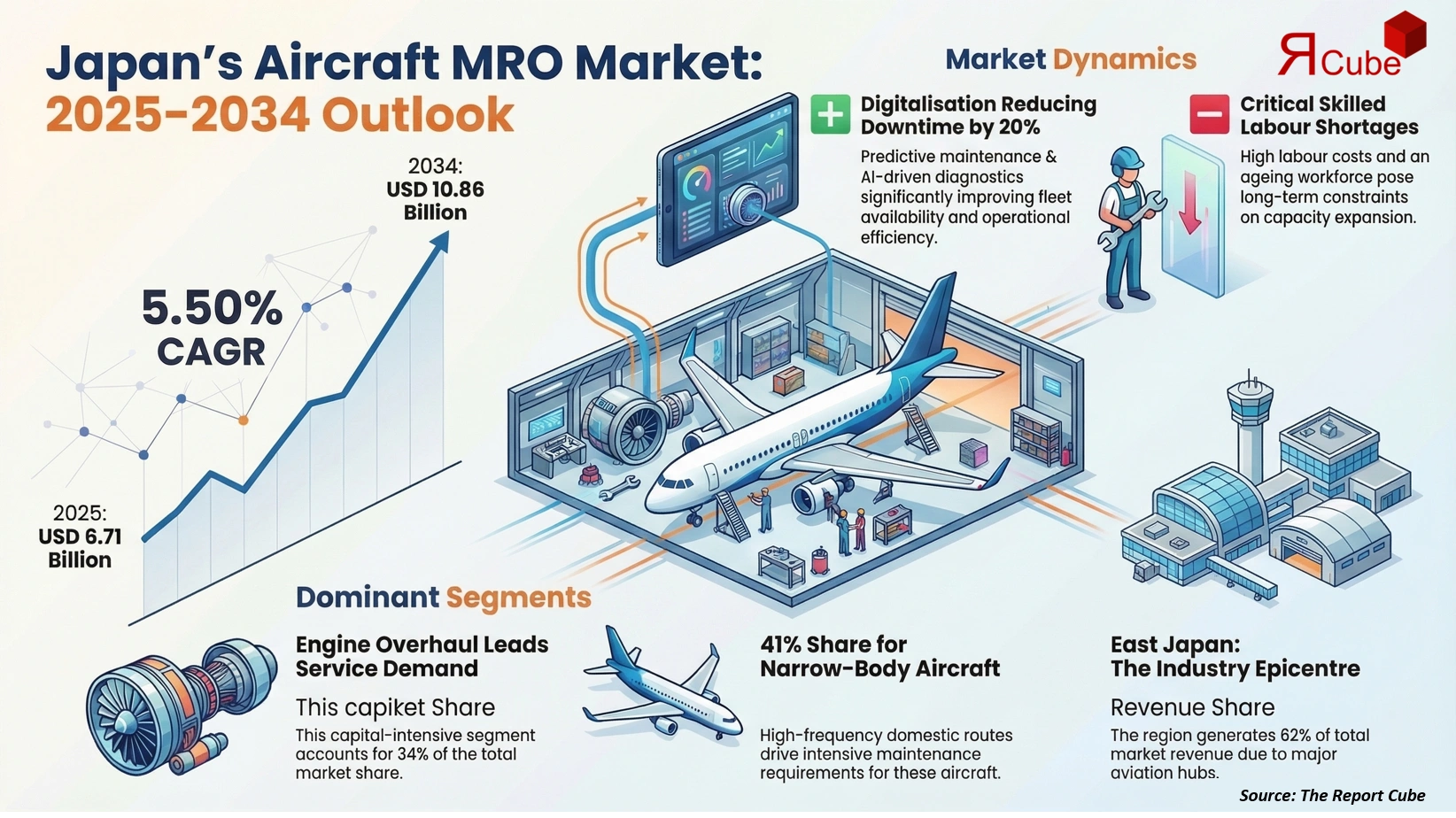
The Japan Aircraft MRO Market is anticipated to register a CAGR of 5.50% during the forecast period 2026-2034. The market size was valued at USD 6.71 billion in 2025 and is projected to reach USD 10.86 billion by 2034. This growth is underpinned by Japan’s expanding commercial aviation fleet, rising aircraft utilization rates, and the increasing average age of in-service aircraft across both commercial and military segments.
Japan’s aviation ecosystem is characterized by high operational standards, stringent safety regulations, and a strong domestic manufacturing base. These factors collectively drive consistent demand for high-quality maintenance, repair, and overhaul services. Airlines are focusing on extending aircraft service life through scheduled heavy maintenance and engine overhauls, while also investing in advanced component MRO to reduce unscheduled downtime. The steady recovery of international passenger traffic and cargo operations has further accelerated maintenance cycles, particularly for narrow-body and wide-body aircraft operating high-frequency routes.
In parallel, Japan’s defense modernization initiatives and growing business aviation activity are creating additional MRO demand. Technological integration, including predictive maintenance and digital inspection tools, is reshaping service delivery models. As a result, the Japan Aircraft MRO Market continues to evolve as a strategically important segment, supported by strong domestic players and increasing collaboration with global MRO providers.
Japan Aircraft MRO Market Recent Developments
- 2025: Mitsubishi Heavy Industries expanded engine overhaul capacity to support next-generation commercial aircraft platforms.
- 2025: ANA Holdings enhanced digital MRO systems to improve predictive maintenance and fleet availability.
Government Initiatives & Policies
- Japan Aerospace Industry Vision: Supports advanced aerospace maintenance capabilities and global MRO competitiveness.
- Civil Aviation Safety Program: Strengthens regulatory frameworks and MRO quality standards.
Japan Aircraft MRO Market Dynamics
Key Driver: Expanding Commercial Aircraft Fleet and Utilization
The primary driver of the Japan Aircraft MRO Market is the expanding commercial aircraft fleet combined with rising utilization rates. Japanese airlines are operating higher flight frequencies to meet recovering passenger demand and stable cargo volumes. Increased aircraft utilization directly translates into shorter maintenance intervals, driving demand for line maintenance, component MRO, and periodic heavy checks. Narrow-body aircraft, which account for a significant portion of domestic and regional operations, require frequent inspections and component replacements due to intensive usage. Additionally, the gradual aging of Japan’s fleet increases the need for engine overhauls and structural airframe maintenance. These factors collectively ensure a steady and recurring demand for MRO services, making fleet growth and utilization a fundamental growth catalyst.
Book your FREE 30-minute expert consultation today
Contact UsIndustry Trends: Digitalization and Predictive Maintenance Adoption
A key trend shaping the market is the rapid adoption of digital tools and predictive maintenance technologies. Japanese MRO providers are integrating data analytics, sensors, and AI-driven diagnostics to anticipate component failures and optimize maintenance schedules. Predictive maintenance can reduce unscheduled aircraft groundings by over 20%, improving fleet availability and lowering operational costs for airlines. Digital twins and automated inspection systems are also gaining traction, particularly in engine and airframe maintenance. This trend aligns with Japan’s broader focus on precision engineering and operational efficiency, enabling MRO providers to deliver faster turnaround times while maintaining stringent safety standards.
Major Challenge: High Labor Costs and Skilled Workforce Constraints
Despite strong demand, the Japan Aircraft MRO Market faces challenges related to high labor costs and a constrained skilled workforce. Aircraft maintenance requires highly trained engineers and technicians, and Japan’s aging workforce poses long-term talent availability concerns. Recruiting and retaining certified personnel increases operating expenses for MRO providers, which can impact pricing competitiveness. Additionally, training new technicians involves long certification cycles, limiting short-term capacity expansion. These workforce-related constraints may restrict rapid scaling, particularly during peak maintenance periods, posing a structural challenge for the market.
Opportunity: Growing Military and Business Aviation Maintenance Demand
Rising defense spending and expanding business aviation activity present a significant opportunity for the Japan Aircraft MRO Market. Japan’s military fleet modernization programs require specialized maintenance, upgrades, and component support, creating stable long-term contracts for domestic MRO providers. Simultaneously, business jet operations are increasing, driven by corporate travel and private aviation demand. Business jets require high-frequency, specialized maintenance services, offering higher margins compared to commercial aircraft. By expanding capabilities in military and business aviation MRO, service providers can diversify revenue streams and reduce dependence on commercial airline cycles.
Japan Aircraft MRO Market Segment-wise Analysis
By Service Type:
- Engine Overhaul
- Airframe Heavy
- Line Maintenance
- Component MRO
- Modification/Upgrade
Engine Overhaul represents the leading service segment, accounting for approximately 34% of the market share in 2025. Engines are the most capital-intensive aircraft components and require regular overhauls to maintain fuel efficiency and reliability. Airframe heavy maintenance follows, driven by scheduled checks for aging aircraft. Line maintenance remains essential for daily operational readiness, while component MRO is expanding rapidly due to the increasing use of advanced avionics and composite materials. Modification and upgrade services are also gaining importance as airlines retrofit cabins and avionics to improve passenger experience and regulatory compliance.
By Aircraft Type:
- Narrow-Body
- Wide-Body
- Regional Jets
- Business Jets
- Military Fleet
Narrow-body aircraft dominate this segment, holding nearly 41% market share, reflecting their extensive use in domestic and regional routes. High flight cycles result in frequent maintenance requirements, particularly for engines and landing gear. Wide-body aircraft follow, supported by international operations and long-haul routes. The military fleet segment contributes a stable share due to long-term maintenance contracts, while business jets, though smaller in volume, offer higher per-aircraft MRO spending. Regional jets maintain consistent demand, particularly for regional connectivity within Japan.
Regional Projection of Japan Aircraft MRO Industry
- East Japan
- West Japan
East Japan leads the Japan Aircraft MRO Market, accounting for approximately 62% of total market revenue. The region hosts major aviation hubs, airline headquarters, and large MRO facilities, enabling higher service volumes and faster turnaround times. Proximity to major airports and manufacturing clusters further strengthens East Japan’s dominance. West Japan follows with a growing share, supported by regional airport development and increasing maintenance outsourcing. While East Japan is expected to maintain leadership through 2034, West Japan is projected to grow steadily as airlines diversify maintenance locations and expand regional operations.
Need insights for a specific region within this market?
Request Regional DataWhy Choose This Report?
- Provides a comprehensive overview of the overall market analysis, encompassing key trends, consumer behavior analysis, and risk assessment to support strategic decision-making.
- Provides accurate, up-to-date insights into market size, segmentation, and emerging opportunities, helping to minimize risk & capitalizing on growth.
- Gives deep understanding of target audience preferences, investment habits, and communication channels for enhanced product development & marketing effectiveness.
- Delivers competitive analysis & benchmarking, uncovering the strengths & weaknesses of market competitors to guide strategies.
- Consolidate comprehensive market intelligence, reducing reasoning & streamlining research efforts.
- Facilitates customized market segmentation & risk mitigation strategies, fine-tuned to the business objectives.
- Aids in identifying both market challenges & untapped opportunities within the industry to drive long-term business growth.
- Provides valuable information based on actual customer data & search trends.
Table of Contents
- Introduction
- Objective of the Study
- Product and Category Definition
- Market Segmentation
- Study Variables
- Research Methodology
- Secondary Data Points
- Breakdown of Secondary Sources
- Primary Data Points
- Breakdown of Primary Interviews
- Secondary Data Points
- Executive Summary
- Market Dynamics
- Drivers
- Challenges
- Opportunity Assessment
- Recent Trends and Developments
- Regulatory and Policy Landscape
- Japan Aircraft MRO Market Overview (2020-2034)
- Market Size, By Value (USD Billion)
- Market Share, By Service Type
- Engine Overhaul
- Airframe Heavy
- Line Maintenance
- Component MRO
- Modification/Upgrade
- Market Share, By Aircraft Type
- Narrow-Body
- Wide-Body
- Regional Jets
- Business Jets
- Military Fleet
- Market Share, By Operator
- Airline-Owned
- Independent MRO
- OEM-Affiliated
- Market Share, By Customer
- Commercial Air
- Cargo Operators
- Defense Forces
- General Aviation
- Market Share, By Region
- East Japan
- West Japan
- Market Share, By Company
- Revenue Shares
- Competitive Landscape
- East Japan Aircraft MRO Market
- Market Size, By Value (USD Billion)
- Market Share, By Service Type
- Market Share, By Aircraft Type
- Market Share, By Operator
- Market Share, By Customer
- West Japan Aircraft MRO Market
- Market Size, By Value (USD Billion)
- Market Share, By Service Type
- Market Share, By Aircraft Type
- Market Share, By Operator
- Market Share, By Customer
- Competitive Outlook and Company Profiles
- Mitsubishi Heavy Industries
- Company Overview
- Service Portfolio
- Strategic Alliances/Partnerships
- Recent Developments
- IHI Corporation
- Company Overview
- Service Portfolio
- Strategic Alliances/Partnerships
- Recent Developments
- Kawasaki Heavy Industries
- Company Overview
- Service Portfolio
- Strategic Alliances/Partnerships
- Recent Developments
- ANA Holdings (ANA)
- Company Overview
- Service Portfolio
- Strategic Alliances/Partnerships
- Recent Developments
- JAL Engineering (JAL)
- Company Overview
- Service Portfolio
- Strategic Alliances/Partnerships
- Recent Developments
- MRO Japan Corporation
- Company Overview
- Service Portfolio
- Strategic Alliances/Partnerships
- Recent Developments
- ST Engineering
- Company Overview
- Service Portfolio
- Strategic Alliances/Partnerships
- Recent Developments
- Lufthansa Technik
- Company Overview
- Service Portfolio
- Strategic Alliances/Partnerships
- Recent Developments
- AAR Corp
- Company Overview
- Service Portfolio
- Strategic Alliances/Partnerships
- Recent Developments
- MTU Aero Engines
- Company Overview
- Service Portfolio
- Strategic Alliances/Partnerships
- Recent Developments
- Others
- Mitsubishi Heavy Industries
- Contact Us and Disclaimer
Top Key Players & Market Share Outlook
- Mitsubishi Heavy Industries
- IHI Corporation
- Kawasaki Heavy Industries
- ANA Holdings (ANA)
- JAL Engineering (JAL)
- MRO Japan Corporation
- ST Engineering
- Lufthansa Technik
- AAR Corp
- MTU Aero Engines
- Others
Frequently Asked Questions






