




Build Your Custom Market Intelligence Report
Customize Your ReportJapan Aviation Market Insights & Analysis
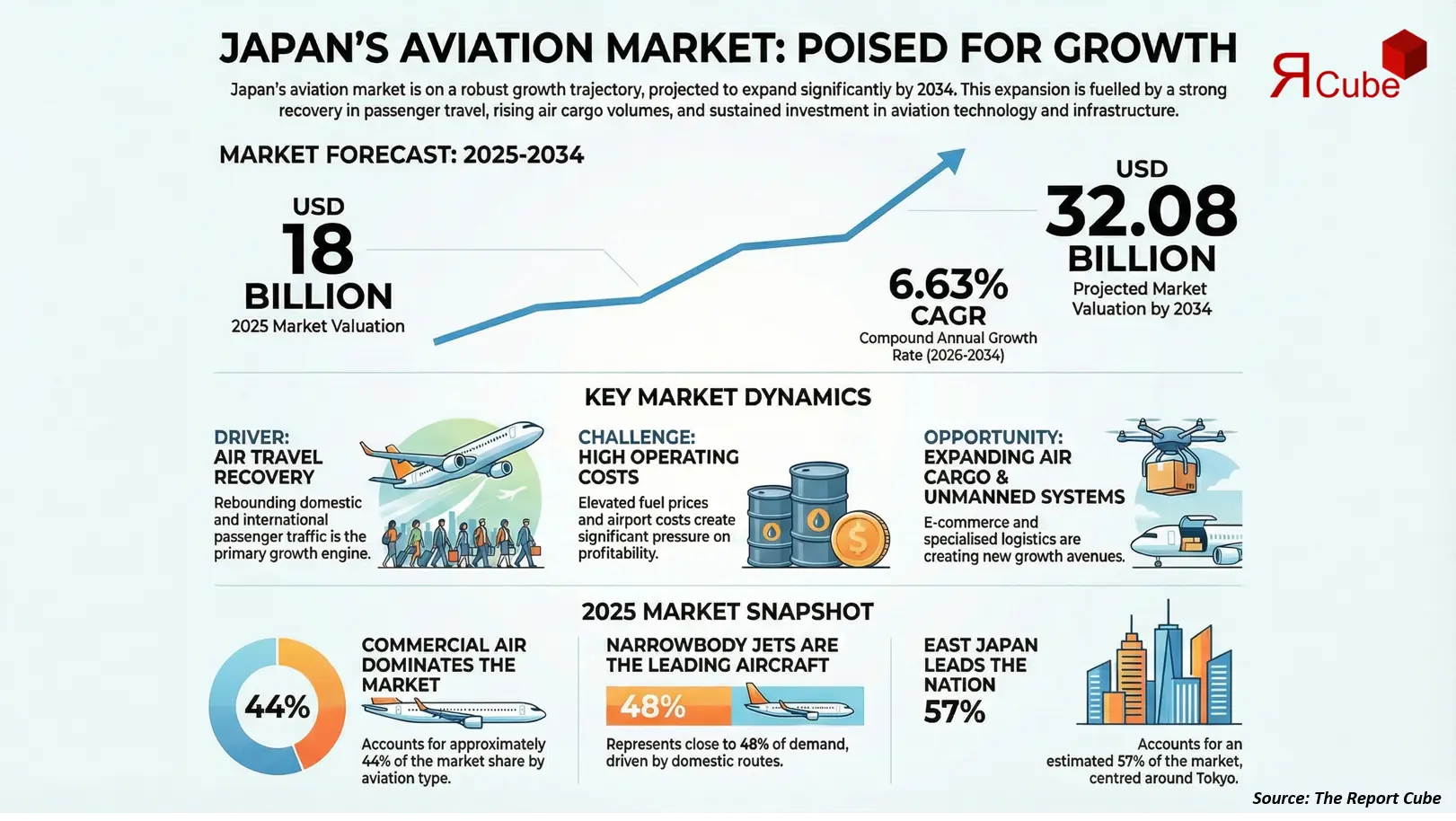
The Japan Aviation Market is anticipated to register a CAGR of 6.63% during the forecast period 2026-2034. The market size was valued at USD 18 billion in 2025 and is projected to reach USD 32.08 billion by 2034. This robust growth trajectory reflects Japan’s gradual rebound in passenger air travel, consistent growth in air cargo volumes, and sustained investments in aviation infrastructure modernization.
Japan’s aviation ecosystem is supported by a strong domestic travel base, high operational efficiency standards, and continuous technological upgrades across airlines and airports. The reopening of international routes, combined with rising inbound tourism and business travel, has strengthened demand for both narrowbody and widebody aircraft. At the same time, Japan’s role as a global manufacturing and logistics hub has amplified the importance of air cargo services, especially for high-value electronics, automotive components, and pharmaceuticals.
Furthermore, the market is benefiting from advancements in aviation MRO services, increasing adoption of digital maintenance systems, and government-backed initiatives aimed at improving airport capacity and regional air connectivity. Together, these factors position the Japan Aviation Market as a mature yet steadily expanding industry, offering long-term growth opportunities across commercial, cargo, and defense-related aviation segments.
Japan Aviation Market Recent Developments
- 2025: ANA Holdings expanded international route capacity using fuel-efficient aircraft to meet rising outbound travel demand.
- 2025: Mitsubishi Heavy advanced aircraft systems and MRO capabilities to support next-generation aviation programs.
Government Initiatives & Policies
- Tourism Nation Promotion Program: Strengthens air connectivity and airport upgrades to support inbound tourism growth.
- Aviation Industry Growth Strategy: Focuses on sustainable aviation, regional connectivity, and aerospace innovation.
Japan Aviation Market Dynamics
Key Driver: Recovery of Domestic and International Air Travel
The primary driver of the Japan Aviation Market is the steady recovery of both domestic and international air travel. Japan’s extensive domestic flight network supports business and leisure travel between major metropolitan areas and regional cities, ensuring stable baseline demand. Internationally, relaxed travel restrictions and rising tourism have accelerated passenger traffic recovery, with international seat capacity surpassing 80% of pre-pandemic levels by late 2024. Full-service carriers and low-cost airlines alike are expanding routes to Asia-Pacific and North America, driving aircraft utilization rates higher. This rebound directly supports fleet expansion, MRO demand, and airport service revenues, making passenger recovery a central force behind market growth.
Book your FREE 30-minute expert consultation today
Contact UsIndustry Trends: Growth in Aviation MRO and Digitalization
A key trend reshaping the Japan Aviation Market is the growing emphasis on aviation MRO services and digital transformation. Airlines are increasingly investing in predictive maintenance, real-time aircraft health monitoring, and advanced analytics to reduce downtime and operating costs. Japan’s strong engineering base and safety culture support the expansion of high-value MRO services, both for domestic fleets and international customers. Additionally, digital solutions such as electronic flight bags, AI-enabled scheduling, and automated ground handling are improving operational efficiency. These trends are closely linked with fleet modernization efforts, ensuring that technology adoption and maintenance excellence remain integral to the industry’s evolution.
Major Challenge: High Operating and Fuel Costs
High operating costs present a notable challenge for the Japan Aviation Market. Elevated fuel prices, currency fluctuations, and stringent safety and regulatory requirements increase cost pressures for airlines and service providers. Japan’s geographically constrained airports also face capacity limitations, leading to higher slot costs and operational complexity. Smaller regional airlines and business aviation operators are particularly sensitive to these cost dynamics, which can limit profitability and fleet expansion plans. While efficiency improvements help mitigate some pressures, sustained cost management remains a critical challenge affecting market participants.
Opportunity: Expansion of Air Cargo and Unmanned Systems
The expanding air cargo segment represents a significant opportunity within the Japan Aviation Market. Growth in e-commerce, time-sensitive manufacturing supply chains, and pharmaceutical logistics has driven consistent demand for dedicated cargo aircraft and specialized services. Nippon Cargo and other operators are increasing freighter utilization to meet this demand. Additionally, unmanned systems are gaining attention for surveillance, disaster response, and logistics support, supported by Japan’s advanced aerospace research capabilities. These emerging applications diversify revenue streams and create new growth avenues beyond traditional passenger aviation.
Japan Aviation Market Segment-wise Analysis
By Aviation Type:
- Commercial Air
- Air Cargo
- Business Aviation
- Military Aviation
- Aviation MRO
Commercial Air dominates the segment, accounting for approximately 44% of the Japan Aviation Market share in 2025. This leadership is driven by strong domestic connectivity and recovering international routes operated by major carriers. Air Cargo follows with nearly 21% share, supported by export-oriented industries and express logistics growth. Aviation MRO is an increasingly important contributor, benefiting from fleet modernization and longer aircraft service lives. Business and Military Aviation maintain stable demand, supported by corporate travel needs and defense modernization programs, respectively.
By Type:
- Narrowbody Jets
- Widebody Jets
- Regional Aircraft
- Helicopters
- Unmanned Systems
Narrowbody Jets lead this segment, representing close to 48% of market demand, due to their extensive use on domestic and short-haul regional routes. Widebody Jets account for approximately 26%, driven by international long-haul operations. Regional Aircraft play a crucial role in connecting smaller cities, while Helicopters support emergency services and offshore operations. Unmanned Systems, though currently smaller in share, are growing steadily as regulatory frameworks evolve and commercial applications expand.
Regional Projection of Japan Aviation Industry
- East Japan
- West Japan
East Japan leads the Japan Aviation Market with an estimated 57% market share, driven by major hubs such as Tokyo and Narita. The region benefits from higher passenger volumes, dense business travel demand, and significant international connectivity. West Japan follows, supported by Osaka and surrounding regions, which contribute strong domestic travel and cargo activity. While East Japan is expected to retain leadership through 2034, West Japan is projected to grow steadily due to regional airport upgrades and tourism promotion initiatives.
Need insights for a specific region within this market?
Request Regional DataWhy Choose This Report?
- Provides a comprehensive overview of the overall market analysis, encompassing key trends, consumer behavior analysis, and risk assessment to support strategic decision-making.
- Provides accurate, up-to-date insights into market size, segmentation, and emerging opportunities, helping to minimize risk & capitalizing on growth.
- Gives deep understanding of target audience preferences, investment habits, and communication channels for enhanced product development & marketing effectiveness.
- Delivers competitive analysis & benchmarking, uncovering the strengths & weaknesses of market competitors to guide strategies.
- Consolidate comprehensive market intelligence, reducing reasoning & streamlining research efforts.
- Facilitates customized market segmentation & risk mitigation strategies, fine-tuned to the business objectives.
- Aids in identifying both market challenges & untapped opportunities within the industry to drive long-term business growth.
- Provides valuable information based on actual customer data & search trends.
Table of Contents
- Introduction
- Objective of the Study
- Product and Category Definition
- Market Segmentation
- Study Variables
- Research Methodology
- Secondary Data Points
- Breakdown of Secondary Sources
- Primary Data Points
- Breakdown of Primary Interviews
- Secondary Data Points
- Executive Summary
- Market Dynamics
- Drivers
- Challenges
- Opportunity Assessment
- Recent Trends and Developments
- Regulatory and Policy Landscape
- Japan Aviation Market Overview (2020-2034)
- Market Size, By Value (USD Billion)
- Market Share, By Aviation Type
- Commercial Air
- Air Cargo
- Business Aviation
- Military Aviation
- Aviation MRO
- Market Share, By Type
- Narrowbody Jets
- Widebody Jets
- Regional Aircraft
- Helicopters
- Unmanned Systems
- Market Share, By Customer
- Business Travel
- Leisure Travel
- Government Defense
- Cargo Operators
- Market Share, By Region
- East Japan
- West Japan
- Market Share, By Company
- Competition Characteristics
- Revenue Shares & Analysis
- East Japan Aviation Market
- Market Size, By Value (USD Billion)
- Market Share, By Segment
- Market Share, By Type
- Market Share, By Customer
- Market Share, By Key Airport Group
- West Japan Aviation Market
- Market Size, By Value (USD Billion)
- Market Share, By Segment
- Market Share, By Type
- Market Share, By Customer
- Market Share, By Key Airport Group
- Competitive Outlook and Company Profiles
- ANA Holdings
- Company Overview
- Fleet and Network
- Strategic Alliances/Partnerships
- Recent Developments
- Japan Airlines
- Company Overview
- Fleet and Network
- Strategic Alliances/Partnerships
- Recent Developments
- Peach Aviation
- Company Overview
- Fleet and Network
- Strategic Alliances/Partnerships
- Recent Developments
- Skymark Airlines
- Company Overview
- Fleet and Network
- Strategic Alliances/Partnerships
- Recent Developments
- StarFlyer
- Company Overview
- Fleet and Network
- Strategic Alliances/Partnerships
- Recent Developments
- Solaseed Air
- Company Overview
- Fleet and Network
- Strategic Alliances/Partnerships
- Recent Developments
- Air Do
- Company Overview
- Fleet and Network
- Strategic Alliances/Partnerships
- Recent Developments
- Fuji Dream
- Company Overview
- Fleet and Network
- Strategic Alliances/Partnerships
- Recent Developments
- Nippon Cargo
- Company Overview
- Fleet and Network
- Strategic Alliances/Partnerships
- Recent Developments
- Mitsubishi Heavy
- Company Overview
- Aerospace Portfolio
- Strategic Alliances/Partnerships
- Recent Developments
- Others
- ANA Holdings
- Contact Us and Disclaimer
Top Key Players & Market Share Outlook
- ANA Holdings
- Japan Airlines
- Peach Aviation
- Skymark Airlines
- StarFlyer
- Solaseed Air
- Air Do
- Fuji Dream
- Nippon Cargo
- Others
Frequently Asked Questions