



Build Your Custom Market Intelligence Report
Customize Your ReportJapan Aircraft Parts Market Insights & Analysis
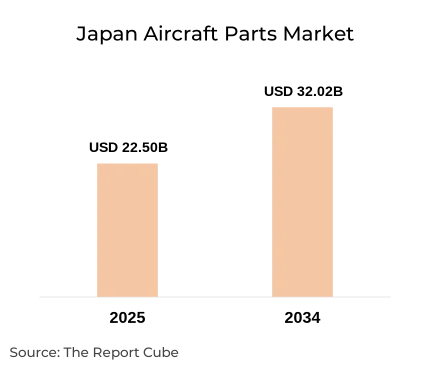
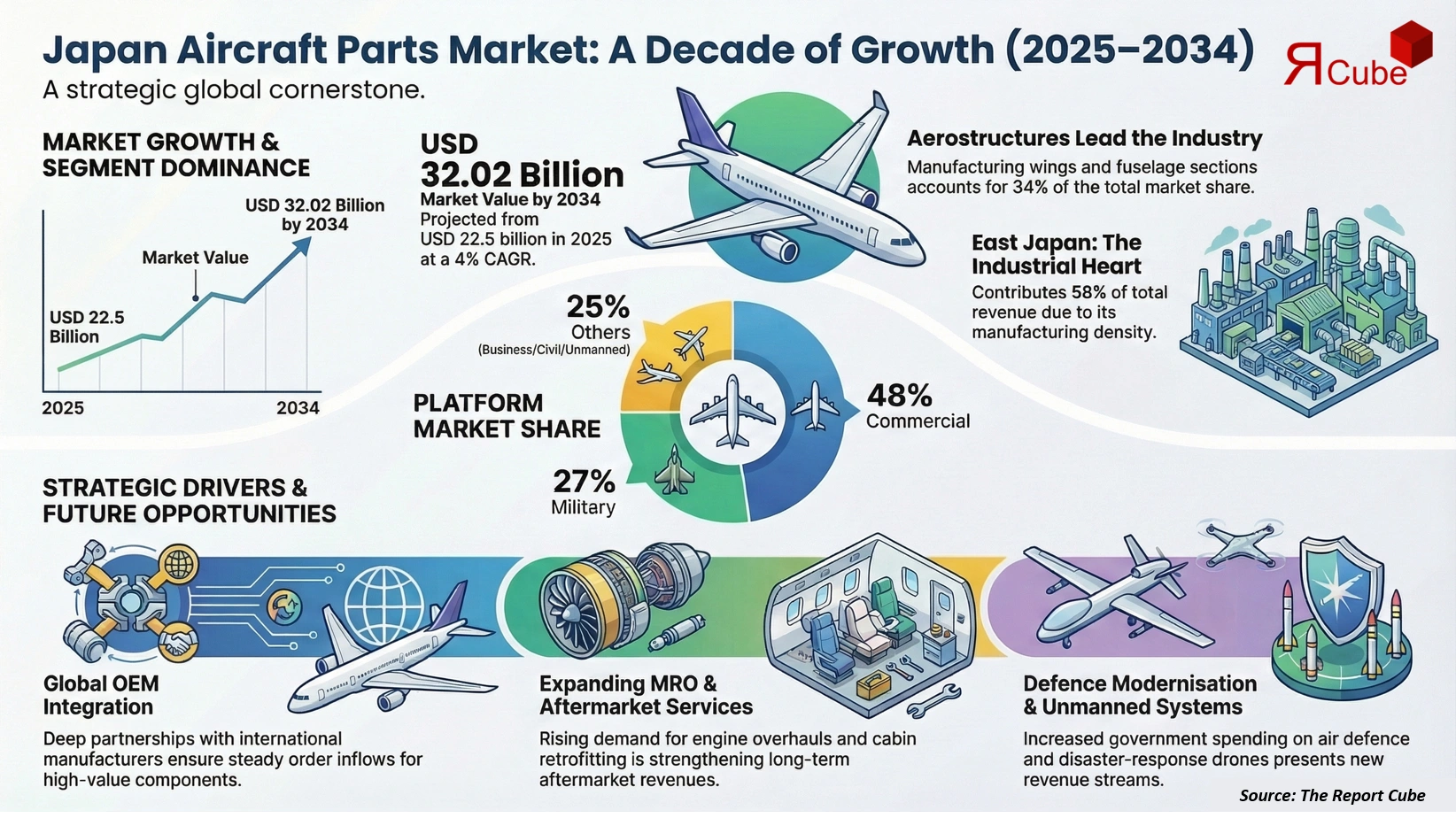
The Japan Aircraft Parts Market is anticipated to register a CAGR of 4% during the forecast period 2026-2034. The market size was valued at USD 22.5 billion in 2025 and is projected to reach USD 32.02 billion by 2034. The market growth is underpinned by Japan’s strong aerospace manufacturing base, long-standing partnerships with global aircraft OEMs, and increasing demand for high-precision components used in commercial and defense aviation.
Japan plays a strategic role in the global aircraft supply chain, particularly in aerostructures, engines, and advanced materials. Leading domestic manufacturers contribute significantly to widebody and narrowbody aircraft programs, supplying critical components such as fuselage sections, wings, engine parts, and cabin systems. As global aircraft production rates gradually increase to meet rising passenger traffic, Japanese suppliers are witnessing higher order volumes from international OEMs.
Furthermore, the expansion of maintenance, repair, and overhaul (MRO) activities within Japan is strengthening aftermarket revenues. Airlines are focusing on extending aircraft life cycles and ensuring operational reliability, which directly boosts demand for replacement parts and specialized services. Coupled with rising defense modernization spending and growing interest in unmanned systems, these interconnected factors collectively support steady long-term growth of the Japan Aircraft Parts Market.
Japan Aircraft Parts Market Recent Developments
- 2025: Mitsubishi Heavy Industries expanded production capacity for composite aerostructures supporting next-generation commercial aircraft.
- 2025: IHI Corporation enhanced aircraft engine component manufacturing to meet rising global OEM demand.
Government Initiatives & Policies
- Aviation Industry Growth Strategy: Supports aerospace R&D, advanced manufacturing, and global competitiveness.
- Defense Equipment and Technology Policy: Promotes domestic aircraft parts production for defense and dual-use platforms.
Japan Aircraft Parts Market Dynamics
Key Driver: Strong Integration into Global Aircraft Manufacturing Programs
The primary driver of the Japan Aircraft Parts Market is its deep integration into global aircraft manufacturing programs. Japanese companies are trusted suppliers of high-value components for leading commercial and military aircraft platforms. Their expertise in precision engineering, advanced composites, and quality assurance enables consistent participation in long-term OEM contracts. As global air travel demand rebounds and aircraft production rates rise, OEMs increasingly rely on established Japanese suppliers to ensure supply chain stability. In 2024, export-oriented aerospace components accounted for a significant share of Japan’s total aerospace output, highlighting the country’s strategic importance. This close alignment with global production cycles ensures steady order inflows, making international OEM collaboration a critical growth catalyst.
Book your FREE 30-minute expert consultation today
Contact UsIndustry Trends: Expansion of MRO and Aftermarket Services
An important trend shaping the market is the expansion of MRO and aftermarket services across Japan. Airlines are prioritizing cost-efficient maintenance strategies to maximize aircraft utilization while minimizing downtime. This has increased demand for engine overhauls, component repairs, and cabin retrofitting services. Japan’s advanced technical workforce and regulatory compliance standards make it an attractive hub for high-quality MRO operations. Additionally, digital maintenance tools and predictive diagnostics are being adopted to improve turnaround times and reduce unscheduled maintenance events. As the global fleet ages, particularly widebody and business aircraft operating in Asia-Pacific, the role of Japanese MRO providers is expected to expand steadily.
Major Challenge: High Dependence on Global OEM Production Cycles
A major challenge for the Japan Aircraft Parts Market is its dependence on global OEM production schedules. Any slowdown in aircraft deliveries due to supply chain disruptions, certification delays, or geopolitical uncertainties directly impacts component order volumes. This reliance exposes suppliers to cyclical demand fluctuations, particularly in the commercial aviation segment. Additionally, high capital investment requirements for advanced manufacturing equipment can strain margins during periods of reduced output. Smaller suppliers are especially vulnerable to such volatility, as they have limited flexibility to diversify revenue streams quickly. Managing production planning and maintaining cost efficiency remain ongoing challenges for market participants.
Opportunity: Rising Defense Spending and Unmanned Systems Development
Growing defense spending and increasing focus on unmanned systems present a significant opportunity for the Japan Aircraft Parts Market. The Japanese government is investing in modernizing air defense capabilities, including fighter aircraft upgrades, transport platforms, and surveillance systems. This drives demand for specialized components such as avionics, propulsion systems, and lightweight structures. Simultaneously, unmanned aerial systems are gaining importance for defense, disaster response, and maritime surveillance applications. Japanese manufacturers, known for precision electronics and systems integration, are well-positioned to capture this emerging demand. These developments diversify revenue sources and reduce overreliance on commercial aviation cycles.
Japan Aircraft Parts Market Segment-wise Analysis
By Type:
- Engines
- Aerostructures
- Avionics
- Cabin Interiors
- MRO Services
Aerostructures represent the leading sub-segment, accounting for approximately 34% of the market share in 2025. Japan’s strength in manufacturing wings, fuselage sections, and composite structures underpins this dominance. Engine components follow closely, driven by long-term partnerships with global engine manufacturers. MRO services are witnessing steady growth as airlines focus on lifecycle cost optimization. Avionics and cabin interiors contribute smaller but stable shares, supported by incremental upgrades and retrofitting activities across commercial and defense fleets.
By Platform:
- Commercial
- Military
- Business Jets
- Civil Helicopters
- Unmanned Systems
The Commercial platform dominates the market, holding nearly 48% share, supported by high export volumes of aircraft components. The Military segment accounts for around 27%, driven by defense modernization programs and indigenous production initiatives. Business jets and civil helicopters together represent a moderate share, supported by regional connectivity and emergency services demand. Unmanned systems, while currently smaller, are emerging rapidly and are expected to gain increased attention due to technological advancements and expanding application areas.
Regional Projection of Japan Aircraft Parts Industry
- East Japan
- West Japan
East Japan leads the Japan Aircraft Parts Market, contributing approximately 58% of total revenue. The region hosts a high concentration of aerospace manufacturing facilities, research centers, and skilled labor, making it the core of Japan’s aircraft parts production. Strong logistics infrastructure and proximity to major ports further enhance export efficiency. West Japan follows with a significant share, supported by growing MRO activities and specialized component manufacturing. East Japan is expected to maintain its leadership through 2034, driven by continuous investments in advanced aerospace technologies.
Need insights for a specific region within this market?
Request Regional DataWhy Choose This Report?
- Provides a comprehensive overview of the overall market analysis, encompassing key trends, consumer behavior analysis, and risk assessment to support strategic decision-making.
- Provides accurate, up-to-date insights into market size, segmentation, and emerging opportunities, helping to minimize risk & capitalizing on growth.
- Gives deep understanding of target audience preferences, investment habits, and communication channels for enhanced product development & marketing effectiveness.
- Delivers competitive analysis & benchmarking, uncovering the strengths & weaknesses of market competitors to guide strategies.
- Consolidate comprehensive market intelligence, reducing reasoning & streamlining research efforts.
- Facilitates customized market segmentation & risk mitigation strategies, fine-tuned to the business objectives.
- Aids in identifying both market challenges & untapped opportunities within the industry to drive long-term business growth.
- Provides valuable information based on actual customer data & search trends.
Table of Contents
- Introduction
- Objective of the Study
- Product and Category Definition
- Market Segmentation
- Study Variables
- Research Methodology
- Secondary Data Points
- Breakdown of Secondary Sources
- Primary Data Points
- Breakdown of Primary Interviews
- Secondary Data Points
- Executive Summary
- Market Dynamics
- Drivers
- Challenges
- Opportunity Assessment
- Recent Trends and Developments
- Regulatory and Policy Landscape
- Japan Aircraft Parts Market Overview (2020-2034)
- Market Size, By Value (USD Billion)
- Market Share, By Type
- Engines
- Aerostructures
- Avionics
- Cabin Interiors
- MRO Services
- Market Share, By Platform
- Commercial
- Military
- Business Jets
- Civil Helicopters
- Unmanned Systems
- Market Share, By End User
- OEMs
- Airlines
- Defense Forces
- MRO Providers
- Market Share, By Region
- East Japan
- West Japan
- Market Share, By Company
- Market Share, By Company
- Competition Characteristics
- Revenue Shares & Analysis
- East Japan Aircraft Parts Market
- Market Size, By Value (USD Billion)
- Market Share, By Type
- Market Share, By Platform
- Market Share, By End User
- West Japan Aircraft Parts Market
- Market Size, By Value (USD Billion)
- Market Share, By Type
- Market Share, By Platform
- Market Share, By End User
- Japan Aircraft Parts - Competitive Outlook and Company Profiles
- Mitsubishi Heavy Industries
- Company Overview
- Product & Parts Portfolio
- Strategic Alliances/Partnerships
- Recent Developments
- Kawasaki Heavy Industries
- Company Overview
- Product & Parts Portfolio
- Strategic Alliances/Partnerships
- Recent Developments
- Subaru Corporation
- Company Overview
- Product & Parts Portfolio
- Strategic Alliances/Partnerships
- Recent Developments
- JAMCO Corporation
- Company Overview
- Product & Parts Portfolio
- Strategic Alliances/Partnerships
- Recent Developments
- IHI Corporation
- Company Overview
- Product & Parts Portfolio
- Strategic Alliances/Partnerships
- Recent Developments
- ShinMaywa Industries
- Company Overview
- Product & Parts Portfolio
- Strategic Alliances/Partnerships
- Recent Developments
- ANA Trading (Aerospace)
- Company Overview
- Product & Parts Portfolio
- Strategic Alliances/Partnerships
- Recent Developments
- MRO Japan Co., Ltd.
- Company Overview
- Service & Parts Portfolio
- Strategic Alliances/Partnerships
- Recent Developments
- Boeing Japan
- Company Overview
- Supply Chain & Parts Sourcing
- Strategic Alliances/Partnerships
- Recent Developments
- Airbus Japan
- Company Overview
- Supply Chain & Parts Sourcing
- Strategic Alliances/Partnerships
- Recent Developments
- Others
- Mitsubishi Heavy Industries
- Contact Us and Disclaimer
Top Key Players & Market Share Outlook
- Mitsubishi Heavy Industries
- Kawasaki Heavy Industries
- Subaru Corporation
- JAMCO Corporation
- IHI Corporation
- ShinMaywa Industries
- ANA Trading (Aerospace)
- Boeing Japan Supply Chain & Parts Sourcing
- Airbus Japan Supply Chain & Parts Sourcing
- Others
Frequently Asked Questions






