



Build Your Custom Market Intelligence Report
Customize Your ReportJapan Aircraft Cabin Interiors Market Insights & Analysis
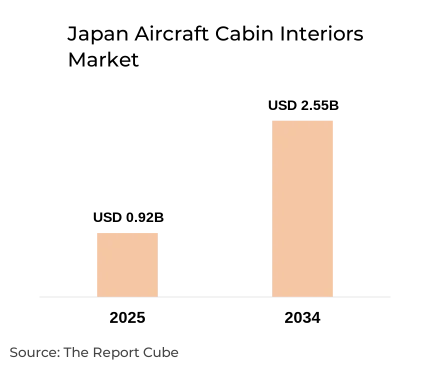
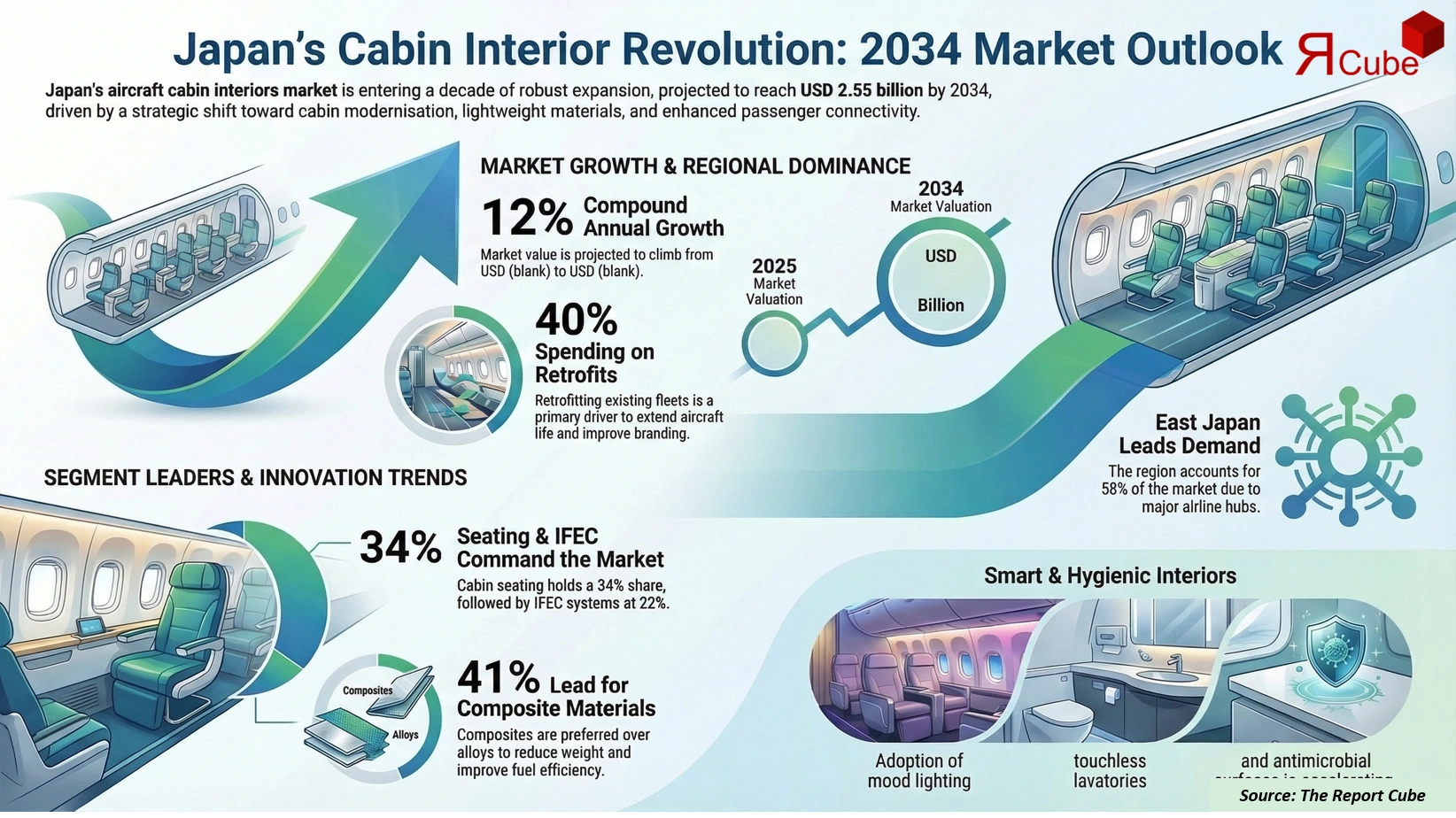
The Japan Aircraft Cabin Interiors Market is anticipated to register a CAGR of 12% during the forecast period 2026-2034. The market size was valued at USD 0.92 billion in 2025 and is projected to reach USD 2.55 billion by 2034. This robust growth trajectory is primarily driven by rising aircraft deliveries, increased retrofit activities, and growing passenger expectations for enhanced comfort, connectivity, and aesthetics across domestic and international routes.
Japan’s aviation industry is witnessing a strategic shift toward cabin modernization as airlines focus on differentiating passenger experience amid intensifying competition. Full-service carriers are investing heavily in premium cabin upgrades, advanced inflight entertainment and connectivity systems, and lightweight seating solutions to improve operational efficiency. At the same time, regional and low-cost carriers are prioritizing standardized, cost-efficient cabin interiors to balance affordability with passenger comfort.
Moreover, Japan’s strong manufacturing ecosystem and emphasis on precision engineering support the development of high-quality cabin interior components. Increasing adoption of composite materials, smart lighting systems, and modular galley designs is reshaping cabin layouts. As international travel demand rebounds and fleet utilization improves, cabin interior retrofits and line-fit installations are expected to remain key revenue generators, reinforcing sustained market expansion through 2034.
Japan Aircraft Cabin Interiors Market Recent Developments
- 2025: JAMCO Corporation expanded production capacity for lightweight galleys and lavatories to support new aircraft deliveries.
- 2025: Panasonic Avionics introduced next-generation IFEC upgrades for Japanese airlines focusing on passenger personalization.
Government Initiatives & Policies
- Japan Aviation Growth Strategy: Supports fleet modernization, safety upgrades, and aerospace manufacturing competitiveness.
- Green Growth Strategy: Promotes lightweight materials and energy-efficient aircraft components.
Japan Aircraft Cabin Interiors Market Dynamics
Key Driver: Rising Aircraft Deliveries and Cabin Retrofit Demand
The primary driver of the Japan Aircraft Cabin Interiors Market is the steady increase in aircraft deliveries combined with rising demand for cabin retrofits. Japanese airlines are expanding and renewing fleets to meet growing passenger traffic while complying with evolving safety and comfort standards. Cabin retrofitting has become a strategic priority, allowing carriers to extend aircraft life, enhance brand identity, and improve passenger satisfaction without full fleet replacement. In 2024, retrofit activities accounted for nearly 40% of cabin interior spending in Japan, highlighting their importance. This trend directly boosts demand for seating, IFEC systems, lighting, and interior panels, positioning cabin interiors as a critical investment area for airlines.
Book your FREE 30-minute expert consultation today
Contact UsIndustry Trends: Adoption of Smart and Lightweight Cabin Solutions
A key trend shaping the market is the rapid adoption of smart and lightweight cabin interior solutions. Airlines are increasingly integrating advanced IFEC systems, mood lighting, and modular galleys to enhance passenger experience while reducing aircraft weight. Composite materials are replacing traditional alloys in seating frames and interior panels, contributing to fuel efficiency and lower emissions. Additionally, touchless lavatories and antimicrobial surfaces are gaining traction as airlines emphasize hygiene and passenger well-being. These innovations align with Japan’s broader sustainability goals and reflect airlines’ focus on long-term cost optimization, making advanced cabin technologies a defining trend through the forecast period.
Major Challenge: High Customization Costs and Certification Complexity
Despite strong growth prospects, high customization costs remain a major challenge for the Japan Aircraft Cabin Interiors Market. Premium cabin interiors often require bespoke designs, advanced materials, and extensive certification processes, significantly increasing development timelines and expenses. Compliance with stringent aviation safety regulations further adds to complexity, particularly for new materials and electronic systems. Smaller airlines and regional operators may face budget constraints, limiting adoption of high-end interior solutions. These factors can slow decision-making and impact project execution, posing short-term challenges for market participants.
Opportunity: Growth in Premium Economy and Regional Aircraft Cabins
The expansion of premium economy seating and regional aircraft operations presents a significant opportunity for the market. Japanese airlines are increasingly introducing premium economy cabins to capture value-conscious travelers seeking enhanced comfort. This shift drives demand for ergonomic seating, upgraded lighting, and improved storage solutions. Simultaneously, growth in regional connectivity is boosting demand for standardized yet modern cabin interiors for narrow-body and regional aircraft. Suppliers offering modular, scalable solutions stand to benefit, as airlines seek flexibility and faster installation cycles. These segments are expected to contribute meaningfully to revenue growth over the next decade.
Japan Aircraft Cabin Interiors Market Segment-wise Analysis
By Product:
- Cabin Seating
- IFEC Systems
- Cabin Lighting
- Galleys
- Lavatories
- Storage Bins
- Interior Panels
Cabin Seating dominates the product segment, accounting for approximately 34% of the market share in 2025. Airlines prioritize seating upgrades to improve comfort, optimize space, and reduce weight. IFEC Systems follow closely, driven by passenger demand for connectivity and entertainment, contributing nearly 22% share. Galleys and lavatories remain essential retrofit components, while interior panels and lighting systems are increasingly upgraded to enhance cabin aesthetics. The balanced demand across product categories reflects airlines’ holistic approach to cabin modernization.
By Material Segment:
- Composites
- Alloys
- Other Materials
Composites lead the material segment with an estimated 41% market share, supported by their lightweight properties and durability. Airlines and manufacturers favor composites to reduce fuel consumption and maintenance costs. Alloys continue to be used in structural applications, holding around 36% share, while other materials cater to niche customization needs. The growing emphasis on sustainability and efficiency is expected to further accelerate composite adoption across cabin interior components.
Regional Projection of Japan Aircraft Cabin Interiors Industry
- East Japan
- West Japan
East Japan leads the Japan Aircraft Cabin Interiors Market, accounting for nearly 58% of total demand. The region hosts major airline hubs, maintenance facilities, and manufacturing centers, driving higher retrofit and line-fit activity. West Japan follows, supported by growing regional air traffic and fleet expansion initiatives. East Japan’s dominance is expected to continue through 2034, underpinned by strong airline presence, advanced infrastructure, and higher passenger volumes.
Need insights for a specific region within this market?
Request Regional DataWhy Choose This Report?
- Provides a comprehensive overview of the overall market analysis, encompassing key trends, consumer behavior analysis, and risk assessment to support strategic decision-making.
- Provides accurate, up-to-date insights into market size, segmentation, and emerging opportunities, helping to minimize risk & capitalizing on growth.
- Gives deep understanding of target audience preferences, investment habits, and communication channels for enhanced product development & marketing effectiveness.
- Delivers competitive analysis & benchmarking, uncovering the strengths & weaknesses of market competitors to guide strategies.
- Consolidate comprehensive market intelligence, reducing reasoning & streamlining research efforts.
- Facilitates customized market segmentation & risk mitigation strategies, fine-tuned to the business objectives.
- Aids in identifying both market challenges & untapped opportunities within the industry to drive long-term business growth.
- Provides valuable information based on actual customer data & search trends.
Table of Contents
- Introduction
- Objective of the Study
- Product and Category Definition
- Market Segmentation
- Study Variables
- Research Methodology
- Secondary Data Points
- Breakdown of Secondary Sources
- Primary Data Points
- Breakdown of Primary Interviews
- Secondary Data Points
- Executive Summary
- Market Dynamics
- Drivers
- Challenges
- Opportunity Assessment
- Recent Trends and Developments
- Regulatory and Policy Landscape
- Japan Aircraft Cabin Interiors Market Overview (2021-2034)
- Market Size, By Value (USD Billion)
- Market Share, By Product
- Cabin Seating
- IFEC Systems
- Cabin Lighting
- Galleys
- Lavatories
- Storage Bins
- Interior Panels
- Market Share, By Material Segment
- Composites
- Alloys
- Other Materials
- Market Share, By Aircraft Type
- Narrowbody
- Widebody
- Regional Jets
- Business Jets
- Market Share, By Application
- Linefit
- Retrofit
- Market Share, By Region
- East Japan
- West Japan
- Market Share, By Company
- Competition Characteristics
- Revenue Shares & Analysis
- East Japan Aircraft Cabin Interiors Market
- Market Size, By Value (USD Billion)
- Market Share, By Product
- Market Share, By Material Segment
- Market Share, By Aircraft Type
- Market Share, By Application
- West Japan Aircraft Cabin Interiors Market
- Market Size, By Value (USD Billion)
- Market Share, By Product
- Market Share, By Material Segment
- Market Share, By Aircraft Type
- Market Share, By Application
- Competitive Outlook and Company Profiles
- Collins Aerospace
- Company Overview
- Product Portfolio
- Strategic Alliances/Partnerships
- Recent Developments
- Safran Group
- Company Overview
- Product Portfolio
- Strategic Alliances/Partnerships
- Recent Developments
- Panasonic Avionics
- Company Overview
- Product Portfolio
- Strategic Alliances/Partnerships
- Recent Developments
- JAMCO Corporation
- Company Overview
- Product Portfolio
- Strategic Alliances/Partnerships
- Recent Developments
- Recaro Seating
- Company Overview
- Product Portfolio
- Strategic Alliances/Partnerships
- Recent Developments
- Diehl Aviation
- Company Overview
- Product Portfolio
- Strategic Alliances/Partnerships
- Recent Developments
- Astronics Corporation
- Company Overview
- Product Portfolio
- Strategic Alliances/Partnerships
- Recent Developments
- Aviointeriors
- Company Overview
- Product Portfolio
- Strategic Alliances/Partnerships
- Recent Developments
- Geven SpA
- Company Overview
- Product Portfolio
- Strategic Alliances/Partnerships
- Recent Developments
- ST Engineering
- Company Overview
- Product Portfolio
- Strategic Alliances/Partnerships
- Recent Developments
- Others
- Collins Aerospace
- Contact Us and Disclaimer
Top Key Players & Market Share Outlook
- Collins Aerospace
- Safran Group
- Panasonic Avionics
- JAMCO Corporation
- Recaro Seating
- Diehl Aviation
- Astronics Corporation
- Aviointeriors
- Geven SpA
- ST Engineering
- Others
Frequently Asked Questions






