




Build Your Custom Market Intelligence Report
Customize Your ReportJapan Commercial Aviation Market Insights & Analysis
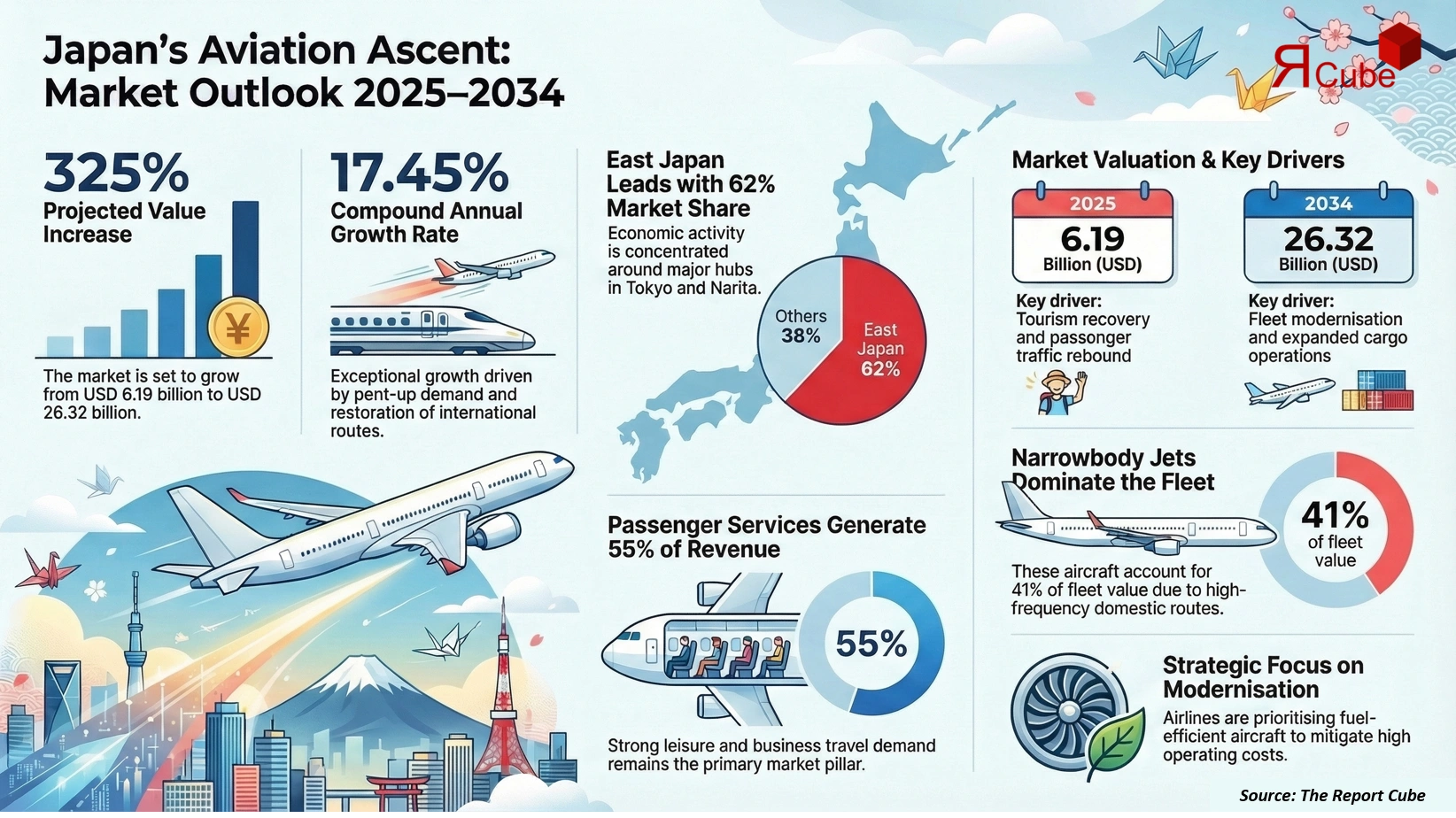
The Japan Commercial Aviation Market is anticipated to register a CAGR of 17.45% during the forecast period 2026-2034. The market size was valued at USD 6.19 billion in 2025 and is projected to reach USD 26.32 billion by 2034. This exceptional growth outlook reflects Japan’s strong rebound in passenger air traffic, accelerating international tourism inflows, and strategic investments in aviation infrastructure and fleet expansion.
Japan’s commercial aviation sector is entering a high-growth phase driven by the restoration of international routes, liberalized travel policies, and rising domestic mobility. Airlines are scaling operations to address pent-up travel demand, particularly across Asia-Pacific and long-haul transcontinental routes. At the same time, Japan’s geographic reliance on air connectivity, combined with limited alternatives for long-distance domestic travel, reinforces the importance of aviation as a core transport mode.
Moreover, the market benefits from Japan’s strong operational discipline, advanced airport infrastructure, and high service quality standards. Airlines are increasingly focusing on capacity optimization, fuel-efficient aircraft, and digital service enhancements to improve profitability. Cargo aviation is also gaining traction as Japan strengthens its role in global electronics, automotive, and pharmaceutical supply chains. These interconnected factors collectively support sustained expansion of the Japan Commercial Aviation Market through 2034.
Japan Commercial Aviation Market Recent Developments
- 2025: All Nippon Airways expanded international flight frequencies across Asia-Pacific to meet rising outbound travel demand.
- 2025: Japan Airlines strengthened cargo operations with additional freighter capacity on transpacific routes.
Government Initiatives & Policies
- Japan Tourism Nation Promotion Plan: Supports international air connectivity and airport capacity expansion.
- Green Growth Strategy: Encourages fuel-efficient aircraft adoption and sustainable aviation development.
Japan Commercial Aviation Market Dynamics
Key Driver: Strong Recovery in Passenger Traffic and Tourism
The most significant driver of the Japan Commercial Aviation Market is the sharp recovery in passenger traffic supported by inbound tourism and domestic travel resurgence. International visitor arrivals to Japan have rebounded rapidly following border reopening, boosting demand for both full-service and low-cost carriers. Domestic air travel remains essential due to Japan’s island geography, where air routes efficiently connect major metropolitan regions with remote areas. Airlines are responding by increasing flight frequencies, reopening suspended routes, and expanding fleets. Passenger volumes across key hubs such as Tokyo and Osaka have shown double-digit annual growth since 2023, directly translating into higher aircraft utilization and revenue generation. This sustained recovery forms a strong foundation for long-term market growth.
Book your FREE 30-minute expert consultation today
Contact UsIndustry Trends: Fleet Modernization and Service Diversification
Fleet modernization has emerged as a defining trend in Japan’s commercial aviation sector. Airlines are investing in next-generation narrowbody and widebody aircraft to reduce fuel consumption, enhance range flexibility, and improve passenger comfort. At the same time, service diversification is accelerating, with airlines expanding premium economy offerings, charter services, and integrated cargo solutions. The rise of low-cost carriers has intensified competition, pushing operators to differentiate through digital booking platforms, loyalty programs, and seamless airport services. MRO services are also gaining prominence as airlines focus on extending aircraft life cycles while maintaining high safety standards. These trends collectively support operational efficiency and revenue diversification across the market.
Major Challenge: High Operating Costs and Capacity Constraints
Despite strong growth prospects, high operating costs remain a major challenge for the Japan Commercial Aviation Market. Fuel price volatility, airport charges, and labor costs place pressure on airline margins, particularly for smaller regional carriers. Additionally, capacity constraints at major airports such as Haneda and Narita limit rapid expansion during peak travel periods. Slot availability challenges can restrict route additions and frequency increases, affecting growth potential. Currency fluctuations also impact aircraft leasing and maintenance costs, especially for internationally sourced components. These factors collectively create financial and operational constraints that airlines must manage carefully to sustain profitability.
Opportunity: Expansion of Air Cargo and Regional Connectivity
The growing importance of air cargo presents a substantial opportunity for the market. Japan’s role as a global manufacturing and export hub drives consistent demand for high-value, time-sensitive shipments. Cargo operators and passenger airlines with belly cargo capacity are expanding freighter fleets and logistics partnerships. Additionally, regional connectivity initiatives are encouraging airlines to strengthen services linking smaller cities with major hubs, supporting balanced economic development. Government-backed airport upgrades and digital air traffic management improvements further enhance operational efficiency. These opportunities provide new revenue streams and reinforce the long-term resilience of the Japan Commercial Aviation Market.
Japan Commercial Aviation Market Segment-wise Analysis
By Aircraft Type:
- Narrowbody Jets
- Widebody Jets
- Regional Jets
- Turboprop Aircraft
- Cargo/Freighter
Narrowbody Jets dominate the market, accounting for approximately 41% of total fleet value in 2025. Their dominance stems from high-frequency domestic and short-haul regional routes that form the backbone of Japan’s aviation network. Widebody Jets follow, supporting long-haul international travel and contributing around 27% market share. Cargo/Freighter aircraft are gaining momentum, driven by export-oriented industries and representing nearly 18% share. Regional jets and turboprops remain essential for connecting smaller airports, ensuring nationwide accessibility and balanced route development.
By Service Type:
- Passenger Services
- Air Cargo
- Charter Services
- Airport Services
- MRO Services
Passenger Services lead the segment with nearly 55% market share, reflecting strong leisure and business travel demand. Air Cargo services follow, accounting for about 25%, supported by electronics and pharmaceutical exports. MRO Services are expanding steadily as airlines prioritize fleet reliability and cost optimization, contributing close to 12% of market value. Charter and airport services play a complementary role, supporting tourism, corporate travel, and operational efficiency across the aviation ecosystem.
Regional Projection of Japan Commercial Aviation Industry
- East Japan
- West Japan
East Japan leads the Japan Commercial Aviation Market with an estimated 62% share, driven by major hubs such as Tokyo and Narita. The region benefits from higher population density, strong business travel demand, and extensive international connectivity. West Japan follows, supported by Osaka and Kansai International Airport, serving as a key gateway for tourism and trade. East Japan’s dominance is expected to continue throughout the forecast period, supported by ongoing airport capacity enhancements and sustained passenger demand.
Need insights for a specific region within this market?
Request Regional DataWhy Choose This Report?
- Provides a comprehensive overview of the overall market analysis, encompassing key trends, consumer behavior analysis, and risk assessment to support strategic decision-making.
- Provides accurate, up-to-date insights into market size, segmentation, and emerging opportunities, helping to minimize risk & capitalizing on growth.
- Gives deep understanding of target audience preferences, investment habits, and communication channels for enhanced product development & marketing effectiveness.
- Delivers competitive analysis & benchmarking, uncovering the strengths & weaknesses of market competitors to guide strategies.
- Consolidate comprehensive market intelligence, reducing reasoning & streamlining research efforts.
- Facilitates customized market segmentation & risk mitigation strategies, fine-tuned to the business objectives.
- Aids in identifying both market challenges & untapped opportunities within the industry to drive long-term business growth.
- Provides valuable information based on actual customer data & search trends.
Table of Contents
- Introduction
- Objective of the Study
- Product and Category Definition
- Market Segmentation
- Study Variables
- Research Methodology
- Secondary Data Points
- Breakdown of Secondary Sources
- Primary Data Points
- Breakdown of Primary Interviews
- Secondary Data Points
- Executive Summary
- Market Dynamics
- Drivers
- Challenges
- Opportunity Assessment
- Recent Trends and Developments
- Regulatory and Policy Landscape
- Japan Commercial Aviation Market Overview (2020-2034)
- Market Size, By Value (USD Billion)
- Market Share, By Aircraft Type
- Narrowbody Jets
- Widebody Jets
- Regional Jets
- Turboprop Aircraft
- Cargo/Freighter
- Market Share, By Service Type
- Passenger Services
- Air Cargo
- Charter Services
- Airport Services
- MRO Services
- Market Share, By Carrier Type
- Full-Service
- Low-Cost
- Regional Airlines
- Market Share, By Customer Segment
- Business Travel
- Leisure Travel
- Inbound Tourism
- Domestic Commuters
- Market Share, By Region
- East Japan
- West Japan
- Market Share, By Company
- Revenue Shares
- Competition Characteristics
- Revenue Shares & Analysis
- East Japan Commercial Aviation Market
- Market Size, By Value (USD Billion)
- Market Share, By Aircraft Type
- Market Share, By Service Type
- Market Share, By Carrier Type
- Market Share, By Customer Segment
- Market Share, By Key Hubs
- Tokyo Haneda
- Tokyo Narita
- Sendai Airport
- Sapporo New Chitose
- West Japan Commercial Aviation Market
- Market Size, By Value (USD Billion)
- Market Share, By Aircraft Type
- Market Share, By Service Type
- Market Share, By Carrier Type
- Market Share, By Customer Segment
- Market Share, By Key Hubs
- Osaka Kansai
- Osaka Itami
- Nagoya Chubu
- Fukuoka Airport
- Competitive Outlook and Company Profiles
- All Nippon Airways (ANA)
- Company Overview
- Fleet and Network
- Strategic Alliances/Partnerships
- Recent Developments
- Japan Airlines (JAL)
- Company Overview
- Fleet and Network
- Strategic Alliances/Partnerships
- Recent Developments
- Peach Aviation
- Company Overview
- Fleet and Network
- Strategic Alliances/Partnerships
- Recent Developments
- Skymark Airlines
- Company Overview
- Fleet and Network
- Strategic Alliances/Partnerships
- Recent Developments
- StarFlyer
- Company Overview
- Fleet and Network
- Strategic Alliances/Partnerships
- Recent Developments
- Solaseed Air
- Company Overview
- Fleet and Network
- Strategic Alliances/Partnerships
- Recent Developments
- Japan Transocean Air
- Company Overview
- Fleet and Network
- Strategic Alliances/Partnerships
- Recent Developments
- Fuji Dream Airlines
- Company Overview
- Fleet and Network
- Strategic Alliances/Partnerships
- Recent Developments
- Air Do
- Company Overview
- Fleet and Network
- Strategic Alliances/Partnerships
- Recent Developments
- Nippon Cargo Airlines
- Company Overview
- Fleet and Network
- Strategic Alliances/Partnerships
- Recent Developments
- Others
- All Nippon Airways (ANA)
- Contact Us and Disclaimer
Top Key Players & Market Share Outlook
- All Nippon Airways (ANA)
- Japan Airlines (JAL)
- Peach Aviation
- Skymark Airlines
- StarFlyer
- Solaseed Air
- Japan Transocean Air
- Fuji Dream Airlines
- Air Do
- Nippon Cargo Airlines
- Others
Frequently Asked Questions






