



Build Your Custom Market Intelligence Report
Customize Your ReportJapan Aviation Electronics Market Insights & Analysis
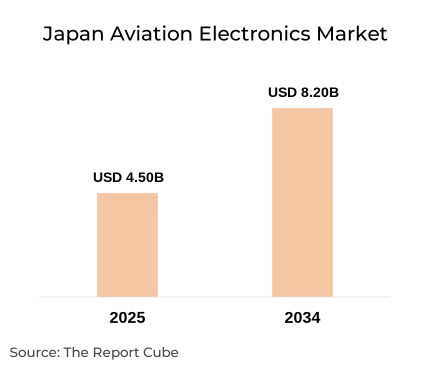
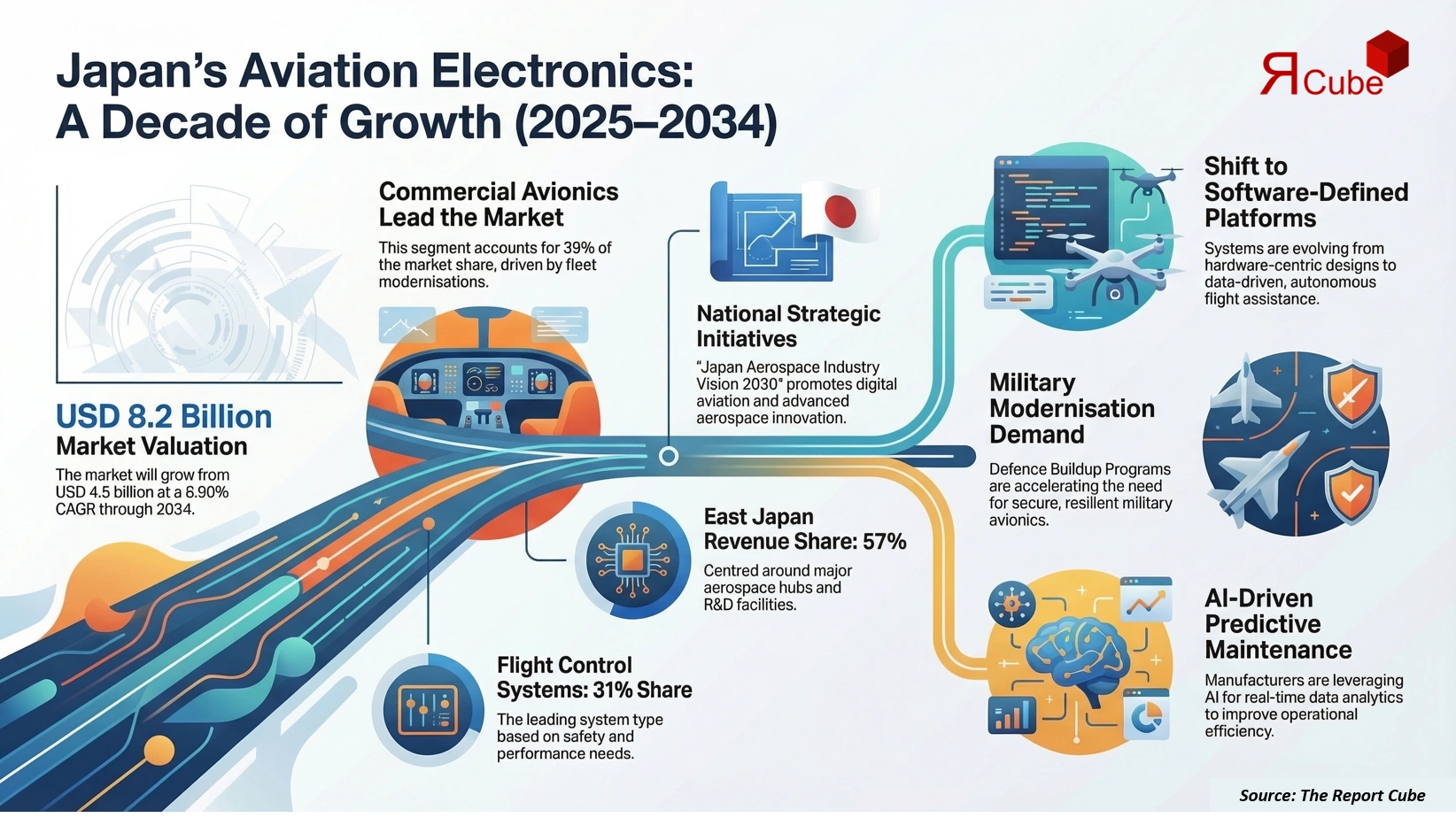
The Japan Aviation Electronics Market is anticipated to register a CAGR of 6.90% during the forecast period 2026-2034. The market size was valued at USD 4.5 billion in 2025 and is projected to reach USD 8.2 billion by 2034. This growth trajectory reflects Japan’s strong position in advanced electronics manufacturing, increasing investments in next-generation avionics, and rising demand for digitally integrated aircraft systems across commercial and defense aviation.
Japan’s aviation electronics ecosystem benefits from a mature aerospace supply chain, high R&D intensity, and strong collaboration between domestic manufacturers and global OEMs. Commercial aviation recovery, combined with fleet modernization programs, is driving airlines to adopt advanced flight control, navigation, and communication systems. At the same time, Japan’s defense modernization initiatives are accelerating demand for secure, resilient, and software-driven military avionics. These parallel demand streams are reinforcing long-term market stability.
Furthermore, the increasing integration of autonomous systems, airport digitalization, and power management electronics is expanding the scope of aviation electronics beyond onboard aircraft systems. Japanese manufacturers are leveraging strengths in semiconductors, sensors, and precision electronics to deliver high-reliability solutions. As sustainability, safety, and operational efficiency remain top priorities, the Japan Aviation Electronics Market is positioned for sustained, innovation-led expansion through 2034.
Japan Aviation Electronics Market Recent Developments
- 2025: Mitsubishi Electric advanced next-generation avionics for commercial aircraft, enhancing flight management and navigation accuracy.
- 2025: Japan Aviation Electronics Industry expanded high-reliability connectors for aerospace and defense avionics platforms.
Government Initiatives & Policies
- Japan Aerospace Industry Vision 2030: Promotes advanced avionics, digital aviation, and aerospace innovation.
- Defense Buildup Program: Supports modernization of military avionics and surveillance systems.
Japan Aviation Electronics Market Dynamics
Key Driver: Rising Demand for Advanced Avionics and Flight Safety Systems
The primary driver of the Japan Aviation Electronics Market is the growing demand for advanced avionics that enhance flight safety, efficiency, and situational awareness. Airlines and aircraft operators are increasingly investing in modern flight control, navigation, and surveillance systems to comply with stringent safety regulations and improve operational performance. In Japan, where airspace congestion and precision operations are critical, advanced avionics play a central role in ensuring reliable flight operations. Commercial aircraft upgrades and retrofits are gaining momentum, particularly for communication and navigation systems that support satellite-based operations. In parallel, defense aviation programs are prioritizing secure and resilient avionics to support mission-critical applications. This sustained focus on safety and reliability continues to generate consistent demand across both commercial and military segments.
Book your FREE 30-minute expert consultation today
Contact UsIndustry Trends: Digitalization and Integration of Autonomous Systems
A key trend shaping the market is the increasing digitalization of aviation electronics and the integration of autonomous systems. Aircraft systems are evolving from hardware-centric architectures toward software-defined, data-driven platforms. Japanese manufacturers are actively developing avionics that support predictive maintenance, real-time data analytics, and autonomous flight assistance. Additionally, airport systems are adopting advanced surveillance, communication, and power management electronics to improve traffic flow and energy efficiency. The emergence of unmanned and optionally piloted aircraft is further expanding demand for autonomous avionics and secure communication systems. This trend reflects a broader shift toward smart aviation ecosystems, where interconnected electronic systems enhance safety, efficiency, and sustainability.
Major Challenge: High Development Costs and Certification Complexity
High development costs and complex certification requirements present a significant challenge for the Japan Aviation Electronics Market. Avionics systems must meet rigorous safety and reliability standards, resulting in long development cycles and substantial testing investments. Certification processes for both commercial and military applications can extend timelines and increase costs, particularly for smaller suppliers. Additionally, rapid technological advancement increases the risk of obsolescence, requiring continuous R&D spending to remain competitive. These factors can limit market entry and slow adoption of newer technologies, especially for emerging segments such as autonomous systems.
Opportunity: Defense Modernization and Airport Infrastructure Upgrades
Japan’s ongoing defense modernization and airport infrastructure upgrades present strong growth opportunities for the aviation electronics market. Increased defense budgets are supporting the adoption of advanced communication, surveillance, and electronic warfare avionics. Simultaneously, investments in airport digitalization are driving demand for modern airport systems, including air traffic management and power management electronics. These initiatives create opportunities for domestic and international suppliers to deliver integrated, high-value solutions. As Japan strengthens its aviation resilience and security capabilities, demand for advanced electronics is expected to remain robust throughout the forecast period.
Japan Aviation Electronics Market Segment-wise Analysis
By Type:
- Commercial Avionics
- Military Avionics
- General Aviation
- Autonomous Systems
- Airport Systems
Commercial Avionics represent the leading segment, accounting for approximately 39% of the market share in 2025. This dominance is driven by fleet upgrades, avionics retrofits, and rising passenger traffic recovery. Military Avionics follow closely, supported by defense modernization initiatives and accounting for nearly 28% share. Autonomous Systems and Airport Systems are emerging segments, benefiting from digital aviation and smart airport investments. General Aviation maintains a steady contribution, supported by business and training aircraft demand.
By System Type:
- Flight Control
- Navigation
- Communication
- Surveillance
- Power Management
Flight Control systems lead this segment with an estimated 31% market share, reflecting their critical role in aircraft safety and performance. Navigation and Communication systems collectively account for over 40% share, driven by satellite-based navigation adoption and secure data link requirements. Surveillance systems are gaining importance with increased air traffic management needs, while Power Management systems are benefiting from electrification trends and energy efficiency initiatives. The balanced growth across system types underscores the integrated nature of modern avionics architectures.
Regional Projection of Japan Aviation Electronics Industry
- East Japan
- West Japan
East Japan leads the Japan Aviation Electronics Market, contributing approximately 57% of total revenue. The region hosts major aerospace manufacturers, R&D centers, and key airports, driving strong demand for advanced avionics and airport systems. West Japan follows with significant contributions from manufacturing facilities and regional aviation hubs. East Japan’s leadership is reinforced by higher investment in innovation, proximity to government institutions, and concentration of defense and commercial aviation activities. This regional dominance is expected to continue through the forecast period.
Need insights for a specific region within this market?
Request Regional DataWhy Choose This Report?
- Provides a comprehensive overview of the overall market analysis, encompassing key trends, consumer behavior analysis, and risk assessment to support strategic decision-making.
- Provides accurate, up-to-date insights into market size, segmentation, and emerging opportunities, helping to minimize risk & capitalizing on growth.
- Gives deep understanding of target audience preferences, investment habits, and communication channels for enhanced product development & marketing effectiveness.
- Delivers competitive analysis & benchmarking, uncovering the strengths & weaknesses of market competitors to guide strategies.
- Consolidate comprehensive market intelligence, reducing reasoning & streamlining research efforts.
- Facilitates customized market segmentation & risk mitigation strategies, fine-tuned to the business objectives.
- Aids in identifying both market challenges & untapped opportunities within the industry to drive long-term business growth.
- Provides valuable information based on actual customer data & search trends.
Table of Contents
- Introduction
- Objective of the Study
- Product and Category Definition
- Market Segmentation
- Study Variables
- Research Methodology
- Secondary Data Points
- Breakdown of Secondary Sources
- Primary Data Points
- Breakdown of Primary Interviews
- Secondary Data Points
- Executive Summary
- Market Dynamics
- Drivers
- Challenges
- Opportunity Assessment
- Recent Trends and Developments
- Regulatory and Policy Landscape
- Japan Aviation Electronics Market Overview (2020-2034)
- Market Size, By Value (USD Billion)
- Market Share, By Type
- Commercial Avionics
- Military Avionics
- General Aviation
- Autonomous Systems
- Airport Systems
- Market Share, By System Type
- Flight Control
- Navigation
- Communication
- Surveillance
- Power Management
- Market Share, By Hardware Type
- Displays
- Sensors
- Connectors
- Embedded Modules
- Cabling
- Market Share, By Software Type
- Flight Software
- Maintenance Software
- Mission Software
- Air Traffic Software
- Market Share, By Region
- East Japan
- West Japan
- Market Share, By Company
- Revenue Shares & Analysis
- Competition Characteristics
- East Japan Aviation Electronics Market
- Market Size, By Value (USD Billion)
- Market Share, By Type
- Market Share, By System Type
- Market Share, By Hardware Type
- Market Share, By Software Type
- Market Share, By Sub‑Region
- Kanto
- Tohoku
- Hokkaido
- Chubu (East)
- West Japan Aviation Electronics Market
- Market Size, By Value (USD Billion)
- Market Share, By Type
- Market Share, By System Type
- Market Share, By Hardware Type
- Market Share, By Software Type
- Market Share, By Sub‑Region
- Kansai
- Chugoku
- Shikoku
- Kyushu‑Okinawa
- Competitive Outlook and Company Profiles
- Japan Aviation Electronics Industry, Ltd.
- Company Overview
- Product Portfolio
- Strategic Alliances/Partnerships
- Recent Developments
- Panasonic Corporation
- Company Overview
- Product Portfolio
- Strategic Alliances/Partnerships
- Recent Developments
- NEC Corporation
- Company Overview
- Product Portfolio
- Strategic Alliances/Partnerships
- Recent Developments
- Mitsubishi Electric Corporation
- Company Overview
- Product Portfolio
- Strategic Alliances/Partnerships
- Recent Developments
- Kawasaki Heavy Industries, Ltd.
- Company Overview
- Product Portfolio
- Strategic Alliances/Partnerships
- Recent Developments
- Honeywell International Inc.
- Company Overview
- Product Portfolio
- Strategic Alliances/Partnerships
- Recent Developments
- Thales Group
- Company Overview
- Product Portfolio
- Strategic Alliances/Partnerships
- Recent Developments
- Collins Aerospace (RTX)
- Company Overview
- Product Portfolio
- Strategic Alliances/Partnerships
- Recent Developments
- Garmin Ltd.
- Company Overview
- Product Portfolio
- Strategic Alliances/Partnerships
- Recent Developments
- Lockheed Martin Corporation
- Company Overview
- Product Portfolio
- Strategic Alliances/Partnerships
- Recent Developments
- Others
- Japan Aviation Electronics Industry, Ltd.
- Contact Us and Disclaimer
Top Key Players & Market Share Outlook
- Japan Aviation Electronics Industry, Ltd.
- Panasonic Corporation
- NEC Corporation
- Mitsubishi Electric Corporation
- Kawasaki Heavy Industries, Ltd.
- Honeywell International Inc.
- Thales Group
- Collins Aerospace (RTX)
- Garmin Ltd.
- Lockheed Martin Corporation
- Others
Frequently Asked Questions






