


Build Your Custom Market Intelligence Report
Customize Your ReportKey Highlights
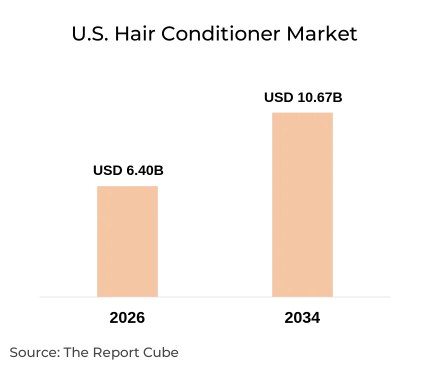
- The U.S. Hair Conditioner Market was valued at USD 6.40 billion in 2026.
- Market size is projected to reach USD 10.67 billion by 2034, extending the supplied growth rate.
- The market is forecast to expand at a CAGR of 6.60% during 2026–2034.
- A leading region could not be identified because no regional share data was supplied or verified.
- Demand for specialized formulations addressing dryness, damage, frizz and hair texture is the major growth driver.
- In March 2026, Henkel announced a definitive agreement to acquire Olaplex for approximately USD 1.4 billion, signalling consolidation in premium haircare.
Market Outlook
The U.S. Hair Conditioner Market covers commercially sold products that improve hair softness, hydration, detangling and protection against damage, including rinse-out, leave-in and deep conditioners. Conditioners are replenished regularly, making the category a recurring part of beauty and personal care spending. Shampoo, hair serums, standalone oils and styling products are excluded unless built into a qualifying conditioning formula.
Demand is shaped by hair texture, dryness, frizz, colour treatment and damage concerns, which push routines beyond basic rinse-out use toward leave-in sprays and intensive masks. Products reach consumers through supermarkets, drugstores, specialty beauty retailers, salons and online platforms. Mass brands emphasize affordability and availability, while mid-range and premium ranges compete on formulation, ingredients and targeted benefits.
The U.S. Hair Conditioner Market is estimated at USD 6.40 billion in 2026 and is projected to reach USD 10.67 billion by 2034, a CAGR of 6.60%. The 2034 value is an analytical extension of the supplied growth rate. Growth depends on product specialization, premium and mid-range formulations, wider online access and sustained household replenishment, within a competitive field of multinational, professional and specialist brands.
Government Regulations
Hair conditioners are regulated as cosmetics in the United States under the Federal Food, Drug, and Cosmetic Act, as expanded by the Modernization of Cosmetics Regulation Act of 2022 (MoCRA). The U.S. Food and Drug Administration (FDA) oversees implementation. MoCRA requires applicable facilities to register, responsible persons to list products, and companies to maintain adequate safety substantiation. It also requires serious adverse events to be reported, gives FDA access to certain records, and grants mandatory recall authority under specified conditions. These obligations raise documentation, testing and quality-system requirements, with the heaviest burden on smaller manufacturers and brand owners that lack dedicated regulatory teams. Established multinational companies with compliance infrastructure are better placed to absorb these costs across the U.S. Hair Conditioner Market.
U.S. Hair Conditioner Market Dynamics
Demand in the U.S. Hair Conditioner Market reflects routine household replenishment combined with a shift toward targeted haircare benefits. Product development, price-tier positioning and channel expansion shape competition, while federal cosmetic regulation affects compliance costs for manufacturers and brand owners.
|
Factor |
Type |
Specific Impact on Market |
Magnitude |
|---|---|---|---|
|
Demand for specialized haircare |
Driver |
Expands targeted formulations for dryness, damage, frizz and texture |
High |
|
Recurring household replenishment |
Driver |
Sustains stable repeat purchasing across price tiers |
Medium–High |
|
Mid-range and premium formulations |
Opportunity |
Supports higher-value products between mass and salon pricing |
Medium–High |
|
E-commerce distribution |
Opportunity |
Improves access to niche formulations and replenishment |
Medium–High |
|
MoCRA compliance and pricing pressure |
Challenge |
Raises documentation costs and squeezes smaller brands |
Medium |
|
Leave-in and deep-conditioning formats |
Trend |
Broadens routines beyond rinse-out products |
Medium–High |
Growth Drivers: Rising Demand for Specialized Haircare
Consumers increasingly select conditioners by hair texture and concern, including dryness, damage, frizz, breakage, colour protection and curl management. This shift encourages manufacturers to widen portfolios with treatment-oriented formulations rather than relying on basic conditioning alone. Brands that can substantiate performance benefits and match products to specific hair needs gain stronger shelf presence and repeat purchasing. The effect is visible across mass, mid-range and premium tiers, supporting steady value growth in the U.S. Hair Conditioner Market.
Market Opportunities: E-Commerce and Mid-Range Expansion
Online retail lets manufacturers reach consumers searching for specialized formulations that may be limited in physical stores, while supporting subscription purchasing, replenishment and review-led discovery. Mid-range conditioners offer a parallel opportunity, delivering performance-oriented formulations at prices below salon-level products. Brands combining digital distribution with clear benefit positioning can build repeat-purchase models and reach consumers trading up from mass products without committing to premium pricing.
Industry Challenges: Regulatory Compliance and Pricing Pressure
MoCRA requirements on facility registration, product listing, safety substantiation and adverse-event reporting add documentation and quality-system costs, which weigh most heavily on smaller manufacturers. At the same time, multinational groups, professional brands, premium specialists and private-label products compete for the same shelf space and online visibility. This competition pressures retail prices, promotional spending and margins, particularly where brands lack distinctive formulations or strong distribution relationships.
Need Specific Data, Let’s Customize the Report for You
Request CustomizationMarket Trends: Growth of Leave-In and Deep-Conditioning Products
Haircare routines are extending beyond traditional rinse-out conditioners toward leave-in sprays, intensive masks and treatment-based products. These formats address hydration, detangling, damage repair, heat protection and frizz control, and they support higher-value positioning. Manufacturers are building integrated ranges around specific hair concerns, linking conditioners with masks and styling-care products. The pace of revenue adoption by format has not been verified in the supplied data.
U.S. Hair Conditioner Market Segment Analysis
The U.S. Hair Conditioner Market is segmented by product type, price tier, gender and distribution channel. These categories reflect differences in product format, consumer spending levels, user needs and retail access. Leading-segment shares below are supplied 2025 estimates.
By Product Type
- Rinse-Out Conditioners
- Leave-In Conditioners
- Deep Conditioners
- Other Specialized Formats
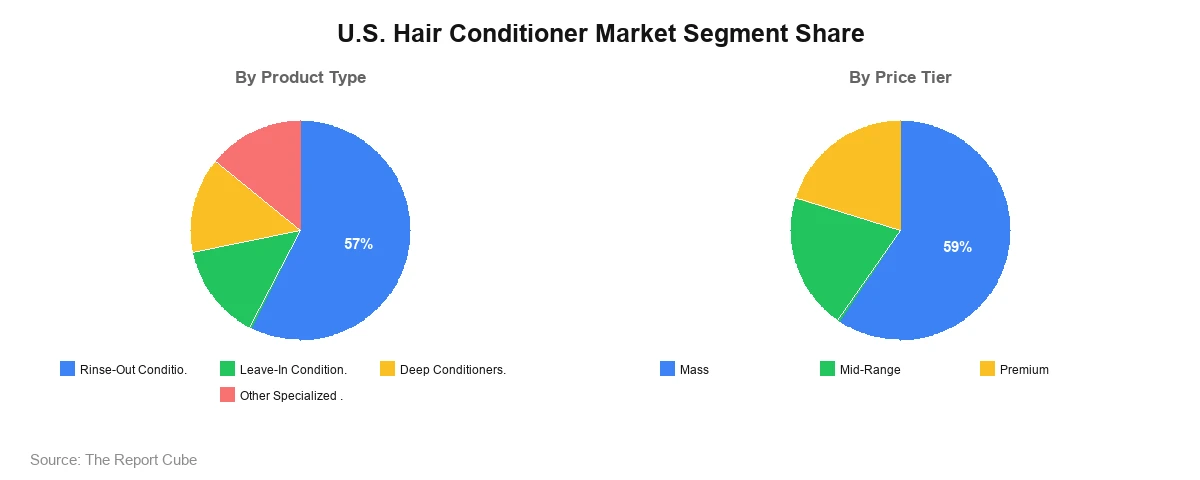
Rinse-out conditioners lead the product segment with an estimated 57% share in 2025, supported by their role in everyday routines after shampooing, where they improve smoothness, softness, detangling and moisture retention. Leave-in conditioners form the second analysed segment, used without rinsing for hydration, detangling, frizz management and heat protection, and they are a prominent growth format. Their revenue rank was not supplied, so no ranking is claimed. Deep conditioners and other specialized formats address intensive repair and are covered only briefly.
By Price Tier
- Mass
- Mid-Range
- Premium
Mass-market conditioners lead the price-tier segment with an estimated 59% share in 2025, supported by affordability, extensive retail availability and repeat household purchasing. Mid-range conditioners are the second analysed segment, appealing to consumers who want specialized benefits without moving to the highest price points, and the supplied data identifies them as the segment with the strongest growth outlook. Premium conditioners compete through advanced formulations, specialized ingredients and professional positioning, and are covered briefly given their smaller commercial base.
Competitive Landscape
The U.S. Hair Conditioner Market includes multinational consumer goods groups, professional haircare manufacturers, premium specialists and emerging brands. Companies compete through brand recognition, retail distribution, formulation innovation, marketing investment and price-tier positioning. The table summarizes general capabilities and does not represent market share or a verified ranking.
|
Company |
Competitive Strength |
Primary Segment Served |
|---|---|---|
|
L’Oréal S.A. |
Broad portfolio spanning mass, premium and professional haircare |
Mass, mid-range and premium |
|
The Procter & Gamble Company |
Wide retail distribution and strong brand recognition |
Mass-market |
|
Unilever PLC |
Consumer reach and diversified brand portfolio |
Mass and premium |
|
Henkel AG & Co. KGaA |
Consumer and professional haircare capabilities |
Mid-range, premium and professional |
|
Kao Corporation |
Formulation and product development in specialized haircare |
Specialized and smoothing |
|
Olaplex Holdings, Inc. |
Bond-repair positioning in treatment-oriented products |
Premium |
|
Amika |
Specialized treatment-focused haircare |
Premium |
L’Oréal S.A.: L’Oréal is a global beauty company whose haircare brands include L’Oréal Paris, Garnier, Redken, Kérastase, Matrix and Pureology. Its portfolio spans mass-market, premium and professional channels, giving it exposure to several price tiers in the U.S. conditioner category. Its competitive strength lies in portfolio breadth, research capability and the ability to offer specialized conditioning products across consumer and salon channels.
Henkel AG & Co. KGaA: Henkel is a German consumer and industrial goods group whose haircare brands include Schwarzkopf, Joico and Kenra. It serves both consumer and professional channels with conditioning and repair formulations. In March 2026, it announced an agreement to acquire Olaplex, strengthening its premium haircare exposure. Its competitive strength lies in professional haircare capability and an expanding premium portfolio.
Recent Developments and Updates
- March 2026: Henkel announced a definitive agreement to acquire 100% of Olaplex at USD 2.06 per share, valuing the transaction at approximately USD 1.4 billion. The deal expands Henkel’s premium haircare presence and is subject to customary closing conditions, including regulatory approvals.
U.S. Hair Conditioner Market Future Outlook
The U.S. Hair Conditioner Market is projected to grow from USD 6.40 billion in 2026 to USD 10.67 billion by 2034 at a CAGR of 6.60%, based on supplied estimates and an analytical extension. Growth is expected to rely on routine replenishment, targeted formulations, leave-in and deep-conditioning formats, mid-range product development and wider online access. These values are projections, not verified outcomes, and depend on consumer spending and product innovation.
Competition is expected to centre on premium and professional-quality formulations, portfolio expansion and distribution reach, as shown by consolidation activity in premium haircare. Risks include pricing pressure, private-label competition, and the compliance costs of MoCRA obligations for smaller brands. Over the long term, manufacturers that combine formulation innovation, competitive pricing and broad retail and digital distribution are best placed to capture growth.
U.S. Hair Conditioner Market Report Coverage
This U.S. Hair Conditioner Market report summarizes the supplied valuation, forecast assumptions, segmentation, competitive ecosystem and regulatory context.
|
Parameter |
Details |
|---|---|
|
Market Name |
U.S. Hair Conditioner Market |
|
Market Size (Base Year) |
USD 6.40 billion (2026) |
|
Market Size (Forecast Year) |
USD 10.67 billion (2034) |
|
CAGR |
6.60% |
|
Base Year |
2026 |
|
Historical Period |
2021–2025 |
|
Forecast Period |
2026–2034 |
|
Geographic Scope |
United States |
|
Segmentation |
By Product Type; By Price Tier; By Gender; By Distribution Channel |
|
Regions Covered |
West, Southwest, North, Midwest |
|
Key Companies |
L’Oréal S.A.; The Procter & Gamble Company; Unilever PLC; Henkel AG & Co. KGaA; Kao Corporation; Olaplex Holdings, Inc.; Amika |
|
Customization |
Available as per requirement |
Why Choose This U.S. Hair Conditioner Market Report?
- Presents the supplied 2026 valuation, 2034 projection and 6.60% CAGR with stated assumptions.
- Segments the market by product type, price tier, gender and distribution channel.
- Reviews drivers, opportunities, challenges and trends shaping conditioner demand.
- Identifies where regional share data is unavailable instead of estimating it.
- Profiles key companies by capability and primary segment served.
- Highlights leave-in, deep-conditioning, mid-range and online growth opportunities.
- Summarizes FDA and MoCRA requirements to support planning and positioning decisions.
Table of Contents
- Introduction
- Objective of the Study
- Product Definition
- Market Segmentation
- Study Variables
- Research Methodology
- Secondary Data Points
- Companies Interviewed
- Primary Data Points
- Breakdown of Primary Interviews
- Secondary Data Points
- Executive Summary
- Market Dynamics
- Drivers
- Challenges
- Opportunity Assessment
- Recent Trends and Developments
- Policy and Regulatory Landscape
- U.S. Hair Conditioner Market Overview and Forecast Analysis (2021-2034)
- Market Size, By Value, By Growth Rate (CAGR/USD Billions)
- Demand – Supply Trends
- Market Share, By Product Type
- Rinse-Out Conditioners
- Leave-In Conditioners
- Deep Conditioners
- Other Conditioners
- Market Share, By Price Tier
- Mass / Economy
- Mid-Range
- Premium
- Luxury
- Market Share, By End User
- Women
- Men
- Market Share, By Distribution Channel
- Hypermarkets & Supermarkets
- Specialty Beauty Stores
- Pharmacy & Drug Stores
- Online Retail / E-commerce
- Other Distribution Channels
- Market Share, By Competitors
- Competition Characteristics
- Revenue Shares
- Rinse-Out Conditioners U.S. Hair Conditioner Market Overview, 2021-2034F
- By Value (USD Million)
- By Price Tier – Market Size & Forecast 2021-2034, USD Million
- Mass / Economy
- Mid-Range
- Premium
- Luxury
- Leave-In Conditioners U.S. Hair Conditioner Market Overview, 2021-2034F
- By Value (USD Million)
- By Price Tier – Market Size & Forecast 2021-2034, USD Million
- Mass / Economy
- Mid-Range
- Premium
- Luxury
- Deep Conditioners U.S. Hair Conditioner Market Overview, 2021-2034F
- By Value (USD Million)
- By Price Tier – Market Size & Forecast 2021-2034, USD Million
- Mass / Economy
- Mid-Range
- Premium
- Luxury
- Other Conditioners U.S. Hair Conditioner Market Overview, 2021-2034F
- By Value (USD Million)
- By Price Tier – Market Size & Forecast 2021-2034, USD Million
- Mass / Economy
- Mid-Range
- Premium
- Luxury
- Competitive Outlook (Company Profile – Partial List)
- L'Oréal S.A.
- Company Overview
- Business Segments
- Strategic Alliances/Partnerships
- Recent Developments
- The Procter & Gamble Company
- Company Overview
- Business Segments
- Strategic Alliances/Partnerships
- Recent Developments
- Unilever PLC
- Company Overview
- Business Segments
- Strategic Alliances/Partnerships
- Recent Developments
- Henkel AG & Co. KGaA
- Company Overview
- Business Segments
- Strategic Alliances/Partnerships
- Recent Developments
- Kao Corporation
- Company Overview
- Business Segments
- Strategic Alliances/Partnerships
- Recent Developments
- The Estée Lauder Companies
- Company Overview
- Business Segments
- Strategic Alliances/Partnerships
- Recent Developments
- Kenvue Inc.
- Company Overview
- Business Segments
- Strategic Alliances/Partnerships
- Recent Developments
- Coty Inc.
- Company Overview
- Business Segments
- Strategic Alliances/Partnerships
- Recent Developments
- Revlon Inc.
- Company Overview
- Business Segments
- Strategic Alliances/Partnerships
- Recent Developments
- Amway Corporation
- Company Overview
- Business Segments
- Strategic Alliances/Partnerships
- Recent Developments
- L'Oréal S.A.
- Contact Us & Disclaimer
Top Key Players & Market Share Outlook
- L'Oréal S.A.
- The Procter & Gamble Company
- Unilever PLC
- Henkel AG & Co. KGaA
- Kao Corporation
- The Estée Lauder Companies
- Kenvue Inc.
- Coty Inc.
- Revlon Inc.
- Amway Corporation
Frequently Asked Questions