



Build Your Custom Market Intelligence Report
Customize Your ReportGlobal HDPE Nonwoven Market Key Highlights
By Type:
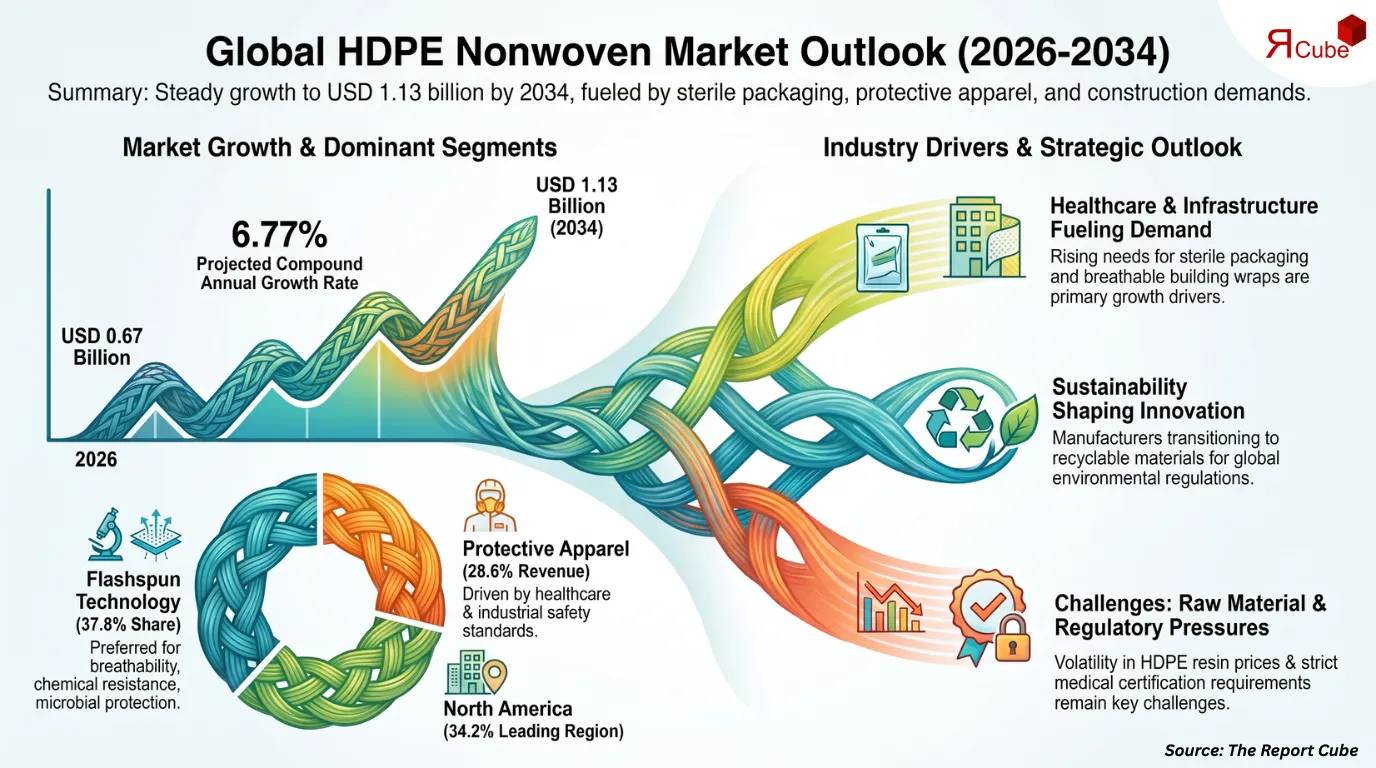
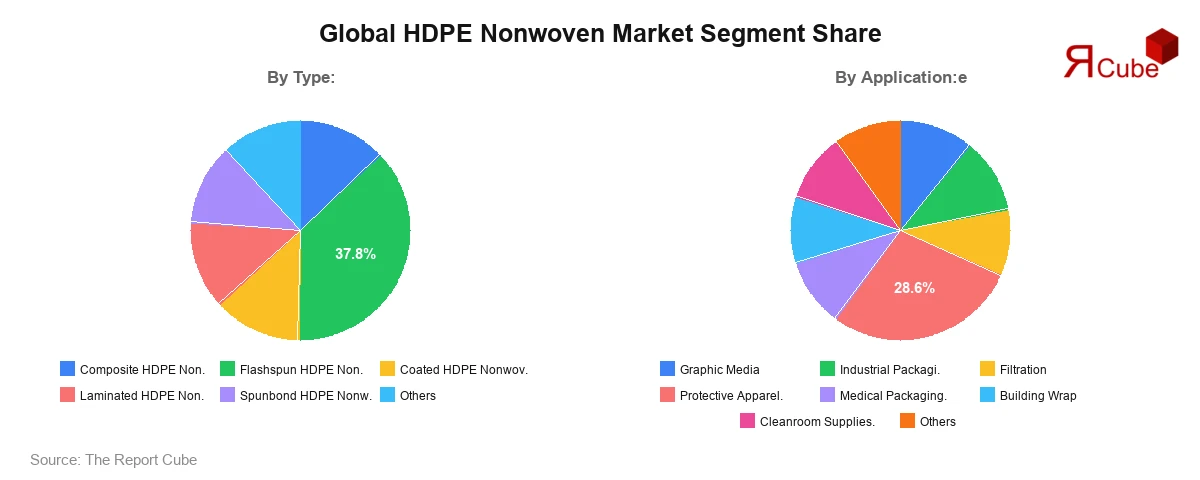
Flashspun HDPE Nonwoven segment leads the market with approximately 37.8% share.
By Application:
Protective Apparel segment dominates the market with nearly 28.6% of total revenue.
Regional Outlook:
North America dominates the Global HDPE Nonwoven Market with around 34.2% market share.
Global HDPE Nonwoven Market Insights & Analysis
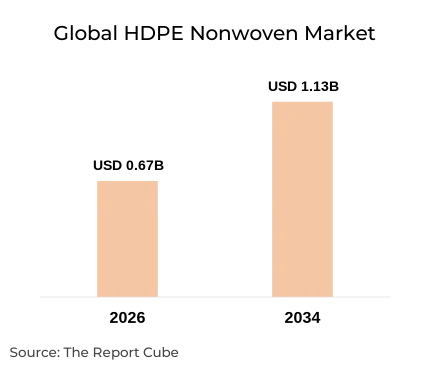
The Global HDPE Nonwoven Market is anticipated to register a CAGR of around 6.77% during the forecast period 2026-2034. The market size is valued at USD 0.67 billion in 2026 and is projected to reach USD 1.13 billion by 2034. Market growth is supported by rising demand for lightweight, durable, and chemically resistant materials across healthcare, industrial packaging, construction, cleanroom operations, and protective clothing applications. HDPE nonwoven products are increasingly preferred because they provide excellent moisture resistance, high tensile strength, and breathable protection while remaining lightweight. Growing investments in advanced packaging technologies, sterile medical packaging, and building envelope systems are expanding product adoption across developed and emerging economies. Manufacturers are also introducing recyclable and lower environmental impact production processes to meet evolving sustainability goals while improving product performance.
Continuous innovation in flashspun technology, multilayer composites, and laminated HDPE nonwoven materials is creating new opportunities for manufacturers serving healthcare, pharmaceutical packaging, filtration, and industrial safety markets. Government investments in healthcare infrastructure, stricter workplace safety regulations, and increasing construction activity are supporting steady demand worldwide. Companies continue expanding production capacity, strengthening regional distribution networks, and investing in material science to improve barrier protection and product durability. Strategic mergers, technology partnerships, and product portfolio diversification are also strengthening market competition. Growing demand for sterile barrier systems, protective apparel, building wraps, and cleanroom supplies is expected to maintain stable long-term market growth while encouraging further innovation throughout the HDPE nonwoven value chain.
Global HDPE Nonwoven Market Impact Analysis
| Factor | Type | Specific Impact on Market | Magnitude | Business Implication |
|---|---|---|---|---|
| Rising Demand for Geotextiles | Market | Infrastructure and agriculture projects lift geotextile usage globally | High | Supports long term volume growth in construction and soil control uses |
| Growth in Medical and Hygiene Uses | Consumer | Increased need for medical packaging and protective disposables worldwide | High | Encourages capacity addition for healthcare grade HDPE nonwoven lines |
| Shift Toward Sustainable Materials | Environmental | Preference for recyclable nonwovens strengthens HDPE adoption rates | Medium | Drives innovation in eco designed grades and recycling capabilities |
| Advances in Spunbond Technologies | Technological | Improved spunbond lines enhance output and fabric performance levels | Medium | Supports cost optimization and premium product differentiation globally |
| Availability of Substitute Materials | Competitive | PP and PET nonwovens compete in packaging and hygiene segments | Medium | Necessitates focus on niche properties and application specific value |
| Macroeconomic and Geopolitical Volatility | Environmental | War and inflation cycles influence input prices and end demand | Medium | Requires dynamic pricing, hedging and diversified regional exposure |
| Strong Global Volume Growth Outlook | Market | Market value expected to rise with mid to high single digit CAGR | High | Supports strategic capacity expansion and long horizon investment plans |
Global HDPE Nonwoven Market Dynamics
Key Driver: Expanding Healthcare Packaging and Personal Protection Requirements
Healthcare systems worldwide continue to increase their use of HDPE nonwoven materials for sterile medical packaging, surgical products, protective clothing, and cleanroom supplies. These materials provide reliable microbial protection, moisture resistance, and mechanical strength while remaining lightweight and easy to process. Rising production of pharmaceutical products, medical devices, and diagnostic equipment has increased the need for dependable packaging materials that preserve product quality throughout storage and transportation. Growing healthcare expenditure across both developed and developing countries is further supporting long-term demand for advanced HDPE nonwoven solutions.
Industrial workplaces are also adopting higher safety standards that encourage wider use of protective apparel manufactured from HDPE nonwoven fabrics. Chemical processing facilities, laboratories, electronics manufacturing plants, and biotechnology companies require protective garments capable of resisting contamination while maintaining worker comfort. Product manufacturers continue introducing improved material structures that deliver better breathability without compromising barrier performance. This steady expansion across healthcare and industrial safety applications remains a primary contributor to the overall HDPE nonwoven market growth.
Industry Trends: Product Innovation Focused on Sustainability and High-Performance Materials
Material innovation remains central to market competition as manufacturers develop HDPE nonwoven products with greater durability, improved recyclability, and enhanced barrier protection. Flashspun and laminated structures continue gaining acceptance because they deliver superior performance across healthcare, construction, industrial packaging, and cleanroom applications. Production facilities are increasingly incorporating automated inspection systems and advanced process controls that improve product consistency while reducing material waste and operational costs. These investments are helping manufacturers meet stricter quality standards demanded by highly regulated industries.
Environmental performance has become an important purchasing consideration across global packaging and construction markets. Companies are introducing recyclable product portfolios, reducing manufacturing emissions, and optimizing material utilization throughout production cycles. Research activities are also focused on improving product strength while lowering overall material consumption. These advancements are supporting wider adoption of HDPE nonwoven materials in sustainable construction, protective packaging, filtration, and industrial applications where durability and environmental responsibility are equally important.
Book your FREE 30-minute expert consultation today
Contact UsMajor Challenge: Fluctuating Raw Material Costs and Regulatory Compliance
Volatility in high-density polyethylene resin prices continues to influence manufacturing costs throughout the HDPE nonwoven industry. Price movements in global petrochemical markets directly affect production expenses, making long-term pricing strategies more challenging for manufacturers and converters. Energy costs, transportation expenses, and occasional supply chain disruptions further increase cost uncertainty across several production regions. Smaller manufacturers often experience greater margin pressure because they possess fewer opportunities to secure long-term raw material contracts.
Compliance with increasingly rigorous environmental and product quality regulations also requires ongoing investment. Medical packaging and protective apparel manufacturers must satisfy strict certification requirements relating to product performance, safety, and manufacturing quality systems. At the same time, governments continue introducing sustainability measures that encourage greater material recovery and recycling. Balancing regulatory compliance with cost competitiveness remains a significant operational challenge for companies serving multiple international markets.
Opportunity: Growing Adoption Across Construction, Cleanroom, and Industrial Packaging Industries
Infrastructure development and industrial modernization continue creating attractive opportunities for HDPE nonwoven manufacturers. Construction companies are increasing the use of breathable building wraps that improve moisture control, thermal efficiency, and structural durability. Demand for advanced building envelope materials is expanding alongside investments in residential housing, commercial facilities, and energy-efficient construction projects. These applications require durable nonwoven products capable of delivering long-term weather protection under demanding operating conditions.
Additional opportunities are emerging from pharmaceutical manufacturing, semiconductor production, biotechnology, and high-value industrial packaging. Cleanroom operators require contamination-resistant materials that maintain product integrity throughout sensitive manufacturing processes. Logistics providers are also increasing the use of durable HDPE nonwoven envelopes and protective packaging to improve shipment security while reducing packaging weight. Continued product innovation, expanding industrial applications, and stronger investment in sustainable material technologies are expected to create favorable growth prospects for the Global HDPE Nonwoven Market during the forecast period.
Global HDPE Nonwoven Market Segment-wise Analysis
By Type:
- Composite HDPE Nonwoven
- Flashspun HDPE Nonwoven
- Coated HDPE Nonwoven
- Laminated HDPE Nonwoven
- Spunbond HDPE Nonwoven
- Others
Flashspun HDPE Nonwoven emerged as the leading product segment, accounting for nearly 37.8% of the Global HDPE Nonwoven Market in 2026. Its leadership is supported by an exceptional combination of strength, lightweight construction, breathability, and resistance to water, chemicals, and microorganisms. These performance characteristics make flashspun materials the preferred choice for medical packaging, sterile barrier systems, protective apparel, cleanroom products, and building wrap applications where product integrity is essential. Continuous expansion of pharmaceutical manufacturing, healthcare infrastructure, and industrial safety programs has strengthened demand for premium-grade flashspun materials across developed and emerging economies.
Manufacturers continue investing in advanced flashspun production technologies to improve material consistency, tensile strength, and barrier performance while reducing manufacturing waste. Product innovation is also focused on enhancing recyclability and improving processing efficiency without compromising protective properties. Growing adoption across logistics, construction, and industrial packaging industries is creating additional revenue opportunities for suppliers. As regulatory standards become more stringent for healthcare packaging and protective products, flashspun HDPE nonwoven is expected to maintain its dominant position throughout the forecast period.
By Application:
- Graphic Media
- Industrial Packaging
- Filtration
- Protective Apparel
- Medical Packaging
- Building Wrap
- Cleanroom Supplies
- Sterile Barrier Systems
- Tags and Labels
- Others
Protective Apparel represented approximately 28.6% of global revenue in 2026, making it the largest application segment within the Global HDPE Nonwoven Market. Industries including healthcare, pharmaceuticals, biotechnology, chemical processing, and manufacturing increasingly rely on disposable protective garments to safeguard workers against contaminants and hazardous substances. HDPE nonwoven fabrics offer excellent durability, liquid resistance, breathability, and wearer comfort, making them highly suitable for coveralls, laboratory garments, and cleanroom clothing. Rising awareness regarding workplace safety and infection prevention continues supporting long-term demand for these materials.
Regulatory agencies across several countries continue strengthening occupational safety requirements, encouraging employers to adopt certified personal protective equipment across industrial operations. At the same time, healthcare providers are expanding the use of disposable protective clothing to improve infection control practices. Manufacturers are responding by developing lighter, stronger, and more comfortable HDPE nonwoven fabrics with enhanced barrier performance. Continued investment in advanced protective apparel technologies and increasing industrial safety compliance are expected to reinforce the segment's market leadership during the forecast period.
Regional Projection of Global HDPE Nonwoven Industry
- North America
- Europe
- Asia Pacific
- Middle East and Africa
- South America
North America accounted for nearly 34.2% of the Global HDPE Nonwoven Market in 2026, maintaining its position as the leading regional market. The region benefits from advanced healthcare systems, well-established pharmaceutical manufacturing, strong industrial packaging capabilities, and widespread adoption of high-performance construction materials. Demand remains particularly strong for sterile medical packaging, cleanroom products, building wraps, and protective apparel across the United States and Canada. Continuous investments in healthcare modernization and industrial automation further support consumption of premium HDPE nonwoven materials.
Regional manufacturers continue strengthening production capacity through investments in material science, sustainable manufacturing technologies, and product innovation. Increasing emphasis on recyclable packaging solutions and energy-efficient building materials is encouraging broader adoption of HDPE nonwoven products across commercial construction, logistics, and industrial applications. Strong research capabilities, established distribution networks, and the presence of major global manufacturers enable North America to remain a leading contributor to market revenue while supporting future technological advancements across the HDPE nonwoven industry.
Need insights for a specific region within this market?
Request Regional DataGlobal HDPE Nonwoven Market Regional Analysis
The HDPE nonwoven market shows varied regional dynamics driven by construction, packaging, hygiene and regulatory trends worldwide.
| Region | Demand Level | Key Areas | System Dominance | Core Demand Logic | Growth Nature |
|---|---|---|---|---|---|
| North America | High | U.S., Canada industrial belts | Medical & hygiene nonwovens | Sterile packaging and protective apparel needs | Steady, innovation-led expansion |
| Europe | Medium to High | Germany, France, U.K., Italy | Automotive, medical, filtration grades | Regulated, sustainability-focused demand | Compliance-driven, technology upgrades |
| Asia Pacific | Very High | China, India, Japan, ASEAN hubs | Geotextiles & packaging nonwovens | Urbanization, infrastructure and e-commerce | Fastest-growing, volume-centric growth |
| Middle East & Africa | Emerging | UAE, Saudi Arabia, South Africa | Construction and agriculture fabrics | Infrastructure and water management projects | Project-led, intermittent acceleration |
| South America | Moderate | Brazil, Mexico, Argentina | Packaging and agro-textile nonwovens | Crop protection and consumer packaging | Cyclical, tied to economic stability |
Government Initiatives & Policies
- United States Healthcare Supply Chain Resilience: During 2025, U.S. agencies continued initiatives to strengthen domestic production of medical products and critical healthcare supplies, supporting demand for high-performance medical packaging and protective nonwoven materials.
- European Union Circular Economy Action Plan: The European Union continued implementing circular economy measures during 2025-2026 that encourage recyclable materials, sustainable packaging innovation, and responsible plastic use, promoting investment in recyclable HDPE nonwoven solutions.
Global HDPE Nonwoven Industry Recent Developments
- 2025: Amcor plc completed its combination with Berry Global, creating a broader consumer and healthcare packaging platform. The transaction expands material science capabilities, strengthens packaging innovation, and supports future development of advanced protective packaging applications utilizing high-performance nonwoven materials.
- 2025: DuPont de Nemours, Inc. updated its corporate separation strategy while retaining industrial material businesses that include Tyvek-related applications. The decision provides continuity for healthcare, construction, and industrial customers relying on HDPE nonwoven products for protective barriers, sterile packaging, and building envelope applications.
Why Choose This Report?
- Provides a comprehensive overview of the overall market analysis, encompassing key trends, consumer behavior analysis, and risk assessment to support strategic decision-making.
- Provides accurate, up-to-date insights into market size, segmentation, and emerging opportunities, helping to minimize risk while capitalizing on growth opportunities.
- Gives deep understanding of target audience preferences, investment habits, and communication channels for enhanced product development and marketing effectiveness.
- Delivers competitive analysis and benchmarking, uncovering the strengths and weaknesses of market competitors to guide business strategies.
- Consolidates comprehensive market intelligence, reducing research efforts and streamlining strategic planning.
- Facilitates customized market segmentation and risk mitigation strategies, fine-tuned to specific business objectives.
- Aids in identifying both market challenges and untapped opportunities within the industry to drive long-term business growth.
- Provides valuable information based on actual customer demand patterns, industry developments, and search trends.
Table of Contents
- Introduction
- Objective of the Study
- Product and Category Definition
- Market Segmentation
- Study Variables
- Research Methodology
- Secondary Data Points
- Breakdown of Secondary Sources
- Primary Data Points
- Breakdown of Primary Interviews
- Secondary Data Points
- Executive Summary
- Market Dynamics
- Emerging Opportunities
- Adoption Trends
- Demand Drivers
- Disruption Analysis (Challenges)
- Industry Analysis & Strategic Insights
- Supply/Value Chain Analysis
- Pricing Analysis
- Go-To-Market (GTM) Strategy
- BCG Matrix
- Recent Trends and Developments
- Import and Export Analysis
- Regulatory and Policy Landscape
- Region-wise Policies
- Government Initiatives
- Global HDPE Nonwoven Market Overview and Forecast Analysis (2021-2034)
- Market Size, By Value, By Growth Rate (CAGR/USD Billion)
- Market Share, By Type
- Composite HDPE Nonwoven
- Flashspun HDPE Nonwoven
- Coated HDPE Nonwoven
- Laminated HDPE Nonwoven
- Spunbond HDPE Nonwoven
- Others
- Market Share, By Basis Weight
- Below 40 GSM
- 41 To 80 GSM
- 81 To 120 GSM
- 120 GSM Above
- Market Share, By Form
- Envelopes
- Sheets
- Rolls
- Tapes
- Coveralls
- Pouches
- Laminates
- Others
- Market Share, By Application
- Graphic Media
- Industrial Packaging
- Filtration
- Protective Apparel
- Medical Packaging
- Building Wrap
- Cleanroom Supplies
- Sterile Barrier Systems
- Tags And Labels
- Others
- Market Share, By End-User
- Printing and Graphics Companies
- Healthcare and Medical Device Companies
- Industrial Packaging Companies
- Cleanroom Operators
- Personal Protective Equipment Manufacturers
- Construction and Building Envelope Companies
- Logistics and Mailing Companies
- Pharmaceutical Packaging Companies
- Others
- Market Share, By Region
- North America
- Europe
- Asia Pacific
- Middle East and Africa
- South America
- Market Share, By Company
- Revenue Shares and Analysis
- Competitive Landscape
- North America HDPE Nonwoven Market Overview and Forecast Analysis (2021-2034)
- Market Size, By Value, By Growth Rate (CAGR/USD Billion/Million)
- Market Share, By Type
- Market Share, By Basis Weight
- Market Share, By Form
- Market Share, By Application
- Market Share, By End-User
- Market Share, By Country
- The United States
- Canada
- Mexico
- Rest of North America
- Europe HDPE Nonwoven Market Overview and Forecast Analysis (2021-2034)
- Market Size, By Value, By Growth Rate (CAGR/USD Billion/Million)
- Market Share, By Type
- Market Share, By Basis Weight
- Market Share, By Form
- Market Share, By Application
- Market Share, By End-User
- Market Share, By Country
- Germany
- The United Kingdom
- France
- Italy
- Spain
- Netherlands
- Russia
- Poland
- Belgium
- Sweden
- Rest of Europe
- Asia Pacific HDPE Nonwoven Market Overview and Forecast Analysis (2021-2034)
- Market Size, By Value, By Growth Rate (CAGR/USD Billion/Million)
- Market Share, By Type
- Market Share, By Basis Weight
- Market Share, By Form
- Market Share, By Application
- Market Share, By End-User
- Market Share, By Country
- China
- India
- Japan
- South Korea
- Australia
- Indonesia
- Thailand
- Malaysia
- Vietnam
- Philippines
- Singapore
- New Zealand
- Rest of Asia Pacific
- Middle East and Africa HDPE Nonwoven Market Overview and Forecast Analysis (2021-2034)
- Market Size, By Value, By Growth Rate (CAGR/USD Billion/Million)
- Market Share, By Type
- Market Share, By Basis Weight
- Market Share, By Form
- Market Share, By Application
- Market Share, By End-User
- Market Share, By Country
- Saudi Arabia
- The United Arab Emirates
- South Africa
- Egypt
- Nigeria
- Morocco
- Turkey
- Rest of the Middle East and Africa
- South America HDPE Nonwoven Market Overview and Forecast Analysis (2021-2034)
- Market Size, By Value, By Growth Rate (CAGR/USD Billion/Million)
- Market Share, By Type
- Market Share, By Basis Weight
- Market Share, By Form
- Market Share, By Application
- Market Share, By End-User
- Market Share, By Country
- Brazil
- Argentina
- Chile
- Colombia
- Peru
- Rest of South America
- Competitive Analysis, 2026
- Market Share of Key Players
- Competitive Mapping for Each Type, Basis Weight, Form, Application, and End-User
- North America HDPE Nonwoven Companies Share and Competitive Analysis, 2026
- Europe HDPE Nonwoven Companies Share and Competitive Analysis, 2026
- Asia Pacific HDPE Nonwoven Companies Share and Competitive Analysis, 2026
- Middle East and Africa HDPE Nonwoven Companies Share and Competitive Analysis, 2026
- South America HDPE Nonwoven Companies Share and Competitive Analysis, 2026
- Company Profile (Partial List)
- Fibertex Nonwovens A/S
- Company Overview
- Product Portfolio
- Strategic Alliances/Partnerships
- Recent Developments
- Don and Low Ltd.
- Freudenberg SE
- Asahi Kasei Corporation
- Johns Manville Corporation
- Xinlong Holding Group Company Ltd.
- DuPont de Nemours, Inc.
- TWE Group GmbH
- Mogul Co., Ltd.
- Zhejiang Kingsafe Nonwovens Co., Ltd.
- Sandler AG
- PFNonwovens Holding s.r.o.
- Suominen Corporation
- Toray Industries, Inc.
- Tex Tech Industries, Inc.
- Ahlstrom Oyj
- Avgol Industries 1953 Ltd.
- Magnera Corporation
- Fitesa S.A.
- Mitsui Chemicals, Inc.
- Others (Partial List)
- Fibertex Nonwovens A/S
- Contact Us and Disclaimer
Top Key Players & Market Share Outlook
- Fibertex Nonwovens A/S
- Don and Low Ltd.
- Freudenberg SE
- Asahi Kasei Corporation
- Johns Manville Corporation
- Xinlong Holding Group Company Ltd.
- DuPont de Nemours, Inc.
- TWE Group GmbH
- Mogul Co., Ltd.
- Zhejiang Kingsafe Nonwovens Co., Ltd.
- Sandler AG
- PFNonwovens Holding s.r.o.
- Suominen Corporation
- Toray Industries, Inc.
- Tex Tech Industries, Inc.
- Ahlstrom Oyj
- Avgol Industries 1953 Ltd.
- Magnera Corporation
- Fitesa S.A.
- Mitsui Chemicals, Inc.
Frequently Asked Questions






