



Build Your Custom Market Intelligence Report
Customize Your ReportGlobal Thermoplastic Vulcanizate (TPV) Market Key Highlights
By Product:
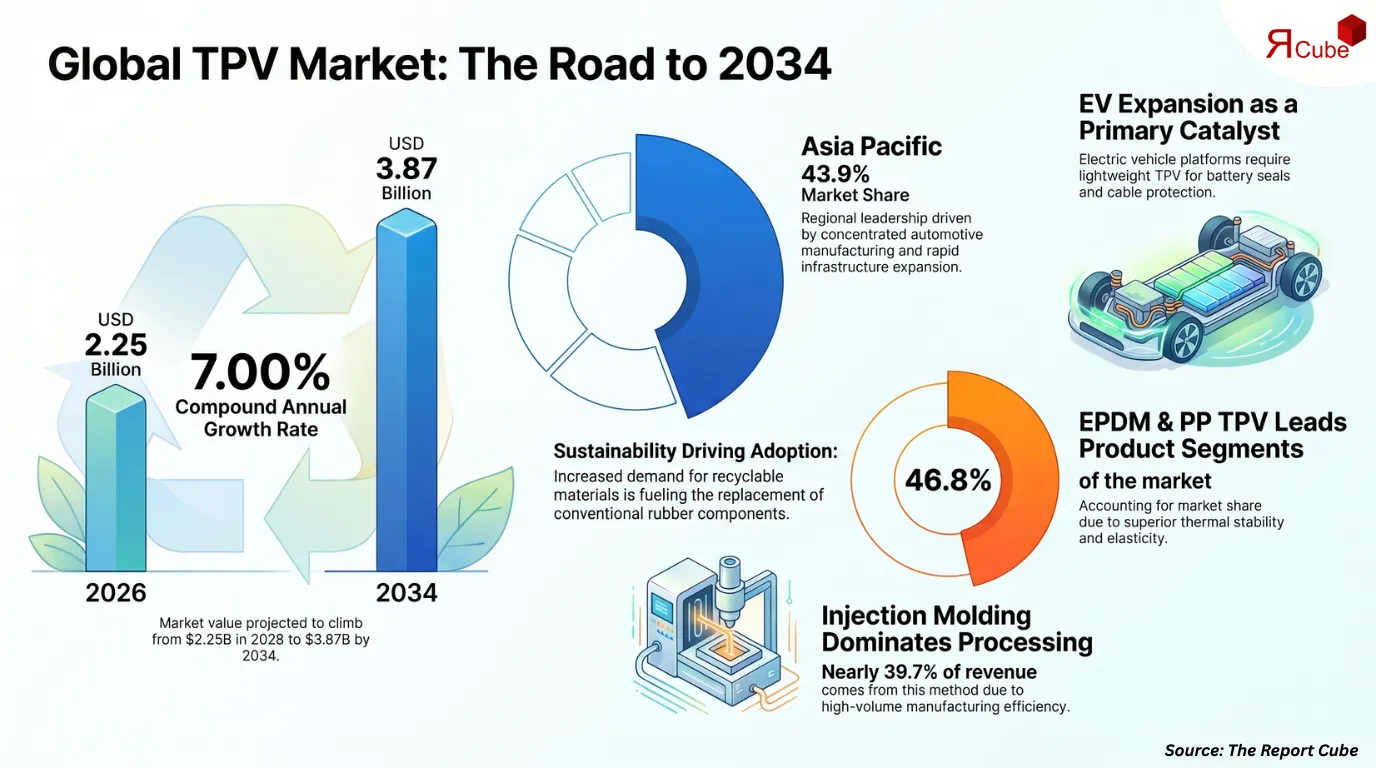
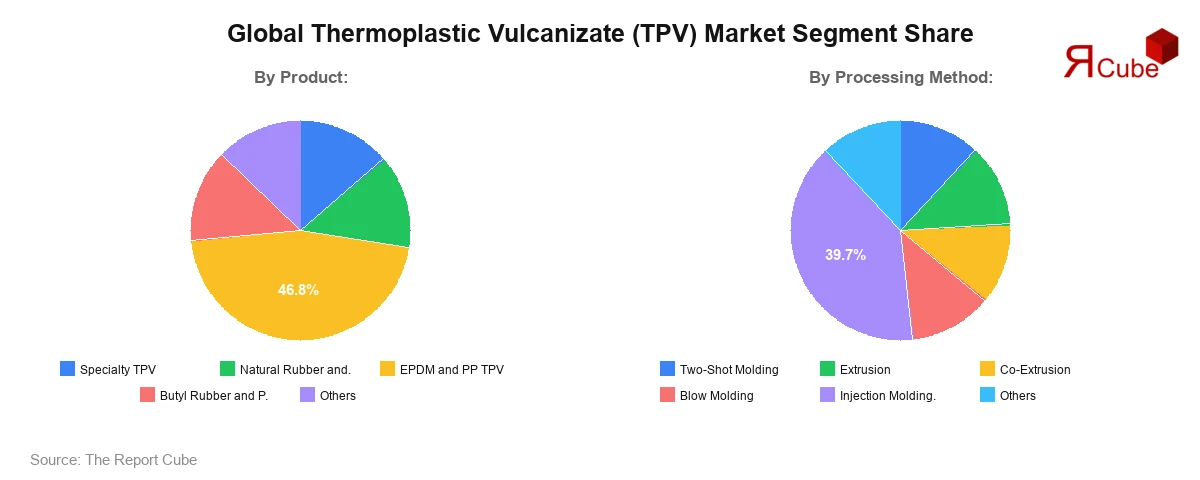
EPDM and PP TPV segment leads the market with approximately 46.8% share.
By Processing Method:
Injection Molding segment dominates the market with nearly 39.7% of total revenue.
Regional Outlook:
Asia Pacific dominates the Global Thermoplastic Vulcanizate (TPV) Market with around 43.9% market share.
Global Thermoplastic Vulcanizate (TPV) Market Insights & Analysis
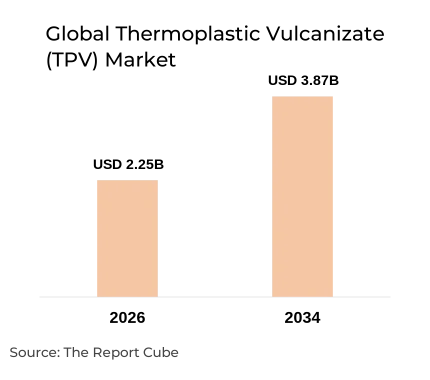
The Global Thermoplastic Vulcanizate (TPV) Market is anticipated to register a CAGR of around 7.00% during the forecast period 2026-2034. The market size is valued at USD 2.25 Billion in 2026 and is projected to reach USD 3.87 Billion by 2034. Market growth is being supported by rising adoption of lightweight and recyclable elastomer materials across automotive, consumer goods, healthcare, electrical, and construction industries. TPV materials combine the elasticity of thermoset rubber with the processing efficiency of thermoplasticis, making them an attractive solution for manufacturers seeking improved durability, chemical resistance, and design flexibility. Increasing replacement of conventional rubber components with recyclable TPV compounds is strengthening demand as manufacturers focus on sustainability and lower production costs. The market also benefits from expanding electric vehicle production, where lightweight sealing systems, weather strips, cable protection, and under-the-hood components are becoming increasingly important.
Continuous investments in advanced polymer technologies, customized material formulations, and high-performance compounding are creating new opportunities across industrial applications. Leading manufacturers are introducing specialty TPV grades with improved heat resistance, UV stability, flame retardancy, and lower volatile organic compound emissions to meet evolving regulatory standards. Growth in global infrastructure projects, consumer appliances, and medical devices is also increasing demand for durable elastomer solutions that offer efficient processing through injection molding and extrusion. Furthermore, the expansion of manufacturing capacity across the Asia Pacific, increasing investments in electric mobility, and greater emphasis on circular economy initiatives are expected to support long-term growth of the thermoplastic vulcanizates market throughout the forecast period.
Global Thermoplastic Vulcanizate (TPV) Market Impact Analysis
| Factor | Type | Specific Impact on Market | Magnitude | Business Implication |
|---|---|---|---|---|
| Automotive Lightweighting Demand | Market | TPV usage rises as automakers replace metals and PVC parts | High | Supports sustained TPV volume growth in seals and interiors |
| Stringent Emission Regulations | Regulatory | Rules on fuel economy push OEMs toward lighter TPV materials | High | Creates long term TPV demand in mobility and transport systems |
| Shift to Electric Vehicles | Technological | EV platforms need durable, light and recyclable polymer parts | High | Opens design wins in gaskets, cable jackets and under hood uses |
| Growth in Construction and Infrastructure | Market | Rising projects spur need for flexible seals and profiles | Medium | Boosts TPV demand in glazing, roofing and expansion joints |
| Healthcare and Consumer Applications | Consumer | Preference grows for soft touch, PVC free medical components | Medium | Supports TPV use in tubing, grips and handheld device parts |
| Raw Material Cost Volatility | Environmental | Fluctuating EPDM and oil prices pressure producer margins | Medium | Needs pricing discipline, hedging and efficiency in compounding |
| Asia Pacific Industrialization | Competitive | Regional manufacturers expand capacity and export capability | High | Intensifies price pressure but deepens TPV penetration globally |
Global Thermoplastic Vulcanizate (TPV) Market Dynamics
Key Driver: Automotive Lightweighting Accelerates Adoption of High-Performance TPV Materials
Automotive manufacturers continue replacing traditional rubber materials with thermoplastic vulcanizates to improve vehicle efficiency without compromising mechanical performance. TPV compounds combine flexibility, excellent sealing capability, chemical resistance, and weather durability while allowing faster processing through conventional thermoplastic manufacturing technologies. These characteristics make them well suited for weather seals, glass run channels, under-the-hood components, battery sealing systems, cable insulation, and vibration management applications. The increasing production of electric vehicles further strengthens material demand because lightweight elastomers directly contribute to extending vehicle driving range and improving overall energy efficiency.
Vehicle platforms are also becoming more modular, requiring materials that perform consistently across multiple applications while reducing manufacturing complexity. TPV enables component consolidation, improved design flexibility, and easier recycling compared with thermoset rubber, supporting sustainability objectives throughout the automotive supply chain. As global OEMs continue investing in electrification and advanced vehicle architectures, demand for high-performance TPV compounds is expected to increase steadily across both passenger and commercial vehicle segments, reinforcing long-term thermoplastic vulcanizates market growth.
Industry Trends: Material Innovation Broadens Industrial and Consumer Applications
Product innovation remains central to competition within the global TPV industry. Material developers are expanding specialty compound portfolios with enhanced UV resistance, flame retardancy, low-temperature flexibility, and superior chemical stability to satisfy evolving customer requirements. These improvements enable TPV materials to penetrate applications beyond automotive manufacturing, including medical devices, electrical connectors, consumer appliances, industrial equipment, and building systems where long service life and reliable performance are critical. Customized formulations designed for specific processing conditions are becoming increasingly common as manufacturers seek greater product differentiation.
Modern compounding technologies and digital manufacturing systems are improving production consistency while allowing precise control over material properties. Advanced quality monitoring, automated processing, and formulation optimization have enabled suppliers to deliver compounds with tighter tolerances and improved repeatability. These technological advancements are strengthening customer confidence, reducing production waste, and expanding the commercial viability of TPV across industries requiring durable, recyclable, and high-performance elastomer materials.
Book your FREE 30-minute expert consultation today
Contact UsMajor Challenge: Feedstock Cost Volatility Continues to Influence Manufacturing Economics
The profitability of TPV manufacturers remains closely connected to fluctuations in petrochemical feedstock prices. Polypropylene, EPDM rubber, specialty additives, and performance modifiers are directly affected by changes in crude oil and natural gas markets, creating uncertainty in raw material procurement. Cost variations influence pricing strategies throughout the supply chain and often compress operating margins, particularly during periods of elevated transportation costs or regional supply disruptions. Manufacturers therefore face ongoing pressure to improve operational efficiency while maintaining product quality and competitive pricing.
Competitive pressure is also increasing as alternative thermoplastic elastomers, silicone materials, and advanced engineering polymers continue expanding into selected applications. End users evaluate materials based on performance, processing efficiency, sustainability, and total ownership cost rather than material type alone. To remain competitive, TPV producers must continuously invest in research, customized product development, and manufacturing modernization while carefully managing production costs in an increasingly competitive global marketplace.
Opportunity: Sustainable Manufacturing and Electrification Create Long-Term Growth Potential
Industrial manufacturers are increasingly integrating recyclable materials into product development strategies as environmental regulations become more stringent worldwide. Thermoplastic vulcanizates support these objectives by combining excellent mechanical performance with thermoplastic recyclability, reducing manufacturing waste and improving production efficiency. This advantage is encouraging broader adoption across electrical infrastructure, renewable energy systems, healthcare equipment, consumer products, and advanced industrial machinery where long-term durability and material consistency remain essential.
The rapid expansion of electric mobility presents an equally significant opportunity for TPV suppliers. Battery systems, charging infrastructure, high-voltage cable protection, thermal management components, and advanced sealing applications require lightweight materials capable of maintaining performance under demanding operating conditions. Continued investments in electric vehicle manufacturing, battery production facilities, and sustainable industrial technologies are expected to strengthen demand for advanced TPV compounds throughout the forecast period, supporting healthy expansion of the global thermoplastic vulcanizates market.
Global Thermoplastic Vulcanizate (TPV) Market Segment-wise Analysis
By Product:
- Specialty TPV
- Natural Rubber and PP TPV
- EPDM and PP TPV
- Butyl Rubber and PP TPV
- Others
Among all product categories, EPDM and PP TPV accounted for the largest revenue contribution, representing approximately 46.8% of the global market in 2026. The segment maintains its leadership because EPDM-based TPV delivers an optimal combination of elasticity, thermal stability, ozone resistance, and long-term mechanical performance. These characteristics make the material particularly suitable for automotive weather seals, under-the-hood air management systems, fluid transfer components, cable protection, and industrial sealing applications exposed to demanding operating environments. Compared with conventional rubber compounds, EPDM and PP TPV enables shorter production cycles through thermoplastic processing while maintaining excellent resilience over extended service life.
Material manufacturers continue refining EPDM-based formulations to improve scratch resistance, color stability, low-temperature flexibility, and chemical compatibility for next-generation engineering applications. Growing production of electric vehicles has created additional demand for lightweight elastomer components capable of supporting battery protection systems and high-voltage electrical assemblies. Demand from construction products, consumer appliances, and industrial machinery has also strengthened as manufacturers increasingly prioritize recyclable materials that simplify manufacturing without compromising durability. Continuous investment in specialty compounding technologies is expected to reinforce the segment's leadership throughout the forecast period while supporting steady expansion of the thermoplastic vulcanizates market size, market share, and overall industry growth.
By Processing Method:
- Two-Shot Molding
- Extrusion
- Co-Extrusion
- Blow Molding
- Injection Molding
- Others
Injection Molding represented the largest processing method with nearly 39.7% of global revenue in 2026. Manufacturers favor this production technology because it supports high-volume manufacturing while delivering consistent dimensional accuracy, excellent surface finish, and efficient material utilization. The process is extensively employed for automotive interior components, sealing systems, medical device parts, consumer products, electrical housings, and industrial equipment where complex geometries and repeatable quality standards are essential. Faster production cycles combined with reduced finishing requirements further improve manufacturing efficiency, making injection molding the preferred processing solution across numerous TPV applications.
Technological advancements in automated molding equipment, digital process monitoring, and precision tooling continue enhancing production productivity and product consistency. Manufacturers are also integrating advanced robotics and smart manufacturing solutions to minimize cycle times, improve quality assurance, and optimize material consumption. As end-use industries demand increasingly sophisticated elastomer components with tighter engineering tolerances, injection molding is expected to remain the dominant processing technology supporting long-term growth across the global thermoplastic vulcanizates market.
Regional Projection of Global Thermoplastic Vulcanizate (TPV) Industry
- North America
- Europe
- Asia Pacific
- Middle East and Africa
- South America
Asia Pacific remained the largest regional market, accounting for approximately 43.9% of global revenue in 2026. Regional leadership is supported by the concentration of automotive manufacturing, polymer processing industries, electronics production, and rapidly expanding industrial infrastructure across China, Japan, South Korea, India, and Southeast Asia. The region has become a strategic manufacturing hub for both domestic consumption and exports, encouraging continuous investment in advanced elastomer production capacity. Increasing vehicle production, expanding electric mobility initiatives, and sustained infrastructure development continue strengthening demand for durable, lightweight, and recyclable TPV materials.
Manufacturing competitiveness across Asia Pacific is further reinforced by established petrochemical supply chains, growing research capabilities, and rising investments in advanced material engineering. Governments throughout the region continue supporting industrial modernization, electric vehicle production, and sustainable manufacturing through long-term industrial policies and investment incentives. Strong demand from construction materials, electrical equipment, consumer appliances, and industrial machinery further broadens the regional application base. With ongoing capacity expansion by global compound manufacturers and increasing adoption of advanced thermoplastic elastomers across diverse industries, Asia Pacific is expected to maintain its dominant position throughout the forecast period.
Need insights for a specific region within this market?
Request Regional DataRegional Analysis of Global Thermoplastic Vulcanizate (TPV) Market
The global TPV market shows varied regional growth, driven by automotive, industrial, and regulatory trends across key geographies.
| Region | Demand Level | Key Areas | System Dominance | Core Demand Logic | Growth Nature |
|---|---|---|---|---|---|
| North America | Very High | US Midwest, US South, Ontario | Automotive TPV compounds | Lightweighting and fuel efficiency | Mature, innovation‑led growth |
| Europe | High | Germany, France, Italy, UK | Under‑hood and sealing TPV | Strict EU emission regulations | Steady, regulation‑driven |
| Asia Pacific | Extremely High | China, Japan, India, ASEAN | Automotive and consumer TPV | Auto output and low labor costs | Fastest‑growing volume hub |
| Middle East and Africa | Medium | Turkey, GCC, South Africa | Construction and industrial TPV | Infra build‑out and piping use | Emerging, project‑linked |
| South America | Medium | Brazil, Mexico, Argentina | Automotive and OEM TPV | Local auto and export bases | Cyclical, OEM‑driven growth |
Government Initiatives & Policies
- European Union Circular Economy Action Plan (Implementation 2025-2026): The European Union continues promoting recyclable polymers, sustainable product design, and increased recycled material usage across automotive and manufacturing industries, encouraging wider adoption of thermoplastic vulcanizates and other recyclable elastomers.
- U.S. Department of Energy Vehicle Technologies Office (2025-2026 Programs): The U.S. Department of Energy continues supporting lightweight materials, advanced polymers, and electric vehicle component innovation through research funding that benefits high-performance TPV applications across transportation industries.
Global Thermoplastic Vulcanizate (TPV) Industry Recent Developments
- 2026: Celanese Corporation continued strengthening the market presence of its Santoprene TPV portfolio across automotive, industrial, consumer, and healthcare applications. The company emphasized durable sealing performance, lightweight material solutions, recyclability, and efficient thermoplastic processing to support manufacturers seeking sustainable elastomer alternatives.
- 2025: Teknor Apex Company expanded the promotion of its Sarlink TPV compounds for automotive, construction, industrial, and consumer applications. The company highlighted improved weather resistance, chemical durability, and processing efficiency to address growing demand for high-performance thermoplastic elastomer solutions.
- 2025: KRAIBURG TPE GmbH and Co. KG enhanced its portfolio of customized thermoplastic elastomer compounds for mobility, industrial, and engineering applications. The initiative focused on delivering application-specific material solutions with improved mechanical performance, sustainability, and long-term durability for global customers.
- 2025: Elastron Kimya Sanayi ve Ticaret A.S. continued strengthening the positioning of its TPV and TPE compound portfolio across automotive, consumer goods, and industrial markets. The company also expanded its export activities while supporting customers with customized elastomer compounds for demanding engineering applications.
Why Choose This Report?
- Provides a comprehensive overview of the overall market analysis, encompassing key trends, consumer behavior analysis, and risk assessment to support strategic decision-making.
- Provides accurate, up-to-date insights into market size, segmentation, and emerging opportunities, helping to minimize risk and capitalize on growth.
- Gives deep understanding of target audience preferences, investment habits, and communication channels for enhanced product development and marketing effectiveness.
- Delivers competitive analysis and benchmarking, uncovering the strengths and weaknesses of market competitors to guide business strategies.
- Consolidates comprehensive market intelligence, reducing research efforts and streamlining strategic planning.
- Facilitates customized market segmentation and risk mitigation strategies, fine-tuned to specific business objectives.
- Aids in identifying both market challenges and untapped opportunities within the industry to drive long-term business growth.
- Provides valuable information based on actual customer data, industry developments, and evolving search trends.
Table of Contents
- Introduction
- Objective of the Study
- Product and Category Definition
- Market Segmentation
- Study Variables
- Research Methodology
- Secondary Data Points
- Breakdown of Secondary Sources
- Primary Data Points
- Breakdown of Primary Interviews
- Secondary Data Points
- Executive Summary
- Market Dynamics
- Emerging Opportunities
- Adoption Trends
- Demand Drivers
- Disruption Analysis (Challenges)
- Industry Analysis & Strategic Insights
- Supply/Value Chain Analysis
- Pricing Analysis
- Go-To-Market (GTM) Strategy
- BCG Matrix
- Recent Trends and Developments
- Import and Export Analysis
- Regulatory and Policy Landscape
- Region-wise policies
- Government Initiatives
- Global Thermoplastic Vulcanizate (TPV) Market Overview and Forecast Analysis (2021-2034)
- Market Size, By Value, By Growth Rate (CAGR/USD Billion)
- Market Share, By Product
- Specialty TPV
- Natural Rubber and PP TPV
- EPDM and PP TPV
- Butyl Rubber and PP TPV
- Others
- Market Share, By Processing Method
- Two-Shot Molding
- Extrusion
- Co-Extrusion
- Blow Molding
- Injection Molding
- Others
- Market Share, By Application
- Hoses and Tubing
- EV Battery Seals
- Building and Construction Seals
- Automotive Weather Seals
- Wire and Cable Jacketing
- Gaskets and O-Rings
- Medical and Healthcare Components
- Appliance Components
- Air Ducts and Boots
- Consumer Goods
- Others
- Market Share, By End-User
- Electrical and Electronics Companies
- Automotive Tier Suppliers
- Healthcare Product Manufacturers
- Automotive OEMs
- Consumer Goods Manufacturers
- Building and Construction Product Manufacturers
- Appliance Manufacturers
- Others
- Market Share, By Region
- North America
- Europe
- Asia Pacific
- Middle East and Africa
- South America
- Market Share, By Company
- Revenue Shares & Analysis
- Competitive Landscape
- North America Thermoplastic Vulcanizate (TPV) Market Overview and Forecast Analysis (2021-2034)
- Market Size, By Value, By Growth Rate (CAGR/USD Billion/Million)
- Market Share, By Product
- Market Share, By Processing Method
- Market Share, By Application
- Market Share, By End-User
- Market Share, By Country
- The United States
- Canada
- Mexico
- Rest of North America
- Europe Thermoplastic Vulcanizate (TPV) Market Overview and Forecast Analysis (2021-2034)
- Market Size, By Value, By Growth Rate (CAGR/USD Billion/Million)
- Market Share, By Product
- Market Share, By Processing Method
- Market Share, By Application
- Market Share, By End-User
- Market Share, By Country
- Germany
- The United Kingdom
- France
- Italy
- Spain
- Netherlands
- Russia
- Poland
- Belgium
- Sweden
- Rest of Europe
- Asia Pacific Thermoplastic Vulcanizate (TPV) Market Overview and Forecast Analysis (2021-2034)
- Market Size, By Value, By Growth Rate (CAGR/USD Billion/Million)
- Market Share, By Product
- Market Share, By Processing Method
- Market Share, By Application
- Market Share, By End-User
- Market Share, By Country
- China
- India
- Japan
- South Korea
- Australia
- Indonesia
- Thailand
- Malaysia
- Vietnam
- Philippines
- Singapore
- New Zealand
- Rest of Asia Pacific
- Middle East and Africa Thermoplastic Vulcanizate (TPV) Market Overview and Forecast Analysis (2021-2034)
- Market Size, By Value, By Growth Rate (CAGR/USD Billion/Million)
- Market Share, By Product
- Market Share, By Processing Method
- Market Share, By Application
- Market Share, By End-User
- Market Share, By Country
- Saudi Arabia
- The United Arab Emirates
- South Africa
- Egypt
- Nigeria
- Morocco
- Turkey
- Rest of the Middle East and Africa
- South America Thermoplastic Vulcanizate (TPV) Market Overview and Forecast Analysis (2021-2034)
- Market Size, By Value, By Growth Rate (CAGR/USD Billion/Million)
- Market Share, By Product
- Market Share, By Processing Method
- Market Share, By Application
- Market Share, By End-User
- Market Share, By Country
- Brazil
- Argentina
- Chile
- Colombia
- Peru
- Rest of South America
- Competitive Analysis, 2026
- Market Share of Key Players
- Competitive Mapping for Each Product, Processing Method, Application, and End-User
- North America Thermoplastic Vulcanizate (TPV) Companies Share & Competitive Analysis, 2026
- Europe Thermoplastic Vulcanizate (TPV) Companies Share & Competitive Analysis, 2026
- Asia Pacific Thermoplastic Vulcanizate (TPV) Companies Share & Competitive Analysis, 2026
- Middle East and Africa Thermoplastic Vulcanizate (TPV) Companies Share & Competitive Analysis, 2026
- South America Thermoplastic Vulcanizate (TPV) Companies Share & Competitive Analysis, 2026
- Company Profile (Partial List)
- KRAIBURG TPE GmbH and Co. KG
- Company Overview
- Product Portfolio
- Strategic Alliances/Partnerships
- Recent Developments
- RTP Company
- Company Overview
- Product Portfolio
- Strategic Alliances/Partnerships
- Recent Developments
- HEXPOL AB
- Company Overview
- Product Portfolio
- Strategic Alliances/Partnerships
- Recent Developments
- China Petroleum and Chemical Corporation
- Company Overview
- Product Portfolio
- Strategic Alliances/Partnerships
- Recent Developments
- Celanese Corporation
- Company Overview
- Product Portfolio
- Strategic Alliances/Partnerships
- Recent Developments
- Teknor Apex Company
- Company Overview
- Product Portfolio
- Strategic Alliances/Partnerships
- Recent Developments
- Avient Corporation
- Company Overview
- Product Portfolio
- Strategic Alliances/Partnerships
- Recent Developments
- Mitsubishi Chemical Group Corporation
- Company Overview
- Product Portfolio
- Strategic Alliances/Partnerships
- Recent Developments
- TSRC Corporation
- Company Overview
- Product Portfolio
- Strategic Alliances/Partnerships
- Recent Developments
- Kuraray Co., Ltd.
- Company Overview
- Product Portfolio
- Strategic Alliances/Partnerships
- Recent Developments
- LyondellBasell Industries N.V.
- Company Overview
- Product Portfolio
- Strategic Alliances/Partnerships
- Recent Developments
- LCY Chemical Corp.
- Company Overview
- Product Portfolio
- Strategic Alliances/Partnerships
- Recent Developments
- Zeon Corporation
- Company Overview
- Product Portfolio
- Strategic Alliances/Partnerships
- Recent Developments
- Ravago Group
- Company Overview
- Product Portfolio
- Strategic Alliances/Partnerships
- Recent Developments
- Audia Elastomers
- Company Overview
- Product Portfolio
- Strategic Alliances/Partnerships
- Recent Developments
- PolyOne Corporation
- Company Overview
- Product Portfolio
- Strategic Alliances/Partnerships
- Recent Developments
- Elastron Kimya Sanayi ve Ticaret A.S.
- Company Overview
- Product Portfolio
- Strategic Alliances/Partnerships
- Recent Developments
- Exxon Mobil Corporation
- Company Overview
- Product Portfolio
- Strategic Alliances/Partnerships
- Recent Developments
- Mitsui Chemicals, Inc.
- Company Overview
- Product Portfolio
- Strategic Alliances/Partnerships
- Recent Developments
- Trinseo PLC
- Company Overview
- Product Portfolio
- Strategic Alliances/Partnerships
- Recent Developments
- Others (Partial List)
- KRAIBURG TPE GmbH and Co. KG
- Contact Us and Disclaimer
Top Key Players & Market Share Outlook
- KRAIBURG TPE GmbH and Co. KG
- RTP Company
- HEXPOL AB
- China Petroleum and Chemical Corporation
- Celanese Corporation
- Teknor Apex Company
- Avient Corporation
- Mitsubishi Chemical Group Corporation
- TSRC Corporation
- Kuraray Co., Ltd.
- LyondellBasell Industries N.V.
- LCY Chemical Corp.
- Zeon Corporation
- Ravago Group
- Audia Elastomers
- PolyOne Corporation
- Elastron Kimya Sanayi ve Ticaret A.S.
- Exxon Mobil Corporation
- Mitsui Chemicals, Inc.
- Trinseo PLC
- Others
Frequently Asked Questions






