



Build Your Custom Market Intelligence Report
Customize Your ReportIndia Electric Vehicle Market Insights & Analysis
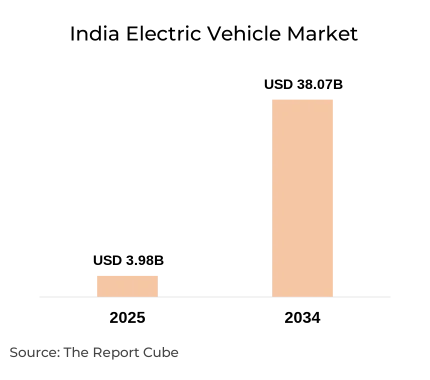
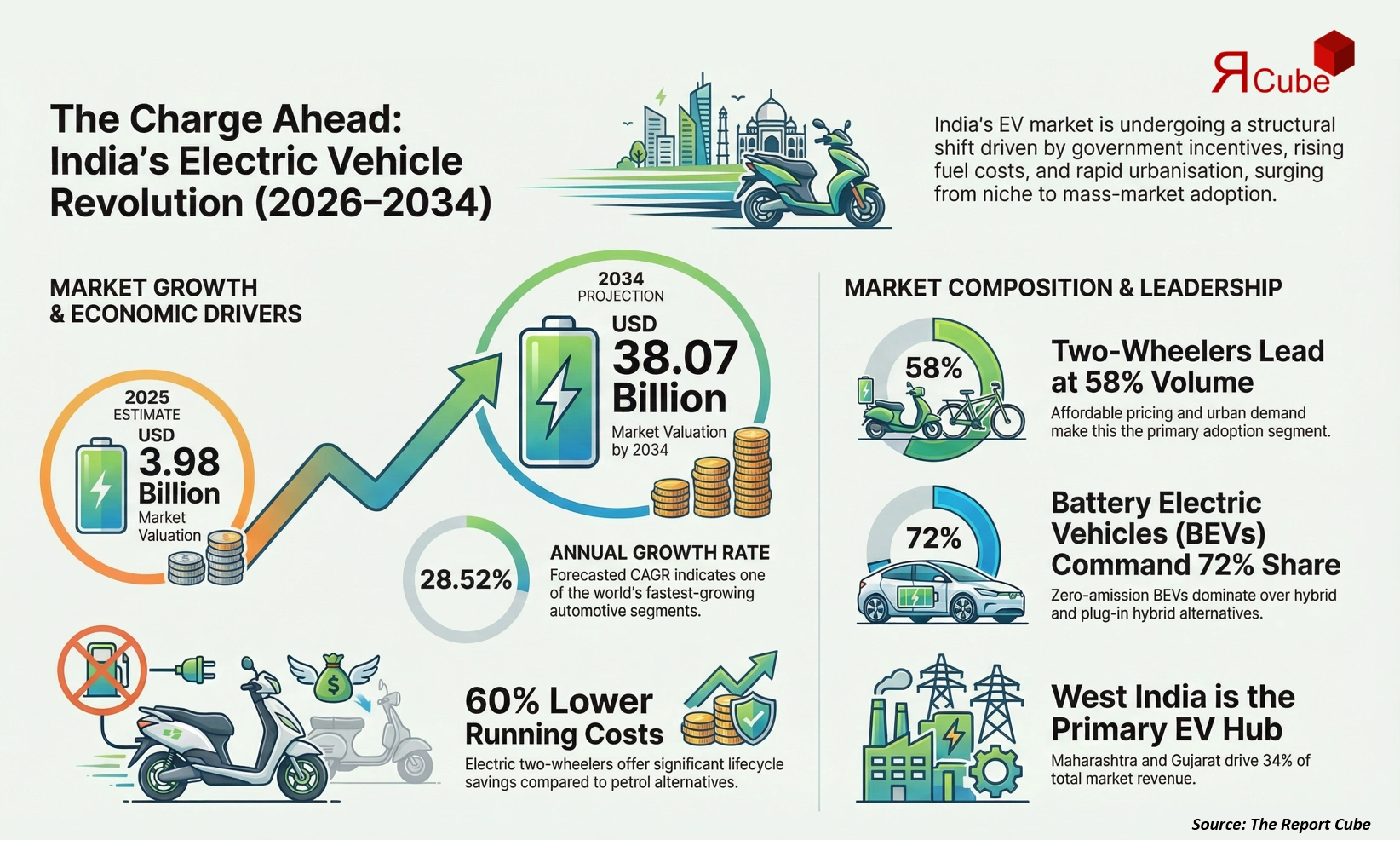
The India Electric Vehicle Market is anticipated to register a 28.52% CAGR during 2026-2034. The market size was valued at USD 3.98 Billion in 2025 and is projected to reach USD 38.07 Billion by 2034. This sharp expansion reflects a structural shift in India’s mobility ecosystem driven by government-led electrification targets, rising fuel costs, rapid urbanization, and increasing environmental awareness among consumers. Electric vehicles are no longer limited to pilot programs or niche urban buyers; instead, they are entering mass adoption across two-wheelers, three-wheelers, and public transportation fleets. Improvements in lithium-ion battery energy density, declining battery prices, and expansion of domestic cell manufacturing have significantly reduced total cost of ownership.
Additionally, charging infrastructure growth across highways and cities, coupled with incentives such as purchase subsidies and tax benefits, has improved consumer confidence. Automakers are accelerating model launches across price segments, while startups are driving innovation in software-defined vehicles, battery swapping, and digital sales models. These factors collectively position the India EV market as one of the fastest-growing automotive segments globally through 2034.
India Electric Vehicle Market Recent Developments
- 2025: Tata Motors expanded its EV portfolio with higher-range passenger electric models targeting mid-income urban buyers.
- 2025: Ola Electric scaled domestic cell manufacturing capacity to support cost reduction and supply chain localization.
Government Initiatives & Policies
- FAME India Phase II: Provides demand incentives for electric two-wheelers, three-wheelers, buses, and charging infrastructure deployment.
- National Electric Mobility Mission Plan (NEMMP): Long-term policy framework promoting EV adoption, domestic manufacturing, and energy security.
India Electric Vehicle Market Dynamics
Key Driver: Government incentives and rising fuel cost pressures
The most influential driver of the India electric vehicle market is sustained policy support combined with rising fossil fuel costs. Government subsidies under FAME II have reduced upfront EV prices by 15-25% across key segments, significantly narrowing the gap with internal combustion vehicles. Simultaneously, volatile petrol and diesel prices have increased consumer sensitivity to operating costs, making electric mobility financially attractive over the vehicle lifecycle. Data indicates that electric two-wheelers offer nearly 60% lower running costs per kilometer compared to petrol alternatives, accelerating adoption among daily commuters. State-level incentives, including road tax exemptions and registration fee waivers, further enhance affordability. Fleet operators, delivery companies, and ride-hailing platforms are also transitioning to EVs to reduce operating expenses and meet sustainability targets. Together, these factors create a powerful economic and regulatory push that continues to accelerate market growth.
Industry Trends: Platform localization and battery ecosystem expansion
One of the most prominent trends shaping the Indian EV industry is the rapid localization of vehicle platforms and battery ecosystems. Manufacturers are increasingly developing India-specific EV architectures optimized for local driving conditions, price sensitivity, and infrastructure limitations. Battery pack assembly and cell manufacturing are expanding domestically, reducing import dependence and improving supply chain resilience. Battery energy density improvements of nearly 20% over the past four years have extended driving range while reducing charging frequency. Software integration, including connected vehicle features and over-the-air updates, is becoming standard even in mass-market models. Battery swapping solutions are gaining traction in commercial two- and three-wheeler segments, improving vehicle uptime and reducing charging downtime. These trends collectively enhance scalability and accelerate mass-market penetration.
Major Challenge: Charging infrastructure gaps and grid readiness
Despite rapid progress, charging infrastructure availability remains a key challenge restraining faster EV adoption in India. While urban charging density has improved, semi-urban and rural regions still face limited access, contributing to range anxiety among potential buyers. Public fast chargers are unevenly distributed, and home charging remains constrained for apartment dwellers without dedicated parking. Grid capacity constraints and peak load management further complicate large-scale electrification. Industry estimates suggest India requires over 1.3 million public charging points by 2030, compared to a fraction currently deployed. Addressing these challenges requires coordinated investment from utilities, private players, and municipal bodies. Until infrastructure scales uniformly, adoption rates may remain regionally concentrated.
Opportunity: Commercial fleets and last-mile mobility electrification
Commercial fleets and last-mile mobility represent a high-growth opportunity within the India EV market. Electric three-wheelers and light commercial vehicles are rapidly replacing ICE models in logistics, e-commerce delivery, and urban freight due to lower operating costs and regulatory support. Studies show fleet operators can reduce total cost of ownership by 30-40% over five years using electric alternatives. Public transportation electrification, particularly electric buses, is gaining momentum as cities prioritize emission reduction and fuel savings. Additionally, corporate sustainability mandates are driving fleet electrification commitments. As financing models, leasing options, and battery-as-a-service offerings mature, commercial EV adoption is expected to outpace private vehicle growth through 2034.
India Electric Vehicle Market Segment-wise Analysis
By Vehicle Type:
- Electric Two-Wheelers
- Electric Three-Wheelers
- Electric Passenger Cars
- Electric Buses
- Electric Light Commercials
Electric two-wheelers dominate the Indian EV market due to affordability, high daily usage, and strong urban demand. This segment accounts for an estimated 58% of total EV volumes, supported by extensive model availability and aggressive pricing strategies. Electric three-wheelers follow closely, driven by commercial and shared mobility use cases. Passenger electric cars, while smaller in volume, are the fastest-growing segment with expanding model diversity and improving driving ranges. Electric buses and light commercial vehicles are gaining traction through government procurement and logistics electrification programs. Together, these segments form a balanced growth structure across personal and commercial mobility.
By Propulsion Type:
- Battery Electric Vehicles
- Plug-in Hybrid Vehicles
- Hybrid Electric Vehicles
Battery Electric Vehicles (BEVs) represent the leading propulsion type, accounting for approximately 72% of India’s EV market share. Their dominance is driven by lower mechanical complexity, higher efficiency, and strong policy incentives favoring zero-emission vehicles. Hybrid electric vehicles serve as a transitional option for consumers concerned about charging availability, particularly in passenger cars. Plug-in hybrids remain limited due to higher costs and lower incentive coverage. As charging infrastructure expands and battery costs continue to decline, BEVs are expected to strengthen their leadership position throughout the forecast period.
Regional Projection of India Electric Vehicle Industry
- North India
- South India
- West India
- East India
- Central India
West India leads the electric vehicle market with an estimated 34% revenue share, driven by strong adoption in Maharashtra and Gujarat. These states benefit from advanced manufacturing ecosystems, early policy adoption, and dense urban demand. South India follows closely, supported by technology-driven consumers and strong startup activity. North India shows high seasonal adoption linked to urban pollution concerns, while East and Central India are emerging markets with growing government-led initiatives. Regional disparities highlight the importance of localized infrastructure and incentive frameworks in driving adoption.
Why Choose This Report?
- Provides a comprehensive overview of the overall market analysis, encompassing key trends, consumer behavior analysis, and risk assessment to support strategic decision-making.
- Provides accurate, up-to-date insights into market size, segmentation, and emerging opportunities, helping to minimize risk & capitalizing on growth.
- Gives deep understanding of target audience preferences, investment habits, and communication channels for enhanced product development & marketing effectiveness.
- Delivers competitive analysis & benchmarking, uncovering the strengths & weaknesses of market competitors to guide strategies.
- Consolidate comprehensive market intelligence, reducing reasoning & streamlining research efforts.
- Facilitates customized market segmentation & risk mitigation strategies, fine-tuned to the business objectives.
- Aids in identifying both market challenges & untapped opportunities within the industry to drive long-term business growth.
- Provides valuable information based on actual customer data & search trends.
Table of Contents
- Introduction
- Objective of the Study
- Product and Category Definition
- Market Segmentation
- Study Variables
- Research Methodology
- Secondary Data Points
- Breakdown of Secondary Sources
- Primary Data Points
- Breakdown of Primary Interviews
- Secondary Data Points
- Executive Summary
- Market Dynamics
- Drivers
- Challenges
- Opportunity Assessment
- Recent Trends and Developments
- Regulatory and Policy Landscape
- India Electric Vehicle Market Overview (2021-2034)
- Market Size, By Value (INR Crore / USD Billion)
- Market Share, By Vehicle Type
- Electric Two-Wheelers
- Electric Three-Wheelers
- Electric Passenger Cars
- Electric Buses
- Electric Light Commercials
- Market Share, By Propulsion Type
- Battery Electric Vehicles
- Plug-in Hybrid Vehicles
- Hybrid Electric Vehicles
- Market Share, By Battery Type
- Lithium-ion Batteries
- LFP Batteries
- NMC Batteries
- Lead-acid Batteries
- Market Share, By Usage Segment
- Personal Mobility
- Shared Mobility
- Last-mile Delivery
- Public Transport
- Fleet and Corporate
- Market Share, By Powertrain Layout
- Front-wheel Drive
- Rear-wheel Drive
- All-wheel Drive
- Market Share, By Region
- North India
- South India
- West India
- East India
- Central India
- Market Share, By Company
- Revenue Shares & Analysis
- Competition Characteristics
- North India Electric Vehicle Market
- Market Size, By Value (INR Crore / USD Billion)
- Market Share, By Vehicle Type
- Market Share, By Propulsion Type
- Market Share, By Usage Segment
- Market Share, By Battery Type
- Market Share, By State
- Delhi
- Uttar Pradesh
- Haryana
- Punjab
- Rajasthan
- Rest of North India
- South India Electric Vehicle Market
- Market Size, By Value (INR Crore / USD Billion)
- Market Share, By Vehicle Type
- Market Share, By Propulsion Type
- Market Share, By Usage Segment
- Market Share, By Battery Type
- Market Share, By State
- Karnataka
- Tamil Nadu
- Telangana
- Andhra Pradesh
- Kerala
- Rest of South India
- West India Electric Vehicle Market
- Market Size, By Value (INR Crore / USD Billion)
- Market Share, By Vehicle Type
- Market Share, By Propulsion Type
- Market Share, By Usage Segment
- Market Share, By Battery Type
- Market Share, By State
- Maharashtra
- Gujarat
- Goa
- Rest of West India
- East India Electric Vehicle Market
- Market Size, By Value (INR Crore / USD Billion)
- Market Share, By Vehicle Type
- Market Share, By Propulsion Type
- Market Share, By Usage Segment
- Market Share, By Battery Type
- Market Share, By State
- West Bengal
- Odisha
- Assam
- Bihar
- Rest of East India
- Central India Electric Vehicle Market
- Market Size, By Value (INR Crore / USD Billion)
- Market Share, By Vehicle Type
- Market Share, By Propulsion Type
- Market Share, By Usage Segment
- Market Share, By Battery Type
- Market Share, By State
- Madhya Pradesh
- Chhattisgarh
- Rest of Central India
- Competitive Outlook and Company Profiles
- Tata Motors
- Company Overview
- EV Product Portfolio
- Strategic Alliances & Partnerships
- Recent Developments
- Mahindra Electric
- Company Overview
- EV Product Portfolio
- Strategic Alliances & Partnerships
- Recent Developments
- Ola Electric
- Company Overview
- EV Product Portfolio
- Strategic Alliances & Partnerships
- Recent Developments
- Ather Energy
- Company Overview
- EV Product Portfolio
- Strategic Alliances & Partnerships
- Recent Developments
- Hero Electric
- Company Overview
- EV Product Portfolio
- Strategic Alliances & Partnerships
- Recent Developments
- TVS Motor Company
- Company Overview
- EV Product Portfolio
- Strategic Alliances & Partnerships
- Recent Developments
- Bajaj Auto
- Company Overview
- EV Product Portfolio
- Strategic Alliances & Partnerships
- Recent Developments
- Hyundai Motor India
- Company Overview
- EV Product Portfolio
- Strategic Alliances & Partnerships
- Recent Developments
- MG Motor India
- Company Overview
- EV Product Portfolio
- Strategic Alliances & Partnerships
- Recent Developments
- BYD India
- Company Overview
- EV Product Portfolio
- Strategic Alliances & Partnerships
- Recent Developments
- Others
- Tata Motors
- Contact Us and Disclaimer
Top Key Players & Market Share Outlook
- Tata Motors
- Mahindra Electric
- Ola Electric
- Ather Energy
- Hero Electric
- TVS Motor Company
- Bajaj Auto
- Hyundai Motor India
- MG Motor India
- BYD India
- Others
Frequently Asked Questions






