



Build Your Custom Market Intelligence Report
Customize Your ReportIndia E-Rickshaw Market Insights & Analysis
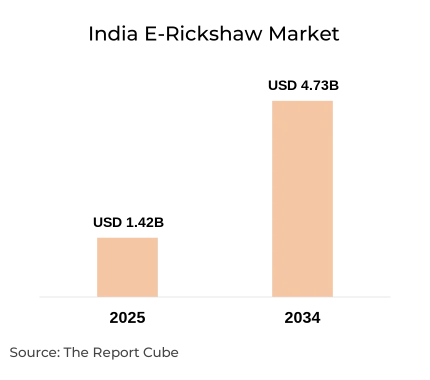
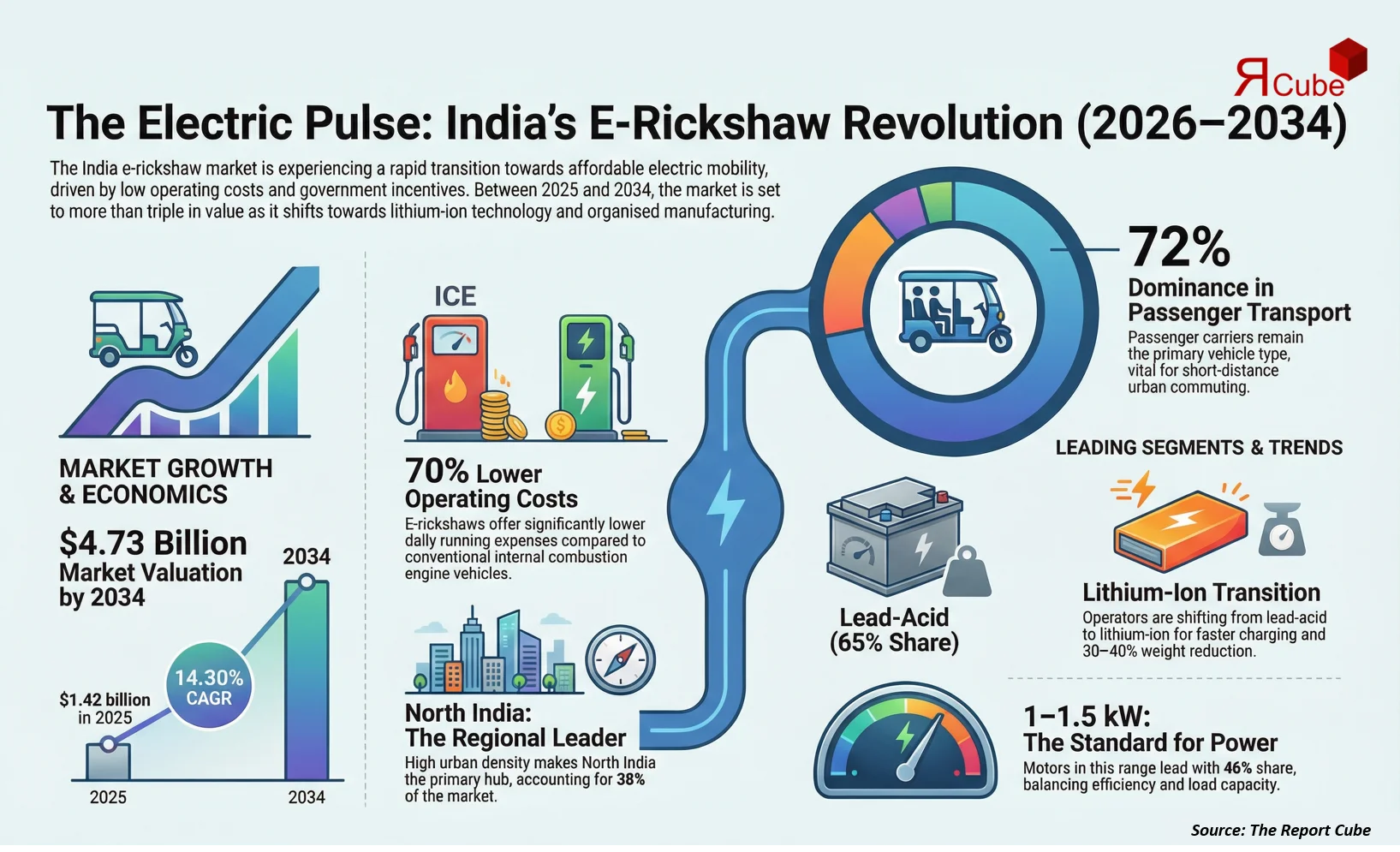
The India E-Rickshaw Market is anticipated to register a 14.30% CAGR during 2026-2034. The market size was valued at USD 1.42 Billion in 2025 and is projected to reach USD 4.73 Billion by 2034. This robust expansion is primarily driven by India’s accelerating transition toward affordable electric mobility solutions, particularly in last-mile passenger and goods transportation. E-rickshaws have emerged as a critical component of urban and semi-urban mobility due to their low acquisition cost, minimal operating expenses, and suitability for short-distance travel. Government-led electrification initiatives, rising fuel prices, and stricter emission norms for conventional three-wheelers are further strengthening adoption.
Additionally, increasing demand for employment-generating transport solutions among lower-income groups has expanded the driver base, especially in Tier II and Tier III cities. Continuous improvements in vehicle durability, motor efficiency, and battery technology particularly lithium-ion integration are improving lifecycle economics and vehicle uptime. The growing presence of organized manufacturers and financing institutions is also enhancing buyer confidence, positioning e-rickshaws as a scalable and sustainable mobility segment across India.
India E-Rickshaw Market Recent Developments
- 2025: Mahindra Last Mile Mobility expanded production of Treo and e-Alfa models to meet rising urban fleet demand.
- 2025: Kinetic Green introduced upgraded lithium-ion e-rickshaws targeting faster charging and extended daily range.
Government Initiatives & Policies
- FAME India Scheme: Provides incentives for electric three-wheelers to accelerate EV adoption and reduce urban emissions.
- National Electric Mobility Mission Plan (NEMMP): Focuses on promoting affordable electric mobility through policy support and infrastructure development.
India E-Rickshaw Market Dynamics
Key Driver: Demand for low-cost, sustainable last-mile mobility
The strongest driver of the India e-rickshaw market is the surging need for cost-effective and sustainable last-mile transportation across densely populated cities and towns. E-rickshaws offer operating costs that are nearly 60-70% lower than internal combustion engine auto-rickshaws, making them highly attractive for daily-income drivers. With average daily travel distances below 60 kilometers, e-rickshaws are well aligned with urban commuting patterns. Rising fuel prices and tighter emission regulations have accelerated the shift toward electric three-wheelers, while government incentives reduce upfront purchase barriers. Additionally, e-rickshaws generate employment for thousands of drivers with limited capital access, reinforcing social and economic adoption. Municipal authorities increasingly recognize their role in reducing congestion and pollution, further supporting deployment through permits and designated routes.
Industry Trends: Shift toward lithium-ion batteries and organized manufacturing
A major industry trend is the gradual shift from lead-acid batteries to lithium-ion battery systems. While lead-acid batteries currently dominate due to lower upfront costs, lithium-ion variants are gaining traction because they offer longer lifespan, faster charging, and 30-40% weight reduction. This transition improves vehicle efficiency and daily earnings for drivers by increasing operational hours. Another key trend is the growing presence of organized manufacturers introducing standardized designs, better safety features, and warranty-backed components. Fleet operators and logistics players are increasingly adopting load-carrier e-rickshaws for short-distance cargo movement, further diversifying demand. Digital financing, telematics integration, and battery-swapping pilots are also emerging trends shaping the next growth phase.
Major Challenge: Infrastructure gaps and fragmented regulations
Despite strong growth, infrastructure limitations remain a critical challenge for the e-rickshaw market. Limited access to formal charging infrastructure forces many operators to rely on informal or unsafe charging setups, affecting battery life and safety. Regulatory fragmentation across states regarding permits, vehicle specifications, and road access creates compliance uncertainty for manufacturers and operators. Additionally, the dominance of unorganized players in certain regions leads to quality inconsistencies and shorter vehicle lifespans. Financing constraints for small operators and limited awareness of maintenance best practices further hinder optimal utilization. Addressing these challenges will require coordinated policy frameworks and infrastructure investments.
Opportunity: Cargo electrification and fleet-based deployments
Significant growth opportunities exist in the electrification of small cargo transport and fleet-based e-rickshaw deployments. Load-carrier e-rickshaws are increasingly used for e-commerce deliveries, agricultural transport, and local logistics, benefiting from lower operating costs and easy maneuverability. Fleet operators value predictable maintenance and energy costs, making electric three-wheelers an attractive alternative to diesel vehicles. Battery leasing and swapping models can further reduce upfront costs and downtime. As urban logistics demand grows, manufacturers that tailor products for commercial use with higher payload capacity and durable components are likely to gain market share.
India E-Rickshaw Market Segment-wise Analysis
By Vehicle Type:
- Passenger Carrier
- Load Carrier
Passenger carrier e-rickshaws dominate the Indian market, accounting for an estimated 72% of total sales due to their widespread use in daily commuting. These vehicles are integral to short-distance urban travel, especially in congested areas where larger vehicles are impractical. Load carriers, while smaller in volume, are witnessing faster growth driven by last-mile logistics and small business deliveries. Rising e-commerce penetration and demand for sustainable cargo solutions are accelerating adoption of load-carrier variants, particularly in urban clusters and industrial zones.
By Motor Power:
- Below 1 kW
- 1-1.5 kW
- Above 1.5 kW
E-rickshaws with motors in the 1-1.5 kW range lead the market with approximately 46% share, balancing power efficiency, load capacity, and affordability. These motors provide sufficient torque for urban gradients while maintaining energy efficiency. Below 1 kW models are common in cost-sensitive regions, while above 1.5 kW variants are gaining traction in cargo and high-utilization applications.
By Battery Type:
- Lead-Acid Battery
- Lithium-Ion Battery
Lead-acid batteries currently account for nearly 65% of installations due to their lower upfront cost and widespread availability. However, lithium-ion batteries are rapidly gaining market share as operators recognize their longer lifespan, faster charging, and reduced maintenance. As battery prices decline and financing options improve, lithium-ion adoption is expected to accelerate significantly during the forecast period.
Regional Projection of India E-Rickshaw Industry
- North India
- East India
- West India
- South India
- Central India
North India leads the e-rickshaw market with an estimated 38% share, driven by dense urban populations, high daily commuting demand, and supportive local policies. States such as Uttar Pradesh, Delhi, and Bihar exhibit strong adoption due to affordability and employment generation benefits. East and West India follow closely, supported by growing urbanization and commercial activity. South India shows rising traction in organized fleet deployments, while Central India presents untapped potential as infrastructure improves.
Why Choose This Report?
- Provides a comprehensive overview of the overall market analysis, encompassing key trends, consumer behavior analysis, and risk assessment to support strategic decision-making.
- Provides accurate, up-to-date insights into market size, segmentation, and emerging opportunities, helping to minimize risk & capitalizing on growth.
- Gives deep understanding of target audience preferences, investment habits, and communication channels for enhanced product development & marketing effectiveness.
- Delivers competitive analysis & benchmarking, uncovering the strengths & weaknesses of market competitors to guide strategies.
- Consolidate comprehensive market intelligence, reducing reasoning & streamlining research efforts.
- Facilitates customized market segmentation & risk mitigation strategies, fine-tuned to the business objectives.
- Aids in identifying both market challenges & untapped opportunities within the industry to drive long-term business growth.
- Provides valuable information based on actual customer data & search trends.
Table of Contents
- Introduction
- Objective of the Study
- Product and Category Definition
- Market Segmentation
- Study Variables and Assumptions
- Research Methodology
- Secondary Data Points
- Breakdown of Secondary Sources
- Primary Data Points
- Breakdown of Primary Interviews
- Data Triangulation and Validation
- Secondary Data Points
- Executive Summary
- Market Dynamics
- Drivers
- Challenges
- Opportunity Assessment
- Regulatory and Policy Landscape
- National EV Policies and Incentives
- State EV Policies for E-Rickshaws
- Registration, Permits and Safety Norms
- India E-Rickshaw Market Overview (2021-2034)
- Market Size, By Value (USD Million)
- Market Share, By Vehicle Type
- Passenger Carrier
- Load Carrier
- Market Share, By Motor Power
- Below 1 kW
- 1-1.5 kW
- Above 1.5 kW
- Market Share, By Battery Type
- Lead-Acid Battery
- Lithium-Ion Battery
- Market Share, By Battery Capacity
- Up to 3 kWh
- 3-6 kWh
- Above 6 kWh
- Market Share, By Ownership Model
- Individual Owner-Drivers
- Fleet Operators
- Aggregators Platforms
- Market Share, By Sales Channel
- Organised OEMs
- Unorganised Local Assemblers
- Market Share, By Usage
- Passenger Transport
- Goods Transport
- Others
- Market Share, By Region
- North India
- East India
- West India
- South India
- Central India
- Market Share, By Company
- Revenue Shares
- Competition Characteristics
- Revenue Shares & Analysis
- Regional Analysis
- North India E-Rickshaw Market
- Market Size, By Value (USD Million)
- Market Share, By Vehicle Type
- Market Share, By Motor Power
- Market Share, By Battery Type
- Market Share, By Sales Channel
- Market Share, By Key States
- Market Share, By State
- Uttar Pradesh
- Delhi
- Punjab
- Haryana
- Rajasthan
- Rest of North India
- East India E-Rickshaw Market
- Market Size, By Value (USD Million)
- Market Share, By Vehicle Type
- Market Share, By Motor Power
- Market Share, By Battery Type
- Market Share, By Sales Channel
- Market Share, By Key States
- Market Share, By State
- Bihar
- West Bengal
- Jharkhand
- Odisha
- Rest of East India
- West India E-Rickshaw Market
- Market Size, By Value (USD Million)
- Market Share, By Vehicle Type
- Market Share, By Motor Power
- Market Share, By Battery Type
- Market Share, By Sales Channel
- Market Share, By Key States
- Market Share, By State
- Maharashtra
- Gujarat
- Rajasthan (West)
- Goa
- Rest of West India
- South India E-Rickshaw Market
- Market Size, By Value (USD Million)
- Market Share, By Vehicle Type
- Market Share, By Motor Power
- Market Share, By Battery Type
- Market Share, By Sales Channel
- Market Share, By Key States
- Market Share, By State
- Karnataka
- Tamil Nadu
- Telangana
- Andhra Pradesh
- Kerala
- Rest of South India
- Central India E-Rickshaw Market
- Market Size, By Value (USD Million)
- Market Share, By Vehicle Type
- Market Share, By Motor Power
- Market Share, By Battery Type
- Market Share, By Sales Channel
- Market Share, By Key States
- Market Share, By State
- Madhya Pradesh
- Chhattisgarh
- Rest of Central India
- North India E-Rickshaw Market
- Technology and Value Chain Assessment
- Battery Technology Trends
- Motor and Controller Technology
- Charging and Swapping Infrastructure
- Manufacturing and Assembly Ecosystem
- After-Sales and Financing Landscape
- Competitive Outlook and Company Profiles
- Mahindra Electric Mobility Limited
- Company Overview
- Product Portfolio
- Strategic Alliances/Partnerships
- Recent Developments
- Piaggio Vehicles Pvt Ltd
- Company Overview
- Product Portfolio
- Strategic Alliances/Partnerships
- Recent Developments
- Kinetic Green Energy & Power Solutions Ltd
- Company Overview
- Product Portfolio
- Strategic Alliances/Partnerships
- Recent Developments
- ATUL Auto Limited
- Company Overview
- Product Portfolio
- Strategic Alliances/Partnerships
- Recent Developments
- Mahindra Last Mile Mobility (e-Alfa, Treo)
- Company Overview
- Product Portfolio
- Strategic Alliances/Partnerships
- Recent Developments
- Goenka Electric Motor Vehicles Pvt Ltd
- Company Overview
- Product Portfolio
- Strategic Alliances/Partnerships
- Recent Developments
- Saera Electric Auto Pvt Ltd (Mayuri)
- Company Overview
- Product Portfolio
- Strategic Alliances/Partnerships
- Recent Developments
- Terra Motors India Corp
- Company Overview
- Product Portfolio
- Strategic Alliances/Partnerships
- Recent Developments
- Thukral Electric Bikes
- Company Overview
- Product Portfolio
- Strategic Alliances/Partnerships
- Recent Developments
- Mini Metro EV LLP
- Company Overview
- Product Portfolio
- Strategic Alliances/Partnerships
- Recent Developments
- Others
- Mahindra Electric Mobility Limited
- Contact Us and Disclaimer
Top Key Players & Market Share Outlook
- Mahindra Electric Mobility Limited
- Piaggio Vehicles Pvt Ltd
- Kinetic Green Energy & Power Solutions Ltd
- ATUL Auto Limited
- Mahindra Last Mile Mobility (e-Alfa, Treo)
- Goenka Electric Motor Vehicles Pvt Ltd
- Saera Electric Auto Pvt Ltd (Mayuri)
- Terra Motors India Corp
- Thukral Electric Bikes
- Mini Metro EV LLP
- Others
Frequently Asked Questions






