



Build Your Custom Market Intelligence Report
Customize Your ReportIndia Electric Vehicle Motor Market Key Highlights
By Motor Type:
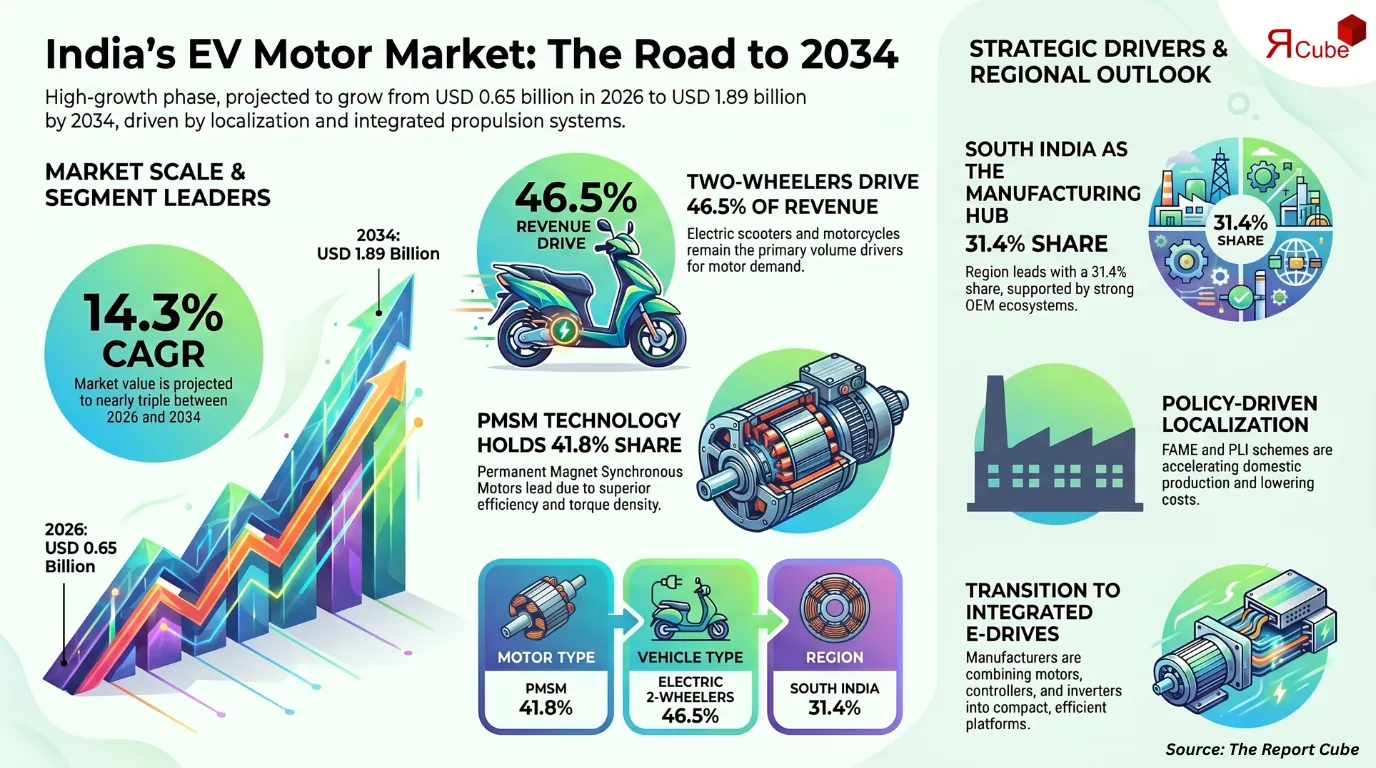
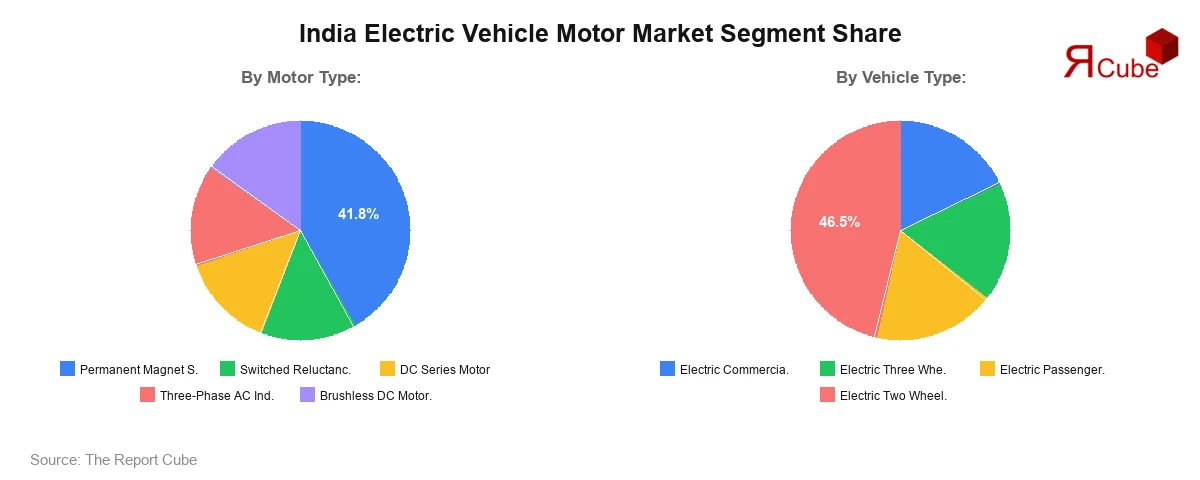
Permanent Magnet Synchronous Motor (PMSM) segment leads the market with nearly 41.8% share.
By Vehicle Type:
Electric Two Wheelers segment dominates the market with approximately 46.5% of revenue.
Regional Outlook:
South India region dominates the India Electric Vehicle Motor Market with around 31.4% share.
India Electric Vehicle Motor Market Insights & Analysis
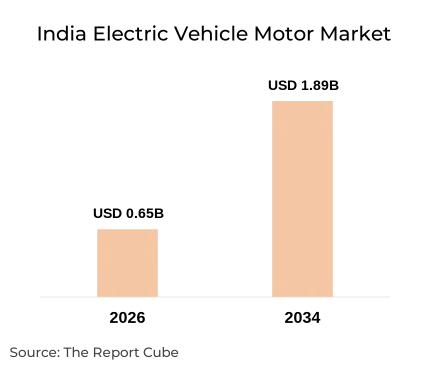
The India Electric Vehicle Motor Market is anticipated to register a CAGR of around 14.3% during the forecast period 2026-2034. The market size is valued at USD 0.65 billion in 2026 and is projected to reach USD 1.89 billion by 2034. The market is entering a high-growth phase as India's electric mobility ecosystem advances from early adoption toward large-scale commercialization. Demand for EV motors is being driven by accelerating production of electric two-wheelers, three-wheelers, passenger vehicles, and commercial fleets. The rapid expansion of domestic manufacturing facilities, combined with increasing investments in power electronics and drivetrain technologies, is creating a stronger supply chain for traction motor production. Manufacturers are prioritizing efficiency-focused motor platforms capable of delivering higher torque output, improved thermal performance, and longer operational life under Indian driving conditions.
Industry participants are increasingly investing in localized motor manufacturing to reduce dependence on imported drivetrain components and improve cost competitiveness. The expansion of battery manufacturing projects, EV industrial corridors, and automotive component clusters across states such as Tamil Nadu, Karnataka, Maharashtra, and Gujarat is strengthening the domestic EV value chain. In parallel, commercial vehicle electrification programs and public transportation modernization initiatives are creating demand for high-power motor systems. The market is also witnessing a transition toward integrated propulsion platforms that combine traction motors, controllers, and inverter technologies into compact solutions designed to improve energy efficiency, vehicle range, and overall drivetrain reliability.
India Electric Vehicle Motor Market Impact Analysis
| Factor | Type | Specific Impact on Market | Magnitude | Business Implication |
|---|---|---|---|---|
| Accelerating EV Adoption Targets | Market | Government push for higher EV share lifts traction motor demand | High | Supports capacity additions for automotive grade EV motors |
| Strong Policy and Incentive Support | Regulatory | FAME and state schemes lower EV costs and aid localization | High | Encourages motor makers to invest in India based production |
| Growth in Charging and E Mobility | Market | Expanding charging grids improve confidence in EV ownership | Medium | Drives long term volume visibility for traction motor lines |
| Technological Shift to High Efficiency Motors | Technological | OEMs shift toward advanced PMSM and axial flux designs | High | Requires ongoing R&D and partnerships with key automakers |
| Supply Risk of Critical Materials | Environmental | Rare earth and magnet price swings impact motor cost levels | Medium | Drives interest in alternate topologies and local sourcing |
| Entry of Global and Domestic Motor Players | Competitive | Multiple suppliers intensify price and technology competition | High | Demands differentiation through reliability and system design |
| OEM Localisation and Export Opportunities | Market | Vehicle makers seek local motor supply for cost and exports | High | Enables India based plants to serve regional EV platforms |
India Electric Vehicle Motor Market Dynamics
Key Driver: Accelerating Electrification Across India's Transportation Sector
The strongest growth catalyst for the India electric vehicle motor market is the rapid expansion of EV adoption across multiple vehicle categories. Electric scooters and motorcycles continue to account for the largest deployment volumes, while electric passenger vehicles are recording significant growth in metropolitan regions. Commercial operators are increasingly shifting toward electric mobility solutions to lower operating costs and comply with sustainability targets. This transition is generating sustained demand for efficient traction motors capable of delivering reliable performance under diverse operating conditions.
Government-backed electrification programs, expanding charging infrastructure, and growing participation from domestic automotive manufacturers have strengthened market confidence. Fleet operators, logistics companies, and public transport authorities are increasingly evaluating total cost of ownership rather than vehicle acquisition costs alone, making electric vehicles more attractive over their operating lifecycle. As vehicle production volumes increase, demand for advanced PMSM, BLDC, and induction motor technologies is expected to rise substantially, supporting long-term market expansion.
Industry Trends: Shift Toward High-Efficiency PMSM and Integrated E-Drive Systems
A prominent trend shaping the India electric vehicle motor market is the growing preference for Permanent Magnet Synchronous Motors (PMSM). These motors offer superior efficiency, compact design, high torque density, and improved energy utilization compared with conventional alternatives. As vehicle manufacturers seek to maximize range and performance while reducing energy consumption, PMSM technology is becoming the preferred choice for passenger vehicles, electric buses, and premium electric two-wheelers.
The market is also witnessing a gradual transition from standalone motor supply toward integrated e-drive architectures. Manufacturers are developing propulsion systems that combine motors, controllers, inverters, and power management electronics into a single platform. This integration improves vehicle packaging efficiency, simplifies installation, enhances thermal management, and reduces maintenance requirements. The trend reflects the broader evolution of India's EV industry toward higher-value, technology-intensive drivetrain solutions capable of meeting future performance and efficiency requirements.
Book your FREE 30-minute expert consultation today
Contact UsMajor Challenge: Supply Chain Dependence and Rare Earth Material Exposure
Although localization efforts are progressing, the industry continues to face challenges related to critical raw material availability. High-performance traction motors, particularly PMSM systems, rely on rare earth magnetic materials that remain vulnerable to global supply fluctuations and pricing volatility. Variations in material costs can significantly influence manufacturing economics and impact profit margins across the value chain.
In addition, domestic manufacturers face ongoing challenges associated with scaling advanced motor production while maintaining international quality standards. Dependence on imported electronic components, semiconductors, and specialized magnet materials can create procurement risks during periods of supply chain disruption. Addressing these challenges will require continued investment in domestic manufacturing capabilities, material innovation, and supply chain diversification strategies to ensure long-term industry resilience.
Opportunity: Localization and Commercial EV Expansion Creating New Revenue Streams
One of the most significant opportunities within the India electric vehicle motor market lies in the localization of advanced drivetrain manufacturing. Government support for domestic production and increasing investment in automotive component manufacturing are encouraging companies to establish local facilities for motor assemblies, controllers, and power electronics. This transition is expected to improve supply chain security, reduce production costs, and strengthen India's position as a regional EV manufacturing hub.
Commercial vehicle electrification represents another major growth avenue. Demand for electric buses, delivery vehicles, and light commercial fleets is increasing as businesses seek lower operating expenses and reduced emissions. These vehicle categories require high-power, durable motor systems capable of operating under demanding duty cycles. As commercial fleet electrification accelerates, motor manufacturers with expertise in high-efficiency propulsion technologies are expected to benefit from expanding procurement opportunities and long-term supply contracts.
India Electric Vehicle Motor Market Segment-wise Analysis
By Motor Type:
- Permanent Magnet Synchronous Motor (PMSM)
- Switched Reluctance Motors (SRM)
- DC Series Motor
- Three-Phase AC Induction Motors
- Brushless DC Motor
Permanent Magnet Synchronous Motors (PMSM) account for the largest share of the India electric vehicle motor market, representing approximately 41.8% of total revenue in 2026. The segment's leadership is closely linked to the performance requirements of modern electric vehicles, where energy efficiency, torque output, and driving range are critical purchasing considerations. PMSM technology delivers superior power density and operational efficiency, making it highly suitable for electric passenger cars, premium two-wheelers, and electric buses operating in urban environments.
Leading automotive manufacturers are increasingly integrating PMSM platforms into next-generation vehicle architectures to improve acceleration characteristics and optimize battery utilization. The technology's ability to maintain high efficiency across varying speed ranges provides a competitive advantage, particularly as consumers place greater emphasis on vehicle range and performance. Continuous advancements in motor control software, thermal management systems, and magnetic material engineering are expected to reinforce PMSM's dominant position throughout the forecast period.
By Vehicle Type:
- Electric Commercial Vehicles
- Medium and Heavy Commercial Vehicles (Buses, Trucks)
- Light Commercial Vehicles (Light Trucks and Buses, Minivans)
- Electric Three Wheelers
- Electric Passenger Cars
- SUV
- Sedan
- Hatchback
- Electric Two Wheelers
- Motorcycles
- Scooters
Electric two-wheelers remain the largest revenue-generating vehicle category within the India electric vehicle motor market, accounting for approximately 46.5% of total market demand. The segment benefits from India's established two-wheeler culture, growing urban congestion, and increasing consumer preference for cost-effective mobility solutions. Electric scooters have emerged as a particularly attractive option due to lower maintenance requirements, reduced fuel dependency, and improving battery performance.
The segment has also benefited from extensive product launches by both established manufacturers and emerging EV startups. As competition intensifies, manufacturers are increasingly investing in efficient BLDC and PMSM motor technologies capable of delivering enhanced performance while maintaining affordability. Improvements in charging accessibility, battery reliability, and vehicle financing options are expected to further strengthen adoption rates and sustain demand for EV motor systems across the two-wheeler segment.
Regional Projection of India Electric Vehicle Motor Industry
- North India
- South India
- West India
- East India
- Central India
South India holds the leading position in the India electric vehicle motor market, accounting for approximately 31.4% of total revenue. The region has developed into one of the country's most important electric mobility manufacturing centers, supported by a strong automotive ecosystem, advanced industrial infrastructure, and proactive state-level EV policies. Tamil Nadu, Karnataka, and Telangana continue to attract substantial investments in EV assembly, component manufacturing, battery production, and research facilities.
The presence of major automotive OEMs, technology companies, and component suppliers has enabled the development of a highly integrated EV supply chain. Several state governments have introduced incentive programs focused on manufacturing expansion, employment generation, and clean mobility adoption. As investment activity continues across vehicle production, battery manufacturing, and drivetrain development, South India is expected to maintain its leadership position while serving as a key innovation and production hub for India's evolving electric mobility industry.
Need insights for a specific region within this market?
Request Regional DataIndia Electric Vehicle Motor Market Regional Analysis
The India electric vehicle motor market differs by region due to EV adoption, industry mix, and charging growth.
| Region | Demand Level | Key Areas | Motor Dominance | Core Demand Logic | Growth Nature |
|---|---|---|---|---|---|
| North India | High | Delhi-NCR, Punjab, Haryana, UP | PMSM & BLDC motors | Fleet EVs, e-3Ws, urban delivery growth | Fleet-led scale-up |
| South India | Very High | Tamil Nadu, Karnataka, Telangana, Kerala | PMSM, induction, and traction motors | Strong OEM base, strong EV manufacturing, tech adoption | Manufacturing-led expansion |
| West India | Very High | Mumbai, Pune, Gujarat, Ahmedabad | PMSM & high-efficiency traction motors | Auto hubs, premium EVs, logistics electrification | OEM and fleet growth |
| East India | Medium | Kolkata, Bhubaneswar, Jharkhand, Odisha | BLDC & cost-optimized traction motors | Price-led adoption, two- and three-wheeler focus | Early-stage growth |
| Central India | Medium | Madhya Pradesh, Chhattisgarh, Nagpur | BLDC & standard traction motors | Tier-2 mobility, slower charging rollout, cost focus | Gradual penetration |
Government Initiatives & Policies
- PM E-DRIVE Scheme (2025): The Government of India expanded support for electric mobility adoption through incentives for electric two wheelers, buses, commercial vehicles, and charging infrastructure development, strengthening demand for domestically manufactured EV motors and drivetrain components.
- Production Linked Incentive (PLI) Scheme for Automobile and Auto Components (2025-2026): The scheme continues supporting advanced automotive technology manufacturing, encouraging localization of EV motors, power electronics, and electric drivetrain systems while improving domestic value addition.
India Electric Vehicle Motor Industry Recent Developments
- 2025: ABB India Limited introduced an integrated electric bus powertrain solution combining a high-torque-density traction motor and advanced inverter architecture. The development improves drivetrain efficiency, thermal management, operational reliability, and vehicle range while supporting India's expanding electric public transportation modernization initiatives.
- 2025: Nidec India Private Limited strengthened deployment of integrated motor-controller systems across commercial EV platforms. The initiative focuses on compact e-drive architectures that improve torque delivery, energy optimization, packaging efficiency, and localization capabilities for logistics fleets and commercial transportation applications.
Why Choose This Report?
- Provides a comprehensive overview of the overall market analysis, encompassing key trends, consumer behavior analysis, and risk assessment to support strategic decision-making.
- Provides accurate, up-to-date insights into market size, segmentation, and emerging opportunities, helping to minimize risk & capitalizing on growth.
- Gives deep understanding of target audience preferences, investment habits, and communication channels for enhanced product development & marketing effectiveness.
- Delivers competitive analysis & benchmarking, uncovering the strengths & weaknesses of market competitors to guide strategies.
- Consolidate comprehensive market intelligence, reducing reasoning & streamlining research efforts.
- Facilitates customized market segmentation & risk mitigation strategies, fine-tuned to the business objectives.
- Aids in identifying both market challenges & untapped opportunities within the industry to drive long-term business growth.
- Provides valuable information based on actual customer data & search trends.
Table of Contents
- Introduction
- Objective of the Study
- Product and Category Definition
- Market Segmentation
- Study Variables
- Research Methodology
- Secondary Data Points
- Breakdown of Secondary Sources
- Primary Data Points
- Breakdown of Primary Interviews
- Secondary Data Points
- Executive Summary
- Market Dynamics
- Emerging Opportunities
- Adoption Trends
- Demand Drivers
- Disruption Analysis (Challenges)
- Industry Analysis and Strategic Insights
- Supply and Value Chain Analysis
- Pricing Analysis
- Go-to-Market (GTM) Strategy
- BCG Matrix
- Recent Trends and Developments
- Import and Export Analysis
- Regulatory and Policy Landscape
- Region-wise Policies
- Government Initiatives
- India Electric Vehicle Motor Market Overview and Forecast Analysis (2021-2034)
- Market Size, By Value, By Growth Rate (CAGR/USD Billion)
- Market Share, By Motor Type
- Permanent Magnet Synchronous Motor (PMSM)
- Switched Reluctance Motors (SRM)
- DC Series Motor
- Three-Phase AC Induction Motors
- Brushless DC Motor
- Market Share, By Vehicle Type
- Electric Commercial Vehicles
- Medium and Heavy Commercial Vehicles
- Buses
- Trucks
- Light Commercial Vehicles
- Light Trucks and Buses
- Minivans
- Medium and Heavy Commercial Vehicles
- Electric Three Wheelers
- Electric Passenger Cars
- SUV
- Sedan
- Hatchback
- Electric Two Wheelers
- Motorcycles
- Scooters
- Electric Commercial Vehicles
- Market Share, By Power Rating
- Up to 50 kW
- 51 kW to 150 kW
- Above 150 kW
- Market Share, By Region
- North
- South
- West
- East
- Central
- Market Share, By Company
- Revenue Shares and Analysis
- Competitive Landscape
- North India Electric Vehicle Motor Market Overview and Forecast Analysis (2021-2034)
- Market Size, By Value, By Growth Rate (CAGR/USD Billion/Million)
- Market Share, By Motor Type
- Market Share, By Vehicle Type
- Market Share, By Power Rating
- South India Electric Vehicle Motor Market Overview and Forecast Analysis (2021-2034)
- Market Size, By Value, By Growth Rate (CAGR/USD Billion/Million)
- Market Share, By Motor Type
- Market Share, By Vehicle Type
- Market Share, By Power Rating
- West India Electric Vehicle Motor Market Overview and Forecast Analysis (2021-2034)
- Market Size, By Value, By Growth Rate (CAGR/USD Billion/Million)
- Market Share, By Motor Type
- Market Share, By Vehicle Type
- Market Share, By Power Rating
- East India Electric Vehicle Motor Market Overview and Forecast Analysis (2021-2034)
- Market Size, By Value, By Growth Rate (CAGR/USD Billion/Million)
- Market Share, By Motor Type
- Market Share, By Vehicle Type
- Market Share, By Power Rating
- Central India Electric Vehicle Motor Market Overview and Forecast Analysis (2021-2034)
- Market Size, By Value, By Growth Rate (CAGR/USD Billion/Million)
- Market Share, By Motor Type
- Market Share, By Vehicle Type
- Market Share, By Power Rating
- Competitive Analysis, 2026
- Market Share of Key Players
- Competitive Mapping for Each Segment and Companies Operating Regionally
- North India Electric Vehicle Motor Companies Share and Competitive Analysis, 2026
- South India Electric Vehicle Motor Companies Share and Competitive Analysis, 2026
- West India Electric Vehicle Motor Companies Share and Competitive Analysis, 2026
- East India Electric Vehicle Motor Companies Share and Competitive Analysis, 2026
- Central India Electric Vehicle Motor Companies Share and Competitive Analysis, 2026
- Company Profile (Partial List)
- Nidec India Private Limited
- Company Overview
- Product Portfolio
- Strategic Alliances and Partnerships
- Recent Developments
- ABB India Limited
- Company Overview
- Product Portfolio
- Strategic Alliances and Partnerships
- Recent Developments
- Kirloskar Electric Company Limited
- Company Overview
- Product Portfolio
- Strategic Alliances and Partnerships
- Recent Developments
- Laxmi Hydraulics Private Limited
- Company Overview
- Product Portfolio
- Strategic Alliances and Partnerships
- Recent Developments
- Bosch Limited
- Company Overview
- Product Portfolio
- Strategic Alliances and Partnerships
- Recent Developments
- WEG Industries (India) Private Limited
- Company Overview
- Product Portfolio
- Strategic Alliances and Partnerships
- Recent Developments
- CG Power and Industrial Solutions Limited
- Company Overview
- Product Portfolio
- Strategic Alliances and Partnerships
- Recent Developments
- Bonfiglioli Transmissions Private Limited
- Company Overview
- Product Portfolio
- Strategic Alliances and Partnerships
- Recent Developments
- Bharat Heavy Electricals Limited
- Company Overview
- Product Portfolio
- Strategic Alliances and Partnerships
- Recent Developments
- Tata Motors Limited
- Company Overview
- Product Portfolio
- Strategic Alliances and Partnerships
- Recent Developments
- Others (Partial List)
- Nidec India Private Limited
- Contact Us and Disclaimer
Top Key Players & Market Share Outlook
- Nidec India Private Limited
- ABB India Limited
- Kirloskar Electric Company Limited
- Laxmi Hydraulics Private Limited
- Bosch Limited
- WEG Industries (India) Private Limited
- CG Power and Industrial Solutions Limited
- Bonfiglioli Transmissions Private Limited
- Bharat Heavy Electricals Limited
- Tata Motors Limited
Frequently Asked Questions






